
Wind-farm crew ships have one job, and it is a strange one. They pull up next to a turbine in a swell, stick out a gangway that cancels the ship’s roll, and let a technician in a hard hat walk across to a ladder without getting his boots wet. The North Sea is full of them. Nobody outside the offshore wind business pays them any attention.
The Danish navy just bought one. It picked a 280-foot ship called Norwind Helm, paid an undisclosed sum for it, and plans to send it out to watch the cables and pipelines lying on the bottom of the Baltic and the North Sea. On August 25 the Nordic trade paper Metal Supply reported who gets to build the robots that will go over the rail: a Norwegian company for a free-swimming drone submarine, and a Swedish one for a robot that works on a cable.
Denmark did not design a warship for this. It bought a boat that already existed and is bolting drones onto it.
FMI, the Danish defense procurement agency, signed the purchase on December 16, 2025, announced it the next day, and called the ship a new capability for the Danish armed forces. Danish sailors have never operated anything like it. The ship arrives at its new base before the end of 2026, then gets modified, its crew trained and its name changed.
A ship that was built to hold still next to a turbine
Norwind Helm came out of the Vard yard at Brattvaag, Norway, on a hull welded at the company’s yard in Braila, Romania. It measures 280 feet (85 meters) long, 64 feet (19.5 meters) across the beam and draws 18 feet (5.5 meters). Caterpillar engines totaling 5,817 hp (4,338 kW) give it a 10-knot (11.5 mph) service speed, and it can stay out 30 days without a port call, according to Baird Maritime’s review of the ship and its sister.
Vard named it in Ålesund on November 15, 2024, two weeks ahead of the contract date, and its operator put it to work the next day.
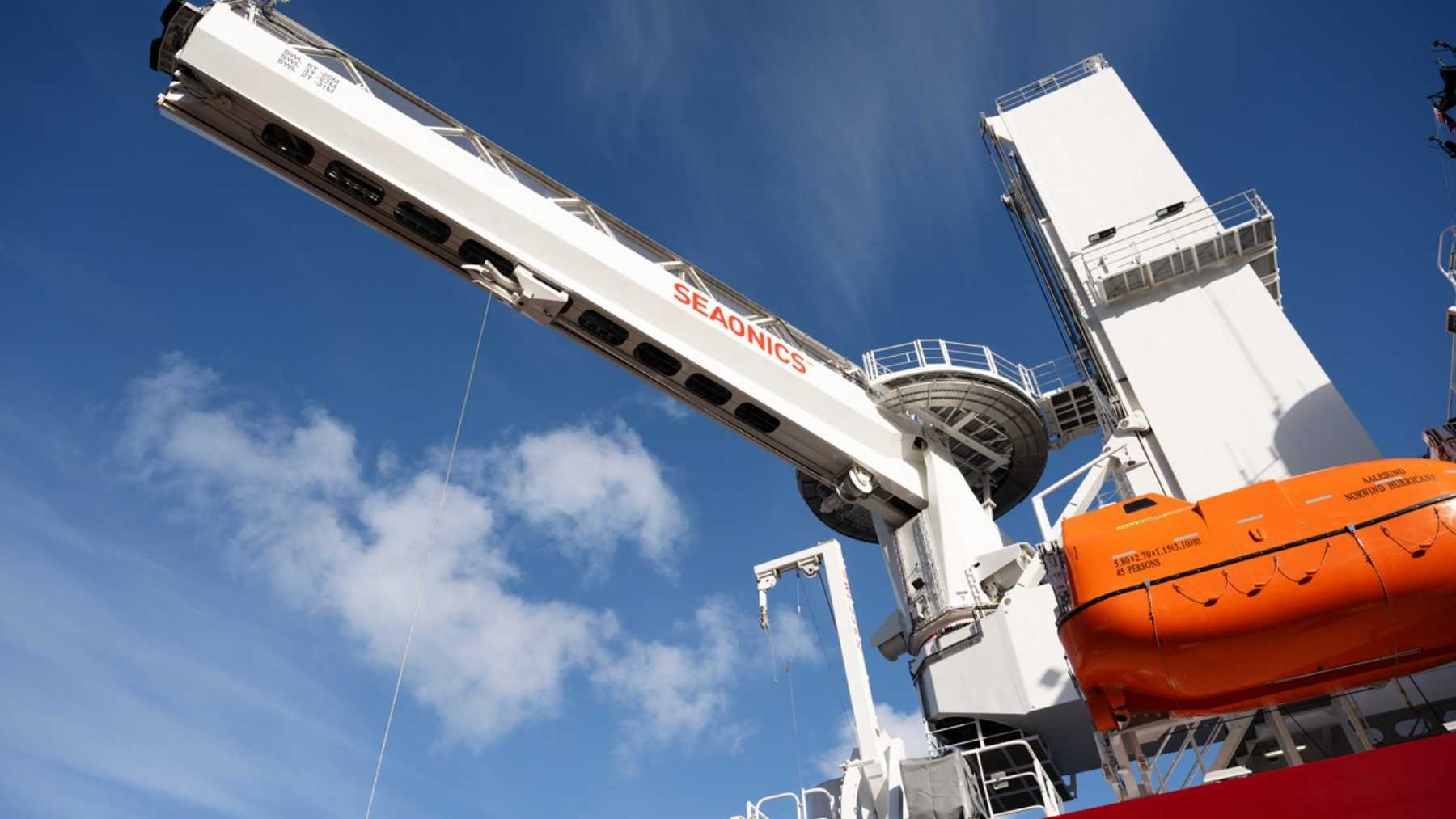
Its job explains the hardware on deck. The 105-foot (32-meter) walk-to-work gangway sits on a system that cancels the ship’s pitch, roll and heave, so a person can cross to a turbine’s ladder while the hull moves underneath. A 15,400-pound (seven metric ton) crane does the same trick for cargo. Kongsberg Maritime supplied the DP2 dynamic-positioning system and tunnel thrusters, which is the gear that lets the ship park on one spot of open water in weather with nobody touching the wheel.
Holding position over a cable is the same trick as holding position next to a turbine. Kongsberg’s biggest drone submarine weighs 8 tons, and getting something that heavy back aboard in a swell takes a compensated crane. Norwind Helm already has one.
The ship has 87 berths. The navy plans to run it with about 50 people, according to the trade site Maritime Danmark, which leaves 37 empty bunks for drone operators and their spare parts.
FMI describes the conversion as minor adaptations so the ship can carry and operate underwater drones and sensors and support military operations. The name goes too. Danish warships do not sail as Norwind anything.
One robot swims free and the other one stays on a leash
According to Metal Supply, FMI selected Kongsberg Discovery, the Norwegian company that builds the HUGIN family of drone submarines, for direct negotiations on an autonomous underwater vehicle system. The paper put the value at $23 million to $54 million (DKK 150 million to 350 million), covering integration plus options on maintenance and spare parts for up to ten years. Saab of Sweden was named the intended supplier of the remotely operated vehicle. Both deals together could reach about $100 million (DKK 650 million).
Two different machines, two different jobs.
An AUV is a submarine with nobody inside it and nobody on the other end of a wire. You program a route, put it over the side, and it runs on its own batteries, steers by inertial navigation and sonar, and comes home with a hard drive full of seabed. HUGIN Endurance, the 8-ton one, runs 40 feet long and has covered 1,200 nautical miles (1,380 miles) on a single dive without surfacing. We went through its 15-day dives in June.
Which HUGIN Denmark gets has not been published. Neither has the number of vehicles.
An ROV is the opposite animal. It hangs off a tether, the tether carries power down and video up, and a pilot on deck flies it with a joystick. Batteries stop being a problem because the ship is the battery. Range stops being a strength because the cable only goes so far. In exchange you get a robot that can hover next to a pipeline, stare at a dent, pick something up and bring it back. Saab’s catalog runs from the Double Eagle mine-hunting family to the Seaeye line of electric work-class ROVs, and the notice does not say which one is headed for the Danish deck.
On paper the two split the work: the free-swimming drone covers distance, the cabled one covers detail. The free-swimmer runs the length of a pipeline in one pass and flags whatever looks different from the last one. The one on the leash goes down and finds out what it is. An American company has been trying to do both jobs in one hull, and the U.S. Navy bought that one in October 2024.
Nothing on the robots is signed, and the ship was bought without a tender
Metal Supply’s report rests on procurement notices, not contracts. Kongsberg was picked for direct negotiations. Saab was named an intended supplier. Neither company had announced an order as of September 2, and FMI has not put out a release on the robots.
The hull went the same route, only faster. The award notice FMI filed with the EU procurement journal on January 13, 2026, records the contract as signed on December 16, 2025, with no tender at all. FMI invoked a national-security clause in Danish procurement law, section 23 of the Udbudsloven, and wrote that the market for ready-built, working ships is very volatile and that it had to sign in 2025 to get one.
The seller on the notice is Norwind Helm AS, a small Ålesund company whose listed contact is the chief executive of Norwind Offshore. FMI’s own press release names Navigare Capital Partners, the Danish investment firm behind the ship, as the seller.
The price stays sealed until January 1, 2036. FMI’s stated reason is that sale prices for commercial ships are treated as trade secrets.
Denmark has bought exactly one of the 26 ships its parliament asked for in April 2025, according to the Danish engineering weekly Ingeniøren, and this used wind-farm ship is it. A supplier had been found for four environmental vessels as of April, with price and specs still open, and the other 21 were expected to go out to tender over the following year.
FMI says the money comes from the 2024–2033 defense agreement and from Denmark’s Acceleration Fund, the $7.7 billion (DKK 50 billion) pot Copenhagen set up in February 2025 to buy military gear fast. Troels Lund Poulsen, the defense minister who announced that fund, said then that direct awards would save time in the decision phase. The drone contracts are taking that route.
So the $100 million figure is a ceiling on two robot packages, not a price tag on the program. Add a hull with a price sealed for a decade, a conversion that had no yard chosen as of February, and 50 salaries a year, and the real number is somewhere north of that, and nobody in Copenhagen has said where.
Baltic cables have been breaking for two years
On December 25, 2024, the tanker Eagle S dragged its 24,000-pound (11,000-kg) anchor for 56 miles (90 kilometers) across the floor of the Gulf of Finland and broke the Estlink 2 power cable between Finland and Estonia along with four data cables, according to Finnish prosecutors. Estlink 2 stayed out for more than seven months.
A Helsinki court dismissed the charges against the crew on October 3, 2025, ruling that prosecutors had not proven intent. On New Year’s Eve, Finnish special forces rappelled from helicopters onto another cargo ship, the Fitburg, after a data cable failed.
Denmark has its own reasons to be nervous. On January 21, 2026, at 10:16 a.m., the island of Bornholm lost all of its electricity when the cable from Sweden dropped out. The utility called it an overload and said the cable itself was intact. Every light on an island of about 39,000 people still went off because one cable on the seabed stopped carrying power.
NATO answered the cable incidents in January 2025 with Baltic Sentry, a patrol operation built around frigates, patrol aircraft and naval drones. Patrols on the surface see ships. They do not see the seabed. Denmark found out in June exactly how far surface surveillance gets you when a Russian corvette ran dark past an anchored Danish drone boat and put a quadcopter over it for eight minutes.
Norwind Helm answers a different question. Somebody has to go down and look at the cable, and the Danish navy did not own anything that could.
Frederikshavn gets the ship at the end of the year
On February 2, 2026, the Danish defense ministry announced the ship would be based at Frederikshavn naval station on the northern tip of Jutland, with delivery expected at the end of 2026. Poulsen said the chief of defense had recommended the base because it was logistically ready and already home to other navy units. He handed the ministry to Jeppe Bruus on June 3, 2026, so the ship will arrive under a minister who did not order it.
Adaptation and crew training start once the ship is in Danish hands. On February 9, 2026, FMI put out a request for information asking shipyards how long the conversion would take and what they could do, and stated that no decision had been made on where the work would happen. FMI has not published a date for the first operational patrol, and with the drone contracts still under negotiation, the robots could well arrive after the ship does.
Vard delivered Norwind Helm to Norwind Offshore on November 15, 2024, and it went to work on a wind farm the following day. Two years later, almost to the month, the same hull is due at Frederikshavn with the Danish navy waiting on the pier and a new name ready for the stern.