
Most graphite stories of the past two years have been battery stories. China mines around 80 percent of the world’s supply, the anode plants sit downstream of it, and Western governments keep breaking ground on mines to claw back a share.
Reactor graphite solves a different problem. A block of it slows neutrons down so the chain reaction keeps going, and that same block carries structural load and guides helium while it does the slowing.
One material, two jobs, at 1,382 degrees Fahrenheit.
On August 3, X-energy signed a binding agreement with SGL Carbon to double output of the grade its reactor is built around, a medium-grain isotropic graphite called NBG-18, at a plant in Chedde, France. We covered that deal from the fuel factory end in Tennessee. The announcement skipped what that French plant looked like a year earlier.
The plant spent a year on short time
Chedde sits in the commune of Passy, in the Arve valley below Mont Blanc. SGL Carbon has run the site since 1993 and lists just over 150 employees there, making synthetic graphite for semiconductors, LEDs, solar, battery production and the nuclear sector.
Last year it nearly stopped. Radio Mont Blanc reported in January that the site had come through a year of long-term reduced activity, falling to about 30 percent in the final six months, after a strategy shift in the electric-car market cut its order book sharply.
Production restarted at the end of 2025.
Since then the plant has taken on about 15 people and expects roughly 15 more within a year, according to site director Pierre Praicheux, who told the station that Passy-Chedde is the main production site for the American reactor components. He also gave the back story on how SGL got the work: the two companies spent about ten years in discussions, with three years of trials, before SGL was picked.
Ten years of talks, three years of testing, one qualified plant.
The January contract is the one paying the wages. X-energy and SGL announced a 10-year supplier framework on January 15, with an initial three-year award worth more than $100 million covering graphite components for the first commercial Xe-100 plant.
One block, two jobs
The Xe-100 is a pebble-bed high-temperature gas reactor rated at 80 megawatts of electricity and 200 megawatts of heat, built to be installed in packs of four to twelve units. Helium leaves the core at 1,382 F (750 C), and the steam generator delivers steam up to about 1,049 F (565 C). X-energy designs the unit for a 60-year life.
The fuel arrives as spheres roughly the size of a billiard ball, which circulate through the core and drop out the bottom for another pass. The Associated Press put the load at about 220,000 pebbles per reactor, each one going around some six times.
Graphite is what those pebbles travel through. It moderates the neutrons, forms the physical core, and conducts heat out of the fuel and spreads it across the structure. Crack the block and you lose the moderator and the load path in the same event, which is why the material is licensed as safety-critical rather than treated as lining.
Coal tar pitch, a vibrating mold and 5,430 degrees
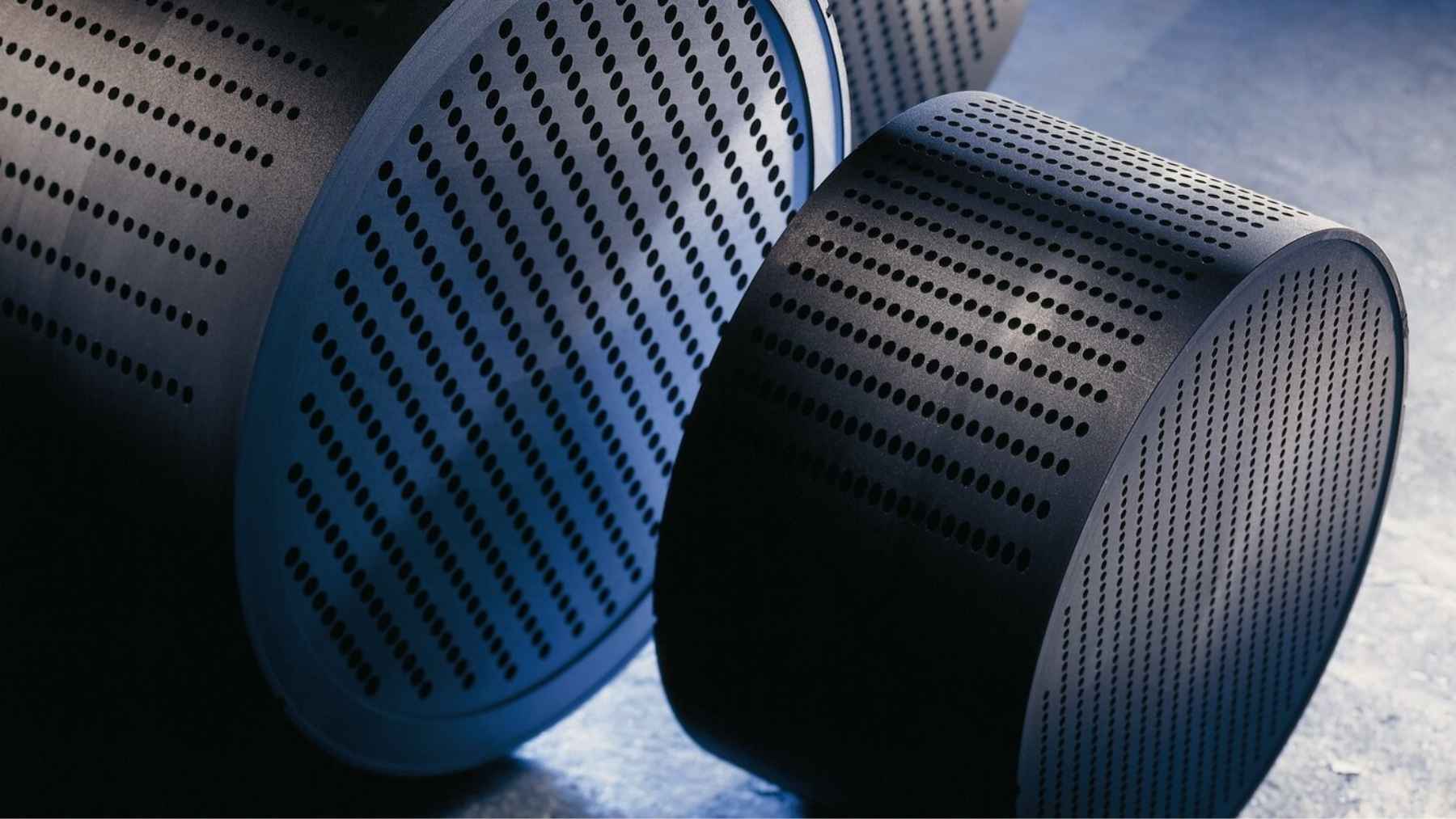
NBG-18 begins as pitch coke bound with coal-tar pitch. SGL forms it by vibration molding, bakes it, soaks it in more pitch and bakes it again to raise the density, then graphitizes it at 4,530 to 5,430 F (2,500 to 3,000 C) with a halogen gas treatment that strips out the impurities a reactor will not tolerate. What comes out carries grains up to about a sixteenth of an inch across (1.6 millimeters) and a density near 115 pounds per cubic foot (1.85 grams per cubic centimeter). The finished grade qualifies as near-isotropic under ASTM D7219, the standard written for nuclear graphites. Every one of those steps has to be repeatable, because the reactor is licensed on the material’s measured behavior rather than on its recipe.
American labs know this grade well. Energy Department characterization reports describe NBG-18 as a medium-grain pitch coke graphite from SGL, formed by vibration molding, and name it the favored structural material for the pebble-bed configuration in the Next Generation Nuclear Plant program. The same reports list NBG-17 as the same material with the grain size cut in half.
The grade predates the American program. It was developed for South Africa’s Pebble Bed Modular Reactor project, and X-energy says its own design team includes veterans of the German and South African pebble-bed programs.
The billets cross the Atlantic before they become blocks
Chedde makes billets. Machining those billets into finished blocks happens in the United States, and X-energy says the first French billets produced under the January award have already shipped to SGL facilities there for cutting. Prototype pieces went through non-nuclear testing and validation at X-energy’s technology center in Frederick, Maryland, before final production started.
SGL’s largest graphite component processing site anywhere is in St. Marys, Pennsylvania, with about 250 employees, and the company runs a smaller machining shop at Sinking Spring in the same state. The August 3 agreement expands US machining capacity in parallel with the French billet capacity, and X-energy is putting up to $8 million into milestone-based payments for new equipment and facilities at Chedde.
Eight million dollars is a rounding error next to a reactor build. It buys position rather than steel: SGL bakes the material in France and cuts it in America, and the front end of that line runs through a single qualified plant.
The reactors these blocks are for have no construction permit yet
Dow’s subsidiary Long Mott Energy filed the construction permit application for four Xe-100 units at Seadrift, Texas in March 2025. The Nuclear Regulatory Commission docketed it in May 2025 and closed the environmental side on May 18, 2026 with a finding of no significant impact. The safety review is still open.
Four units come to 320 megawatts of electricity.
On its second-quarter results, published August 13, X-energy reported revenues and grant income of $54.6 million against $21.5 million a year earlier, and listed the SGL agreement among the quarter’s milestones alongside HALEU enrichment contracts with Centrus Energy and General Matter. On the same day’s earnings call, CEO J. Clay Sell said the Energy Department will add $1 billion in cost-shared funding for Seadrift, taking federal support there to roughly $2.15 billion, and put a permit decision in the first half of 2027, according to the American Nuclear Society.
The graphite runs on a longer clock than the paperwork. Full execution of the Chedde expansion doubles European NBG-18 capacity by 2030, which is around when X-energy tells investors it expects first commercial delivery, and the company is weighing further billet investments in other regions to unclog the front of the line. The reactor itself has never been built at commercial scale anywhere.
Chedde’s own numbers stay small next to all of that: about 15 hires since the end of 2025, another 15 expected within the year, and the first billets already shipped for machining before the August 3 announcement went out.