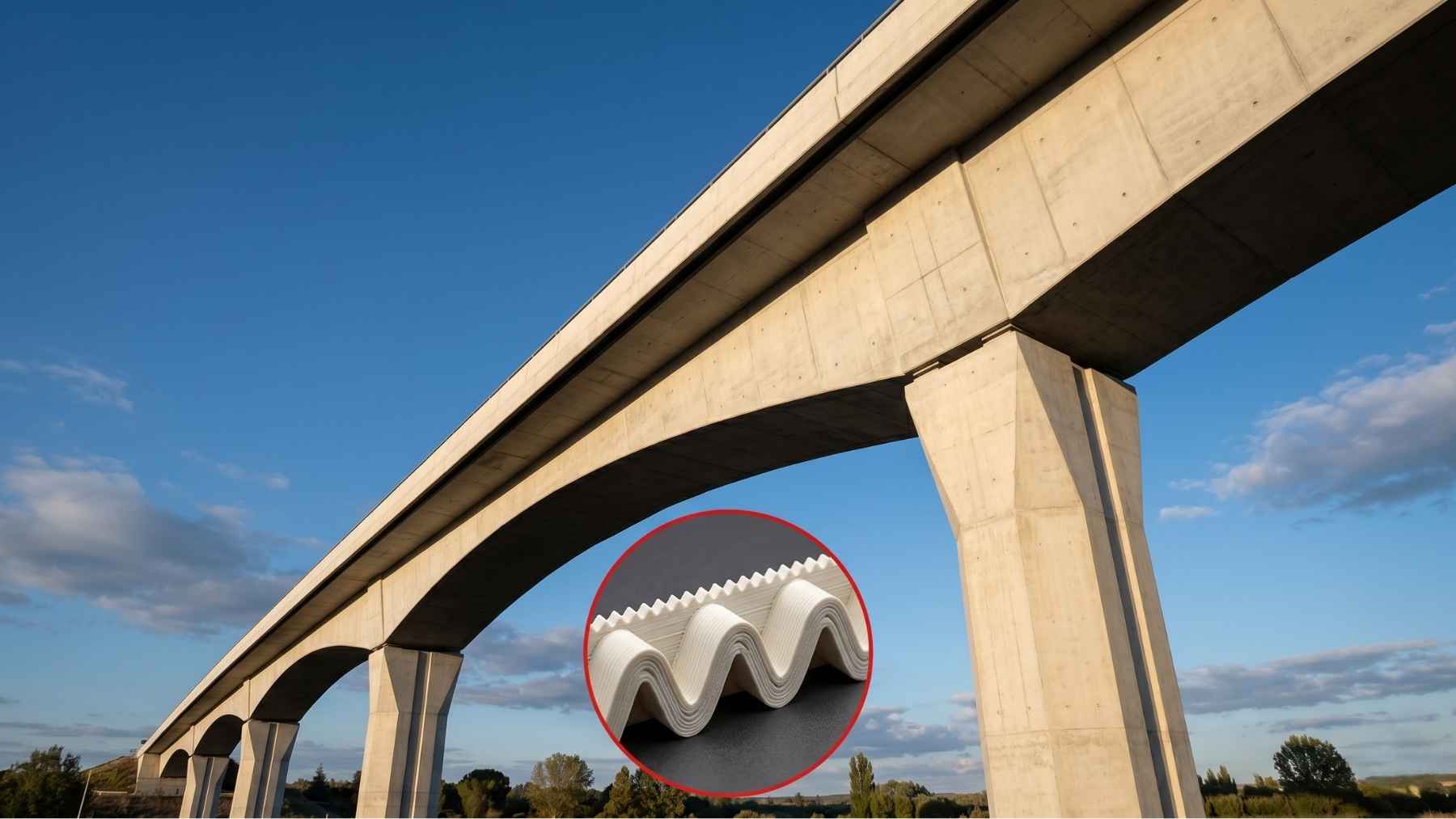

If you have ever parked under a concrete deck and noticed rust-colored streaks bleeding down the columns, you have watched rebar die. The steel bars buried inside that concrete are what stop the whole structure from sagging, and once water and road salt work their way in, that steel corrodes, swells, and cracks the concrete from the inside. So a team of researchers at the University of Sharjah in the United Arab Emirates went looking for a reinforcement that physically cannot rust, and they landed on something that sounds like a punchline until you see the data: wavy plastic.
The catch, and there is always a catch, is that the plastic does not win on raw muscle. It gets close. In lab testing, the best plastic shapes reached nearly 80 percent of the bending strength of a steel-reinforced beam and matched its flexibility, which is a far better showing than “plastic versus steel” has any right to make. The other catch is that this is small beams on a lab bench, not a product you can order yet. But the reason it works at all is the interesting part, and it has almost nothing to do with the plastic itself.
The steel inside your bridges rusts from the day it goes in
Reinforced concrete is the most-used building material on the planet, and it works because of a simple division of labor. Concrete is excellent at being squeezed and useless at being pulled apart, so engineers bury steel bars inside it to handle the pulling. That partnership holds up almost everything you drive on or through: bridge decks, overpasses, parking structures, tunnel liners. According to the University of Sharjah team, roughly half of all the steel produced on Earth, somewhere around 900 million tons a year, goes into construction, and a substantial share of that ends up as rebar.
The problem is that steel and water are not friends, and concrete is riddled with tiny channels that let moisture in. A cubic yard of reinforced concrete typically carries 150 to 250 pounds of steel, and well over 300 pounds in heavily loaded structures, so there is a lot of metal in there waiting to corrode. Add winter road salt or coastal salt air and the chloride speeds the whole process up. As the steel rusts it expands, and expanding steel cracks the concrete around it, which is exactly the rust-stained, crumbling mess you see on aging infrastructure. Steel is strong, cheap, and proven, but it comes with a shelf life nobody enjoys paying to replace.
The trick isn’t the plastic, it’s the shape
Here is where most people, me included, would assume the experiment was “take a steel bar, make it out of plastic, see how badly it loses.” That is not what the University of Sharjah did. As New Atlas reported, the team led by Dr. Muhammad Talha Junaid, an associate professor of materials and structures, treated the shape of the reinforcement as the real variable. They 3D-printed their reinforcements out of polylactic acid, or PLA, the cheap, biodegradable thermoplastic that desktop 3D printers spit out, and then compared two things at once: round bars against flat plates, and plain straight profiles against wavy, serrated, and triangular ones. The findings were published in the journal Construction and Building Materials.
The shape mattered enormously. The serrated, tooth-like profiles bit into the surrounding concrete instead of sitting passively inside it, which stopped the reinforcement from slipping when the beam was loaded. “These serrated shapes acted like teeth, locking into the concrete to prevent slipping,” Junaid said. Flat plates beat round bars by a wide margin too, because a plate gives the concrete far more surface area to grip. Beams reinforced with PLA plates handled roughly twice the peak load and absorbed about five times more energy before failing than beams using simple PLA bars. Same material, wildly different results, purely from changing the geometry.
Wavy plastic plates hit nearly 80 percent of steel’s strength
Beating other plastic shapes is one thing. The real question is how the best plastic compares to steel, and the answer is closer than it has any right to be without quite getting there. The standout configuration was a triangular wavy PLA plate. In the team’s testing it reached nearly 80 percent of the bending strength of a traditional steel-reinforced beam, and it matched steel’s ductility, meaning it flexed under load rather than snapping. The authors describe their approach as a viable, non-corrodible alternative to steel while being upfront that the raw strength runs slightly lower. Eighty percent of steel with zero corrosion is a different trade than the one engineers are used to making.
Lab results · triangular wavy PLA plate
How close 3D-printed plastic got to steel
Source: University of Sharjah, published in Construction and Building Materials (2025). Figures come from small-scale laboratory beams, not full-size structures.
Plastic rebar isn’t new, but cheap printable rebar would be
Non-steel rebar is not a fresh idea on its own. Engineers have been building glass-fiber and carbon-fiber reinforced polymer bars for years, and those composites already get used where corrosion is the enemy. What they are not is cheap, and they are not something you print on demand. PLA flips both of those. It is one of the most common and inexpensive 3D-printing plastics around, it is biodegradable, and the entire point of the Sharjah study is that you can print these custom tooth-like shapes to order rather than rolling standardized steel rod. The construction sector is already pivoting toward additive manufacturing to cut waste and automate production, so “print the reinforcement in whatever shape grips best” lines up neatly with where the industry is headed.
None of which means PLA is about to hold up a highway. PLA is not a high-temperature engineering polymer, and plenty of engineers who saw this research raised fair questions about how a thermoplastic copes with fire, long-term creep, and the kind of sustained tension a steel bar shrugs off. Those concerns are real, and the study does not pretend to settle them. What it does show is that geometry can claw back a surprising chunk of the gap, which reframes the whole question from “what material replaces steel” to “what shape lets a weaker, smarter material compete.”
Where wavy plastic would actually show up first
If wavy PLA ever leaves the lab, it will not debut by replacing the rebar in a skyscraper. It will start in the places where steel’s corrosion problem is worst and its raw strength is overkill: marine structures, coastal construction, parking decks that soak up road salt all winter, anywhere a non-corroding reinforcement is worth trading a little peak strength for. That is the same logic that already pushed fiber-composite rebar into seawalls and salty bridge decks.
It also fits a pattern that has been quietly building in materials labs, where unglamorous infrastructure keeps getting rescued by strange ingredients. British road crews have been testing a graphene-enhanced asphalt that lasts far longer than the conventional stuff, and a Hawaii startup recently handed the Pentagon a patrol boat 3D-printed from plastic stiffened with crushed volcanic rock. Wavy plastic rebar is cut from the same cloth: take a boring, essential material everyone stopped thinking about, and make it weirder and better.
Steel rebar is not going anywhere soon, and the researchers are the first to admit it. But the next time you drive under an overpass with rust streaks running down the concrete, it is worth knowing that the people trying to fix that are not all chasing better steel. Some of them are 3D-printing plastic shaped like a saw blade, betting that the right geometry can beat the stronger metal. Eighty percent of steel that never rusts may not sound like a revolution, but in the right places, it could quietly become the smarter half of the deal.


















Also, the plastic is said to be biodegradable, meaning it will deteriorate over time, which is something that you would actually want to avoid in this application.