
Building a Navy boat the traditional way means a shipyard, fiberglass layup, a rack of molds, a skilled crew, and a calendar measured in weeks. Then you crate up the finished hull, load it onto a ship or a transport plane, and send it across an ocean to wherever the fighting actually is, which in the Pacific can be thousands of miles between the factory and the fleet. A Hawaii startup called Voltage Vessels thinks that entire pipeline is a liability, and it wants to replace most of it with a 3D printer and a spool of plastic mixed with crushed volcanic rock.
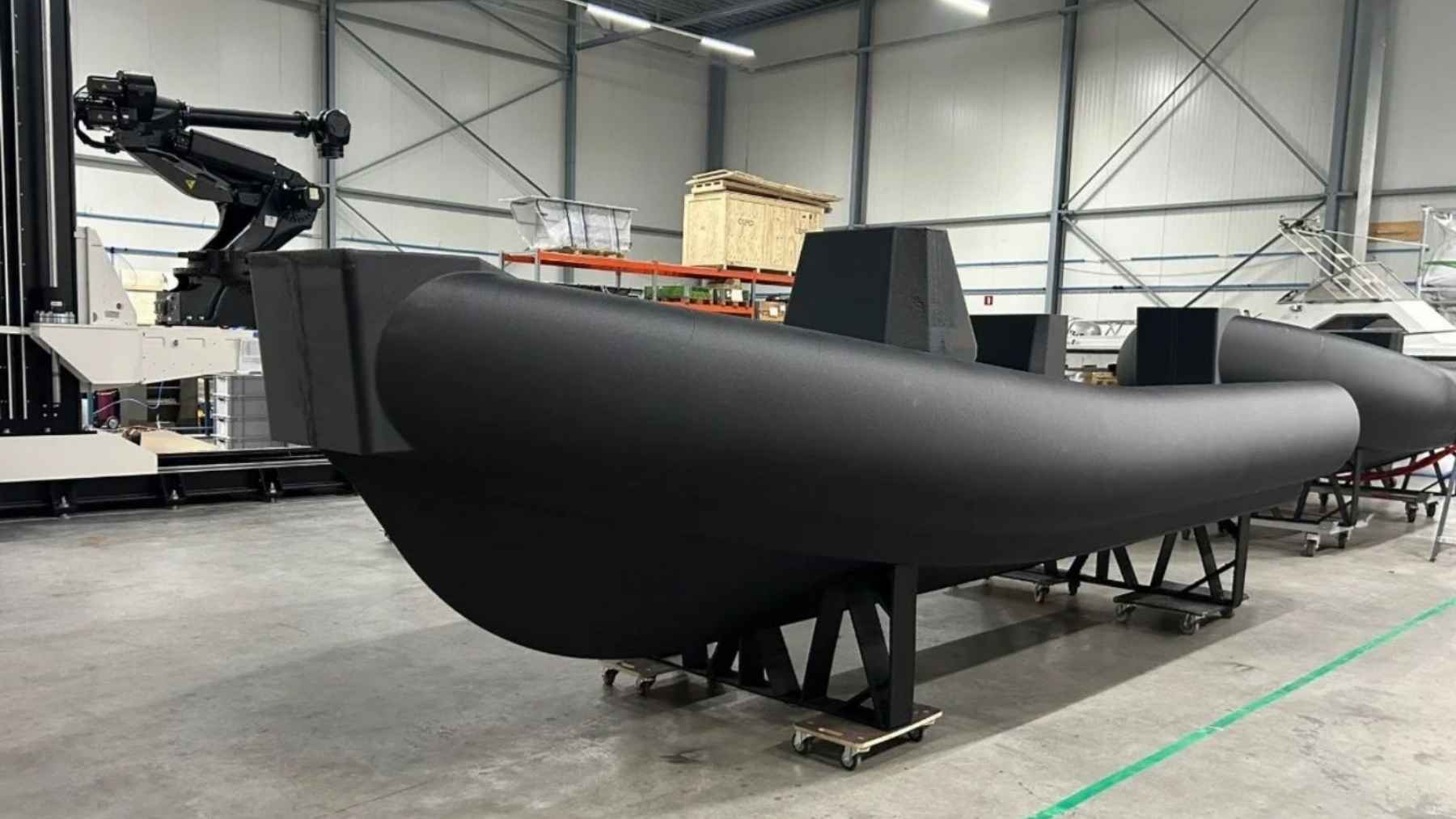
The company has handed the Pentagon a six-meter rigid-hull inflatable boat (RHIB) printed from a proprietary composite, and it is being looked at for possible use in autonomous naval programs. The pitch is unusual enough that it is worth unpacking before anyone starts arguing about whether a printed boat can survive a firefight.
A RHIB printed from recycled bottles and volcanic rock
The hull is six meters long, which is roughly 20 feet, and a typical RHIB that size weighs somewhere around 1,300 pounds (roughly 600 kg). It was made on a large-format printer from the Dutch firm CEAD, the same kind of industrial gantry that several defense contractors already use to extrude composite hulls in one piece.
The trick is the feedstock. Instead of fiberglass or the HDPE blends CEAD normally pushes for printed boats, Voltage Vessels developed its own material in-house and calls it Eclipse X9. It is recycled PETG plastic, the stuff your drink bottles are made of, stiffened with chopped basalt fiber, the volcanic mineral that is basically free in Hawaii. The company, founded by Sam Young, says the material was validated at the University of Maine’s Advanced Structures and Composites Center, where it clocked a tensile strength of about 108 MPa along the print direction. That is more than double the roughly 49 MPa of HDPro, CEAD’s own house composite for marine work.
So you have a recycled drink bottle reinforced with crushed lava, printed on a Dutch robot in Hawaii, pitched to the Pentagon as a patrol boat. It is, at minimum, a sentence you do not get to write very often.
The real pitch is logistics, not the boat
The hull is the demo. The actual sales argument is the supply chain. A forward base in the Pacific sits at the end of a line that can run more than 6,500 miles back to a continental U.S. shipyard. If a RHIB gets shot up, mined, or just smashed against a pier, the replacement has to make that whole trip on a transport, and that takes weeks.
Voltage Vessels wants to swap that for digital distribution: move the design file and the pellets, not the finished hull, and print the boat at a regional node closer to where it is going to get wet. The Indo-Pacific is the obvious customer, since that is where the Pentagon keeps shoving more of its planning, and where ocean distances make every conventional resupply look slow. It is the same logic driving a wave of uncrewed systems being pushed from prototype into procurement for contested-logistics work.
This is not a new idea inside the Navy. The service is already leaning on large-scale additive manufacturing to simplify global support: a Navy Letter of Intent to the Australian metal-printing firm AML3D outlines plans to deploy up to 100 large-format metal 3D printers across its industrial base. Those are mostly for spares and components, though. Voltage Vessels wants to skip past replacement valves and bracketry and print the whole boat, the same jump toward at-the-edge fabrication showing up in the uncrewed surface and undersea vessels navies are now buying.
Basalt does something aluminum and carbon fiber can’t
Basalt is not in the recipe because it sounds good in a press release. It changes what the hull does in the electromagnetic world. Because basalt fiber is electrically non-conductive, Eclipse X9 has a low dielectric constant, which means the hull does not bounce radar energy back the way metal does, and it does not muddle the RF signals that uncrewed boats lean on for navigation, comms, and sensors.
That is a real advantage over aluminum or carbon fiber for small autonomous craft, where every decibel of self-interference matters, the same payload-and-signal calculus driving Europe’s push into autonomous undersea drones. It is not, however, a stealth coating. Radar visibility depends on shape, coatings, and material behavior together, so a non-conductive composite hull on its own is not going to make a RHIB invisible, and the company says its RF transparency is still being characterized across specific frequency bands. The honest read is that basalt buys you a quieter platform for autonomous gear, not a ghost ship.
There is a side benefit that matters for forward bases too. Basalt composites already turn up in marine rebar and fire-resistant panels because they shrug off saltwater and do not corrode like metal. Voltage Vessels says Eclipse X9 held on to more than 90% of its strength after over two years of saltwater immersion, with water absorption under 0.4%. A printed hull that does not need a paint shop and does not rot out at the waterline is exactly what you want sitting on a pier in tropical air.
Where the 25,000-hulls-a-year math falls apart
Here is where the arithmetic gets fun. Voltage Vessels says it can scale production to about 15,000 metric tons of Eclipse X9 a year from U.S.-based compounding, with Hawaii as the pilot site and licensed regional partners filling in the Indo-Pacific. Divide that by a 600 kg hull and you land at a headline-friendly ceiling of roughly 25,000 boats a year.
Take that number with a shaker of salt. It assumes every kilogram of Eclipse X9 goes into a six-meter RHIB, which is not how a real production network behaves once you are also printing patrol boats, USV hulls, and replacement panels off the same machines. Even a fraction of it, spread across distributed nodes, would still be a meaningful change in how fast the Navy can replace small craft.
The hardware to do it already exists. CEAD’s own maritime division says its boat-hull printers can lay down a 19-foot hull in 88 hours of unattended runtime, weekends included. Put a small army of those gantries on Pacific islands and the supply-chain pitch stops looking like a slide deck.
Plenty still hasn’t been proven
A lot, honestly. This is the company’s first formal entry into defense evaluation, which means the Pentagon has not bought anything. The lab numbers from Maine are encouraging, but tensile strength on a test coupon is not the same as a hull pounding through a chop with a crew-served weapon bolted to the deck. The RF transparency story still has to hold up across the exact bands a Navy USV uses. And the two-year immersion data, promising as it is, came out of a tank, not years of real fleet service in salt and sun.
Then there is the boring industrial question: how do you stand up regional print nodes that can run consistent material chemistry, quality control, and IP security on a Pacific island. CEAD’s hardware is real. The microfactory concept is real. Wiring those into a defense logistics chain that clears military acceptance standards is a different problem, and it is the one that has sunk plenty of clever ideas before.
None of that makes the pitch silly. A six-meter RHIB printed from recycled bottles and volcanic fiber, sitting in front of the Pentagon as a candidate for autonomous fleet duty, is exactly the kind of weird-on-paper idea that ends up ordinary once somebody does the unglamorous follow-through. Whether Voltage Vessels is that somebody is the part the Navy gets to figure out.