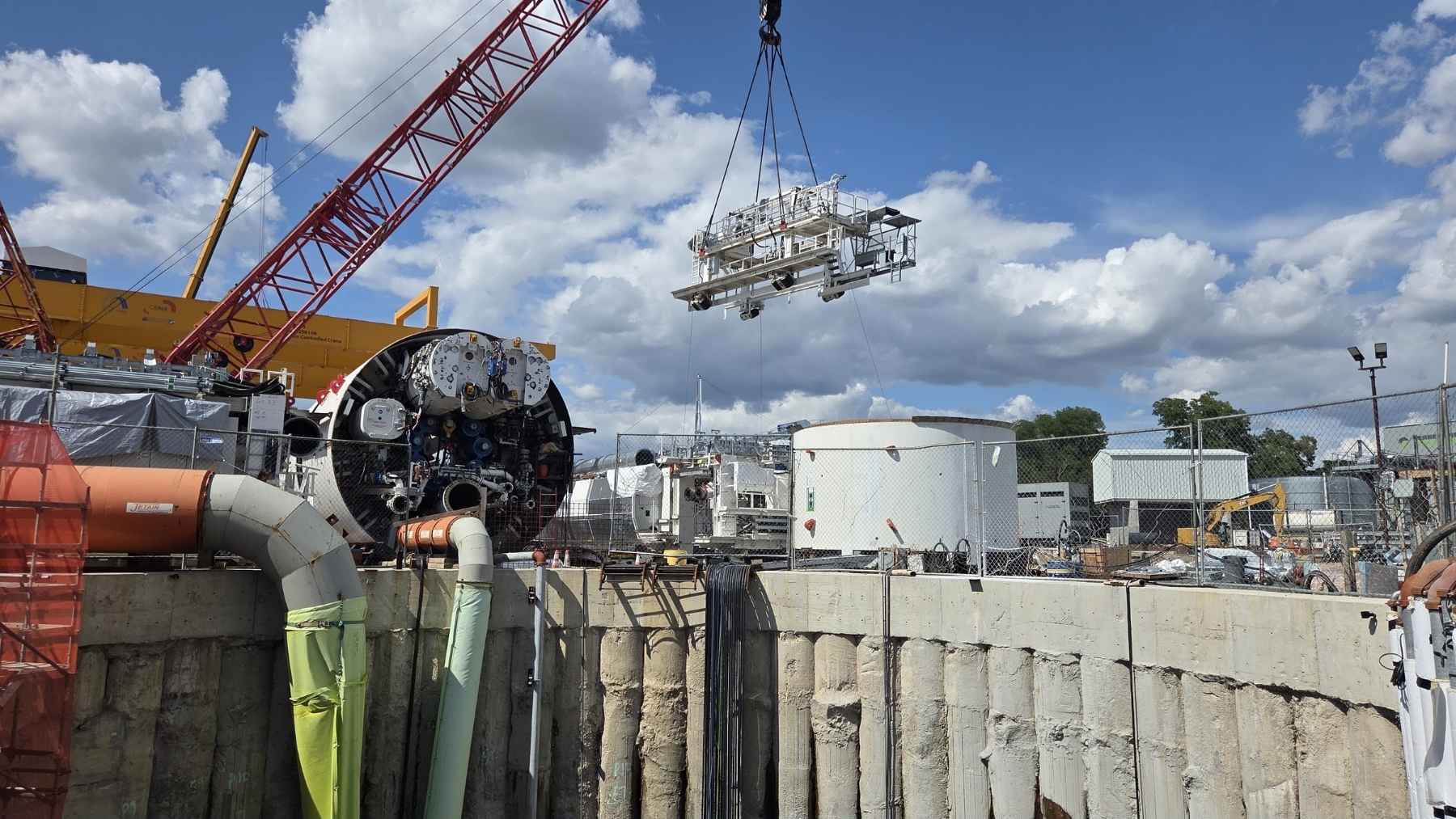

Heavy equipment normally shows up at a job site on a flatbed, gets unloaded, and goes to work. Mary showed up in Washington in crates from Germany, and crews have spent the months since bolting her together at the bottom of a shaft in West Potomac Park, roughly 100 feet down. On August 27, DC Water said the last piece was in.
That last piece was a gantry, one of the trailing sections that hang off the back of a boring machine. With it attached, Mary measures 706 feet from the front of her cutterhead to the tail of her support train, which is just short of two football fields laid end to end. The shaft she went down is about 100 feet deep.
You can see the problem.
Only the front end of Mary does any digging
The cutterhead gets all the photos, and fairly so. It is a 21-foot steel disc weighing around 116 tons (105 metric tons), and it spins against the ground and shaves it away. Behind that sit two shields, the front one and the middle one, which are heavy steel cylinders holding the crew and the working machinery. Everything after that is gantries.
So what do the gantries actually do? Pretty much everything else. They carry the power and hydraulics that shove Mary forward, they haul the chewed-up ground back out to the surface, they feed in the precast concrete segments that become the tunnel wall, and they push fresh air down to the people at the face. DC Water interim general manager Matthew T. Brown called the finished setup “a moving factory underground,” which is about right.
Each gantry weighs roughly 30 tons (27 metric tons). A crane dropped them into the shaft one at a time, and a second machine towed each one along the tunnel to be bolted in place. That could only happen as Mary advanced and opened up room behind her, so assembly ran from her April 10 launch all the way to late August. Building a machine inside the hole it is currently digging is a fairly ordinary practice in tunneling, and it still looks deranged in the photographs.
She digs 350 more feet, then she stops
With the train complete, Mary will advance about 350 feet (107 meters) and park. Crews will then convert her from soft ground to hard rock, and DC Water puts that job at more than two months. She stays in the tunnel the entire time.
Why switch at all? Because the ground changes on her. The route crosses clay, alluvium and bedrock, according to the Tunnelling Journal, with the soft material sitting near the river and the rock waiting as you head up toward Georgetown. Herrenknecht, the German firm that built both machines on this job, describes hard rock work as pushing disc cutters into the face hard enough to snap chips off it, with water jets to hold the dust down and cool the tools. Soft, wet ground is closer to the opposite problem, where you are propping the face up instead of fracturing it. A machine tuned for one behaves badly in the other, which is why DC Water ordered two of them.
DC Water has not published which components come off and which go on during the changeover, and I could not find that detail anywhere else either.
Hauling Mary back to the surface for the refit would be the harder job by a wide margin. A boring machine builds the tunnel wall behind itself as it goes, so it cannot reverse out of anything, and the cutterhead alone is 116 tons sitting 100 feet below West Potomac Park. Crews go to the machine.
They have done stranger work down there. Virginia’s own Mary, a 4,700-ton Herrenknecht at the Hampton Roads Bridge-Tunnel, had her 2,500-ton cutterhead turned around on nitrogen skates at the bottom of a 65-foot pit, and that maneuver alone took six months. Under the Chesapeake, crews replaced 389 cutting tools by hand at the face of a machine named Chessie, about 150 pounds apiece, after she chewed into a buried ship anchor.
Emily is still sitting on the surface
Mary’s sister machine reached the West Potomac Park site on May 27, shipped over from Germany and trucked in from the Port of Baltimore. Emily is built the other way around, tuned for the soft and variable material under the southern half of the route. She will dig about 3.1 miles (5 kilometers) south toward Joint Base Anacostia-Bolling, where the new tunnel ties into the existing Anacostia River Tunnel.
Emily has not launched. Crews are still putting her back together.
Washington’s sewers still dump 650 million gallons a year
Most of the District drains through a combined sewer, which means one pipe network handles the toilets and the storm drains at the same time. A big enough rain fills it, and the surplus goes over the top and into the Potomac without ever seeing a treatment plant. DC Water puts that at roughly 650 million gallons a year. The tunnel catches the overflow, holds it about 100 feet underground while the storm passes, and releases it to the Blue Plains plant once that facility can take it. DC Water expects a 93 percent cut in overflow volume and a drop from about 74 overflow events in a typical year down to four.
The whole 5.5-mile (8.9-kilometer) system runs on an $819 million design-build contract, the largest DC Water has ever awarded, held by the CBNA-Halmar Clean Rivers joint venture with COWI leading the tunnel design. The project also includes nine shafts.
Completion is set for 2030. That is a long way off if you live near the Canal Road NW entrance to Georgetown University, where DC Water warned neighbors about controlled blasting starting the week of July 13. I would not bet against that 2030 date slipping. Big tunnels usually do.
If you want the earlier chapter, we covered Mary’s launch under the Potomac back in the spring, including why the District’s Victorian plumbing keeps losing to rain.
Mary’s full run is 2.4 miles, from West Potomac Park to that Georgetown University entrance on Canal Road NW. She has about 350 feet of it left before she parks for the refit. DC Water announced the final gantry connection on August 27, 2026.