
Hemp has spent most of the last century as a federal problem in the United States. It got swept into the same 1937 tax law that went after marijuana, sat on Schedule I of the Controlled Substances Act from 1970 until 2018, and plenty of people still can’t tell the industrial fiber crop apart from the stuff that gets you arrested. So there’s something a little funny about the fact that the same plant is now written into the rulebook American homes get built from.
The material is called hempcrete, or hemp-lime if you want the technical name, and it landed in the 2024 International Residential Code as Appendix BL. That code is the foundation for the residential building rules in 49 of the 50 states, which means the legal pathway to putting hemp in the walls of a one- or two-family house now exists almost everywhere in the country, according to HempBuild Magazine. The pitch is the part that should get your attention even if you have zero interest in cannabis. It insulates far better than concrete, it pulls carbon dioxide out of the air and locks it into the wall, and as of last fall it has a one-hour fire test to its name. Two jurisdictions have already adopted it, and the first one went live in the summer of 2025.
Hempcrete is insulation, not a substitute for structural concrete
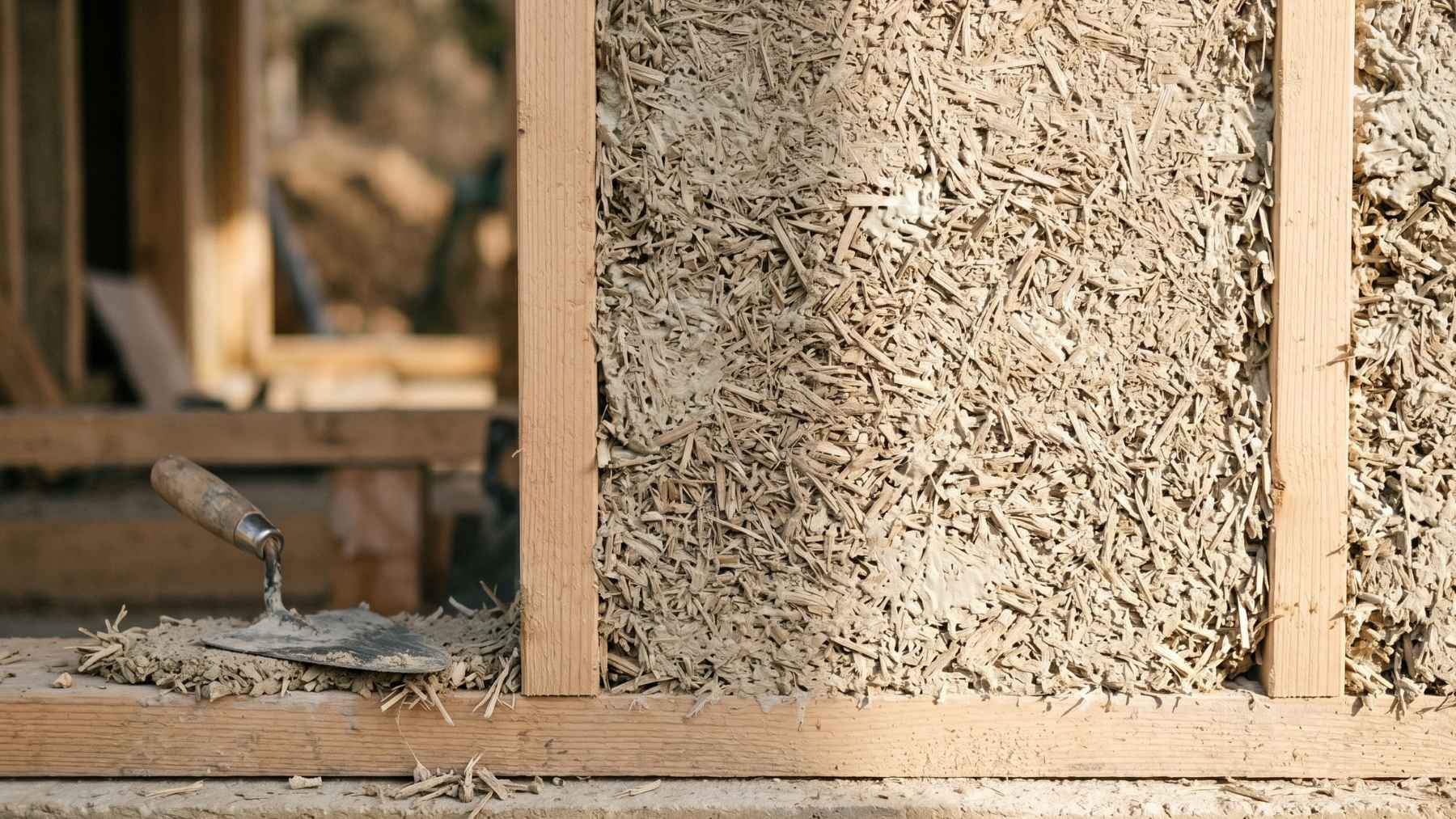
Start with what the stuff actually is, because the name does it no favors. Hempcrete is a mix of the woody core of the hemp stalk, called hurds or shiv, plus a lime binder and water. You build it as non-structural wall infill, using the same basic idea as straw bale or cob construction: you put up a frame, then you pack the walls with the material. It does not hold up your roof. The wood frame does that. Hempcrete fills the gaps and does the insulating.
That distinction matters because the headline comparison gets garbled constantly. When you see a number like “fifteen times better than concrete,” that is heat resistance, not strength. A peer-reviewed field study published in Frontiers measured a retrofitted hempcrete wall and found it carried at least ten times the thermal resistance of a plain concrete wall of the same thickness. Hempcrete lands somewhere around R-2 to R-2.5 per inch depending on the mix. Plain concrete is roughly R-0.1 per inch. Concrete is great for holding weight and lousy at stopping heat. Hempcrete is the reverse. They are doing different jobs.
The catch is thickness. At roughly R-1.9 per inch you need about a 12-inch wall to hit R-24, and colder climates push that to 12 to 16 inches. This is not a thin, high-tech panel you staple to a stud. It is a thick, breathable wall, which is a real design tradeoff you make on purpose.
The lime slowly turns back into stone, and traps carbon as it goes
Here is where it earns the “carbon” part of its reputation. Hemp grows fast and pulls CO2 out of the air through photosynthesis, locking that carbon into the hurds. Then the lime binder cures by reabsorbing carbon dioxide from the atmosphere over months and years, hardening as it goes and converting back toward calcium carbonate, which is the same mineral as limestone. The wall literally drifts back toward stone as it ages, and that carbonation acts as a long-term carbon store.
The net effect is what builders call carbon-sequestering, and with the right ratio of hemp to lime the wall can come out net carbon-negative, meaning it holds more carbon than went into making it. That is a sharp contrast with the default. Cement is one of the most carbon-intensive materials humans make, responsible by most estimates for around 8 percent of global CO2 emissions. The carbon in a hempcrete wall stays put for the life of the building, and the carbonated lime holds it on the kind of timescale limestone does.
There are practical perks on top of the carbon math. Hempcrete buffers humidity instead of trapping it, it resists mold and pests, and when it does burn it does not throw off the toxic smoke that petrochemical foam insulation does. Builders in France have been using hemp-lime for roughly three decades, so none of this is theoretical.
It just passed a one-hour fire test, and that’s headed into the 2027 code
This is the part that moved most recently. On October 22, 2025, at code hearings in Cleveland, the 11-member IRC committee gave unanimous approval to a proposal that writes three fire-tested hemp-lime wall assemblies into the 2027 residential code, according to architect Martin Hammer of the Natural Building Alliance, who co-authored the original code submission. Hemp-lime builder Cameron McIntosh of Pennsylvania’s Americhanvre ran the tests at Intertek Laboratories in York, PA across 2024 and 2025. Each of the three assemblies used a different framing setup, and each one passed a one-hour ASTM E119 test, including the brutal hose-stream portion where they blast the heated wall with a fire hose.
That rating is not a trophy. It is the difference between getting a permit cleanly and not. A one-hour wall is what code requires when an exterior wall sits closer than five feet to a property line, or for the wall between an attached garage and the living space. Having pre-tested assemblies sitting in the code means a builder skips the time and expense of running a one-off fire test for those situations. In wildfire country, a documented fire-resistant wall can also matter for homeowners insurance.
There is a second fire credential worth knowing about. Hemp-lime has twice scored a zero, the lowest and best possible result, on the ASTM E84 surface-burning test that the code requires of every insulation material, in tests run by Hempitecture in 2020 and by American Lime Technology, both at Intertek. A code update approved earlier in 2025 wrote that compliance directly into Appendix BL so nobody has to re-run it. None of this makes the material magic. It makes it tested, which is the standard that actually counts.
Austin already adopted it, and Minnesota is next
The “49 states” line needs a footnote, because an appendix in the residential code is not automatically the law of the land. A state or local jurisdiction has to explicitly adopt Appendix BL for it to be enforceable. Where it has not been adopted, a builder can still bring it to the local building official and propose using it on a project basis. So the accurate version is that the model code 49 states build on now contains a clean hemp-lime pathway, and actual adoption is happening one jurisdiction at a time.
The City of Austin, Texas was first, with Appendix BL taking effect there on July 10, 2025. The State of Minnesota is close behind, having run the appendix through its technical advisory group and codes council in 2025 for inclusion in the state’s next residential code cycle, with cities expected to issue their own supplemental guidance through 2026. Henry Gage Jr., president of the U.S. Hemp Building Association, framed the original code win by saying hemp-lime construction had “moved to the mainstream.” Adoption in real cities is what turns that from a press line into a permit.
Commercial buildings are a separate track. Anything beyond one- and two-family homes and townhouses runs through the International Building Code rather than the residential one, and the hemp-building association has been working to get hempcrete written in there too. For now, if you want a hempcrete office or apartment block, you are still asking for a variance.
A thick hemp wall is a long bet on your power bill
The reason any of this should reach a homeowner is the energy bill. A thick, breathable, high-R hempcrete wall slows heat moving in during summer and out during winter, which trims the heating and cooling load over the decades you own the place. That is the whole trade: you pay more up front for a wall that costs less to live behind. It is not cheap or fast today, to be honest about it. The walls eat floor area, skilled hemp-lime crews are still thin on the ground, the supply chain for building-grade hurd is young, and because it is infill you are paying for a structural frame on top of it.
It is also the same move turning up all over building materials right now: take something cheaper, cleaner, or previously written off, and find out it quietly beats the default. A British highway trial found graphene-laced asphalt that outlasts ordinary pavement by a wide margin. A London chemistry team is working on a molecular aluminum that could stand in for the precious metals buried in your catalytic converter. A Hawaii startup is printing Navy patrol boats out of recycled bottles stiffened with volcanic rock. Hempcrete is the home-construction version of that idea, with the added twist that the raw material was illegal to grow here for most of living memory.
Hemp spent more than 80 years as federal contraband. The most interesting thing about it now might be how boring it has become: a fire-tested, carbon-storing wall filler with a code number, sitting in a building department’s binder in Austin. For a plant with that kind of rap sheet, getting written into the rulebook is about as mainstream as it gets.