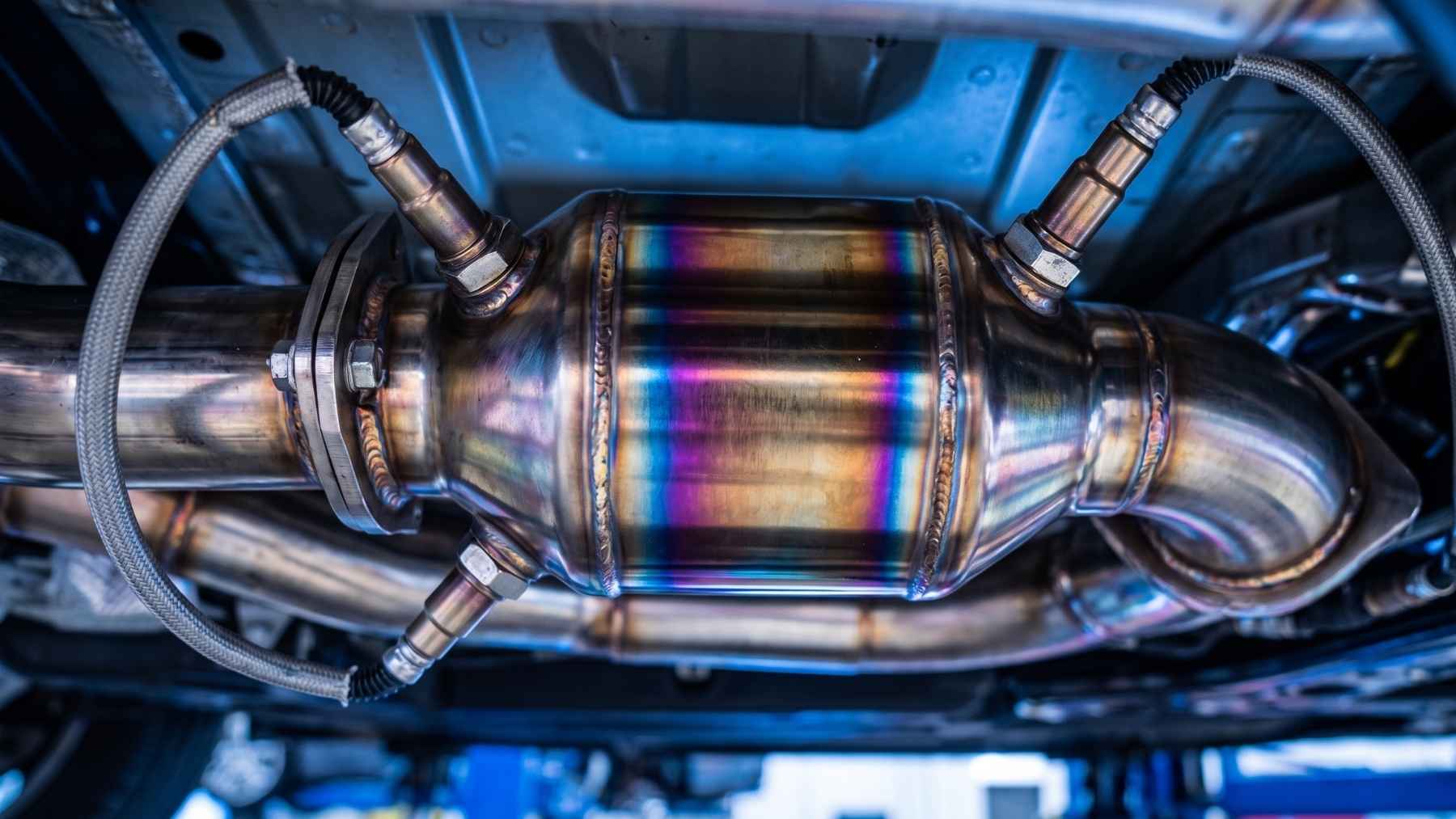

About five grams of South African and Russian metal sit in a stainless steel housing under the floor of nearly every new gas car sold in the United States. That metal is platinum, palladium and rhodium. The supply chain for it runs through two countries that the United States has serious geopolitical problems with. Anything that makes that supply chain less brittle is worth a closer look.
Platinum is trading around $1,650 an ounce. Palladium is at $1,425. A new molecular form of aluminum, isolated for the first time in late January by a chemistry team at King’s College London and Trinity College Dublin, is, on a per-gram basis, around 20,000 times cheaper than either, and in the lab it does several of the things those two precious metals are paid premium prices to do. The discovery is called a cyclotrialumane, and another 30 to 60 grams of South African metal sits inside the fuel cell stack of every hydrogen truck that PACCAR and Toyota are currently deploying through their joint program. The cyclotrialumane sits in the corner of chemistry that most car buyers never think about. It might also matter.
What the King’s team actually did
The paper, “A neutral cyclic aluminium (I) trimer,” was published in Nature Communications on January 30, 2026, with a DOI of 10.1038/s41467-026-68432-1. The senior author is Dr. Clare Bakewell, a Senior Lecturer in the Department of Chemistry at King’s College London, working with researchers Imogen Squire, Matthew de Vere-Tucker, Michelangelo Tritto, Lygia Silva de Moraes and Tobias Krämer from Trinity College Dublin.
The compound itself is three aluminum atoms bonded together in a triangular ring, with covalent metal-metal bonds and stable behavior in solution. That stability is the breakthrough. Low oxidation state aluminum compounds have been studied since the early 1990s, but earlier examples were dimers, monomers or aggregates that fell apart the moment they dissolved into the kinds of liquids real chemistry happens in. The cyclotrialumane stays a trimer in solution. The structure does not break. That changes what you can do with it.
What the King’s team did with it, in the experiments described in the paper, was use the trimer to break the hydrogen-hydrogen bond in dihydrogen gas and to insert ethylene molecules into the aluminum core, producing five- and seven-membered aluminum-carbon ring systems that no metal, transition or main group, had previously been documented forming. Splitting dihydrogen and chain-growing carbon are exactly the kinds of reactions that platinum and palladium catalysts perform across industrial chemistry every day.
“Transition metals are the workhorses of chemical synthesis and catalysis,” Bakewell said in the King’s press release accompanying the paper, “but many of the most useful are becoming increasingly difficult to access and extract – often being located in regions of political instability, increasing the demand and price. Chemists have been looking towards more common elements from the periodic table, and we chose aluminium, as it’s super abundant, making it approximately 20,000 times less expensive than precious metals such as platinum and palladium.”
Why your car carries five grams of geopolitically constrained metal
The connection from a chemistry paper to the automotive supply chain runs through the catalytic converter. About 98% of new vehicles sold worldwide carry one, and the average loading per converter sits around five grams of platinum group metals split across platinum, palladium and rhodium. Industry estimates put automotive catalytic converters at about 65% of total global platinum, palladium and rhodium demand. The Bushveld Complex in South Africa supplies around 80% of new mined platinum. Russia’s Norilsk Nickel plus South Africa together supply roughly 80% of new mined palladium.
Those are not comfortable numbers in 2026. South African mine output has been disrupted through 2025 by flooding and a chronic power crisis that has forced load-shedding across the country’s platinum belt. Russian palladium has been moving through sanctions and counter-sanctions since 2022. Heraeus Precious Metals projects platinum to trade between $1,300 and $1,800 an ounce in 2026, on the back of a third consecutive year of supply deficit, even as the shortfall narrows. Rhodium, the smallest component of a converter at one to two grams, is currently the most valuable metal in the package at around $9,500 per ounce.
Translated into vehicle terms, the precious metal content inside a typical US gas car’s catalytic converter is worth somewhere between $500 and $900 in raw material at current spot prices, with rhodium accounting for most of that figure despite weighing the least. Multiply that by roughly 16 million new vehicle sales a year in the United States and you are talking about a multibillion-dollar annual demand line that moves through Johannesburg and Norilsk before it arrives at the assembly plant in Tennessee.
| Vehicle type | PGM load | Raw cost* |
|---|---|---|
| Gas passenger car | ~5 g (Pt+Pd+Rh) | $500–$900 |
| Hybrid (HEV) | ~5–7 g (Pd-heavy) | $550–$1,000 |
| Battery EV | ~0 g | $0 |
| Hydrogen FCEV truck | 30–80 g (Pt only) | $1,600–$4,250 |
The hydrogen truck problem is bigger than the gas car problem
The number that should worry the fuel cell side of the heavy-duty trucking conversation is not the five grams in a catalytic converter. It is the 30 to 60 grams of platinum that sits inside the fuel cell stack of every hydrogen fuel cell electric truck currently rolling off the PACCAR-Toyota production line as a Kenworth T680 FCEV or a Peterbilt 579 FCEV, with some stack designs reaching as high as 80 grams. Per truck, that is roughly six to twelve times the platinum load of a gas passenger car, and the load cannot be thrifted down the way passenger-car converters have been thrifted over the last twenty years.
Platinum is the catalyst that drives the hydrogen-oxygen electrochemical reaction inside the fuel cell stack. Without enough of it, the cell cannot make electricity efficiently. If hydrogen fuel cell trucks scale into even a fraction of the long-haul Class 8 fleet that the trucking industry is currently planning around, the platinum demand math gets uncomfortable in a hurry. Industry scenarios published in late 2025 project that ten to twelve million fuel cell vehicles deployed globally per year by 2040 would consume between 600,000 and 720,000 ounces of new platinum annually, enough to offset roughly half of the automotive catalyst demand that the EV transition is expected to subtract from the global market over the same period.
The point is not that any of that buildout is certain. None of it is. The point is that the automotive industry’s exposure to platinum and palladium is not going away with the gas car. It is shifting, partly to hybrids, which actually use more palladium per vehicle than pure ICE cars do, and partly to hydrogen trucks, which use far more platinum per vehicle than gas cars ever did. Every architecture currently competing for the post-diesel Class 8 market has either a precious metal or a rare earth dependency baked into it.
What this discovery does, and what it doesn’t
The cyclotrialumane chemistry, if it scales out of the lab, addresses the precious metal side of that exposure. Platinum and palladium are workhorse catalysts because they break specific chemical bonds and they survive doing it across temperature cycles. The King’s compound has now been shown, on the bench, to do both of those things at room temperature with aluminum, the most abundant metal in the Earth’s crust. That is the part of the result that justifies the headlines.
What the cyclotrialumane does not do, despite what some of the secondary coverage has implied, is replace neodymium and dysprosium in the permanent magnets that drive electric vehicle motors. Those rare earth elements are doing a fundamentally different job inside an EV: they sit inside the rotor of a permanent magnet synchronous motor and generate the magnetic field that the stator pushes against. Aluminum, in any molecular form, does not produce that kind of magnetism. The Chinese supply chain dominance over neodymium and dysprosium remains a separate problem that this paper does not solve.
It also does not replace the lithium, nickel, cobalt or manganese inside an EV battery cell. Those are storage materials, not catalysts. Different chemistry. Different supply chain. Different problem.
The honest framing of what the King’s discovery does is narrower and more useful than “aluminum replaces rare earths.” It opens a credible path to replacing platinum and palladium catalysts in some industrial chemistry applications. That is the path that, downstream, could reduce automotive exposure to South African and Russian PGM supply, both in catalytic converters on gas cars and, eventually, in fuel cell stacks on hydrogen trucks. Bakewell herself has been careful with the framing. “We’re very much in the exploratory phase and we’re just at the start of beginning to unlock the capability of these earth-abundant materials,” she said in the press release. “From what we’ve seen already, this chemistry could support a transition to cleaner, greener and cheaper chemical production.” Could. Not will. Not yet.
Stakes for the US automotive industry
The path from a chemistry paper to a production catalyst is long, and most papers like this one never finish the walk. Industrial catalyst development typically takes a decade or more from bench result to commercial process. The cyclotrialumane will need to demonstrate reactivity across the specific bond-breaking and bond-forming reactions that platinum and palladium are currently asked to do at scale, survive over thousands of catalytic cycles without decomposing, and be manufacturable in usable quantities at a cost that actually realizes the 20,000-fold price advantage Bakewell’s team has on paper. Each of those is a separate research program.
What it offers, in the meantime, is the first credible thread in a long time pointing to a way out of the precious metal corner that the automotive industry has spent thirty years walking into. Catalytic converters on gas cars are not going anywhere this decade. Hydrogen fuel cell trucks need more platinum per vehicle, not less. The Russian and South African supply chain for the metals that make both of those possible is not getting more stable. A small chemistry team in London just published a paper suggesting that there might, eventually, be an alternative made from a metal that the United States produces in industrial quantities at home. That is worth tracking.