
If you grew up in the late 1990s with any awareness of British SUVs, you probably remember the Freelander as Land Rover’s small, slightly wobbly attempt at a soft-roader for the school run. Land Rover discontinued it in the mid-2010s, replaced it with the Discovery Sport, and most people assumed the nameplate was gone for good. Then Chery showed up.
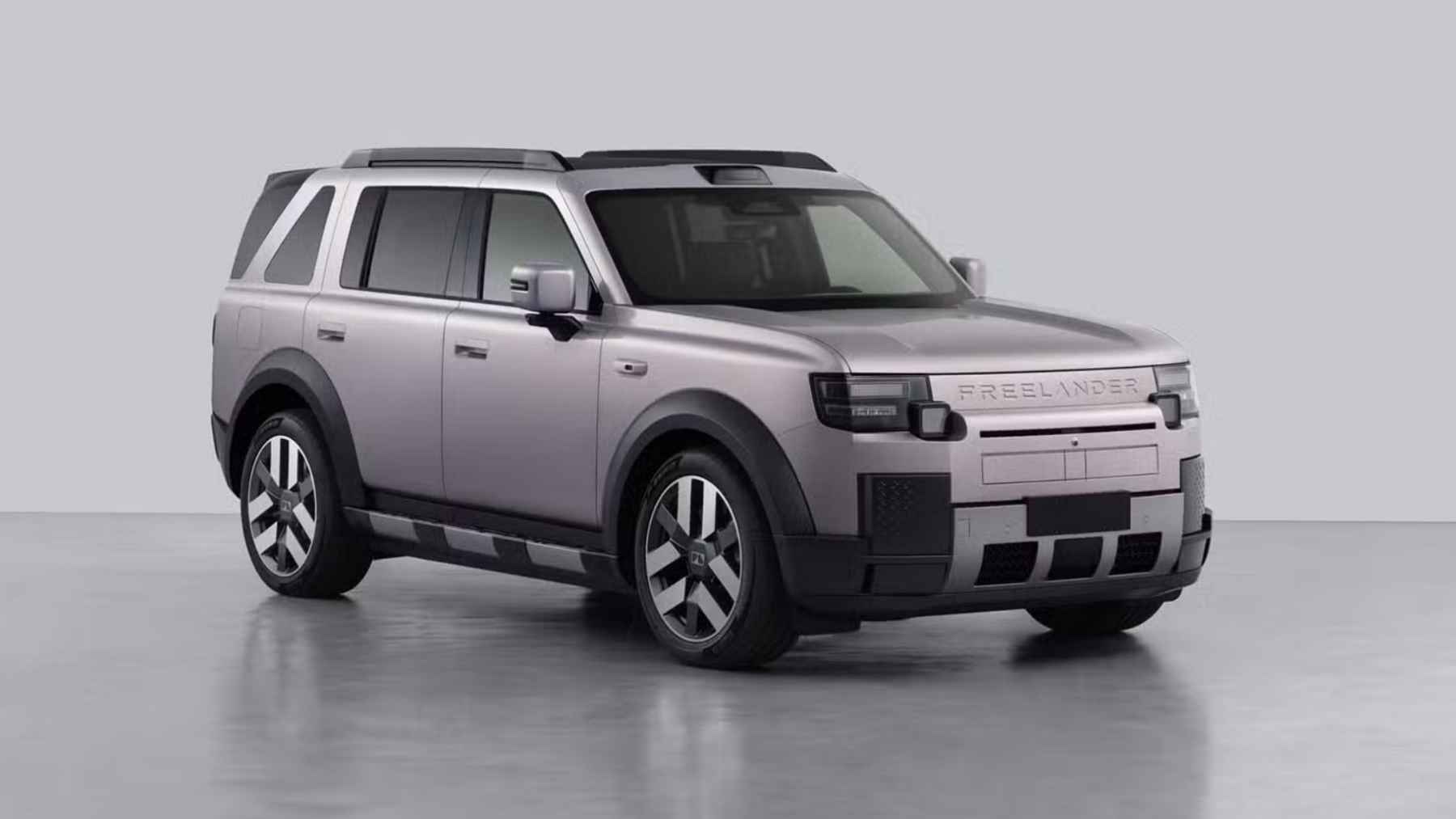
The Chinese automaker is now reviving Freelander as a standalone marque, built in China, with JLR’s blessing on the design. The first model, the Freelander 8, broke cover in China this spring as a 5.1-meter, 800V SUV that’s physically bigger than a Defender. And now JLR’s new boss has effectively given Chery the green light to sell it in the UK and Europe, the kind of thing that would have triggered emergency board meetings a decade ago. Americans, for what it’s worth, aren’t getting it at all.
Speaking to Autocar, JLR CEO PB Balaji said the company has no intention of blocking Chery if it decides to ship Freelanders to British and European buyers, even though those cars would land in roughly the same segment as the Discovery and Defender. His reasoning is simple: it isn’t really JLR’s car to sell.
“It’s Chery’s car,” and JLR is fine with that
Balaji took over as JLR chief executive in November 2025, succeeding Adrian Mardell. He’s a longtime Tata Motors finance man who had served as the parent company’s group CFO since 2017 before getting the top job, so when he talks about the Freelander partnership, he’s doing it as someone who has watched the joint venture’s books from the parent company’s side for years. JLR announced his appointment back in August 2025.
Asked directly whether JLR would block Chery from selling Freelanders in Britain, Balaji told Autocar “it’s Chery’s car” and that JLR would “let them make up their mind.” He added that sales will start in China, with global expansion left to Chery to figure out. JLR’s job, as he put it, is making sure the design lines up with what the company stands for, and after that the whole thing is Chery’s baby.
Translation: JLR designs the thing, licenses the name, takes whatever it takes from the joint venture, and stays out of the showroom fight. Balaji’s comments also strongly suggest UK sales wouldn’t run through existing JLR dealerships, which lines up with everything else he’s saying.
The Freelander 8, decoded
If you’ve been ignoring this story because “Chinese SUV with a British badge” sounds like a parts-bin special, the spec sheet is worth a look. The Freelander 8 rides on Chery’s E0X platform with an 800-volt architecture, and it can be configured as a battery-electric, plug-in hybrid, or extended-range EV. The launch version is the EREV, which pairs a full battery pack with a small gasoline generator that tops it up on the move, the same basic trick Jeep is using on the Grand Wagoneer 4xe. It’s also the first 800V setup ever fitted to an extended-range vehicle, which is a genuinely novel piece of engineering rather than marketing fluff.
The dimensions aren’t subtle. The Freelander 8 measures up to 5,185 mm (204.1 inches) long, 2,050 mm (80.7 inches) wide, and 1,898 mm (74.7 inches) tall, riding on a 3,040 mm (119.6-inch) wheelbase. That’s longer than a Defender 110 and a Toyota Land Cruiser Prado. CATL supplies the batteries, with its dual-chemistry Freevoy pack, peak DC charging tops out around 350 kW, and the tech stack includes a roof-mounted LiDAR, Huawei’s Qiankun ADS 4.1 driver-assist suite, and a Qualcomm Snapdragon 8397 running the cabin.
European pricing hasn’t been confirmed, but it’s reportedly being targeted somewhere between €45,000 and €55,000, comfortably below where a Defender starts. That gap is exactly what Chery wants to exploit.
A new model every six months for half a decade
The Freelander 8 isn’t a one-off. Chery is treating the revived nameplate as a full sub-brand and plans to launch a new Freelander roughly every six months for the next five years, building out a lineup of six SUVs. That’s a product pace legacy European brands basically can’t match, and it’s the part of this story that should make JLR’s own planners a little uneasy, whatever Balaji says in public.
Freelander’s global CEO, Wen Fei, has been clear that the exported cars won’t just be Chinese-market models with a different plug. According to Auto Express, the plan is bespoke regional variants with different layouts, tuning and specs for each major market. As Fei put it, “we are not exporting a Chinese car to the world but we are building a world car, for the world, from the very beginning.” The UK launch is lined up for the second half of 2027.
That’s a more considered approach than the usual “ship whatever sold in Shanghai” strategy that has tripped up other Chinese exporters.
Why JLR isn’t worried about cannibalization
Here’s where Balaji’s argument gets interesting. The Freelander 8 lines up directly against Discovery and Defender on size, and arguably against Discovery Sport on concept. So why isn’t JLR sweating it?
His answer to Autocar was that the two brands sit in different places on price and product, so they don’t really see themselves as rivals. He framed it as “together we should be expanding the market,” the kind of line you use when you want everyone to keep buying SUVs and you don’t much care which badge ends up on the hood.
There’s a colder financial logic underneath. JLR brings in the lion’s share of Tata Motors’ revenue, north of 70 percent, and Balaji ran the parent company’s group finances for eight years before taking the JLR job. He knows precisely how much margin JLR makes on a Defender, and how thin the joint-venture economics are on a Chinese-built Freelander. If the math says letting Chery have a roughly $50,000 segment beats fighting a Chinese cost structure with a British factory, then the math says what it says.
JLR has also confirmed that Freelander will sit as a standalone marque, completely outside its official “House of Brands” lineup of Range Rover, Defender, Discovery and Jaguar. No badging crossover, no shared showroom space. Just a licensing deal with a Chinese partner doing the engineering and production inside China.
Who actually wins here
The cynical read: JLR gets paid for design work and brand licensing, dodges the capex of building yet another mid-market SUV platform, and lets Chery absorb the political risk of selling a Chinese-built vehicle in post-Brexit Britain and an increasingly tariff-happy West, a risk that’s already playing out across North America. Chery, in return, gets a British-sounding badge with real heritage, a designed-in-the-UK styling signature, and instant credibility in showrooms where “made in China” is still a harder sell than the spec sheets suggest it should be.
Whether the buying public goes along with it is a separate question. The Freelander name carries weight with anyone over 35 in the UK, but it carries weight as a small, occasionally unreliable Land Rover, not as a 5.1-meter Chinese electric flagship with LiDAR and a Qualcomm chip inside. Chery is betting nostalgia covers that gap. Balaji is betting that even if it doesn’t, JLR’s Defender and Range Rover buyers won’t trade down.
So make of that what you will. The Freelander 8 reaches Chinese roads later this year, with UK showrooms, separate ones run by Chery and not JLR, likely to follow in the back half of 2027.
 C ROOKIE3 months ago