
Osmotic power had its big coming-out party last August, when Japan switched on a plant in Fukuoka that makes electricity from the salinity gap between treated wastewater and concentrated seawater. We covered that launch, and it went on to become one of the most-read stories this site has ever published. Fair enough. A generator with no fuel, no emissions and no bedtime is worth your attention.
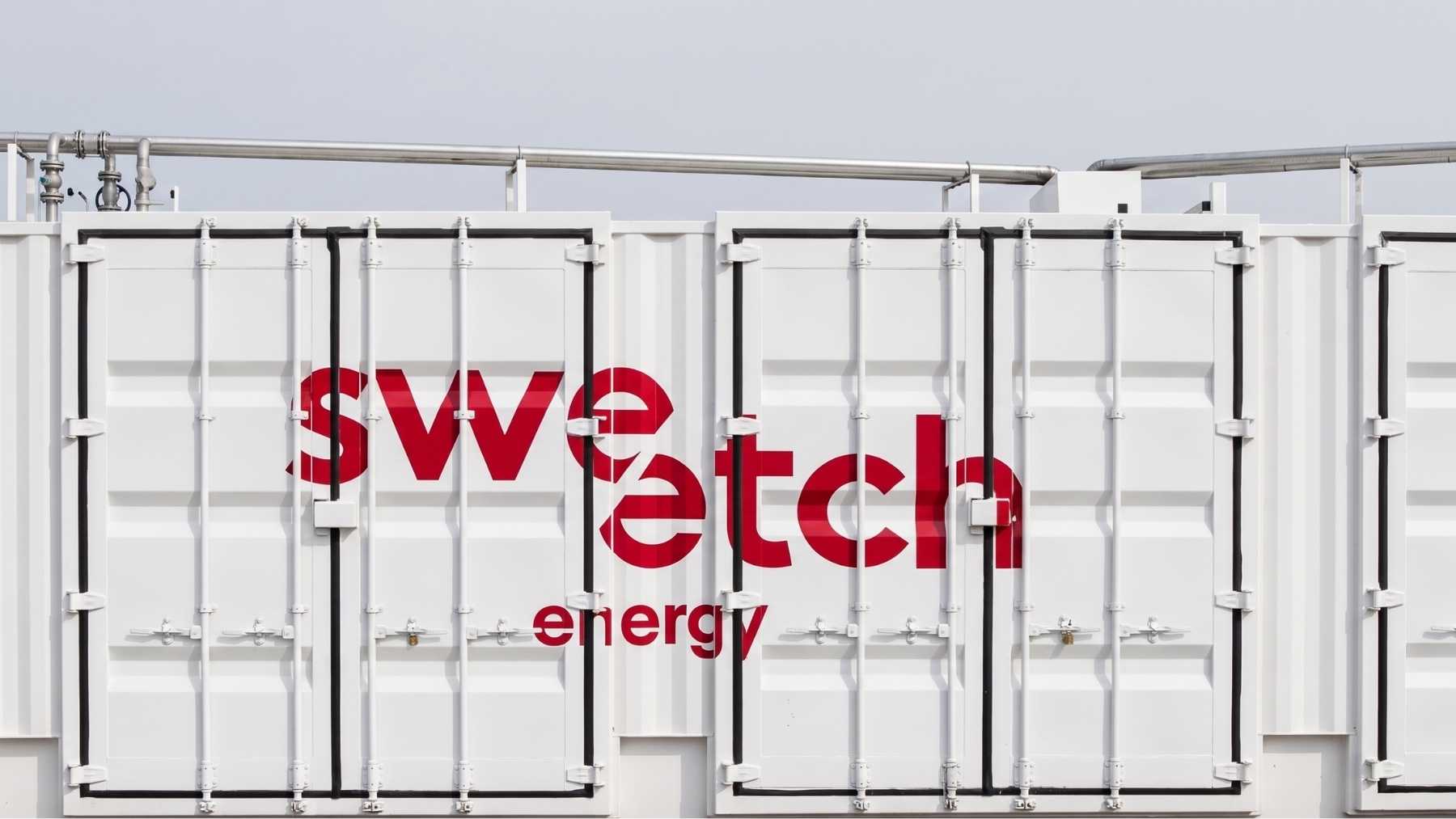
Here’s the thing, though. Fukuoka nets about 110 kilowatts, which is historic, useful, and roughly enough to run a midsize office building. The project trying to turn the same physics into actual grid infrastructure sits some 6,000 miles away, at a canal lock in the south of France where the Rhône River empties into the Mediterranean. The company is called Sweetch Energy, the machine inside is nothing like the one in Japan, and the roadmap it shares with CNR (Compagnie Nationale du Rhône), the operator that produces 25% of France’s hydropower, runs to 500 megawatts in a single river delta over the next decade. That is a target about 4,500 times the output of the plant everyone spent last fall talking about.
The membrane is the whole machine
Fukuoka’s plant works on pressure. Salt water pulls fresh water through a membrane, pressure builds on the salty side, and that pressure spins a turbine like a tiny hydro dam. Sweetch’s INOD technology (Ionic Nano Osmotic Diffusion, if you collect acronyms) skips the turbine entirely. Its membranes are made from a bio-based nanotube material, and they sort ions rather than water molecules. The charged particles stream through, that stream is literally an electric current, and electrodes harvest it directly. Less hydroelectric dam, more saltwater battery that the river keeps refilling.
The physics came out of an actual lab. Lydéric Bocquet, a CNRS research director at the École Normale Supérieure and one of the reference names in nanofluidics worldwide, led the group that identified the underlying effect in the early 2010s, and he co-founded Sweetch in 2015 with entrepreneur Bruno Mottet to commercialize it. The membranes are now patented, and in a column for Polytechnique Insights, Bocquet puts the efficiency gain at nearly 20 times what previous osmotic plants managed. Earlier pilots in Norway and the Netherlands topped out between 4 and 50 kilowatts, which is why most of the industry quietly walked away from the idea a decade ago. The whole bet here is that the membrane, not the concept, was the problem.
So what’s actually in the water right now?
The demonstrator is called OPUS-1, and it sits at the Barcarin lock in Port-Saint-Louis-du-Rhône, the exact spot where the Rhône finishes its run and hits the Mediterranean. Site selection here was not romantic. The Med is saltier than the open ocean, a bigger salinity gap means more recoverable energy, and for once in the energy business the geography is doing somebody a favor. Sweetch says the station entered its testing phase at the end of 2024, with an initial stage sized at a few dozen kilowatts, validating the membranes against real river water, real silt and real seasons.
The partner matters as much as the lock. CNR has been on this project since the beginning, first as industrial partner and then as an investor. The control room, meanwhile, is American in a sense: Rockwell Automation (NYSE: ROK) supplies the process control and visualization platform running the station, a deal the Milwaukee company announced in 2024. And if a European river quietly chasing baseload power sounds familiar, Germany is running its own version of that bet with 124 hydrokinetic turbines anchored in the Rhine. The German approach harvests the river’s motion. The French one harvests its chemistry.
The factory sits inside an old Citroën plant
In May of last year, Sweetch opened its first production unit: 3,000 square meters (about 32,000 square feet) of membrane and generator manufacturing at La Janais, on the southern edge of Rennes. If that name rings a bell for car people, it should. Citroën built one of its largest factories at La Janais in 1961, the site passed to PSA and then Stellantis, and the plant next door still builds the C5 Aircross today, including the electric version that entered production in July 2025. Sweetch’s unit occupies part of Bâtiment 78, a former PSA building that Rennes Métropole spent €18 million converting into a low-carbon industrial hub.
The unit runs with 25 people and is designed for fully automated, low-cost output, because the entire osmotic business case lives or dies on cheap membranes. Sweetch also says its generators use no rare materials and lean on a European supply chain, which in 2026 reads as a feature aimed straight at anyone tired of checking what China restricted this month. A building that spent six decades around Citroëns now laminates the membranes that are supposed to start a 500-megawatt climb. Industrial reconversion rarely gets this on-the-nose.
500 megawatts is a roadmap, not a ribbon cutting
Here is the actual plan, with the company’s own numbers attached. OPUS-1 is the first of a series of stations Sweetch and CNR intend to install across the Rhône estuary over the coming decade, adding up to as much as 500 MW. The company says that would cover more than 1.5 million people, roughly Marseille plus its metro area. CNR pegs the delta’s total osmotic resource at close to 4 terawatt-hours a year, which Bocquet notes is about one-third of the 13 TWh the river’s dams already generate. On land use, Sweetch claims a megawatt-scale osmotic station needs around 1,500 square meters (about 16,000 square feet), roughly 60 times less ground than equivalent solar. That last figure is the company’s own comparison, so file it accordingly, but the principle holds: the energy lives in the water, not spread across a field.
The money and the org chart both point the same direction. Sweetch had raised €40 million by the end of 2023, including a €25 million Series A (about $27 million at the time) and a €2.5 million European Innovation Council grant, with EDF Pulse, CNR, Bpifrance and ADEME among the backers. Heuzé, then CEO, said in the funding announcement that “osmotic energy has now the potential to achieve this objective,” the objective being competitive clean power around the clock. The World Economic Forum named the company a 2025 Technology Pioneer last July. Then in April, Sweetch reshuffled its leadership: co-founder Nicolas Heuzé moved up to Executive Chairman to focus on strategy and fundraising, and Bertrand Chupin, a 25-year energy veteran who ran Technip Energies’ loading systems business and served as chief commercial officer of the green-hydrogen venture Rely, took over as CEO. Companies do not hire a Technip project-delivery executive to babysit a few-dozen-kilowatt demo. That is a scale-up org chart.
And the United States is explicitly on the map. Sweetch opened a Boston-area office in 2023, inside the Greentown Labs climatetech incubator in Somerville, Massachusetts, and lists North America among its expansion targets, with company estimates putting the continent’s osmotic potential at 49 gigawatts. No U.S. site has been named yet; exploring is the official verb. But every big American river that ends in salt water carries the same gradient, which is presumably what that Boston desk is there to think about.
Now the honest part. Osmotic power has a paper trail going back to the 1950s and, until very recently, almost nothing plugged into a grid, because the membranes always cost too much for the watts they produced. Sweetch’s entire thesis is that bio-based nanotube membranes finally break that math, and the proof will not come from press releases. It will come from the first megawatt-scale station on the delta and the price per megawatt-hour it delivers. If the membranes hold their cost at scale, the Rhône gets its 500 megawatts and Fukuoka gets remembered as the opening act. If they don’t, Barcarin joins a long list of locks, dikes and piers where blue energy looked great at 50 kilowatts. Either way, the river runs 24 hours a day. That part is already proven.