
Cleaning up ocean shipping usually comes with a shopping list. A new engine, a new fuel, a bunkering terminal that can actually deliver that fuel, and a decade of waiting for all three to show up. So I read the Singapore-to-Ghana numbers twice, because a small Bay Area company says it skipped the whole list and still cut a cargo ship’s fuel burn by close to a quarter.
Newlight announced on September 1 that its hydrogen-hybrid system had finished its first long-distance commercial run, installed aboard a 650-foot (199-meter) bulk carrier operated by Lomar Shipping. The ship is rated at 57,038 deadweight tons, meaning it can carry about 62,900 short tons of cargo, fuel, water and stores. Over 8,500 nautical miles (roughly 9,780 miles) from Singapore to Ghana, Newlight measured a 24 percent drop in fuel consumption, a 28 percent drop in carbon dioxide and a 22 percent drop in carbon monoxide.
Every one of those figures comes from Newlight, from a single voyage, and I have not seen an independent verification of them published.
So what is the hydrogen actually doing in there?
Hydrogen works as an accelerant in this setup, and it makes up a small share of what goes into the cylinder. Engines this size burn heavy fuel oil, which has roughly the consistency of tar until you heat it up. It lights slowly and it does not burn completely, which is why big ships trail soot. Hydrogen behaves the other way around. It ignites across a very wide range of fuel-to-air mixtures and it burns fast, so a small dose of it going in at the right instant drags the rest of the charge along and the engine gets the same push out of less oil.
Co-founder Evyatar Cohen told TechCrunch that the system essentially instructs the engine to cut its fuel flow, because the hydrogen is covering the difference. Extra power was never the goal. Running an engine on hydrogen alone is a different project entirely, and a Finnish builder pulled that off on a 13,000-horsepower piston engine feeding Spain’s grid earlier this year.
Timing is the hard engineering. A main engine changes load constantly as sea state, draft and speed shift, so the injection has to track that load in real time. Newlight’s controller reads combustion pressure, exhaust temperature and the pressure of the air coming into the cylinder, then sets how hard and how long it injects as those conditions move, working ahead of each combustion cycle by milliseconds. It repeats that on every stroke of the piston.
Two weeks alongside, and no dry dock
If you own ships, I’d guess that detail lands harder than any of the percentages.
A dry dock is exactly what it sounds like. The ship floats into a basin, the water gets pumped out, and the hull sits on blocks while people work on it. You pay the yard and you earn nothing while the ship sits there, which is why owners treat an unscheduled docking roughly the way you’d treat an unscheduled transmission rebuild. Newlight says its retrofit goes on in one to two weeks with the vessel afloat, and that the ship can keep working while the crew fits it. Nothing in the hull or the engine gets replaced.
RINA, the Italian classification society, approved the package against its class rules for hydrogen-fueled ships and against the IGF Code, the international safety code for ships burning gases and other low-flashpoint fuels. The society ran a four-day acceptance test in November 2025 on two engines: a four-stroke running as a generator ashore, and a two-stroke driving a yacht at sea. Patrizio Di Francesco, a principal engineer at RINA, said the solution is “robust and safety-focused by design.” RINA also handed Newlight its Hydrogen Innovation Award.
Newlight has not named the ship or said which engine is in it, which I’d want before assuming the result carries over cleanly to other hulls.
Hydrogen still has to come from somewhere
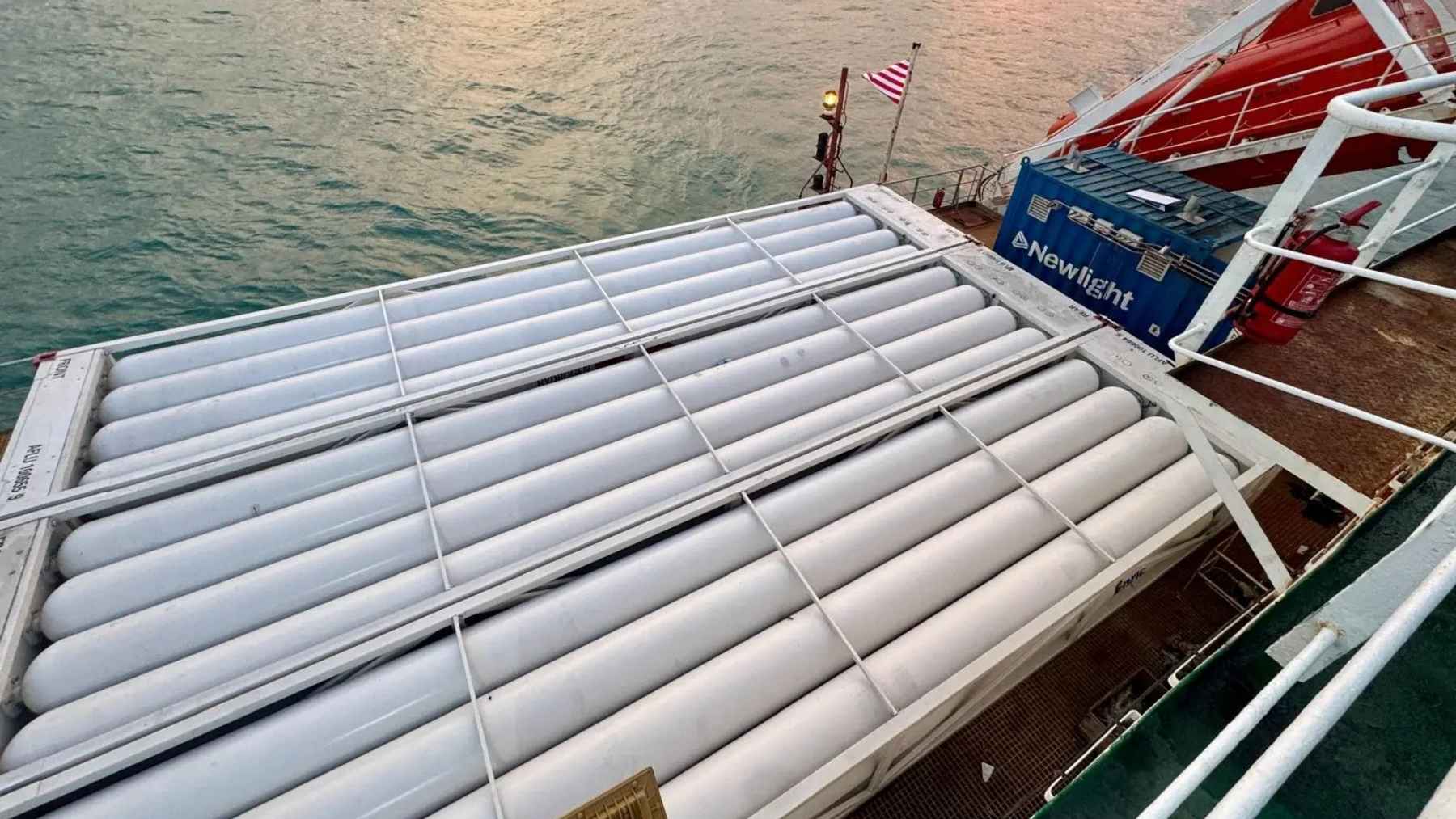
The system runs on compressed hydrogen carried aboard. Newlight has not published how much the ship held, how often it took more on, or what that hydrogen cost per voyage. Its answer to the wider infrastructure problem is that the engine goes back to burning oil on its own whenever there is no hydrogen to inject, so an empty tank never strands the ship. That is a real advantage over ammonia and methanol conversions, which commit a vessel to a fuel most ports still cannot supply. Storing hydrogen on a working vessel is its own engineering headache, and different navies have landed on wildly different answers to it.
A 28 percent carbon cut measured at the funnel also says nothing about how the hydrogen was made. If it came from natural gas, part of that carbon moved upstream instead of disappearing. That distinction has money attached to it in Europe, where the EU ETS counts a ship’s emissions tank-to-wake while FuelEU Maritime counts fuels well-to-wake, so the same hydrogen scores differently depending on which rule is doing the counting.
Fuel is expensive and the carbon rules are landing
Singapore’s very low sulfur fuel oil was assessed at $836 a metric ton on September 2, up $59 in a single day, with high sulfur fuel oil at $662, according to bunker price reporter Engine. Newlight’s release blames the Strait of Hormuz and thinned-out Suez traffic for the volatility. Fuel is typically the largest single line in a vessel’s operating budget, which is why a quarter off that line gets attention from people with no interest whatsoever in hydrogen.
Then there’s the regulation. The European Union phased its carbon market into shipping in steps, with allowances covering 40 percent of 2024 emissions, 70 percent of 2025 emissions and 100 percent of emissions reported from 2026 onward, according to the European Commission. Methane and nitrous oxide came into scope on January 1, 2026.
Global rules are messier. The IMO’s Net-Zero Framework was set for adoption in October 2025 and got adjourned for a year instead, after a motion to postpone passed 57 votes to 49. Member states went back to London from April 27 to May 1 to argue about it, and Secretary-General Arsenio Dominguez closed that meeting by telling them “we are back on track, but we have to rebuild trust.” Owners are being asked to spend against rules nobody has signed yet. A retrofit you can reverse looks a lot safer in that position than a newbuild you cannot.
That is one voyage on one hull, with the numbers taken by the company selling the equipment. I’d want a second run on a different ship with somebody else reading the flow meter before treating 24 percent as a rule rather than a result. The claim is unusually easy to check, though, which is more than you can say for most of what gets announced in this corner of the industry. You either see it on the next invoice or you don’t.
Newlight says 12 vessels now sit under signed agreements with a handful of shipping companies, and that it wants to move onto whole fleets during 2027. The company has raised a $9 million seed round backed by lomarlabs, BIRD Energy, Undeterred Capital, CiRi Ventures and Fusion VC. The IMO’s adjourned session on the Net-Zero Framework resumes in London on December 4, 2026, subject to confirmation by MEPC 85 the same week.