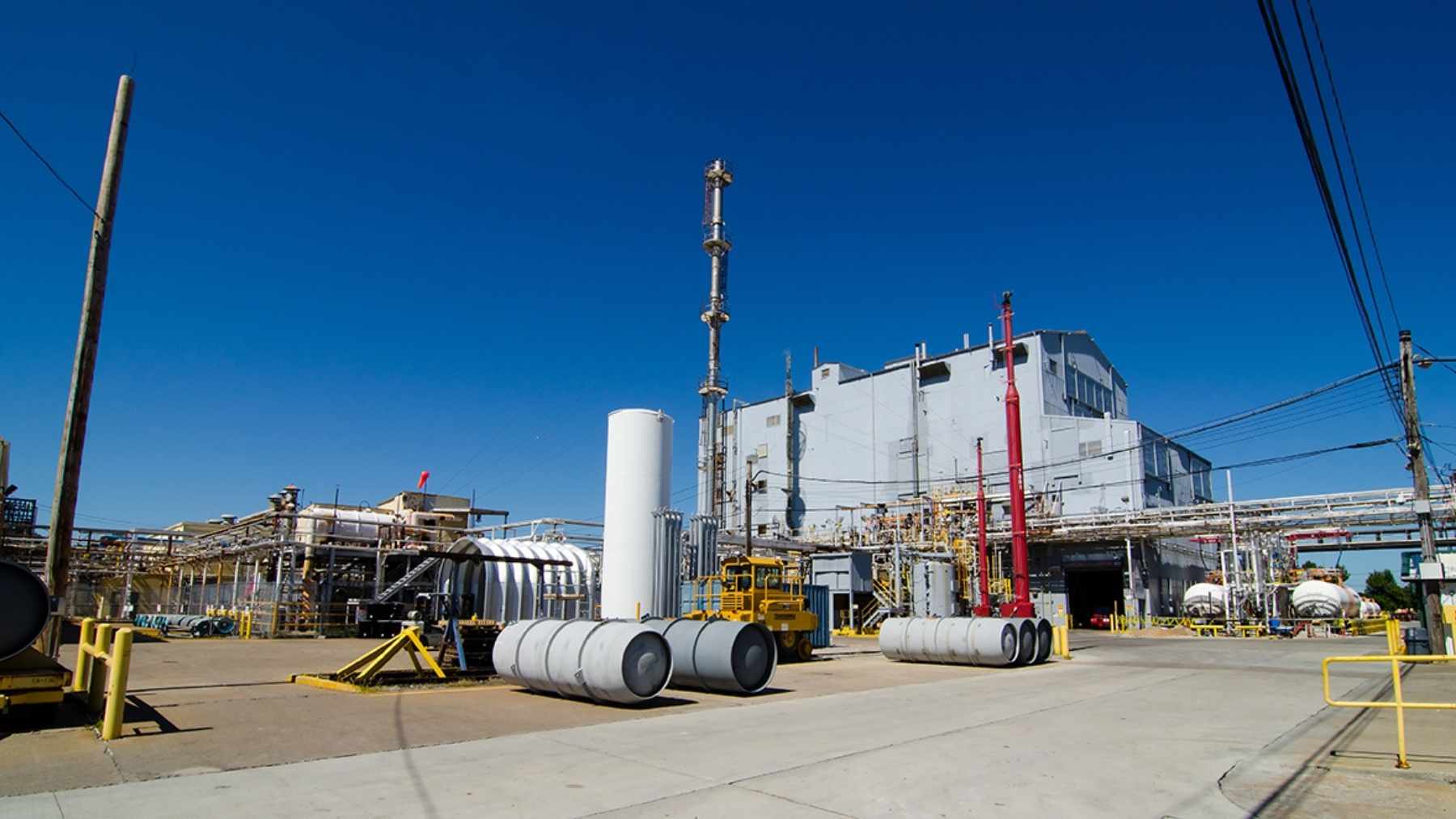

Everybody in the nuclear business wants to talk about enrichment right now. Foreign enrichers took 63 percent of the feed American utilities sent out last year, and the only HALEU cascade in the country is sixteen machines in an Ohio hall. Enrichment is where the money and the hand-wringing go. But yellowcake does not go into a centrifuge. It has to become a gas first, and in the United States that job gets done in exactly one building, a plant outside Metropolis, Illinois, that opened in 1958.
On August 31, an Idaho Falls startup called Raven-Flint Nuclear announced three things at once. The Department of Energy picked it for the Nuclear Energy Launch Pad at Idaho National Laboratory, where it wants to build a pilot conversion plant called Torch. Its own lab made uranium hexafluoride without using elemental fluorine. And the Nuclear Regulatory Commission docketed its license application for engineering-scale uranium work at that lab.
Three milestones in one press release, and none of them involves a shovel.
Yellowcake has to become a gas before anyone can enrich it
A mine or a mill ships uranium as U3O8, the yellow powder, packed in 55-gallon drums. A conversion plant turns that powder into uranium hexafluoride, UF6, a compound that sits as a solid at room temperature and turns into a gas at about 133°F (56°C) at normal pressure, which is the property a centrifuge needs. An enrichment plant then raises the share of uranium-235 in that gas, and a fuel fabricator turns the enriched product into pellets and rods.
Four steps. America has been pouring federal money into the third one, as we covered when sixteen centrifuges in Piketon, Ohio won the right to sell HALEU, and into the fourth, with the TRISO fuel plant going up in Tennessee. The second step has had one address for 68 years.
That address is Metropolis Works, 1.9 miles northwest of Metropolis, Illinois (yes, the Superman one, the town has the statue). The plant opened in 1958. Honeywell idled it in 2018 when nobody wanted UF6, restarted it in 2023, and then spun its advanced materials business off as Solstice Advanced Materials in October 2025, so the only uranium converter in the country is now less than a year old as a company and 68 years old as a factory.
Solstice said on February 10 that it expects Metropolis to turn out more than 10,000 metric tons (about 11,000 US tons) of UF6 in 2026, roughly 20 percent above what it had planned for 2024, against a backlog of more than $2 billion. The plant holds an NRC license that runs to 2060, and every pound it makes gets sold through ConverDyn, a partnership between Solstice and General Atomics.
Raven-Flint’s release says that single plant meets less than half of what US utilities need. The EIA does not publish a conversion figure by country, but its 2025 Uranium Marketing Annual Report shows American reactor owners delivered 32 million pounds of uranium feed to enrichers last year, which works out to roughly 12,300 metric tons (13,600 US tons) of uranium, and Solstice’s 10,000 metric tons of UF6 contains about 6,800 metric tons (7,500 US tons) of uranium, some of it bound for overseas customers.
The American Nuclear Society put it plainly in August: the entire Western conversion footprint is Cameco’s plant at Port Hope, Ontario, Orano’s two-site operation in France, and Metropolis, and the three of them cover Western demand only if all three run at high availability. The Illinois plant sat idle from early 2018 until 2023.
Fluorine is the reason conversion plants are expensive and a little terrifying
A conventional plant takes that yellow powder and reduces it to uranium dioxide with hydrogen. It hits the dioxide with hydrogen fluoride to make uranium tetrafluoride, a green salt. Then it hits the green salt with elemental fluorine, F2, to get to UF6, with a purification step somewhere along the way depending on whose plant it is. F2 is not something you buy by the tanker. Plants make it on site by running electricity through hydrogen fluoride in electrolytic cells. Fluorine is the most reactive element on the periodic table and will go after almost anything it touches, water included. The NRC’s own description of conversion lists fluorine, hydrofluoric acid and uranyl fluoride as the main hazards, plus hydrogen for the explosion risk, and says the danger at these plants is chemical rather than radiological. Nothing in the building is enriched, so a criticality accident is off the menu. A fluorine leak is on it.
Raven-Flint says its process, which it calls the Corvus Route, takes F2 out of the chain entirely. The DOE voucher abstract from June describes it as eliminating elemental fluorine and any fluorinating agents made from it. The company says that cuts the capital cost of a plant by more than 30 percent compared with legacy technology and removes the need for hydrogen fluoride electrolyzers, which it says are built by foreign companies. Its website goes further and advertises a roughly 45 percent capital saving and about 27 percent less electricity, which it attributes to dropping the F2 cells.
How does it get six fluorine atoms onto every uranium atom without F2? The company has not said. Energy Intelligence reported in March that Raven-Flint was promising fluorine-free conversion without sharing its process, and the company’s site still says the technical schematics are restricted to regulators and partners under NDA. What changed on August 31 is that the company now says it has actually made UF6 this way, and it published a photo of the stuff, a white solid inside a coiled clear line at the Idaho Falls lab, dated August 2026. Dr. William Phillips, Raven-Flint’s director of engineering, said the result “validates the chemistry behind the Corvus Route.”
The release gives no quantity.
500 tons a year is a pilot, and the company says so
Torch is designed for 500 metric tons of uranium a year, about 550 US tons, which the company says is enough UF6 to fuel two large power reactors. Set that beside the 10,000-plus metric tons of UF6 Solstice expects out of Illinois this year, about 6,800 metric tons of uranium, and Torch comes in at roughly one thirteenth the size. The release also says the plant would serve DOE and DOE-affiliated customers and could produce unobligated domestic UF6 for defense purposes, meaning material with no foreign-origin strings attached.
The company named its units in order. The bench unit at its Idaho Falls headquarters is called Match. The pilot at the lab is Torch. Nobody has named the commercial plant yet, and the release is explicit that the lab work is meant to feed a separate NRC application for one.
The site moved over the summer. When Raven-Flint joined the Texas Nuclear Alliance on June 11, CEO Nick Smith talked about building in Texas near the company’s customers, and the company’s website said it was in active discussions with multiple states competing to host the facility. The August 31 release puts Torch on the INL site in Idaho. Smith, who was project director for the Molten Chloride Reactor Experiment at INL before founding the company, said in June that first deliveries would come in 2028, and the company has a letter of intent with Aalo Atomics, the Texas microreactor developer that took a reactor critical this summer, for conversion services starting that year.
POWER magazine reported last week that a letter of intent covers the pilot’s full output. Raven-Flint’s own site now says it is taking orders.
Launch Pad selection gets you a lab badge, not a check
The Nuclear Energy Launch Pad is run by the National Reactor Innovation Center at INL and grew out of the reactor and fuel pilot programs DOE started in 2025, the ones that put five brand-new reactors critical under DOE authorization this summer. The second round of selections went out on August 25: 13 projects across 12 companies, eight of them first-timers. Raven-Flint is one of the eight. So is Sublime Nuclear, a Los Angeles startup founded this year that also wants to build conversion capacity and has published almost nothing about how.
The program hands over a prioritized route into the DOE authorization process for work on the lab site, plus access to INL people, INL facilities and regulatory support. NRIC director Brad Tomer described the job as “helping bridge the gap between concept and commercialization.” No dollar figure came with the selection. The federal money Raven-Flint has publicly drawn so far is a GAIN voucher awarded in June, which pays INL to help the company build the mass-balance and material-accounting methods an NRC license will require, and the voucher page lists no amount either.
The NRC docketing covers engineering-scale testing at the company’s radiochemistry lab in Idaho Falls, not a production plant. Docketing means the agency has decided the application is complete enough to review. It starts the clock. Josh Charnin-Aker, the company’s co-founder and COO, said the R&D done under DOE authorization would inform the commercial-scale NRC application still to come.
Congress supplied the legal hook in the Nuclear Fuel Security Act of 2023, folded into the defense authorization bill that December, which tells DOE to ensure the availability of domestically produced, converted, enriched, deconverted and reduced uranium. Converted is right there in the statute, and Solstice’s February expansion plan says it is backed in part by DOE as well.
On August 28, three days before the Raven-Flint release, the EIA reported that US mines produced 2.1 million pounds of U3O8 in 2025, more than triple the 2024 figure and the most since 2017. Every pound of it bound for an American reactor still has to go through Metropolis, Illinois, or leave the country to get turned into gas.
Image credit: ConverDyn – Mark Davis













Hope you twits vote in another hitler