
American companies announce new reactors most weeks now. Microreactors for data centers, molten salt designs, fusion machines wrapped in magnets and shipped in pieces. Almost all of those machines need lithium that has been sorted by atomic weight first, and no plant in the United States has made either of the two useful isotopes at commercial scale since the Kennedy administration.
A company in Santa Fe closed $7 million on Monday to go after that gap. Molten Salt Solutions announced an oversubscribed seed round led by Dolby Family Ventures, with Vanedge Capital Partners, Alumni Ventures, Gaingels, True Ventures and Future Ventures also in. The money moves it from lab-validated technology into pilot-scale production against customer agreements it has already signed.
John Elling runs the place. Fusion plants and small modular fission reactors, the chief executive said in the announcement, both “depend on a secure domestic supply of enriched lithium.”
Lithium-6 and lithium-7 do completely different jobs
Lithium-7 goes into water. Pressurized water reactors dose their primary coolant with lithium hydroxide to hold the pH up against the boric acid they run for neutron control, and without it the water turns acidic and corrodes the piping. That lithium has to be nearly pure lithium-7, because any lithium-6 left in the mix catches neutrons and makes tritium inside the loop. World Nuclear Association puts the working recipe at 99.95 percent lithium-7 hydroxide, dosed at roughly 2.2 parts per million.
The Nuclear Regulatory Commission counts 64 pressurized water reactors among the 95 units licensed to operate in the United States, and that fleet supplies about a fifth of American electricity. GAO put its appetite at roughly 300 kilograms of lithium-7 a year, about 660 pounds, in a 2013 letter to Congress that also named the only two exporters as China and Russia. Molten salt reactors want far more per machine. World Nuclear Association puts a single molten salt reactor’s inventory at tens of tons of very pure lithium-7, sitting in the coolant salt rather than burning off.
Lithium-6 does the opposite job. A neutron strikes a lithium-6 nucleus, splits it into tritium and helium, and that tritium goes back into the machine as fuel. Deuterium-tritium fusion plants have to breed their own supply that way, because commercial tritium output worldwide runs to a few kilograms a year against a published estimate of 56 kilograms, about 123 pounds, for a single gigawatt-scale plant every year.
The last American plant to do this ran on mercury
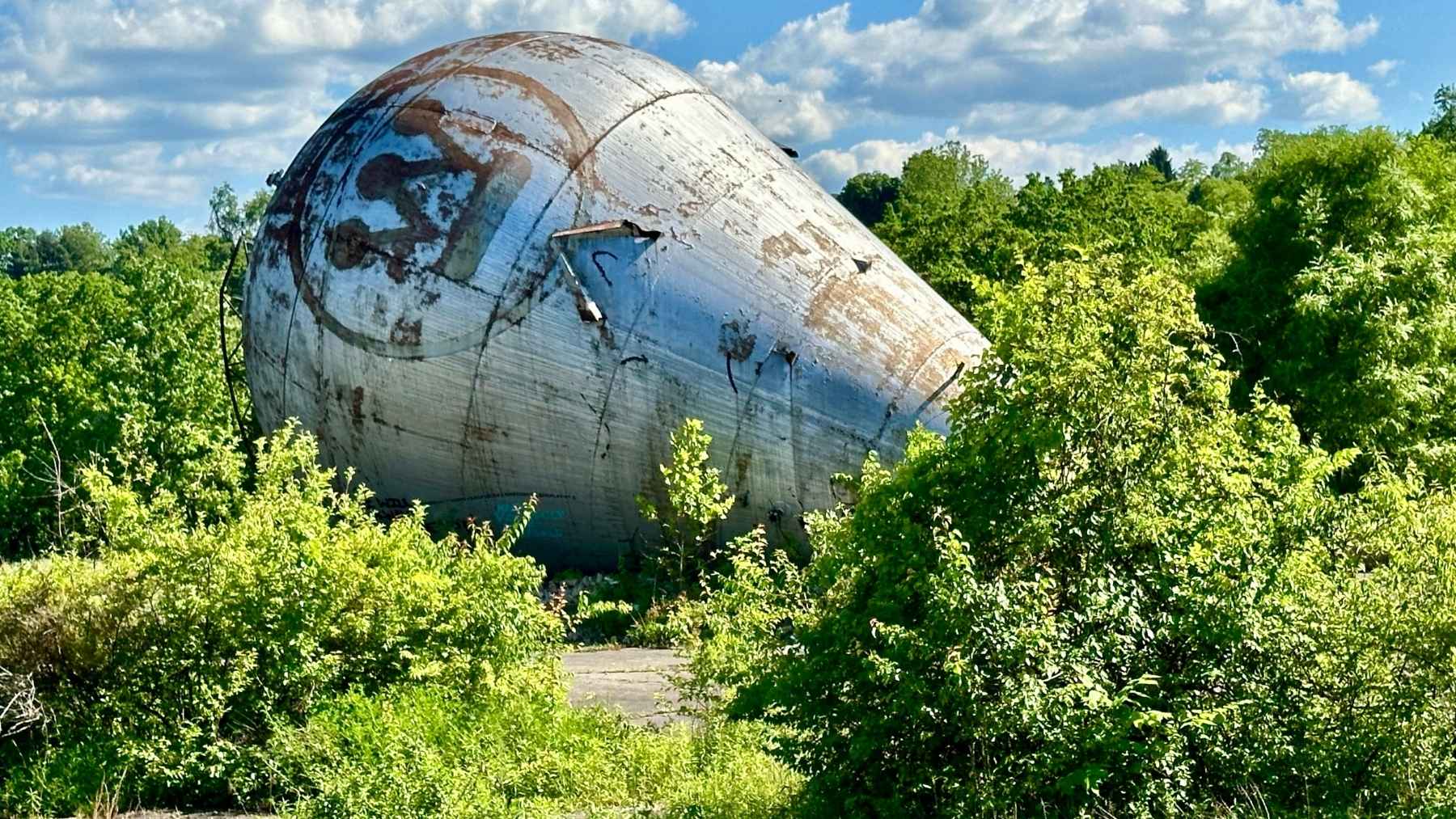
Oak Ridge did this job once. Workers finished installing column exchange equipment, COLEX for short, at the Y-12 plant in 1955, running lithium hydroxide down vertical columns against a mercury-lithium amalgam and drawing enriched lithium off the ends. The plant was separating lithium-6 for thermonuclear weapons, and it stopped once the program had banked enough of it. Operations ceased in 1962, according to the Energy Department. Those columns were bolted onto Alpha-4, a four-story building covering 500,000 square feet.
Mercury went everywhere.
Enough of it soaked into the equipment, the buildings and the ground around them that the cleanup is still running six decades later. One Energy Department project drained 8,500 feet of COLEX piping and recovered 2.3 tons of mercury still sitting in the lines.
China and Russia have covered the gap since. GAO told Congress in 2013 that American pressurized water reactors were running on enriched lithium hydroxide produced and exported by those two countries alone, and that no federal agency had taken ownership of the risk. American reactor programs have hit the same wall on other materials, including a coolant metal no US refinery has produced since 1997.
Molten Salt Solutions says it does the same job inside one system
The company’s answer is chemistry rather than lasers. Molten Salt Solutions runs a solvent exchange process that performs many separation steps inside one integrated system, instead of spreading them across thousands of separate stages the way the legacy chemical exchange method does. Out of that comes the line in the funding announcement: a platform 100 times more efficient than legacy enrichment. That figure is the company’s own, and no independent party has published a measurement of it.
Los Alamos is in the founding story. Isotope enrichment people out of Los Alamos National Laboratory started the company, and it works out of Santa Fe.
Monday’s round follows a $3 million pre-seed and more than $5 million in grants, including support through New Mexico’s Advanced Energy Award. DOE added an award in October 2025 under its Innovation Network for Fusion Energy program, for a project titled Development of Fusion-Grade Lithium Material Specifications. Molten Salt Solutions is running it with Los Alamos and the University of New Mexico, and the project exists because the fusion industry has not agreed on purity specifications for lithium yet. The announcement names no site, no nameplate capacity and no start date for the pilot line.
The customers already have dates on the calendar
Fissionaire signed first among the fission developers. That company is building thermal-spectrum molten salt breeder reactors aimed at carbon-free power, industrial heat, desalination and medical isotope production, and it agreed on June 3 to buy lithium-7 from Molten Salt Solutions for the salt. Deliveries could begin at test-scale quantities in 2028 and expand to multi-ton volumes as Fissionaire moves through larger testing. David Holcomb, the chief technology officer and co-founder, called an assured lithium-7 supply “a key element for Fissionaire’s success.” Corrosion is the other half of that problem, and one British startup has been heating molten salt in a mass spectrometer to work out which metals it eats.
Type One Energy and Gauss Fusion signed in March. Both agreements set frameworks for future supply rather than firm tonnage, with kilogram-scale test material possible as early as 2027 and several hundred tons on the table if the pilot plants get built. Frederick Bordry, chief technology officer at Gauss Fusion, said at the time that the sector has to build large-scale lithium enrichment capacity.
Type One Energy had an announcement of its own on the same Monday. Tennessee governor Bill Lee and the state environment department said they had issued the company the first fusion-specific byproduct material license in the country, covering the stellarator going into the retired Bull Run coal plant at Clinton. Tennessee wrote those rules itself after the NRC handed fusion regulation to the states, and they took effect on June 9. Type One plans to break ground on the first phase this year and reach full startup in 2034.
Type One designed Infinity Two for 800 megawatts of fusion power with 400 megawatts going onto the grid. Infinity One, the prototype that comes first, is scheduled for commissioning in 2029. Every one of those machines runs on tritium bred from lithium-6.
Two other American companies are chasing the same isotopes
Hexium is doing it with lasers. The company revived atomic vapor laser isotope separation, a Livermore technique from the 1970s, tuning lasers to ionize lithium-6 out of a vapor stream so electric fields can pull it clear of lithium-7. Lawrence Livermore National Laboratory is designing and prototyping two high-power laser systems for that line under a DOE Technology Commercialization Fund award announced in April. Hexium is building a pilot facility of its own.
Marathon Fusion is doing it with a plasma centrifuge, and said last week that it had enriched lithium-6 and hydrogen isotopes in the lab. No American company is producing either isotope at commercial scale today.
Molten Salt Solutions estimates that fusion deployment over the coming decades will need thousands of tons of enriched lithium a year. Its first contracted deliveries are counted in kilograms. Fissionaire’s first test-scale shipment is set for 2028, and Energy Department crews were still pulling mercury out of the COLEX piping at Oak Ridge in 2022.
 billfortune DRIVER2 months ago