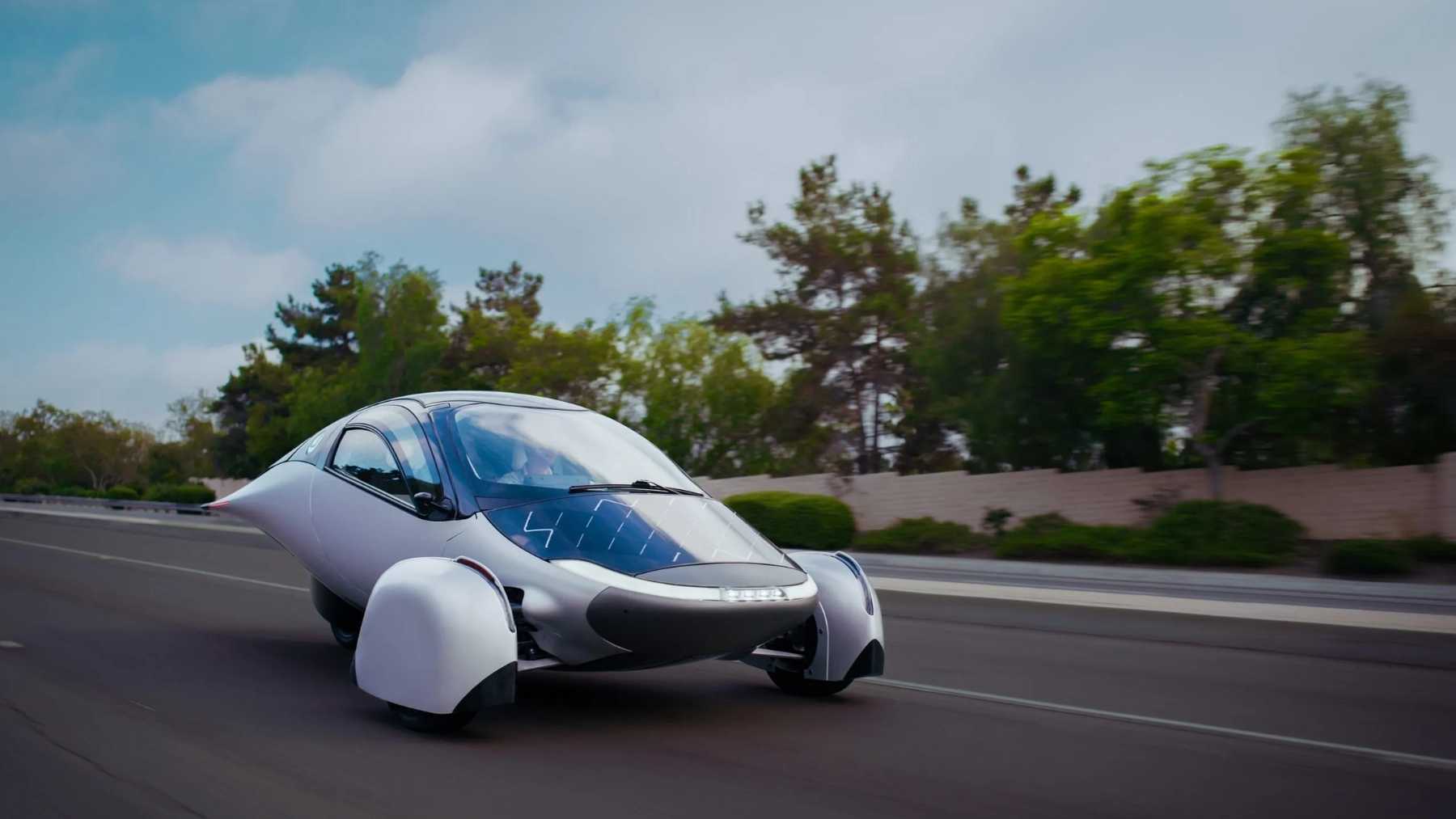

Every few years somebody rolls a solar car onto an auto show stand, quotes a daily range figure, and the number behind it never leaves a spreadsheet. Sometimes the company gets as far as building a handful. Then investors walk, and the car becomes a Wikipedia entry. So when Aptera says its three-wheeler harvests around 40 miles a day out of sunlight, you have every reason to wait for the receipts.
A German lab measured this one.
TÜV Rheinland, founded in Germany in 1872 and certifying solar equipment since 1982, sent its own calibrated instruments to Aptera’s Carlsbad, California facility in July. Across three consecutive days, the car pushed between 4,233.2 and 4,754.2 watt-hours into its battery pack. Aptera published the full test report on August 27, instrumentation and raw data included.
Three days in July, three different setups
Dr. Giorgio Bardizza ran the campaign for TÜV Rheinland Italia. His team wired data loggers to each of the car’s seven photovoltaic strings and to the high-voltage line feeding the pack, then recorded current, voltage and power from sunrise to sunset on July 6, 7 and 8. A flat panel bolted to a warehouse roof holds one angle all day. Aptera’s body holds none of them, because the shell curves in every direction and each cell sees a different slice of sky as the sun moves.
Each day ran differently on purpose.
On July 6 the car sat closed and untouched in a fixed spot, and the loggers read 4,233.2 Wh. On July 7 crews turned it once at solar noon and then left it alone, and the meter read 4,402.6 Wh. On July 8 they raised the rear hatch to tilt more cells toward the sky and turned the car during the day, and the line carried 4,754.2 Wh. All three days cleared the 4.0 kWh the company has been quoting for years.
Bardizza’s report puts ±1.3% expanded uncertainty at 95% confidence on the DC energy measurement across the 12-hour integration window. That uncertainty covers the electricity, and nothing downstream of it.
Aptera had already announced a 4.42 kWh day back on June 25, measured by its own people on its own car. Nobody outside the building could check the method. The June release converted the result into 44 miles using the same efficiency target, and it promised third-party work later. Three manufacturers recently signed up for 13 gigawatts of perovskite-coated solar glass on six weeks of outdoor data. What arrived on August 27 is the later part: one identified sample, three documented configurations, calibrated hardware, a stated uncertainty, and a public PDF.
The strongest day was the weakest day for sun
July 8 delivered 5,446 watt-hours per square meter of global horizontal solar dose, against 5,779 Wh/m² on July 7 and 5,709 Wh/m² on July 6. The car made its biggest number on the dimmest of the three days. Raising the hatch and turning the vehicle bought back more energy than the missing sunlight took away.
Steve Fambro, Aptera’s co-founder and co-CEO, called the parked day “the most exciting result.” A driver who has to shuffle a car around a lot at noon to harvest electricity will stop doing it by the second week.
Electrek put a typical US commuter at around 30 miles a day, so 42 miles landing in the pack while the car sits in an office lot covers the trip and leaves change. Park it in a garage, park it under a tree, park it in Seattle in February, and those watt-hours shrink. TÜV ran clear July skies in coastal Southern California, and the August 27 release says the results reflect exactly those conditions.
Aptera calculated the miles, TÜV did not measure them
Aptera converted those watt-hours into roughly 42, 44 and 47 miles using its target efficiency of 100 watt-hours per mile. TÜV measured energy, not distance.
Aptera’s own product guidance still describes 100 Wh/mile as an estimate under a specified EPA driving cycle rather than a completed measurement on a production car, and the August 27 release states that production vehicles may not reach the target. At The Charger worked through the report and drew the same line between the measured watt-hours and the calculated miles.
TÜV Rheinland Italia filed the work as Test Report No. IT26DDPK 001, an on-site witnessing service on one sample the manufacturer selected: an APTERA ATLAS 1 validation vehicle. The report does not certify the car, a component, or compliance with any regulatory standard, and it does not claim the sample represents production batches. Anybody can download it and check the calibration dates on the Dewesoft analyzers.
Lightyear and Sono both quit building solar cars
Solar cars have a graveyard. Atlas Technologies B.V., the subsidiary that built the Lightyear 0, filed for bankruptcy in January 2023, after a handful of the €250,000 cars (roughly $270,000) came off the Valmet Automotive line in Finland. Sono Motors terminated the Sion program on February 24, 2023, with more than 45,000 reservations and pre-orders on its books, and co-founder Laurin Hahn announced the pivot to selling solar tech to other manufacturers.
Both companies are still trading as suppliers. Lightyear announced a collaboration with Nissan on January 26, 2026, fitting 3.8 square meters (about 41 square feet) of custom panels across a demonstration vehicle’s hood, roof and tailgate. Neither one sells a solar car.
Aptera builds its whole case on consumption. The Lightyear 0 wore 54 square feet (5 square meters) of cells for a claimed 43 miles of solar a day, and the Aptera wears about 32 square feet (just over 3 square meters) and just metered 42 miles’ worth untouched. Aptera claims a drag coefficient of 0.13 for a two-seat body on three wheels. Every kilowatt-hour a heavier car spends on air and mass is a kilowatt-hour its roof has to replace, and no roof on a sedan ever kept up.
A Bavarian factory recently glued 3.5-pound sheets of solar film onto concrete towers with a hand roller, and a Finnish builder crossed from Finland to Spain on a home-built yacht running on household solar panels. Light hardware wins with sunlight. Heavy hardware does not.
Aptera still has not delivered a car to anyone
The EPA issued a Certificate of Conformity for the 2026 Aptera Launch Edition on June 18, and the company announced it on July 7. Federal Motor Vehicle Safety Standards compliance remains the prerequisite before customer deliveries. Aptera completed the first vehicle off its 14-station validation assembly line in March and had five validation cars built by early July.
On August 4, Aptera issued purchase orders for the bodies and chassis of its first 40 production vehicles. On August 20 it announced a program with Shanghai Launch Automotive Technology worth up to about $44 million (RMB 300 million), covering assembly fixtures, tooling, vehicle testing and pilot production, with two-thirds payable in cash and the balance in warrants of up to roughly $15 million. First bodies and chassis are due to start arriving in October, and assembly of those 40 cars is targeted for the fourth quarter.
Aptera reported $10.1 million in cash and cash equivalents on June 30 against a second-quarter GAAP net loss of $10.9 million, and roughly 50,000 people are holding reservations. TÜV Rheinland’s report is the kind of third-party evidence the Sion and the Lightyear 0 never had. Evidence does not build 40 cars.
Three clear days in Carlsbad do not make an annual yield study, and one validation vehicle is not a fleet. TÜV Rheinland has still put its name on something narrower and harder than this industry usually offers. Fred Lambert at Electrek picked out the same day: on July 6, 2026, with nobody touching it, one Aptera pushed 4,233.2 watt-hours down its own high-voltage line.















Imagine that the 5 of us figured out that we drove 2, 7, 8, 15, and 1,000 miles per day. The average, the mean, is 206 miles. Is that typical. No, not even at a glance. The median number, the center number, the most representative of daily driving in that sample is 8 miles per day.