
Anyone who has ever pushed a long drill bit through a fence post knows the problem. The deeper the hole gets, the more the bit wants to wander off line. Under the Thames, where a 464-metric-ton machine named Caroline is boring a 2.2-kilometer cable tunnel between Essex and Kent, the fix for that problem is blunt: when the hole needs to bend, she cuts it bigger than herself.
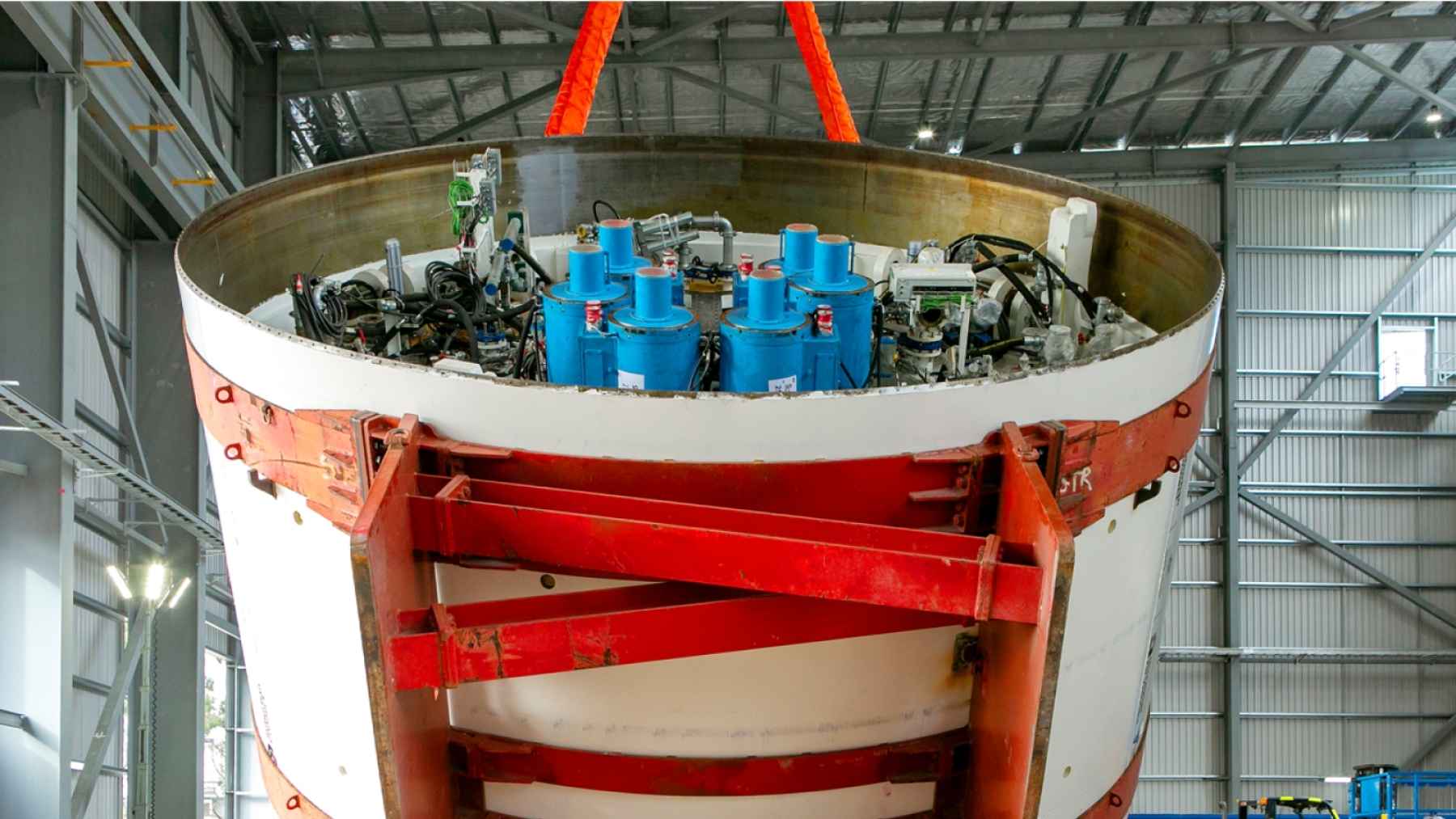
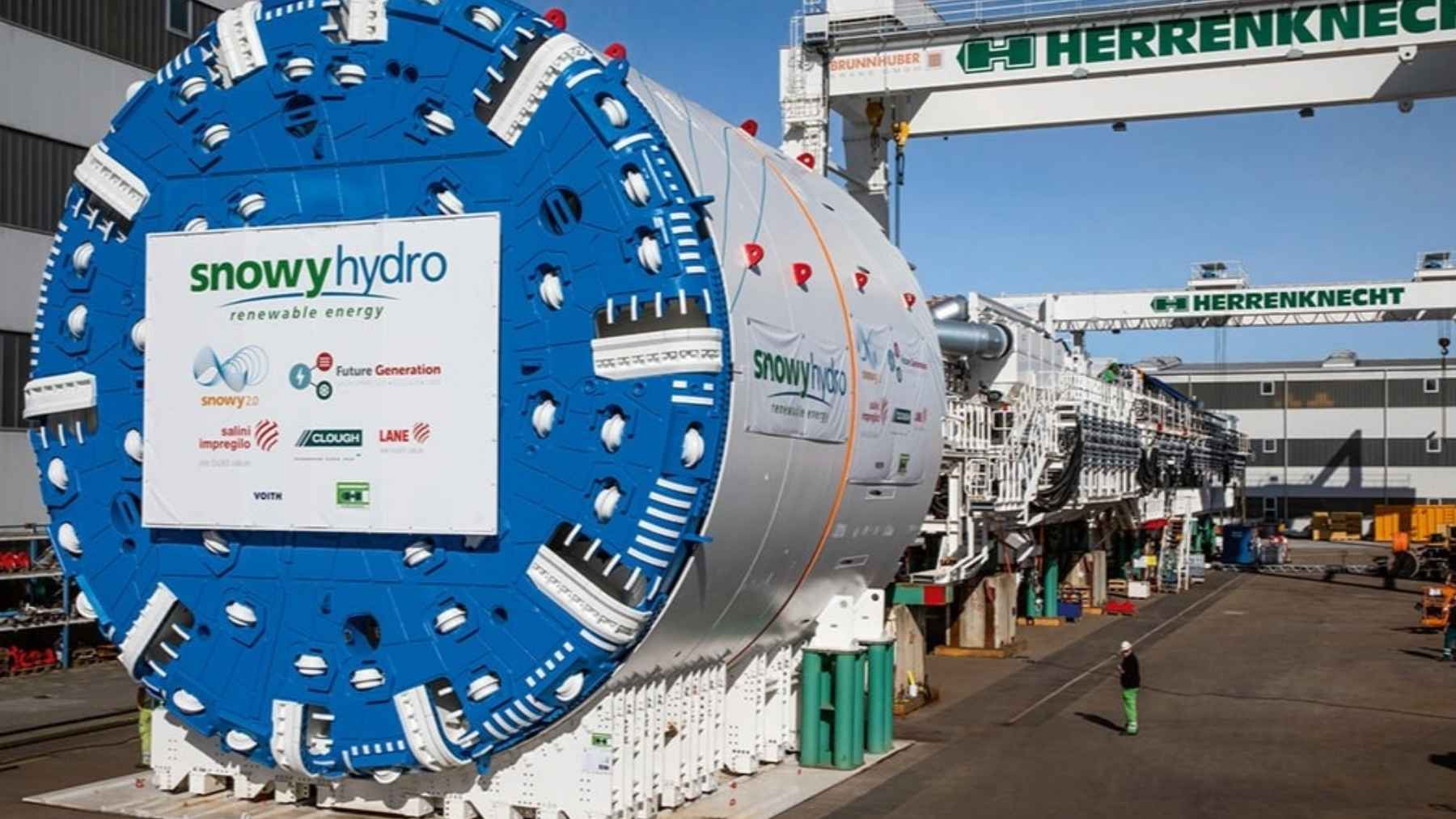
Caroline is a Mixshield, built by Herrenknecht in Schwanau, Germany, for National Grid’s Grain to Tilbury project. Her cutting wheel measures 4,730 millimeters across, about 15.5 feet. The full machine, shield plus the train of gantries behind it, runs 108 meters, roughly 354 feet, and weighs 464 metric tons, around 511 US tons.
The Ferrovial Bemo joint venture is driving her from Tilbury on the Essex bank toward Gravesend in Kent, carving the hole that will carry a new 400 kV circuit under the river. The shield doing the actual cutting accounts for about 272 of those tons. Everything behind it exists to feed her, steer her and haul the ground back out.
The oversized hole is her steering system
A tunnel boring machine is a rigid cylinder that lines the hole behind itself with concrete rings as it advances. That leaves very little slack for turning. Caroline’s alignment bends through curves with a radius of 350 meters, about 1,150 feet, which is tight for a machine longer than a football field.
Her answer is a hydraulic overcutter. Rams push the cutting tools outward so the excavated hole comes out slightly wider than her own shield, and that extra clearance is what lets her lean into a curve and correct her line mid-drive. It sounds like a footnote on the spec sheet. It is the difference between holding the design alignment and binding in her own cut.
The cutterhead itself runs on 720 kW of drive power, about 965 horsepower, geared down until it delivers 2,369 kNm of torque, roughly 1.75 million lb-ft, at cutting speed. Torque, not speed, is what breaks rock.
She needs the steering margin more than most machines do. The drive sits 41 meters below the Thames, about 135 feet, near the point where the river opens toward the North Sea, and the tide overhead changes the water pressure on a schedule. Herrenknecht built her to hold out 4.5 bar, roughly 65 psi, with a multiple sealing system wrapped around everything that rotates.
Pressure management is the entire idea behind a Mixshield. The front chamber holds the ground up with pressurized slurry while the crew behind the bulkhead works at normal atmosphere. Anyone who has to reach the face itself, mostly to swap worn cutting tools, passes through a personnel airlock and takes the pressure change in stages, the same basic protocol a diver follows.
Chalk sounds easy until the flint shows up
Geology is the second reason this machine got a custom build. The bore runs through chalk about 15 meters below the riverbed, per New Civil Engineer, and chalk is soft as rock goes. The catch is what the chalk is carrying.
Flint nodules sit scattered through it, and the project engineering puts their compressive strength at up to 1,000 megapascals in localized zones, around 145,000 psi. That is far harder than the concrete rings Caroline bolts into place behind herself. The cutterhead can go from soft white rock to some of the hardest natural material in Britain within a single rotation.
Mixed ground like that is exactly the loading that makes a machine want to twist and climb, so Caroline carries anti-roll fins and a mini gripper that brace her against the tunnel so the cutting wheel can be retracted when needed. She also probes ahead of herself. A drilling rig samples the ground before she reaches it, and a telescopic camera can inspect the tunnel face without anyone climbing through the airlock at all.
She started the drive with only her front 12 meters
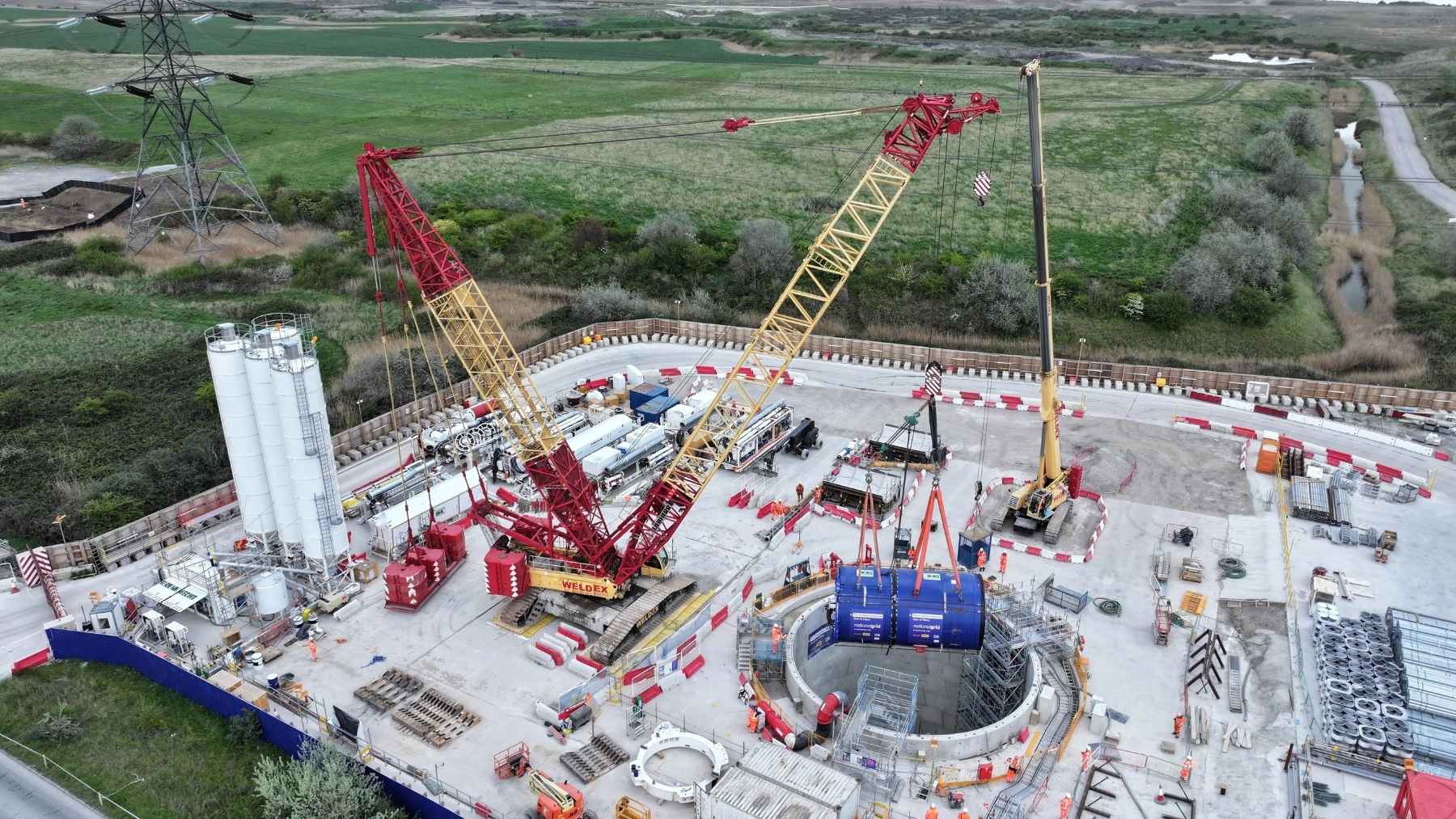
Caroline’s launch was odd even by tunneling standards. The shaft at Tilbury is 15 meters across and the machine is 108 meters long, which is not a fit anyone can negotiate. So the team ran what New Civil Engineer described as an umbilical launch, sending a 12-meter front section down to start the initial excavation while the rest of her train waited on the surface.
The ceremonial send-off came on March 12, with UK energy minister Michael Shanks at the shaft and a name fresh off a local schools competition. Caroline honors Caroline Haslett, the pioneering electrical engineer who helped found the Women’s Engineering Society. By early May, according to Herrenknecht, the drive proper was underway.
National Grid’s project page currently lists her as on the move and past her first stage of excavation, with launch, alignment and systems performing as intended. Tunneling is expected to continue through 2026.
The shafts themselves came from an even bigger Herrenknecht machine. A vertical shaft sinking machine named Verena, 15.9 meters in diameter and the largest of her type in Europe, dug the 45-meter launch shaft at Tilbury in about four weeks late last year, sinking up to 2.7 meters a day with nobody working inside the hole. She was then dismantled, moved across the river and dug the 48-meter reception shaft at Gravesend, wrapping up in early May. Construction Enquirer reported the name and puts the whole Grain to Tilbury upgrade at £230 million, about $300 million.
Her big sister finished under the Elbe first
If the setup sounds familiar, it should. Caroline belongs to the same Mixshield class as Elsa, the 190-meter machine that finished a 3.2-mile cable tunnel under the Elbe for Germany’s SuedLink transmission line. She comes from the same builder and works on the same slurry-shield logic, and the job description matches too: put a high-voltage line under a busy shipping channel without the ships above noticing. Caroline is the compact edition, sized for a single 400 kV crossing rather than a national corridor.
Britain is keeping the family busy. Herrenknecht borers dug the Elizabeth line and Thames Tideway, HS2’s final two machines are grinding toward Euston right now, and the firm is building the largest borer ever put underground in Europe for the Lower Thames Crossing, launching from the same stretch of Essex riverbank in 2028. London is even sketching utility bores that will carry nothing more dramatic than hot water from a garbage incinerator.
The reason for all the digging is the same on both rivers. The existing Thames Cable Tunnel between Tilbury and Gravesend opened in 1969 and has reached the end of its working life. National Grid forecasts electricity demand to double by 2050, and Grain to Tilbury is one strand of its Great Grid Upgrade, the rebuild meant to move more power, much of it offshore wind, from where it gets generated to where it gets used. Shanks said the point is to “get us off the rollercoaster of fossil fuel markets,” per Ground Engineering. Europe is scattered with versions of the same bet, from the SuedLink corridor Elsa dug for to the six tidal turbines France has been trying to bolt to a seabed off Normandy.
There is a neat loop in the supply chain, too. The concrete segments Caroline installs are cast by Pacadar on the Isle of Grain, the same Kent yard that produced rings for HS2. The Grain to Tilbury tunnel is, quite literally, being lined by Grain.
Her finish line is already built. The Gravesend shaft went in with one section of wall left deliberately unreinforced, and when Caroline reaches it, ahead of cable installation and full completion scheduled for 2029, her last job is to punch straight through.