
Drone boats have spent three years earning a reputation as the cheapest way to put a hole in a warship. Ukraine made that case in the Black Sea. The US Navy made it again off Kauai in July, when a 16-foot robot boat drove itself into a retired amphibious assault ship and opened a fresh hole near the waterline.
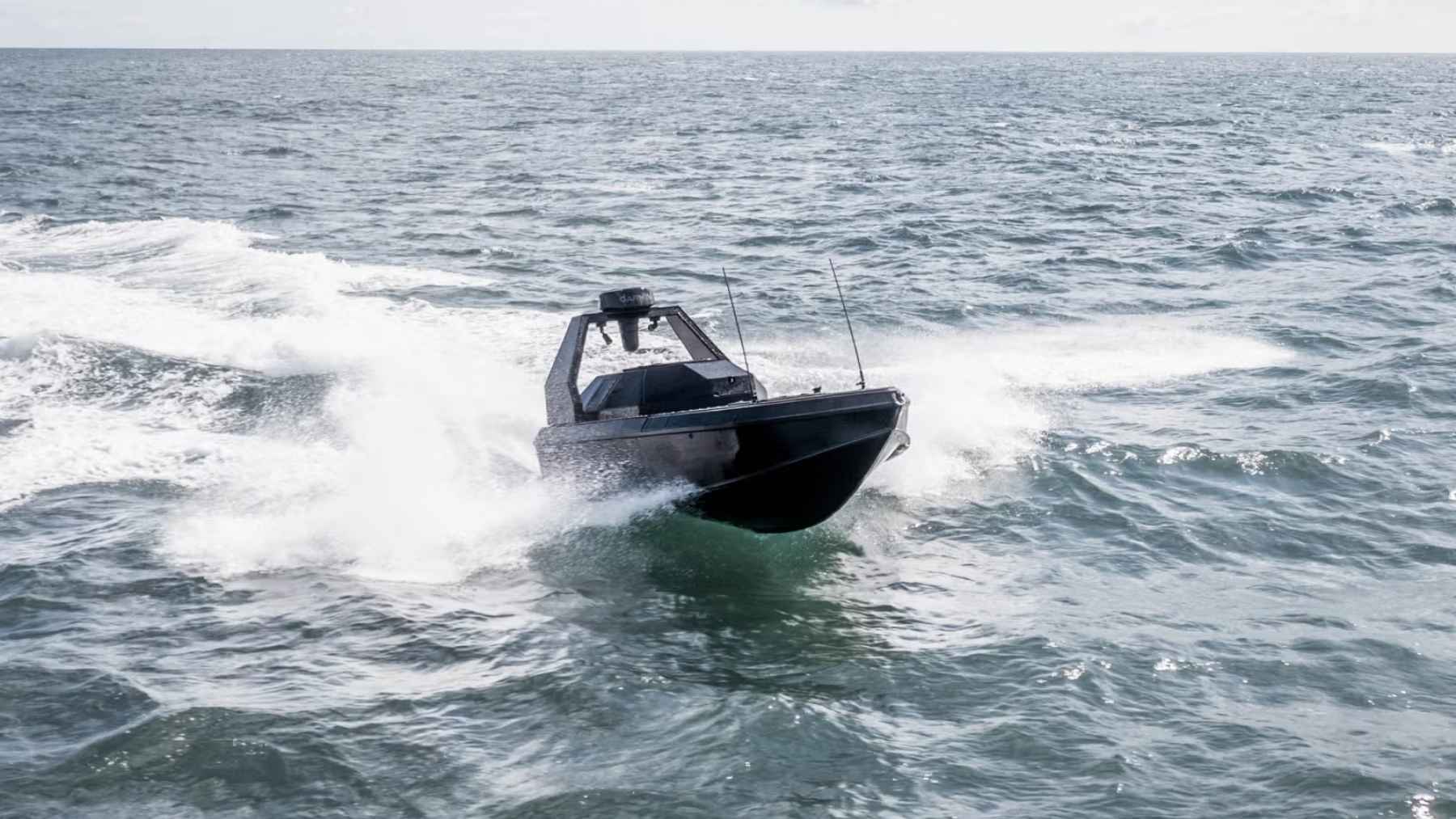
Germany just christened one with a very different assignment. The Bundeswehr’s new 20-foot unmanned boat carries cameras, radar and a mast full of sensors, and it went into the water with nothing on board to shoot. Its entire value comes from standing in a second place at the same time.
A radio direction finder hands you a line, not a dot. Point an antenna at a transmitter and you learn which way the signal came from, and nothing at all about how far away it started. A warship sailing alone has one antenna and one position, so it can draw exactly one of those lines. Cross that line with a second one taken from another known position, and the two intersect on a coordinate. Sailors have been calling that a cross bearing since radios went to sea.
The German boat is named Seetaube, and that second position is the whole design brief.
One ship can only ever take one bearing
The Bundeswehr laid the logic out plainly in its own account of the boat, published on August 19. To pin down a signal source you need bearings from two known coordinates. The Seetaube supplies the second one and can be moved wherever the geometry works best, which is something a frigate cannot do without a second frigate.
Sven Weizenegger, who heads the Cyber Innovation Hub der Bundeswehr, put the appeal in budget terms. He told German trade outlet Produktion that the system “expands the fleet without tying up another ship,” speaking in German.
The sensors sit on stabilized mounts so they can hold a bearing while the hull is rolling. Anyone who has tried to keep a spotting scope on a target from a small boat in chop understands why that matters more than it sounds.
Autonomy here has a ceiling, and the Bundeswehr is specific about where it sits. Operators load a pre-planned mission, the boat runs it on its own, and it follows the international rules of the road at sea within defined limits. A human watches the whole thing and can take the controls at any point. The Bundeswehr uses the phrase man in the loop and means it literally.
Self-protection is acoustic rather than kinetic. Warning systems and automated maneuvers are there to stop a curious third party from getting close, which is a real concern for a boat that will spend long stretches sitting by itself in the Baltic. Danish operators found that out the hard way in June, when a Russian corvette ran past an unmanned Danish surveillance boat with its transponder off and put a quadcopter over it for eight minutes.
The hull is 20 feet of plastic
Seetaube is built on the Vanta-6, one of two unmanned surface vessels the German defense startup Stark introduced at NATO’s REPMUS and Dynamic Messenger exercises off Tróia, Portugal, in September 2025. The 4 and the 6 in the model names are the hull lengths in meters. Nothing more clever than that.
Both hulls are molded from HDPE, the same high-density polyethylene that kayaks and chemical tanks are made from. Baird Maritime’s review of the two boats credits the material with shrugging off rough water and minor impact damage, which is a polite way of saying you can bounce one off a quay wall and go back to work. Steel would rust and aluminum would dent. Plastic mostly deforms and springs back.
Stark’s published specification puts the Vanta-6 at 4,630 pounds (2,100 kg) with up to 1,100 pounds (500 kg) of payload on top. Baird lists a Garmin radar covering the full 360 degrees, a stabilized electro-optical and infrared camera for night and bad weather, and GNSS-resilient antennas for the days when somebody is jamming.
The Bundeswehr has not published which sensors went into its boat. It says cameras, radar and sensors, and stops there.
The top speed and the range describe two different trips
The manufacturer rates the Vanta at more than 45 knots, or 52 miles an hour, and Baird Maritime’s specification table for both boats lists a maximum of 40 knots, 46 miles an hour. The same review’s body text says the craft exceed 40 knots without naming a ceiling. Neither figure has been independently timed in public.
Range gets a similar footnote, and this one is on Stark’s own product page. The company quotes roughly 900 nautical miles at 5 knots. Convert that and the boat covers 1,047 miles (1,685 km) at 5.8 miles an hour, which is a brisk walk. The 52 mph number and the 1,047 mile number do not belong to the same trip.
Sea state is the third place the paperwork wobbles. Stark’s spec table says the Vanta operates in Sea State 4 and survives Sea State 6, while Baird’s review credits the Vanta-6 with operating in Sea State 5 and puts the smaller Vanta-4 at Sea State 4. Under the World Meteorological Organization scale, Sea State 4 runs 4 to 8 ft (1.25 to 2.5 m) of wave height, Sea State 5 runs 8 to 13 ft (2.5 to 4 m), and Sea State 6 runs 13 to 20 ft (4 to 6 m).
That same product page argues with itself on payload too. The marketing copy near the top claims up to 1,650 lb (750 kg), and the specification table further down says up to 1,100 lb (500 kg). Every German outlet covering the Seetaube handover used 500 kg. That is the number I would put money on.
The name is an acronym and the bird is American
Kiel got the champagne. The christening happened at the port in early August, according to the Bundeswehr, and marineforum reported the ceremony including the bottle broken across the bow. The godmother was a chief petty officer (Hauptbootsmann) identified only by her first name, Cara, from Electronic Warfare Battalion 912, and she wished the boat and its operators a hand’s breadth of water under the keel. Naval superstition apparently applies to boats with nobody aboard.
Seetaube translates as sea dove. The Bundeswehr says the name comes from a black seabird that lives along the North American west coast and the Siberian east coast, and that the choice was meant to signal an unarmed system committed to peace. Then it admits the second reason. TAUBE also spells out Taktische Aufklärungs- und Beobachtungs-Einheit, or tactical reconnaissance and observation unit.
Somebody got paid to make the bird and the acronym land on the same word, and they earned it.
The same hull has already fired a loitering munition
Stark showed the Cascade being launched off a Vanta in June, two months before the Seetaube got its name. Cascade is a tube-launched loitering munition offered in 25, 37 and 62 mile configurations (40, 60 and 100 km), carries up to 10 pounds (4.5 kg), flies for up to an hour and can be readied to fire in under a minute. It goes off a boat from a canister or a containerized rack.
Armed unmanned boats are not a German novelty at this point. A 38-foot American catamaran put six loitering munitions off its own deck in the Arabian Gulf while the operator sat in Bahrain. Another German supplier now sells a box that throws a quadcopter off a crewless boat at 15 knots and catches it coming back.
The Bundeswehr took the unarmed configuration on purpose. Its own release describes an unarmed system, the naming rationale leans on that word, and no German outlet covering the handover has reported a weapons fit on this hull. The platform supports effectors in other configurations, and the customer here declined them.
Nothing about that is permanent. The Vanta is built as a modular boat, and payloads swap in the field.
The Seetaube is not in service. The Bundeswehr published its account on August 19 and set out the sequence that comes first: crew training, then real sea operations, then a full reconnaissance mission, and only after all three does the boat get formally commissioned. The Bundeswehr puts that at months. Until it finishes, Germany owns one 20-foot plastic boat with a name, a godmother and nothing on board to shoot.