
Fusion already had its miracle moment, at least on paper. In December 2022, the National Ignition Facility in California pointed 192 lasers at a peppercorn of frozen hydrogen and pulled 3.15 megajoules out of a reaction those lasers had fed with 2.05, and “more energy out than in” led every newscast in the country. The building told a different story.
Firing the laser system took roughly 300 megajoules of electricity by TechCrunch’s reporting, and less than 1% of the energy spent on those lasers ever reached the fuel, so the facility as a whole ended its most famous night deep in the red.
No lab anywhere has built a fusion machine that comes out ahead once you count the whole building. On August 25, a startup called Pacific Fusion broke ground on a $1 billion campus at Mesa del Sol in Albuquerque, New Mexico, to build the first one that does.
The company is giving itself until 2030.
150 box trucks pointed at a pea
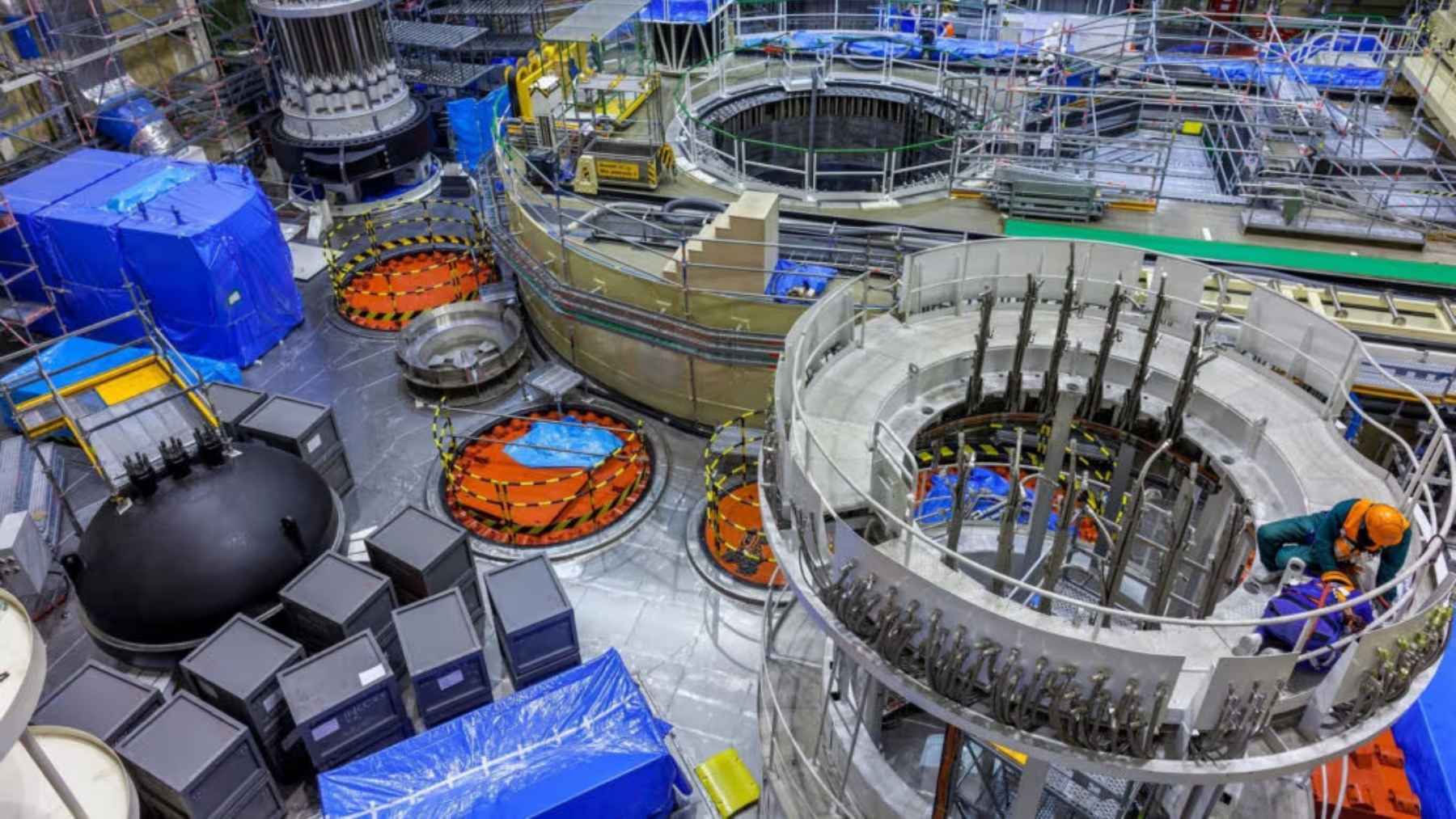
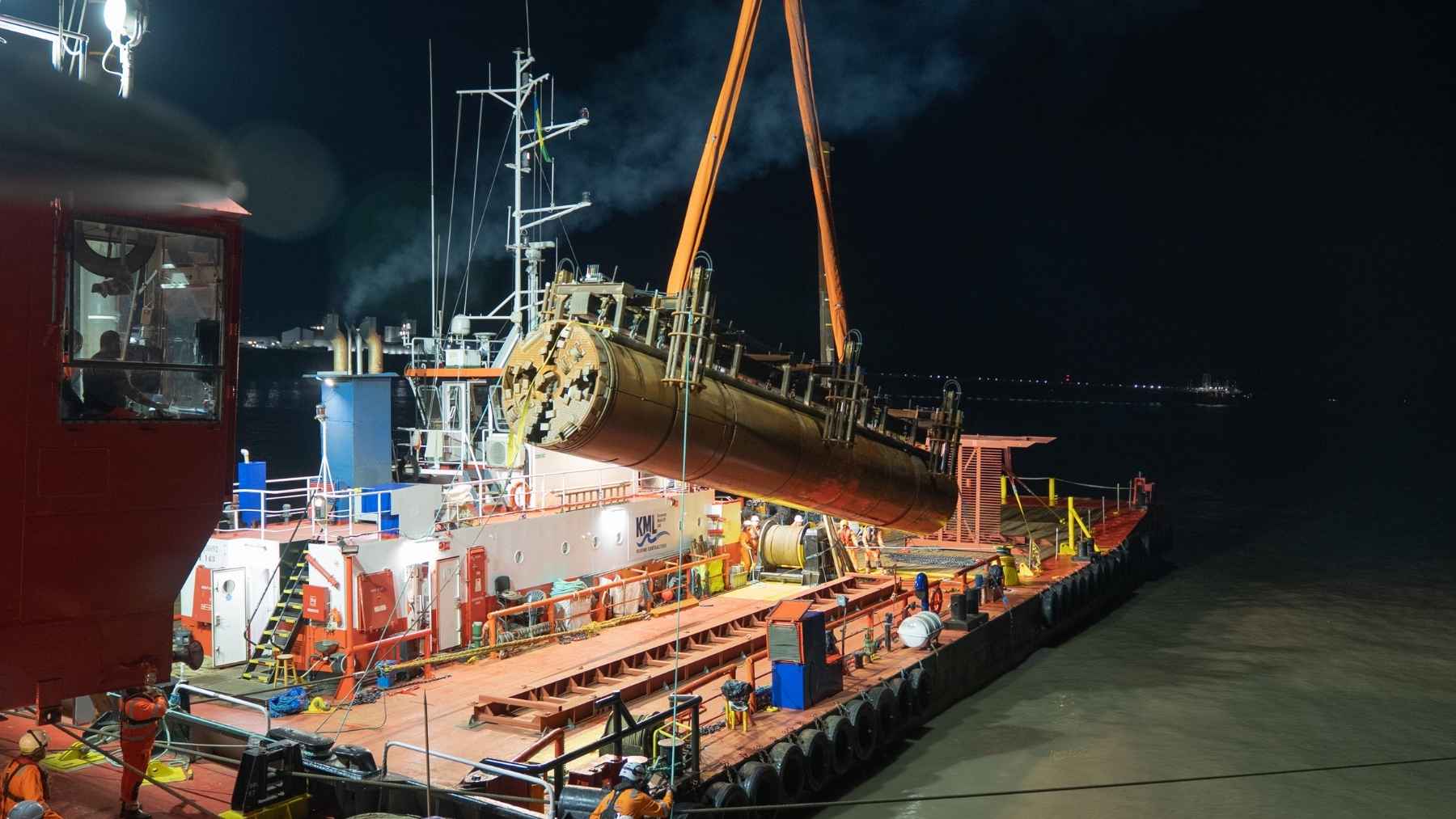
Pacific Fusion’s machine skips the two things you probably associate with fusion. It uses no giant lasers, and it uses no superconducting magnets of the kind wrapped around tokamaks like ITER, the cathedral-scale project in France that just lowered a 1,100-ton sector into its assembly pit. The Albuquerque design runs on capacitors instead. Lots of them.
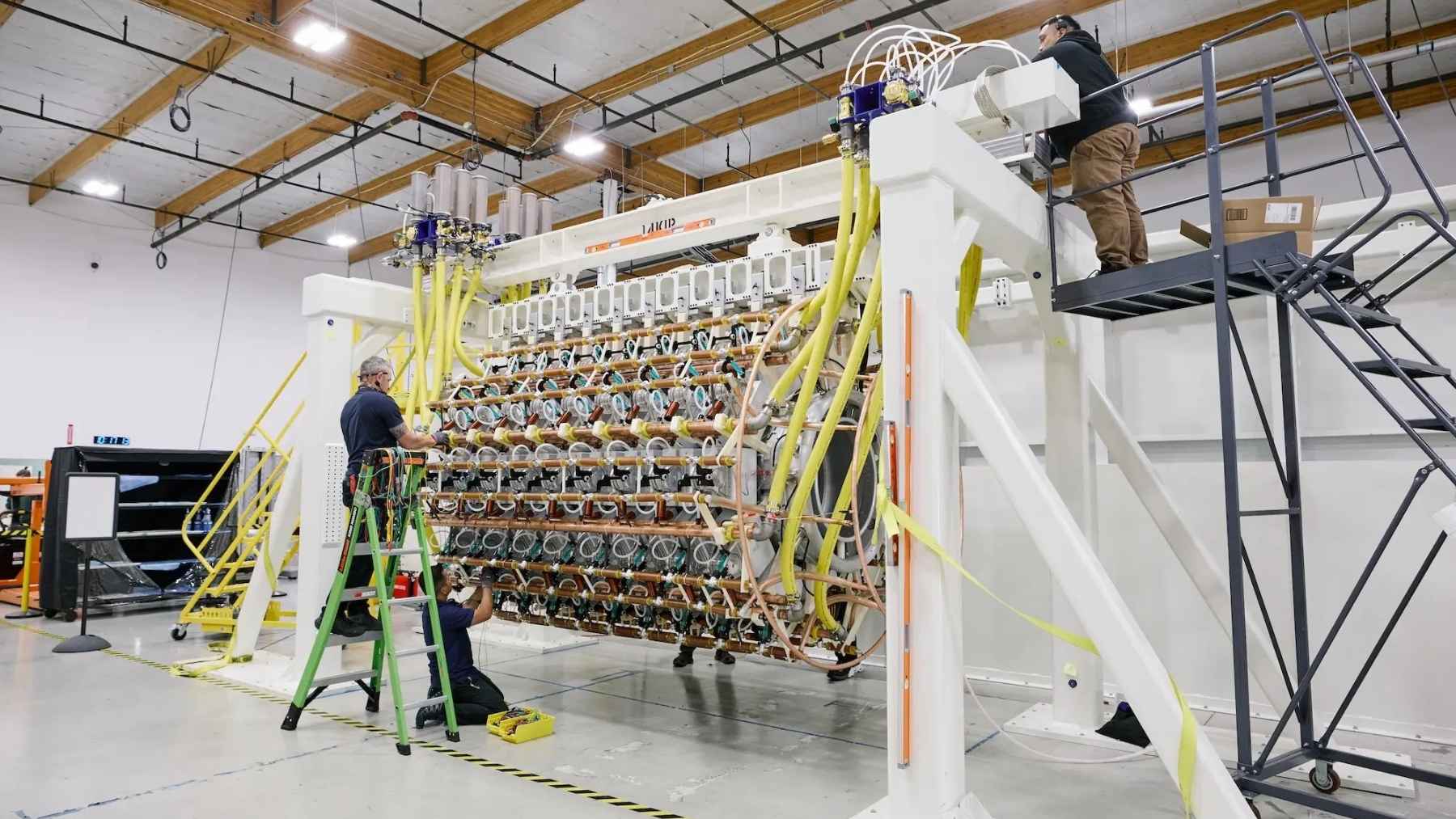
Picture more than 150 modules, each about the size of a box truck, arranged in a ring around one central chamber and all wired to fire at the same instant. Nature toured the assembly line in August and described cylindrical banks of capacitors built to discharge in parallel, combining into a single electrical pulse thousands of times stronger than a lightning bolt, aimed at a fuel capsule the size of a pea.
Current at that scale generates a magnetic field violent enough to do the lasers’ job by brute force. The field crushes the capsule inward, in under 100 billionths of a second, until hydrogen nuclei fuse into helium and dump their energy out.
Engineers call the approach pulsed magnetic inertial fusion, and the modules themselves, impedance-matched Marx generators, are built from ordinary industrial capacitors and switches rather than exotic one-off hardware. A tokamak holds a plasma steady for minutes like a furnace. This thing goes off like a piston engine, one bang at a time.
80 megajoules in, 100 out
Pacific Fusion’s target arithmetic fits in one line: each pulse starts with about 80 megajoules of electricity stored in the capacitors, and each shot is designed to return roughly 100 megajoules of fusion energy. Keith LeChien, the company’s co-founder and chief technology officer, gave Nature those figures, and the gap between them is the whole product. Physicists call it net facility gain, more energy out than the entire machine had stored before firing.
That bar has never been cleared.
NIF’s ignition shots cleared a much lower one, counting only the laser energy that touched the target and ignoring the building around it.
Efficiency explains the difference. Less than 1% of the energy NIF spends firing its lasers reaches the capsule, while Pacific Fusion’s design sends current straight at the target and should land about 12% of the initial charge on it, according to LeChien. Michael Campbell, a fusion engineer at the University of California, San Diego, put the stakes plainly to Nature: “you have to produce more energy from every shot than you take” from the grid before a power plant is worth discussing.
The 100-megajoule figure carries a second meaning, and you can measure both. A 100-megajoule shot would run more than eleven times larger than the 8.6 megajoules NIF pulled from its record experiment in April 2025, and outputs that size create the temperatures and pressures found inside detonating nuclear weapons. Converted for your utility bill, 100 megajoules is about 28 kilowatt-hours, roughly one day of electricity for an average American home on EIA figures. Pacific Fusion is selling the ratio, not the wattage.
LeChien attached the honest caveat himself. Even a machine performing exactly as designed would deliver about one-fifth of the per-shot gain a commercial power plant needs, he told Nature, and turning single shots into round-the-clock operation brings engineering problems the demonstration does not touch. So the Albuquerque unit will prove or disprove the arithmetic, and somebody still has to build the piston engine that repeats it all day.
Why Albuquerque, of all places
Sandia National Laboratories sits down the road. Sandia runs the Z machine, the most powerful pulsed-power facility on the planet, and Pacific Fusion has already borrowed it, running a February 2026 test series on a simplified target made of nothing fancier than aluminum and plastic. Lawrence Livermore, out in California, has been firing a four-stage prototype of the company’s Marx generator called Sirius, which passed 3,000 continuous shots in July under a cooperative research agreement.
Los Alamos contributed decades of the underlying science too. Pacific Fusion was founded in 2023, and its pitch has always been assembling those government-lab breakthroughs into one privately funded machine. New Mexico happens to be where most of the breakthroughs live.
The weapons connection is the part written in plain sight. The Department of Energy’s National Nuclear Security Administration signed a memorandum of understanding with the company at the groundbreaking, covering high-yield fusion, high-energy-density science, pulsed-power technology, advanced materials and computer modeling.
Shots above 100 megajoules recreate conditions inside exploding warheads, which lets scientists check the aging U.S. stockpile without detonating anything, a capability the government first flagged as missing back in 1990, two years before America stopped underground explosive testing. Pacific Fusion calls its build the only high-yield fusion facility under construction in the United States.
China hangs over the whole announcement. LeChien said the groundbreaking proves America can still “build the hard things” and build them faster than any other country, including China, while NNSA Administrator Brandon Williams warned that Beijing is moving quickly in the same field. He has a point about the pace: China tested a 582-ton superconducting magnet for its fusion program in June, the largest ever built.
New Mexico wants the whole industry, not just the machine
The campus itself covers 225,000 square feet at Mesa del Sol and carries about 200 permanent jobs plus hundreds more in construction, per Senator Ben Ray Luján’s office. About 20 miles south in Los Lunas, Pacific Fusion is expanding a plant to mass-produce the pulser modules, and its next declared milestone is a full-scale production unit.
Money has followed the milestones so far: the company has raised more than $1 billion since 2023, with portions tied to hitting technical marks, inside a private fusion sector Nature counts at over $14 billion raised in five years. Commonwealth Fusion Systems belongs to that same wave, with a compact tokamak outside Boston that is 75% built and chasing net energy from the plasma in 2027, a real milestone but an easier bar than making the whole building come out ahead.
Utility interest is on the record too. Public Service Company of New Mexico, the state’s largest electricity provider, said at the groundbreaking it wants to explore fusion for its future generation mix, and Governor Michelle Lujan Grisham said she hopes New Mexico becomes the first state to put fusion power on a grid. Hopes are free. Megajoules are not.
Hardware is the honest scoreboard here, and Nature’s reporters read it off a warehouse floor: when the magazine visited Los Lunas in August 2026, workers and a few industrial robots had finished two of the more than 150 modules the machine needs, and Pacific Fusion has given all of them, wired in a ring and firing as one, a 2030 deadline.
 @garyhalmbacher DRIVER2 months ago