
Concrete is great at being squeezed and pretty bad at being pulled apart. Wine barrels sorted that out about 2,000 years ago with wooden staves and steel hoops, and the people who build municipal water tanks sorted it out again in the 1930s. Wrap tensioned steel wire around a round concrete wall and the wall sits permanently in compression. Fill it up, and the liquid inside pushes out against a wall that is already being squeezed in. The concrete never has to hold anything in tension, so it does not crack.
The Department of Energy just cleared one of those for something a lot less friendly than your drinking water.
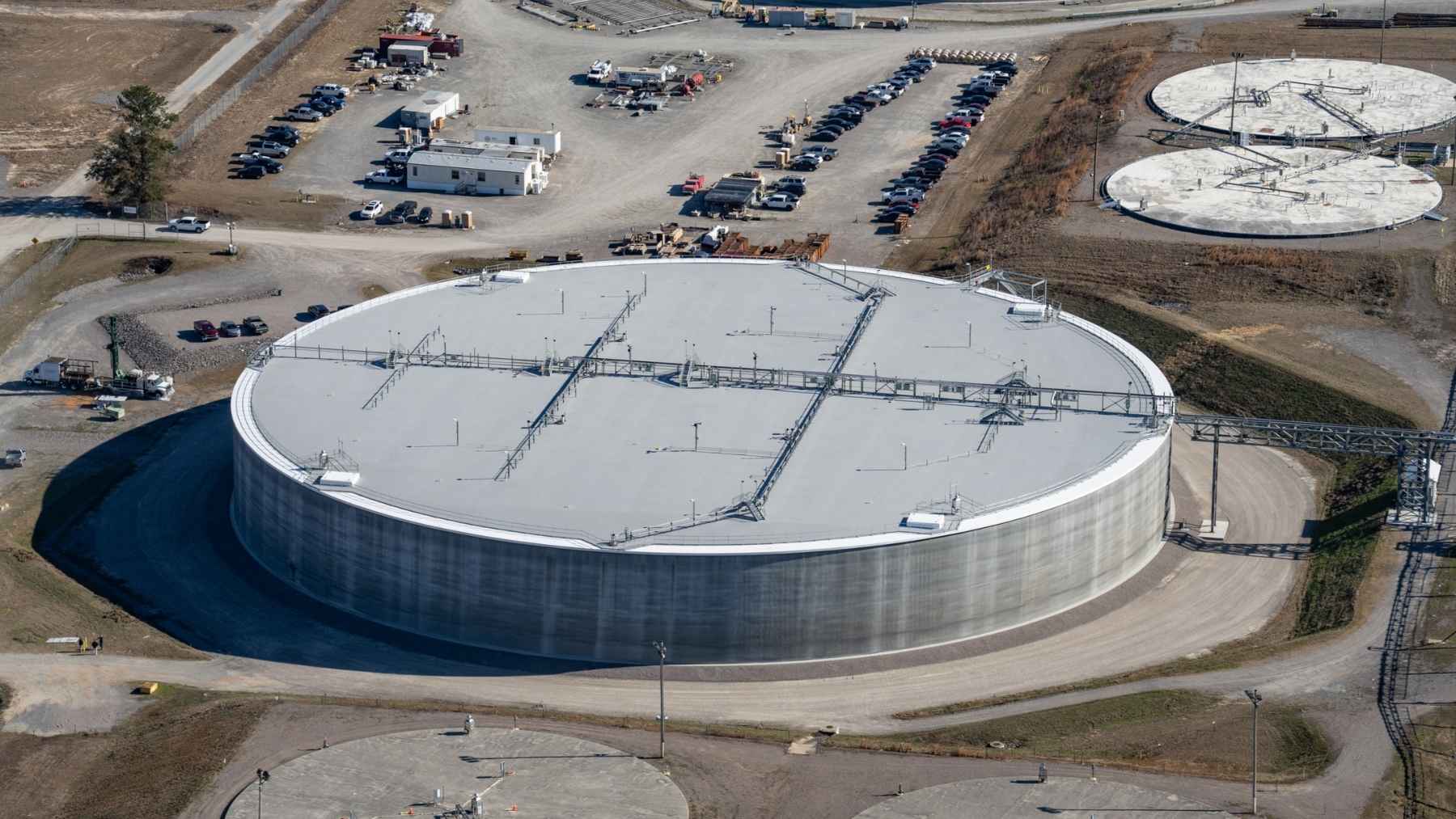
On August 25, DOE’s Office of Environmental Management authorized Saltstone Disposal Unit 10 at the Savannah River Site near Aiken, South Carolina. SDU 10 is the fifth of the site’s mega-size units. It measures 375 feet across and 43 feet high, and it can take up to 33 million gallons.
So what actually goes in there?
Savannah River has 51 underground carbon-steel tanks holding the liquid leftovers of Cold War plutonium and tritium production. DOE’s February 2026 fact sheet puts about 34 million gallons of radioactive liquid waste in the 43 tanks that are still operational. Eight of the 51 have been operationally closed.
That waste comes in two forms. The sludge at the bottom goes to the Defense Waste Processing Facility and comes out as glass, the same trick a 300-ton furnace in Washington State pulls on Hanford’s tank waste. The salt waste goes to the Salt Waste Processing Facility, which strips out the highly radioactive fraction (cesium and strontium, mostly) and sends that off to be vitrified too. What is left is a decontaminated salt solution, and that is where saltstone begins.
The Saltstone Production Facility mixes that solution with fly ash and slag until it is a cement-like grout. Crews pump the grout into an SDU. It solidifies into a monolithic, nonhazardous form and stays there permanently. You are essentially making a very large concrete plug and leaving it where you poured it, which is frankly the least exciting good idea in the whole nuclear cleanup business.
Why wrap a building in 341 miles of cable?
Because the grout does not arrive solid. It arrives pumpable, and for as long as it stays that way it behaves like any other liquid, pushing outward and hardest at the bottom. Savannah River Mission Completion, the site’s liquid waste contractor, said in June 2024 that wrapping SDU 10 in 341 miles of cable was the next job after the concrete, and that the cable in the walls holds the structure together while grout is going in and before it hardens.
So the wall does its hardest work early. Once the block sets, the load stops behaving like a liquid.
The rest of the structure works on the same principle. DOE’s February fact sheet lists 425 post-tension vertical tendons and more than 7,000 panels of rubber liner in a mega-volume unit, on top of the 25 wall sections, 208 reinforced concrete columns and seven roof sections. The tendons squeeze it top to bottom. The wire squeezes it side to side. The liner is what actually keeps liquid off the concrete.
I will flag one thing before we go further. DOE’s news releases from 2024 and 2026 both say more than 20,000 cubic yards of concrete goes into each SDU, while the February 2026 fact sheet says nearly 17,000. I cannot find an explanation for the gap, so treat the concrete volume as approximate and the rest of these figures as published.
The paperwork took longer than the pour
Crews finished construction on SDU 10 in June 2024, which DOE says was nearly 10 months ahead of schedule and two years after SDU 9 was built. A leak tightness test followed in December 2025. Authorization landed on August 25, 2026, roughly 26 months after the last concrete was placed.
That is not a complaint. A leak test on a vault this size, holding material that came out of a nuclear tank farm, is the sort of thing you want done slowly.
DOE describes the authorization as the last step before SDU 10 can begin receiving decontaminated material. The agency has not published a date for the first batch of grout. Cleared and filled are two different states, and SDU 10 is in the first one.
33 million gallons and 34 million gallons are not the same number
You will see both figures in the same week of coverage, and together they invite a conclusion that does not hold. The 34 million gallons is raw liquid waste sitting in 43 tanks. The 33 million gallons is finished saltstone, produced downstream from decontaminated salt solution mixed with fly ash and slag, after the hot fraction has already been pulled out and routed to the glass plant.
One vault does not swallow the tank farms. I would not do that math.
The older units give you some sense of pace, with the same caveat. SDU 2 holds roughly three million gallons, began filling in September 2012 and finished in July 2014. I would not scale that up to guess at SDU 10 either, because the plant that feeds these units was not running yet in 2012.
Why build them this big?
DOE approved the mega-volume design in 2012, about 10 times the size of the older cylinders, because SWPF was going to produce more decontaminated salt solution than three-million-gallon units could absorb. The agency says the larger design saves more than $500 million over the life of the liquid waste program compared with the 80 smaller units originally planned. SDU 6, the first of them, was finished in May 2017 and started taking grout in August 2018.
The plant upstream has kept its end up. In a March 4, 2026 release, DOE said more than 10.6 million gallons of salt waste had gone through SWPF since 2022, including more than 1.8 million gallons between August and December 2025 after new cross flow filters were installed. Over those same four years the site reports 46 million fewer curies in the tank waste.
None of this is unique to South Carolina. H Canyon, the 1,028-foot plant on the same site, has a half nobody has entered since 1955, and Britain is currently three quarters of the way through a replacement filter building at Sellafield because the original was designed for 25 years and has run 41.
Two more to go
Chuck Comeau, DOE-Savannah River’s federal project director, says the larger units have come in “under budget and ahead of schedule”. SDU 11 had all its concrete placed by July 9, 2026, with the same 25 wall sections and 208 columns, wrapped in seven layers of steel cable totaling over 340 miles. Construction on SDU 12, the last disposal unit Savannah River needs, began in April 2026.
 @chasenalier ROOKIE2 months ago