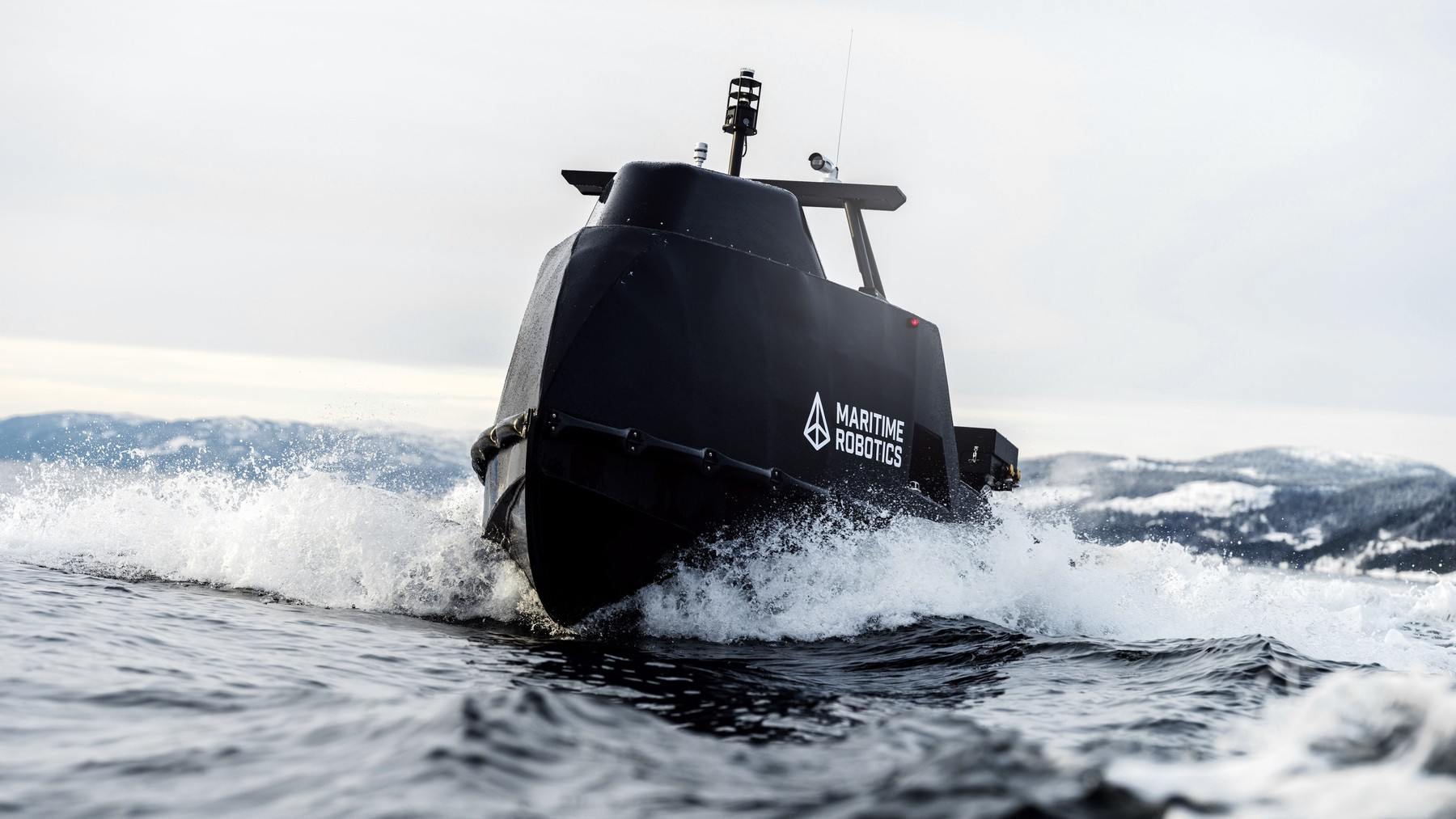

If you’ve ever looked at Norway on a map, you know its west coast isn’t really a line at all. It’s a ragged mess of fjords, rocky little islands and narrow sounds, and it’s where a lot of the country’s offshore oil and gas comes ashore. It’s also a pretty demanding place to send a boat with nobody on it.
But that’s what Maritime Robotics did in May. Its Mariner X drone boat left the company’s headquarters on the Trondheim waterfront on the morning of May 18 and headed south. By Friday, May 22, it had covered more than 500 nautical miles and reached its destination without a single person aboard, according to the Ocean Autonomy Cluster, the Norwegian industry group that wrote the trip up.
A nautical mile is a bit longer than the miles on your car’s odometer, so you can call it about 575 regular miles. Equinor ran the trip alongside Maritime Robotics, and anyone with an internet connection could follow the boat in real time as it worked its way down the coast.
So what is the Mariner X?
Basically, it’s a 29.5-foot workboat with the people taken out. The industry calls it a USV, or uncrewed surface vessel, which is a slightly clunky way of saying a boat that drives on top of the water with no crew, as opposed to an underwater drone. It can run fully on its own or be driven remotely by a pilot on shore.
The hull is high-density polyethylene. That’s the same tough plastic family you’ll find in a lot of kayaks and gas cans, and Maritime Robotics says it lets the boat shrug off harsh conditions with very little maintenance.
It weighs about 11,000 pounds dry and can carry roughly 2,650 pounds of gear on its back deck. Top speed is about 14 mph (12 knots), depending on conditions and what’s bolted to it. It’s got bow thrusters for slow, precise maneuvering and two moonpools, which are essentially holes through the hull that let you lower sensors straight into the water. Maritime Robotics also lists fuel for up to 25 days. And there’s backup propulsion in case the main system quits.
That backup propulsion is frankly the spec I’d care about most on a trip like this. If the engine dies on a crewed boat, someone on board can at least try to fix it. If it dies on a boat with no one aboard, a few hundred yards off a rocky Norwegian shoreline, you’ve got a pretty expensive problem.
How much of the trip did it drive on its own?
Not all of it. The cluster says the run south was a mix of autonomous and remote-controlled navigation, and shore staff watched the boat from two remote operations centers the whole way, one run by Maritime Robotics and one by Equinor itself.
A remote operations center is pretty much what it sounds like. It’s a room on land with screens, camera feeds and data links, where a trained pilot can watch the boat, take over the controls or let the autonomy system get on with it. Maritime Robotics runs its own out of Brattorkaia in Trondheim, the same control room it used in April to demonstrate a swarm of drone boats for the US Navy.
The Mariner X also kept office hours, sort of. According to the cluster, it mainly ran between 8 a.m. and 8 p.m., which is about the length of a standard 12-hour offshore shift if you’ve ever worked one.
I tried some back-of-the-napkin math with those hours. Monday morning to Friday comes out to somewhere around 50 to 60 hours of actual running time. Spread 500 nautical miles across that and the boat was averaging something like 8 to 10 knots (roughly 9 to 11.5 mph), which isn’t far off its top speed. That’s my estimate, though, not Maritime Robotics’. The cluster didn’t publish an average speed, and it didn’t say where the boat tied up at night either, which I’d honestly love to know.
Where exactly it finished is a little murky too. The cluster’s own write-up names two different energy plants as the end point, one north of Bergen and one well south of it, and as far as I can find, Maritime Robotics hasn’t put out its own account that clears it up.
So why does an oil company care about a 29-foot boat?
Short version: Equinor would like fewer people out in risky places.
Equinor has a lot of pipelines, subsea structures and platforms off Norway that need regular inspection, and much of that work still means putting crews out at sea. The cluster says the point of the trip was to show that autonomy, sensors and remote operations can make offshore work safer and more efficient while cutting how often people have to be exposed to it. Arne Gurtner, Equinor’s senior vice president for technology, digital and innovation, called the voyage “an important step in scaling marine robotics across the Norwegian Continental Shelf.”
The trip also doubled as a training run. The cluster says a key goal was getting the client comfortable operating its own USV, and that training typically meant hands-on remote control, client-specific testing, and docking and undocking. Docking sounds boring, I know. But think about how many people you’ve watched struggle to back a pickup into a parking spot, then imagine doing it with a 29-foot boat from a desk miles away. That’s arguably the most useful skill anyone picked up on the whole trip.
Equinor isn’t new to this, either. It’s already hired a 79-foot crewless ship called Reach Remote 1 for work in its gas fields, which we covered back in July.
Equinor has a Mariner X of its own now
By early June, Equinor had its own Mariner X and was showing it off at NUI’s test facilities in Bergen, according to GCE Ocean Technology. That post calls the boat about 26 feet long, which doesn’t match the 29.5 feet Maritime Robotics lists, so I’d trust the builder on that one.
The cluster’s trip report never names the client it was training, so I can’t tell you for certain that Equinor’s boat is the same hull that ran down the coast in May. Still, Equinor had its own control room watching the entire trip, so it wouldn’t be a wild guess.
If the Mariner X sounds familiar, you may have read about it here, when we covered its turn in a NATO-linked exercise off Portugal at the end of the summer. It used sound to keep a 110-pound underwater drone on track from the surface. The coastal run came a few months before that.
And Equinor doesn’t look like it’s done with drones. It opened its KNARR marine robotics test center on October 28, with test areas at depths of 82, 459 and 820 feet, and Maritime Robotics had systems in the water for the opening, alongside Eelume and Blueye Robotics.