
If you’ve bought a fresh pear at an American grocery store, there’s a pretty good chance it was grown in Washington or Oregon. A July market report out of UC Davis puts those two states at about 88% of the fresh pear volume in the US.
Belgium takes its pears seriously too. It’s the sixth-biggest pear producer in the world, and its main pear variety is one called Conference. So when a team from KU Leuven, a Belgian university, wanted to find out whether a single piece of farmland could grow fruit and make electricity at the same time, it picked a commercial pear orchard in the town of Bierbeek to try it.
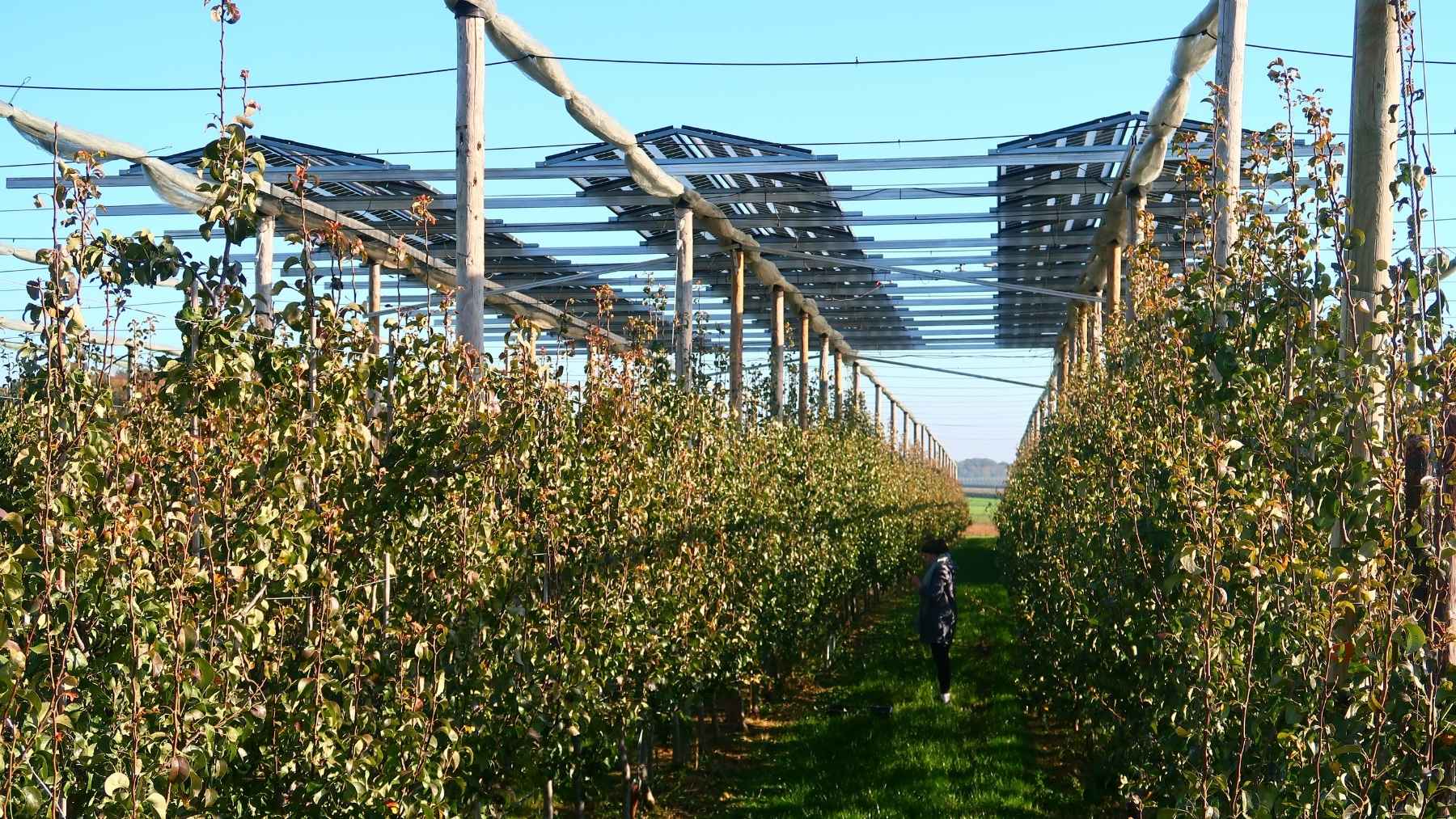
The orchard belongs to a fruit business run by brothers Jan and Patrick Van der Velpen, and it already had wooden supports up for hail nets. The researchers took the net off part of the orchard and mounted 185-watt Bisol Lumina solar panels on those same supports instead, 13.8 feet above the ground, in three double rows that each run 69 feet. Each panel measures about 3.3 by 5.5 feet, and roughly 40% of its surface lets light through to the trees below.
So what’s a hail net doing over a pear tree in the first place?
It’s basically a big sheet of see-through plastic mesh stretched over the rows, so one bad summer storm doesn’t dent a whole year’s crop. The trade-off is shade. The clear net on this farm cut the light reaching the trees by about 9%, and the comparison rows kept theirs on through every growing season of the study.
So how much fruit did the pears lose?
The team followed three harvests. Researchers measured 12 trees under the panels and compared them with five rows of 12 trees under regular hail nets. If you’re wondering why nets are the benchmark instead of open sky, it’s because the panels are meant to replace the nets, so the nets are what they’ve got to beat.
Across those three seasons, the solar row produced 15% less fruit by weight than the netted rows. The gap was 16.2% in the first season. It came in at 15% in the second and 13.7% in the third. I’d argue that consistency is the most useful thing in the whole paper. A grower can budget around a loss that shows up at roughly the same size every year.
Why that much? The panels cut the light reaching the trees’ canopy by about 24% over a growing season, and on some days the total light for the day dropped by as much as 51%. You don’t need a plant science degree to figure out where the missing pears went.
I was more surprised by how much stayed the same. The trees flowered on the same schedule, they shed the same share of young fruit in spring, and leaves under the panels turned light into sugar just as well as leaves under the nets. After harvest, the pears’ firmness, sugar and starch readings were basically the same too, apart from a lower sugar reading after storage in one season.
The fruit did come out a little smaller, though. When the crop went through an optical sorting machine, the solar row’s pears slid down one size class, about 0.2 inch, in two of the three seasons. The trees under the panels also grew more bottle-shaped pears, although that difference only held up statistically in one season.
Those bottle-shaped pears tend to come from the top flower in each cluster, and the solar trees hung on to more of those flowers. The researchers suggest thinning those top flowers by hand, which this grower already does to the young fruit in spring.
Solar panels can apparently do a hail net’s other jobs
Growers also use hail nets to keep summer sun from scorching the fruit. During the study, pears in the netted rows and in the solar row came through without sunburn, while neighboring fields with no netting got burned.
Spring nights were more interesting. On frosty nights, the air inside the canopy under the panels ran roughly 1°F warmer than under the nets. It works a lot like cloud cover. At night the ground loses heat straight up into the sky, and a layer of clouds (or a roof of glass panels) catches some of that heat and sends it back down.
The orchard didn’t take any frost damage during the trial, even with below-freezing nights while the trees were in bloom. The authors describe what they saw as “a slight frost protection” in their paper in Agronomy for Sustainable Development, and honestly, I’d lean on the word slight. The netted trees made it through those same nights.
Then there’s fall. Leaves under the panels stayed green somewhere between 8 and 12 days longer than on the netted trees, depending on the year. The team thinks the slightly warmer air under the glass, less UV light, or a mix of both could explain it. We’ve covered a German apple grower whose fruit ripens 10 to 12 days late under solar panels, though leaves hanging on in November and apples ripening late aren’t the same thing.
So what does 1.44 mean for a farmer?
Here’s where the electricity comes in. Researchers score dual-use farms like this one with something called a land equivalent ratio. Basically, you take everything one acre produced in fruit and power combined, and ask how much land you’d need to get the same output from an ordinary orchard plus a separate solar farm.
For this orchard, that ratio averaged 1.44 across the three seasons. So you’d need 1.44 acres split between a regular pear orchard and a regular solar farm to match what one acre of this setup turned out. That extra 44% counts pears and power together. The pear harvest itself still shrank by 15%.
I’d love to give you a kilowatt-hour figure here, but the pear paper doesn’t include one. The electricity side was written up in an earlier Applied Energy paper from the same KU Leuven group, and its public abstract describes the power output as solid while also concluding the system didn’t make financial sense yet. That paper put the first-year pear loss at 16% at minimum, against the 15% three-season average in the newer study.
It’s still one row of 12 trees
Which brings me to the catch. The solar half of this study is a single row of 12 trees, and the researchers say the size of the site and the budget kept it that way. They spread five netted comparison rows across the field to make the statistics hold up. They’re upfront about it, and they also list pests, disease and soil water under the panels as things that still need studying.
You might remember the sweet corn under a raised array in Massachusetts, which came in at about 80% of the open rows next door, while these pears landed at 85% of the netted rows. That’s arguably a better result for the pears, though hail nets and open sky aren’t the same starting point. It’s a bit of a pears-and-corn comparison.
Would a grower in Washington or Oregon take that trade? I honestly don’t know. The KU Leuven researchers write that whether a system like this pays off hangs on the cost of its electricity over its lifetime, and raised panels need decent power prices to cover what they cost to build. I’d guess Belgium and the Pacific Northwest make for a very different conversation there.
And if you’d like to check the math yourself, KU Leuven has posted the three seasons of pear data in its public research data repository, the same dataset behind that 15% figure.