
The internal combustion engine has been getting eulogized for about a decade now. Brussels set a 2035 cutoff for new gasoline and diesel cars, automakers pivoted billions toward batteries, and the obituaries more or less wrote themselves. A handful of engineers in Granada, Spain, apparently never read any of them.
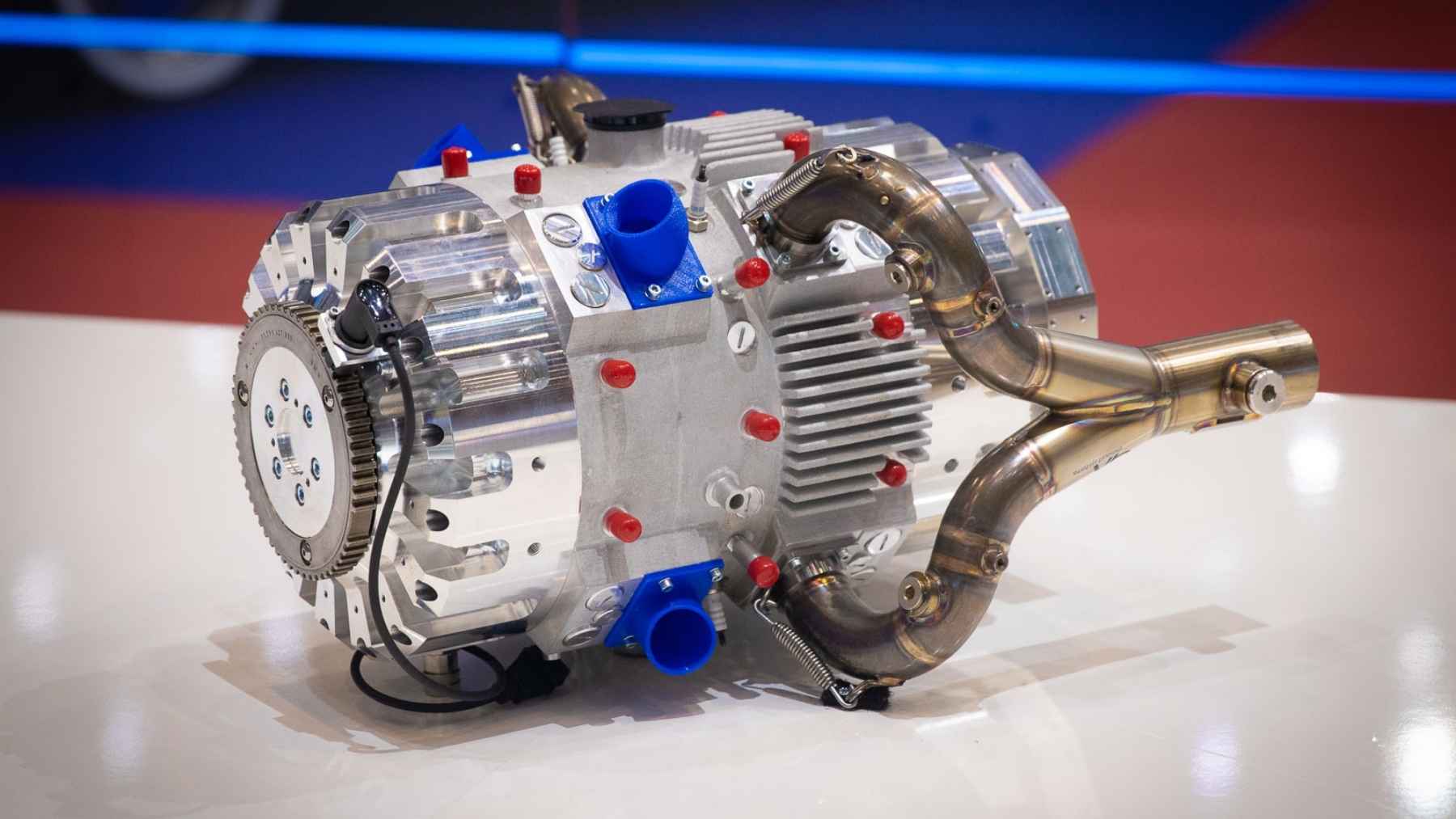
Their company, INNengine, has spent more than ten years building a combustion engine that throws out the one part everyone assumes an engine needs: the crankshaft. The result weighs about 35 kilograms (77 lb), makes 120 horsepower, and will happily burn hydrogen instead of gasoline. And it isn’t a render or a bench curiosity. One of these engines is bolted into a Mazda Miata that actually runs, and the American engine press has started paying close attention.
There’s No Crankshaft, and That’s the Entire Trick
Pop the hood on a normal engine and the crankshaft is the thing doing the translating: pistons go up and down, the crank turns that into rotation, and a small museum of valves, camshafts and a cylinder head sits on top to manage the breathing. INNengine’s e-REX architecture deletes most of that. According to INNengine’s own technical breakdown, there’s no crankshaft, no valves, no camshaft, and no cylinder head.
What it has instead is eight pistons arranged in opposed pairs, four to a side, sharing combustion chambers in the middle. The pistons push on rollers that ride a wavy “cam track,” and that track is what turns their back-and-forth motion into the rotation you actually use. An ECU-controlled shaft can twist those cam tracks slightly, changing the compression ratio on the fly. That last detail matters more than it sounds, and we’ll get to why.
The package INNengine advertises is 55% smaller and 70% lighter than a comparable four-stroke, with the moving parts balanced against each other so completely that the thing barely vibrates. None of the underlying ideas are new, for what it’s worth. Opposed-piston engines go back to designs like the Commer TS3 and the Napier Deltic, and the concept traces all the way to an 1882 patent from James Atkinson. INNengine’s contribution is shrinking it, simplifying it, and aiming it at a world that suddenly cares about burning hydrogen.
INNengine Calls It a One-Stroke. Plenty of Engineers Call That Generous
INNengine markets the e-REX as a “1-stroke” engine, trademark and all, claiming four power events per revolution against a four-stroke’s one and a two-stroke’s two. The pitch is that you get the power density of a two-stroke without the dirty, oil-burning reputation that pushed two-strokes out of cars decades ago.
Plenty of engineers who study the design don’t buy the label, and read it as a modern two-stroke at heart: the combustion stroke overlaps the exhaust, the oil stays quarantined below the pistons, and direct injection cleans up what used to make two-strokes filthy. INNengine’s counter is that the engine has none of the emissions problems that defined the old two-strokes, so the label doesn’t fit.
You can file the naming fight under marketing if you want. The mechanically interesting part holds up either way: an opposed-piston engine with on-demand variable compression, no crankshaft, and a footprint of roughly 40 centimeters down its longest side. Whatever you call the stroke, the hardware is doing something unusual.
It Burns Hydrogen, Gasoline, or Pretty Much Whatever You Give It
The variable compression ratio is the part that pays off here. A normal engine is built around one fuel’s burn characteristics. INNengine’s can shift its compression on demand, which means the same hardware can run gasoline, hydrogen, or various blends without being rebuilt. The company has even floated wood pellets, which tells you how loose the fuel requirement is.
The hydrogen mode is the headline. Burn hydrogen in a piston engine and the tailpipe gives you water vapor instead of CO₂, while keeping the noise, the throttle feel and the basic mechanical character a lot of drivers don’t want to give up. That’s a different bet than the fuel-cell chemistry others keep trying to make cheaper, and a different bet than a battery. It’s combustion that happens to be carbon-free at the pipe.
That flexibility is also the strategic point. An engine that can switch fuels is an engine that survives whatever Brussels, Washington or anyone else decides about gasoline ten years out. The catch is the same one hanging over every hydrogen project: making and moving the hydrogen. The U.S. runs a famously thin refueling network, and storage is hard enough that German engineers are stuffing pressurized hydrogen into spinning tractor wheels to squeeze out more range. Kawasaki, for its part, has been chasing the same hydrogen-combustion idea on motorcycles and industrial generators. INNengine is betting the engine side is ready before the fuel side is.
It’s Running in a Mazda Miata, Not Rolling Off an Assembly Line
The engine in the Miata is the M500, a roughly 500cc unit weighing about 35 kilograms that, by INNengine’s account, makes 120 horsepower with no turbo, supercharger or battery helping out, plus around 150 Nm (111 lb-ft) of torque. It’s the latest of three prototypes the company says it has built and tested, and it puts the engine at TRL6 on the technology-readiness scale, meaning a working system demonstrated in a relevant setting. The 700cc e-REX meant for range-extender duty is the next rung up, not something you can buy.
And you can’t actually buy any of it, which matters. INNengine doesn’t sell engines to the public. It works with industrial partners, manufacturers and tech firms that might license or integrate the design, and the Miata exists to prove the concept runs in a real car rather than on a dyno. This is a small team with modest funding that has built a handful of engines, not a company shipping crates of them. The outfit traces back to engineer Juan Garrido Requena, who founded it in Granada in 2011.
So the honest read is narrow and genuinely impressive at the same time: a tiny shop in Granada has a crankshaft-free, hydrogen-capable engine that demonstrably works in a sports car. Whether that scales into something you’ll ever find under a hood is a separate question, and it’s the one the next year is about.
Horse and Airbus Defence Both Signed On. Now It Needs the Money
For a company this small, the partner list is the surprising part. In March 2025, INNengine announced a deal with Horse Powertrain, the engine business spun out of Renault and part-owned by China’s Geely, to test two e-REX prototypes at the Polytechnic University of Valencia, with a stated plan to license the technology and eventually build it in volume if validation holds up. Horse runs eight manufacturing plants and three R&D centers, so it isn’t a casual validator.
Then in August 2025 came Airbus Defence, the arm behind the Eurofighter, the Tiger helicopter and the Sirtap drone. The agreement is under wraps, but the note INNengine sent its shareholders was illustrated with a drone, and a compact, multifuel, high-power-density engine is an obvious fit for unmanned aircraft. It’s the same logic driving the broader push toward hydrogen-powered drones that can stay aloft far longer than battery ones.
The missing ingredient is cash. In February 2026, CEO Roberto Lendaro told Spanish outlet El Economista the company was raising €12 million to finish development, describing the e-REX as “the world’s only vibration-free thermal engine.” He said INNengine was in advanced talks with an Andalusia-focused fund over a €5–7 million slice and hoped to close the round in the third quarter of 2026. The engineering has cleared bench tests, a sports car and two industrial heavyweights. The next milestone is a bank transfer.
The Engine Exists. The Factory Is the Open Question
Strip away the funding rounds and the partner logos and you’re left with something a little romantic: a group of engineers in a Granada workshop who decided the combustion engine wasn’t finished, deleted its most fundamental part, and got a hydrogen-burning version of it running in a Mazda Miata. The skeptics are right that calling it a one-stroke is generous, and that a small startup sits a long way from a production line. They’re also looking at an engine that exists, runs, and does something genuinely new with very old physics. The question was never whether the thing works. It’s whether anyone with a factory decides to build it.