
Adhesive tape does not sound like heavy industry. It weighs nothing, it costs a few bucks a roll, and the hardest job most people ever give it is holding a poster to drywall. But making the stuff means drying solvent off moving webs of film, over and over, and that takes steam. A lot of steam, around the clock, made the way industrial steam has been made for a century: by burning something.
tesa’s plant in Hamburg is the largest factory the company owns anywhere in the world, and this fall it starts building a 40-megawatt-hour block of concrete to take most of that job away from the gas.
The system comes from ENERGYNEST, a Norwegian thermal storage firm with an office in Hamburg. It pairs a 10-megawatt electric heater with 24 storage modules that hold heat inside concrete pipes, and tesa says in its announcement that groundbreaking happens this fall with commissioning expected in summer 2027.
The company puts the saving at around 4,600 metric tons of CO₂ a year, which it describes as roughly 20 percent of the site’s emissions against a 2018 baseline. Run that backwards and the whole factory lands somewhere near 23,000 metric tons. Which tells you more about a roll of tape than the roll ever will.
Concrete is a strange thing to build a battery out of
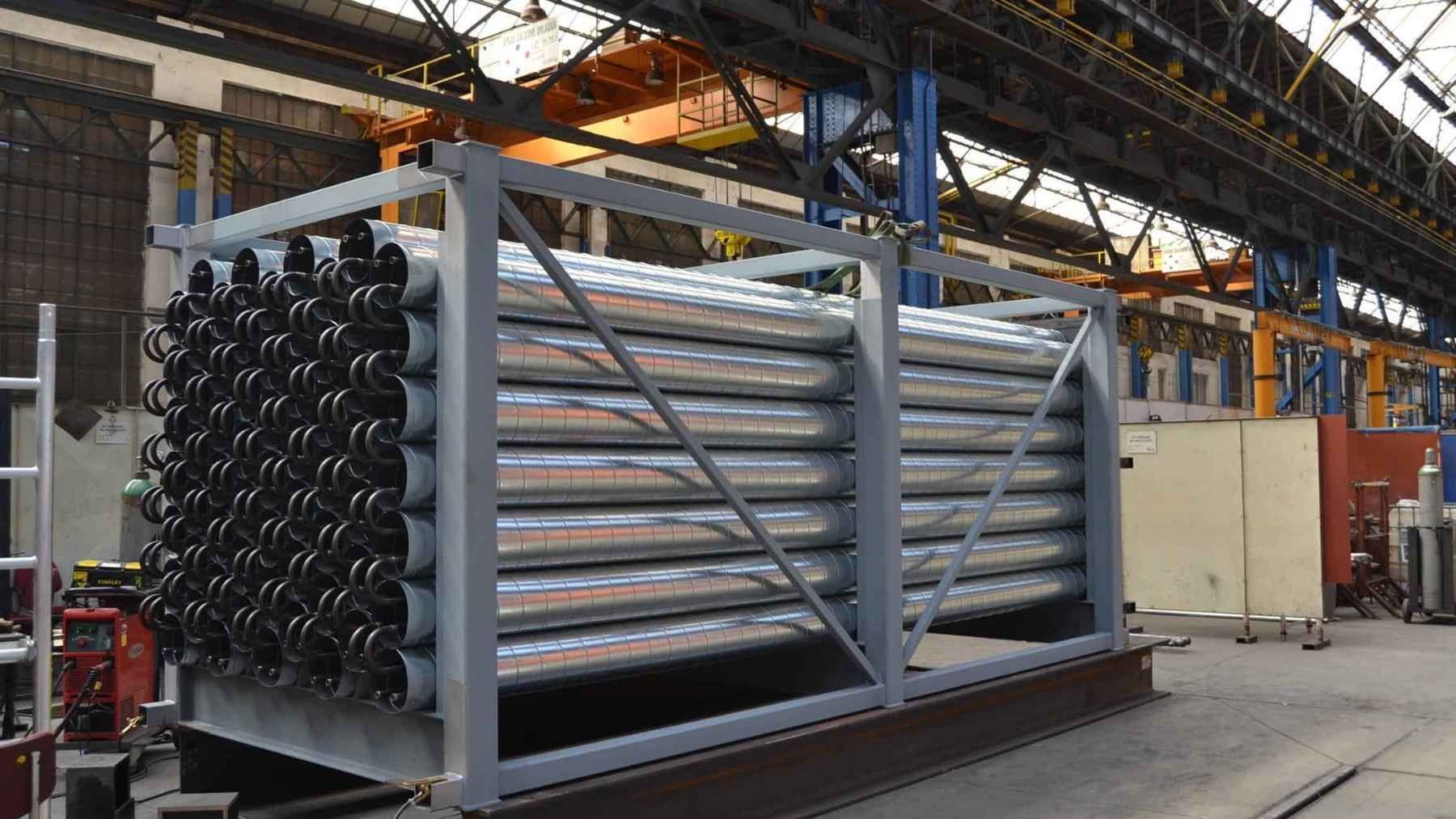
ENERGYNEST calls its storage medium HEATCRETE, a thermal concrete cast around steel tubes. Electricity runs an ordinary resistance heater, the heater warms thermal oil, and the oil circulates through the tubes and dumps its heat into the concrete. When the factory wants steam, the flow reverses.
It is not a clever material. That is the entire pitch.
The numbers are modest by battery standards and that is deliberate. According to a technology review published by Energy-Storage.News in June, ENERGYNEST charges to a maximum of 734°F (390°C), typically working between 482°F and 734°F, and discharges heat between 248°F and 572°F. That is well short of the 1,832°F a stack of refractory brick in Kern County will reach, but tape lines do not need 1,832°F. They need steam.
The same review puts a standard 20-foot container at roughly 2 megawatt-hours of capacity, which sizes the Hamburg build at somewhere around twenty containers of concrete. tesa’s own figure is 24 modules. Either way, this is a machine you could walk past in a yard without noticing.
Do the division on the ratings and you get the shape of it. A 10-megawatt heater filling a 40-megawatt-hour store means four hours at full tilt to charge. How long it runs on the way back down depends on how hard the plant is pulling steam, and nobody has published that.
The whole point is buying power when nobody else wants it
A heat store only earns its keep if electricity is sometimes cheap and sometimes not, and Germany has that problem in abundance. The country now regularly produces more wind and solar in the middle of the day than it can absorb.
April was a good illustration. pv magazine, citing analysis from consultancy Ricardo, reported that 123 of Germany’s 720 day-ahead hours that month cleared below zero, with 85 percent of them landing between 10am and 4pm. The average across those hours was minus €36 per megawatt-hour. The deepest single hour hit minus €413.80.
Negative prices mean generators pay somebody to take the electricity. If your factory can swallow 10 megawatts on command and stash it as heat, those hours stop being a grid headache and start being a procurement strategy.
The flip side is what gets thrown away. Euronews reported in late July, citing market analysts at Montel, that German commercial curtailment rose about 20 percent in the first half of 2026, from 1,216 to 1,463 gigawatt-hours, even as negative-price hours fell from 389 to 299.
Perspective on that: a 40-megawatt-hour store cycled once a day soaks up roughly 14.6 gigawatt-hours across a year. Against 1,463 gigawatt-hours curtailed in six months, one factory is a rounding error. You would need a few hundred of these before the national numbers moved.
The power itself is not in short supply. Germany finished standing 64 turbines at the 960-megawatt He Dreiht wind farm in the North Sea without a cent of state subsidy, and there is plenty more coming. Getting it into a factory boiler is the part nobody had solved.
Germany rewrote its industrial power rules while this was on the drawing board
Here is the piece that changed after tesa put out its January announcement. Germany’s long-delayed industrial electricity price finally cleared its last hurdle in the spring.
The European Commission approved the scheme under state aid law on April 16 under case number SA.120495, according to a note from law firm Gleiss Lutz. The funding guideline entered into force in early May, applies retroactively from January 1, 2026 through the end of 2028, and carries a total volume of €3.8 billion.
The mechanics matter. Eligible energy-intensive firms get a subsidy covering part of the gap between market price and a floor of 5 cents per kilowatt-hour, applied to half their consumption. And recipients have to put at least half the aid back into decarbonization measures.
Which is to say: a German factory that electrifies its steam and installs a flexible load capable of eating cheap power is now doing precisely the thing the state wants that money spent on. tesa has not said whether it will apply, and applications are not expected until 2027 anyway. But the policy weather has shifted in favor of anyone with a heat store in the yard.
A smaller store is doing more of the job than a bigger one down the Elbe
Two days before tesa’s announcement, Covestro and California’s Rondo Energy broke ground on a 100-megawatt-hour brick heat battery at Brunsbüttel, about 40 miles northwest of Hamburg near the mouth of the Elbe. It is due online by the end of this year and saves up to 13,000 metric tons of CO₂ annually.
Bigger battery, bigger saving. But it covers only about 10 percent of the steam at Brunsbüttel, while tesa’s 40-megawatt-hour store is expected to carry two-thirds of Hamburg.
That gap is not a verdict on the technology. It is a verdict on the sites. A chemical complex like Brunsbüttel burns steam on a scale a tape plant never approaches, so 100 megawatt-hours barely dents it. tesa’s number looks impressive because the factory it serves is small enough to be finished off.
Brick, concrete, sand, crushed rock and molten salt are all in commercial service somewhere right now, and they are not really competing on cleverness. China stood a molten-salt tower at 15,256 feet on the Tibetan plateau that banks heat at 1,040°F. What decides the medium is the temperature the customer’s process actually needs, and tape needs far less than steel.
One honest wrinkle. That June technology review from Energy-Storage.News lists the Hamburg project at 52 percent electrification of heat and a 2,700-metric-ton annual CO₂ cut, which is materially below the two-thirds and 4,600 metric tons in tesa’s own release. No party has said either figure is wrong, and project scopes do move between engineering studies and final design. tesa’s own published number is the one used throughout this piece.
Your car has more than 130 of these tapes in it
This is where the tape plant stops being a curiosity. tesa says more than 130 of its adhesive products can end up in a single electric car, and over 70 in a smartphone. Hamburg is the site that makes the high-performance stuff for electronics, automotive, printing and paper.
Wire harnessing, battery pack assembly, display bonding, the strips that stop trim from buzzing. None of it is visible and all of it has to survive a decade of heat cycling. That is the output the steam is drying.
ENERGYNEST has been inside this industry before. Its Belgian installation, per that same review, sits at Avery Dennison, another adhesive materials maker, where six modules totaling 5 megawatt-hours pair with a solar thermal field. Hamburg is eight times the storage of that job.
tesa says it and ENERGYNEST are already assessing rolling the concept out to more plants, and that the same design suits chemicals, paper and food production. The company has committed around €300 million worldwide to its transformation, reports a 39 percent cut in Scope 1 and 2 emissions so far, and buys 90 percent of its global electricity from renewables.
The concrete is one leg of a four-part plan for Hamburg. The other big one is hydrogen: tesa said back in 2024 that connecting the plant to Hamburg’s HH-WIN industrial hydrogen network could save a further 6,000 metric tons of CO₂ a year, with the first hydrogen-made tapes targeted for 2027.
None of this is built yet. The diggers arrive in the fall, the steam is promised for summer 2027, and tesa has not disclosed what the system costs, which makes the payback impossible to check from outside.
The real test is whether a second one gets ordered. One 40-megawatt-hour store in Hamburg proves a supplier can deliver on a single site. A second and a third at other tesa plants would mean the math actually held up, and that is a much harder thing to put in a press release.