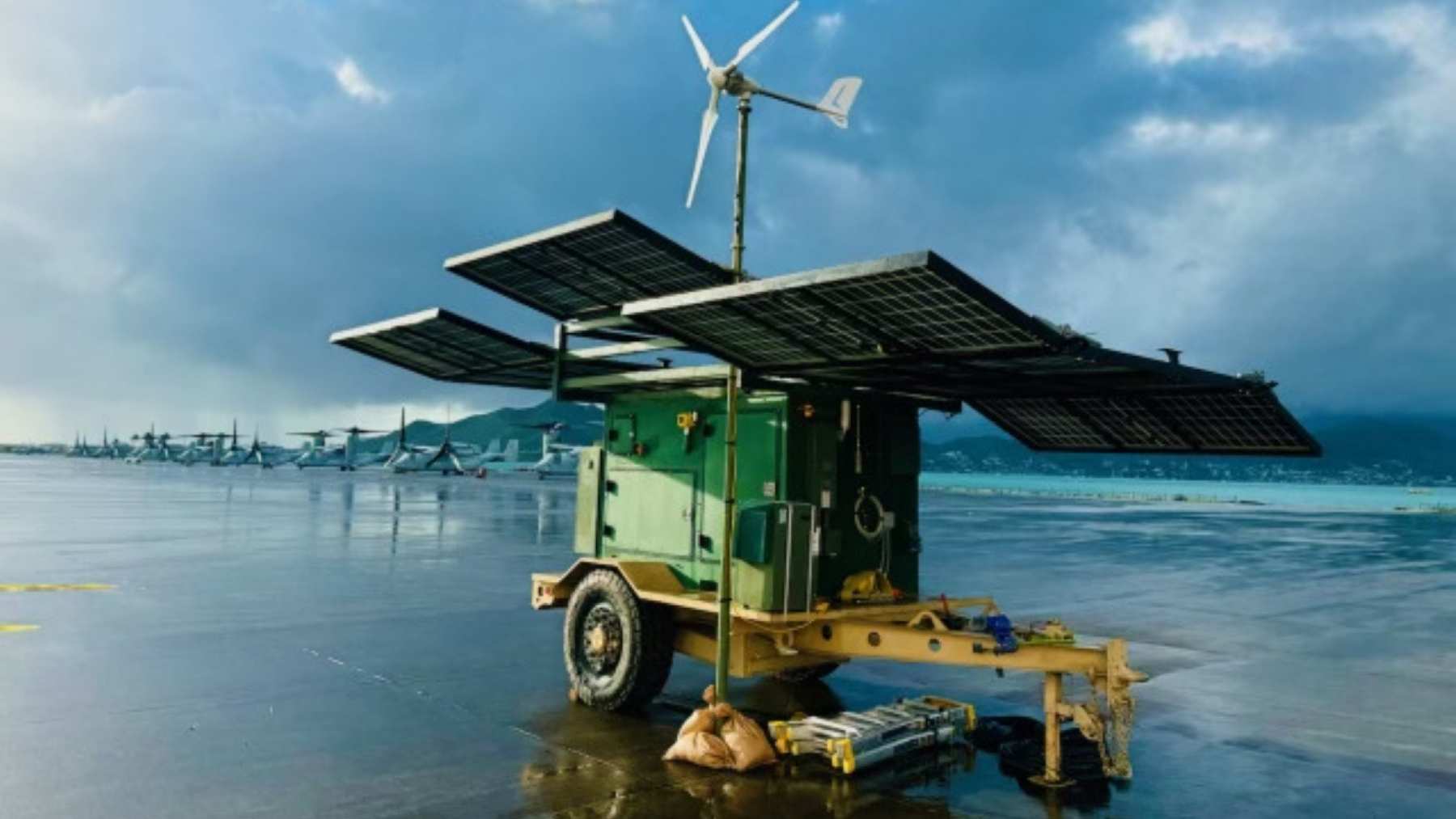

On the southeastern tip of Oahu, at Marine Corps Base Hawaii in Kaneohe Bay, a piece of equipment roughly the size of two porta-potties spent part of April 2025 pulling drinking water and hydrogen fuel out of the Pacific air. The unit was called HyTEC, short for Hydrogen at the Tactical Edge of Contested Logistics. It was built by a veteran-founded Houston startup called NovaSpark Energy Corp. Inside the casing were a small wind turbine, solar panels, and an electrolysis stack. Wind and sun supplied the power. Atmospheric humidity supplied the water. Out came roughly 4.5 pounds of compressed hydrogen every 24 hours, plus enough potable water for a small unit.
The demonstration was carried out at the 2025 Pacific Operational Science and Technology conference Field Experimentation event known as POST FX, in front of an audience that included U.S. Indo-Pacific Command. Air & Space Forces Magazine covered the test in mid-April, then updated the story on April 21 to correct the location from Hickam Air Force Base to MCB Hawaii. Thirteen months later, in late May 2026, that program has rolled into a wider procurement track, a commercial partnership with a publicly listed solar company, and a parallel storyline that connects directly to the Heven Z1 drone we covered earlier this week.
What the HyTEC unit actually does
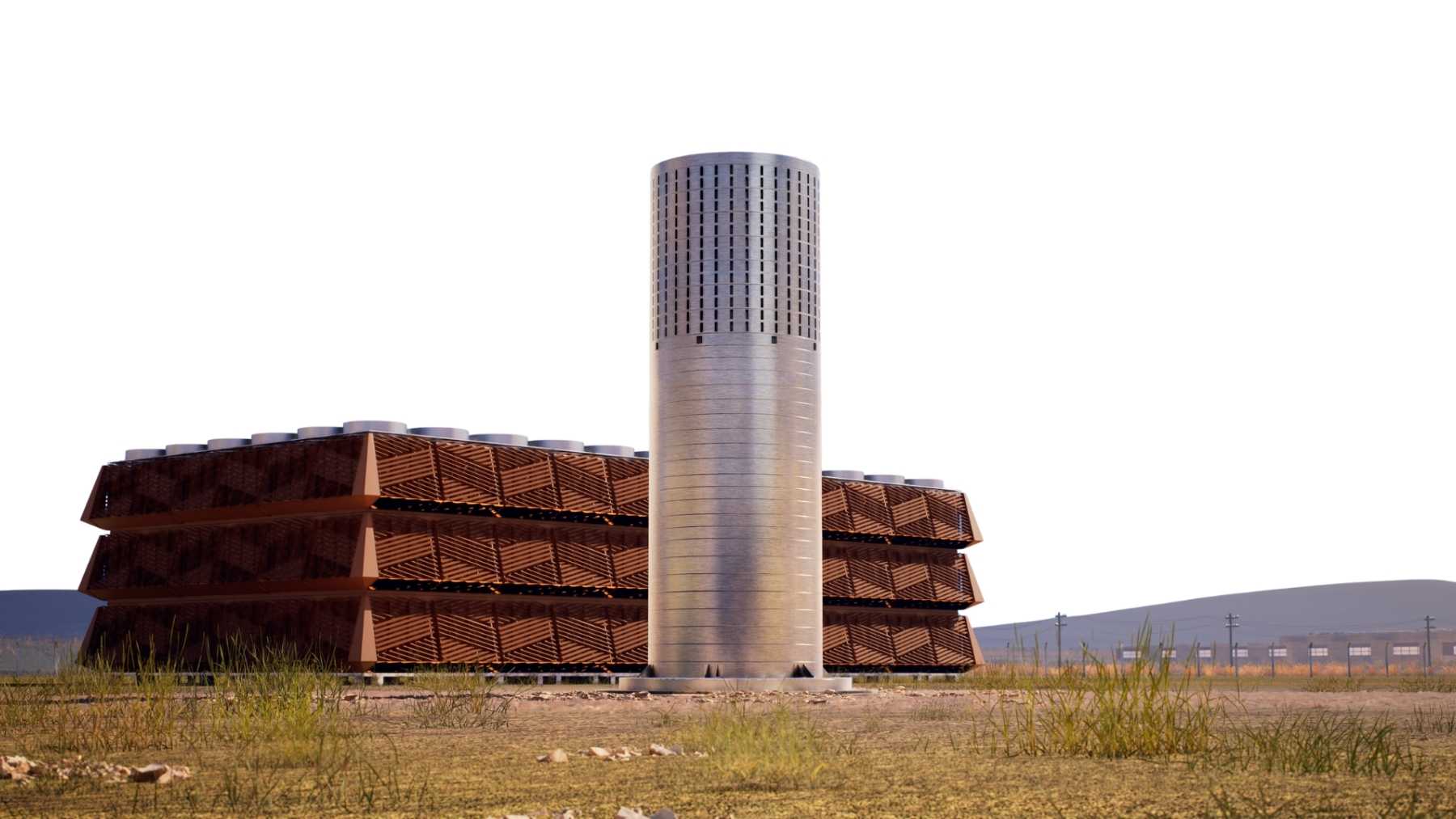
The technical claim is simple to state and harder to engineer. Two photovoltaic panels and a small wind turbine generate electricity. That electricity runs an electrolysis cell, which uses water harvested from atmospheric humidity to produce hydrogen on one electrode and oxygen on the other. The hydrogen is compressed and stored on board. Any water left over is potable. The unit, according to NovaSpark’s own product page, can be scaled to between 3 and 250 kilograms of hydrogen per day per node depending on the configuration. The version demonstrated in Hawaii was at the small end of that range.
Compressed hydrogen does one of two jobs from there. It either runs through a fuel cell on site to make electricity, or it fuels a hydrogen-powered drone in the field. NovaSpark told Air & Space Forces that the system is accessorized with briefcase-sized hydrogen fuel cells capable of 4 kilowatts of electrical output, enough to run satellite terminals and other field communications gear. The whole rig takes less than 30 minutes to set up and is small enough to be air-dropped on a parachute or towed by a Joint Light Tactical Vehicle, the JLTV that replaced the Humvee in front-line U.S. Army and Marine Corps service.
Rick Harlow, NovaSpark’s CEO, framed the operational rationale in the same Air & Space Forces piece: “The Marines told us, ‘we need to be able to move up to five times a day, because we don’t want to be a sitting target.'” The portability is the product. A diesel generator with a similar power profile can be hauled around. It cannot be folded into something the size of a pair of porta-potties and dropped from a transport aircraft, and it does not make its own fuel.
Why “Swiss Army knife” — what the unit replaces
The pitch a private company would normally make to a Pentagon program office is single-use and high-cost. NovaSpark went the other way. Lanson Jones, the company’s Chief Innovation Officer, gave Air & Space Forces a fairly long quote that is worth reading in full: “I call it the Swiss Army knife, because not only can you create hydrogen to fuel drones, or make electricity, but you can also use the compression equipment to refill tires, and, if the hydrogen tank is full and you want to keep it, you can tap directly into the power from the wind turbine and from the solar panels without using that hydrogen. And you can do other really cool stuff, like make water for the troops.”
The point underneath that quote is the cost of the alternative. According to Harlow, fuel delivered into an austere Pacific theater outpost can run somewhere between $400 and $500 a gallon by the time it lands, once airlift, intermediate staging, and convoy risk are priced in. Jones described the unit’s acoustic signature as roughly equivalent to a dishwasher, under thirty decibels by his account, with effectively no thermal signature on top. For a Marine Corps doctrine that has shifted toward distributed, mobile, hard-to-target outposts across the first island chain, those numbers are the entire pitch.
How the contract got here
NovaSpark and Heven AeroTech’s Zepher Flight Labs subsidiary were the two companies the Defense Innovation Unit selected in April 2024 to prototype an expeditionary hydrogen generator under the HyTEC program. The Marine Corps Expeditionary Energy Office (E2O) and the Naval Information Warfare Center Pacific were the DoD mission partners. By March 19, 2025, both companies had delivered first prototypes for operator training. NovaSpark’s unit went to Marine Corps Base Hawaii at Kaneohe Bay and trained Combat Logistics Company 33. Zepher’s unit went to Marine Corps Air Station Yuma and trained Marine Wing Support Squadron 371. POST FX, the April 2025 field experimentation event at Kaneohe Bay, was the public demonstration of NovaSpark’s unit in front of INDOPACOM.
The procurement scaffolding behind the demo is broader than one DIU contract. According to Harlow, NovaSpark also won an AFWERX Commercial Solutions Offering contract through the Air Force innovation arm, since extended, and an Other Transaction Authority contract from the Army Contracting Command in Picatinny, New Jersey. Harlow told Air & Space Forces that any military agency or element can buy off that OTA contract, and so can the various state National Guards. That last clause matters. National Guard purchasing authority is the route into FEMA-adjacent disaster response, which is the civilian beachhead the company has been openly aiming at.
What has changed since the Kaneohe Bay demo
Three things have moved since the April 2025 Air & Space Forces piece. The first is investment. In June 2025 NovaSpark closed a seed round with Boot64 Ventures, a Louisiana-based firm focused on national resilience startups, and Maven Scouts. The second is a partnership announced on November 13, 2025, between NovaSpark and Ascent Solar Technologies, the publicly listed thin-film solar manufacturer. Ascent Solar’s lightweight, flexible photovoltaic panels are being paired with the HyTEC unit to deliver an air-droppable, lighter version of the system for defense and disaster applications. The third is the wider Heven Z1 procurement we covered earlier this week. The Z1 is the drone the HyTEC unit is designed to fuel.
The NovaSpark home page now lists U.S. Air Force, U.S. Army, U.S. Navy, AFWERX, the Defense Innovation Unit, and Lockheed Martin among its partners. Lockheed Martin named the company a Small Business Innovation Success Partner for 2024. That is a single year and a specific designation, not a guaranteed program of record, but it is a credible bridge from prototype trailer to a defense prime’s product roadmap.
The Z1 connection — and why this matters for the broader thread
Two HyTEC awards, two companies, two prototypes, same April 2024 contract round. NovaSpark’s unit ended up at Kaneohe Bay training Marines on the unit’s user interface. Zepher Flight Labs’ unit ended up in Yuma. A year later, Heven AeroTech, Zepher’s parent company, got a Basic Ordering Agreement from the U.S. Army Contracting Command at Redstone Arsenal for the Z1 hydrogen drone the trailer is designed to fuel. The reading is straightforward: the same April 2024 DIU round produced both the airframe procurement track and one of the two fuel-side procurement tracks. NovaSpark’s unit is the other one.
The thread is also visible against our earlier Greyshark piece. Three Western defense programs, in three domains, have moved hydrogen fuel cell propulsion from R&D into procurement inside roughly one year: a German underwater drone, an American airborne drone, and the American expeditionary fueling rig that goes with the latter. The civilian conversation about hydrogen has been about Toyota Mirai sales numbers and California station closures, both of which are real. The defense conversation has been running on a separate clock with a separate funding model and very different operational requirements.
What this does not tell you
Four caveats are worth keeping in view.
- The April 2025 HyTEC demo unit output, about 4.5 pounds of hydrogen per 24 hours, is enough to refuel a Group II ISR drone or run a 4-kW comms post for a day. It is not, by any reasonable measure, a substitute for refueling a fleet of passenger vehicles. Scaling to the 250 kg/day per node range NovaSpark advertises is a separate engineering and financing question.
- The NovaSpark and Zepher Flight Labs HyTEC trailers are distinct prototypes from two separate companies, not one program with two suppliers. They share a name and a sponsor and not much else mechanically.
- Defense-to-civilian technology transfer is talked about openly by both companies and is a stated NovaSpark business direction (FEMA, disaster response, mining, telecom, data centers, all listed on the company site). It has not yet produced a public civilian deployment of HyTEC outside of military training events.
- The fuel cost figure Harlow cited ($400 to $500 per gallon delivered into an austere Pacific theater outpost) is his company’s framing of the alternative, not an independently audited DoD cost line. The order of magnitude is broadly consistent with figures published in past Marine Corps Expeditionary Energy Office briefings on contingency fuel logistics.
Where this leaves the reader
The civilian hydrogen station network in the United States is, as of late May 2026, in the worst operational shape it has been in five years. The Pentagon’s expeditionary hydrogen network, by contrast, has gone from one DIU prototype contract in April 2024 to multi-agency Other Transaction Authority access, an AFWERX extension, a Lockheed Martin partnership, an Ascent Solar tie-up, and a parallel Army BOA for the drone the unit fuels. The two stories use the same molecule. They do not use the same supply chain, the same physics targets, or the same customers. The Houston unit that spent April 2025 making fuel out of Pacific air is a procurement story now. Whether any of this lands on a civilian forecourt is a question the contracts in front of us do not answer.