
Ground-source heat pumps are arguably the most efficient way to heat and cool a building. The ground below the frost line holds a pretty steady temperature all year, so instead of fighting the outside air, the system trades heat with the dirt under the parking lot. Engineers love them, and so would your power bill. And yet almost no one installs one.
So what’s stopping everybody? Mostly the drilling. Before a geothermal system can touch that steady underground temperature, someone has to bore a set of deep holes into the ground, and that part’s loud, messy, and expensive enough that a full installation can run up to five times the price of a regular air-source heat pump. Most building owners look at the quote once and go buy the regular heat pump.
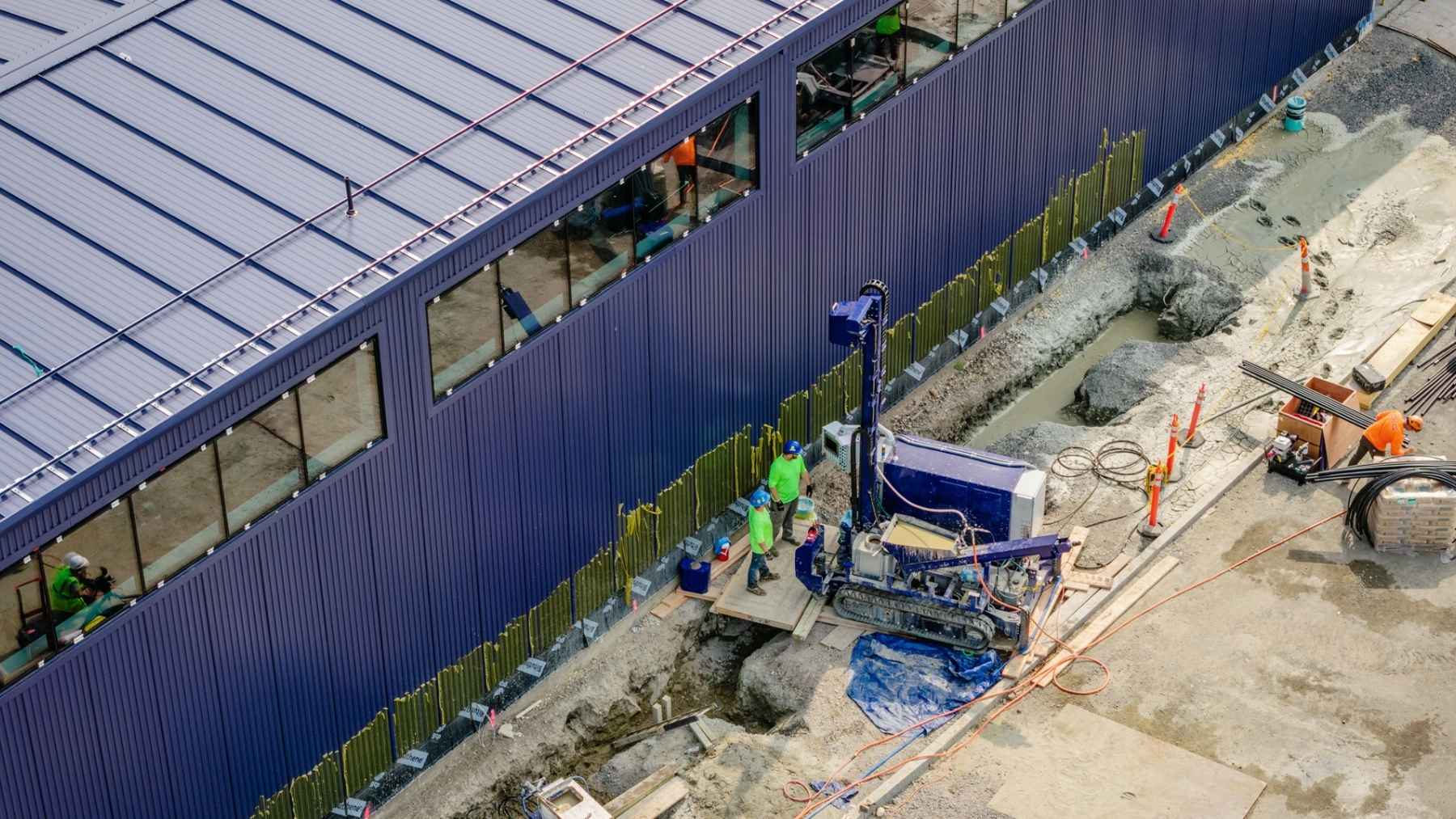
Which brings me to the rig that spent part of August parked outside the headquarters of Boston general contractor Suffolk Construction. It belongs to Dig Energy, a New Hampshire startup, and it drilled seven geothermal boreholes there for the building’s new heating and cooling system. Instead of grinding through the ground with a metal bit, it cut those holes with water sprayed at 10,000 pounds per square inch, hard enough to slice through soil and solid rock. Dig announced the finished job, its first commercial project ever, on September 10, and according to ThinkGeoEnergy the drilling itself took about two weeks.
One thing to get straight before we go on: these are shallow boreholes for heating and cooling one building, a different animal from the deep wells that chase volcanic heat to make electricity, like the 10,350-foot well on an Oregon volcano we covered this week. Same word, geothermal, but one hunts power and the other just keeps an office building comfortable in July.
The drill pipe never comes back out
A conventional geothermal crew drills the hole with a carbide bit or a compressor, lines it with casing so it doesn’t cave in, then feeds a heat exchange pipe down the finished hole. Three steps, lots of equipment, lots of noise.
Dig’s rig collapses all of that into one move. The drill string, meaning the long stack of pipe that connects the surface gear to the cutting tip, simply stays in the ground once the hole is done and becomes the heat exchanger itself. Even the nozzle stays down there. The company designed it to be cheap enough that burning through a new one per hole still pencils out. And because nothing has to be pulled out or fed back in, the hole can be a lot skinnier than a conventional one.
Cutting rock with high-pressure water isn’t a new idea, and Dig doesn’t pretend it is. Oil and gas outfits played with it decades ago and dropped it because it didn’t drill their wells any faster. Dulcie Madden, Dig’s co-founder and CEO, called it “a known industry practice that’s being adopted in a novel way” when she talked to Canary Media. She also estimates only about 1 percent of US buildings run on geothermal today, which tells you how much room there is if the drilling cost actually drops.
So how does drilling with water save water?
You may be thinking that a machine shooting a constant 10,000-psi jet into the ground should use more water than a regular drill, not less. I thought the same thing. It turns out conventional drilling’s the thirsty one, because those rigs pump large amounts of water downhole anyway, to cool and lubricate the bit and to turn the loose earth into a mud that can be flushed back out of the hole.
Dig’s setup skips the casing, cuts a narrower hole, and pulls the water and debris back up to the surface with a jet pump. Madden says the Boston job used a tenth of the water that conventional drilling would’ve needed, and left 75 percent less material to be carted away than a standard operation would have.
The whole rig fits in a parking space
Parker Mundt, a partner at Suffolk Technologies, says the rig’s footprint is about the same as a single parking spot, which is basically the difference between drilling in a dense city and not drilling there at all. If you’ve ever walked past a conventional drilling site, you know the soundtrack. Madden compares a standard operation to a demolition site, and she’s frankly not exaggerating by much.
This one apparently didn’t register.
Madden says people in nearby buildings couldn’t hear a thing while the rig was running, and she told the Concord Monitor that roughly 80 visitors came through the drill site during the job. “You can stand right next to it and have a regular conversation without protection,” she said. Try that next to a rig hammering casing into bedrock and see how your ears feel afterward.
About that first customer
Now for the caveat I’d want you to keep in mind before you get too excited. Suffolk Technologies, the venture capital arm of Suffolk Construction, is an investor in Dig Energy and brought the startup through its Boost accelerator program. So Dig’s first commercial customer is, essentially, the headquarters of its own backer. That’s about the friendliest landing spot a first job can have, and it’s a fair reason to wait for the second and third projects, on lots the company didn’t already have a key to, before calling this proven.
The money claim deserves the same caution. Dig says its approach can cut geothermal drilling costs by up to 80 percent compared with conventional methods, but neither company shared actual numbers from the Boston job. Mundt would only say the early results look competitive on cost and schedule. I’d also love to tell you how deep or how wide those seven holes are, and I can’t, because no one involved has published either figure yet. For a drilling story, that’s a pretty big blank.
Still, the company has earned some patience. Madden and her co-founder Thomas Lipoma, who happen to be married, spent about five years developing the rig in a New Hampshire barn before raising a $5 million seed round in September 2025. Neither of them came from the energy business. She has a biology degree and a master’s in public health, and he’s a mechanical engineer, which makes the whole thing feel like two people who found a forgotten trick and ran with it. Ground loops for single buildings are quietly becoming a busy corner of the industry anyway, from startups like this one to the giant underground radiator we covered in Canada.
If you want Dig’s rig on your lot, you’ll wait a while. Madden says the company’s booked through mid-summer 2027, there’s already a new version of the rig in the works designed to cut drilling time, and the seven finished boreholes in Boston were announced on September 10, 2026.