
Keeping water out of the structure is most of the job in marine engineering. Ships, oil platforms, offshore wind foundations, the entire business runs on the assumption that the sea stays on the outside.
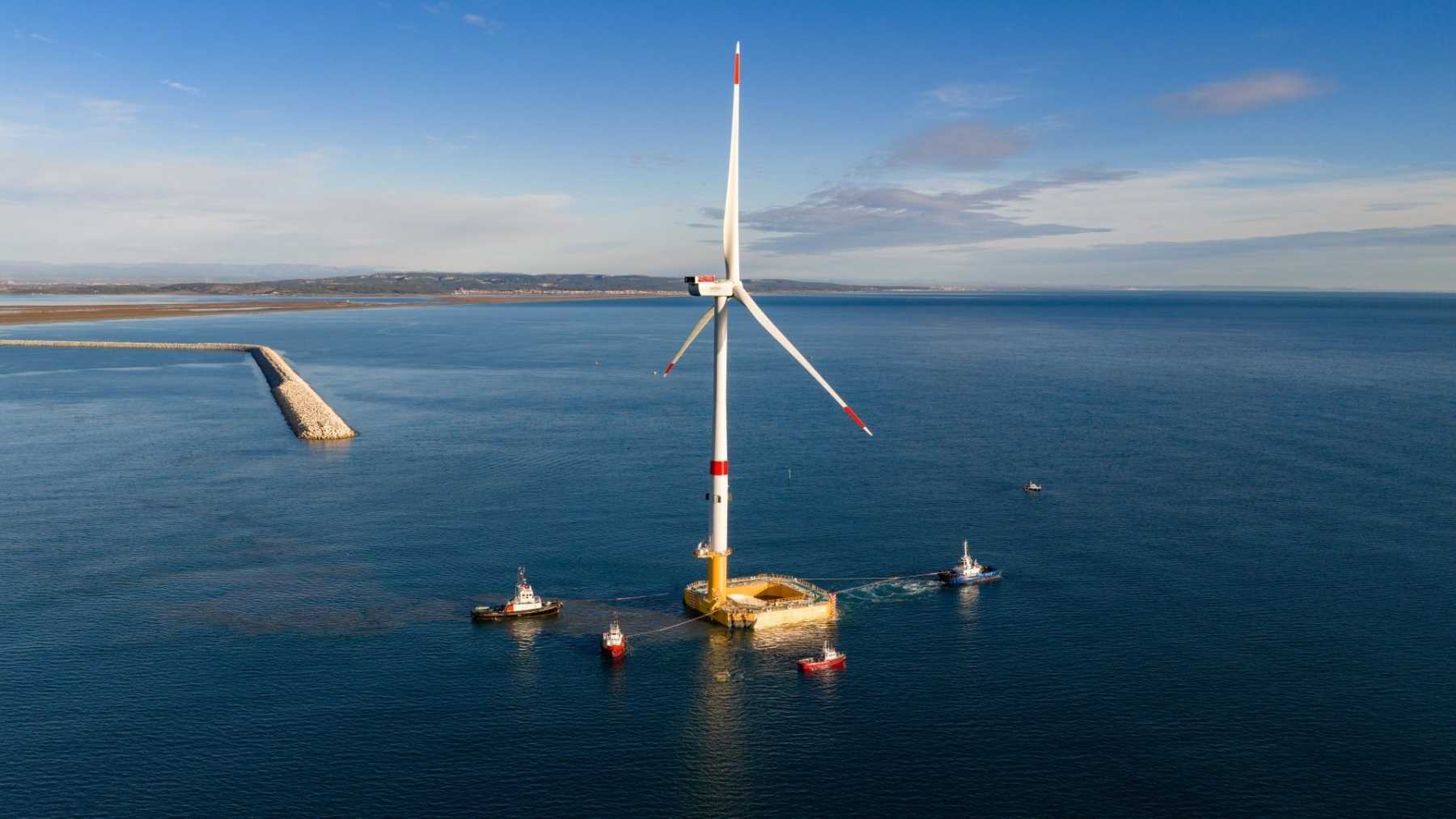
France’s newest floating wind farm runs on the opposite assumption. Each of the three platforms holding up a 10-megawatt turbine off the Occitanie coast is a square steel ring with a big opening in the middle, and that opening is full of the Mediterranean.
The farm is called EolMed, it sits some 20 kilometers off Port-La Nouvelle and Gruissan, and it has been running at full capacity since May 2026. The pool of seawater trapped inside each floater is not a leak or a design compromise. It is the stability system. BW Ideol, the French company behind the concept, literally calls the technology the Damping Pool, and after 15 years of tank tests, two single-turbine demonstrators and one very long construction saga, three of them are now feeding the French grid at once.
The hole in the middle is the whole idea
Every floating wind company has its own answer to the same problem: a 10-megawatt turbine is a giant lever, and waves want to rock it. Some designs fight back with sprawling semi-submersible hulls. A Portuguese startup called Gazelle wants to do it with a counterweight slung between three anchored arms. China’s approach, on the evidence of the 16-megawatt Three Gorges Pilot floating off Guangdong, is mostly to build the platform enormous.
BW Ideol’s answer is a square barge measuring 45 meters by 45 meters by 17 meters, which makes each side nearly as long as an Olympic swimming pool. The hull is a ring. The center is open to the sea.
According to the project’s own fact sheet, the captive water in that central opening damps the platform’s response to the swell, and the base plate extends outward around the entire perimeter to add even more damping. The turbine itself is bolted to the deck at the rear of the floater through a transition piece.
So the same water that is trying to rock the tower gets put to work canceling the motion. The industry spends fortunes keeping the sea out of things. Here, the design only works because they let it in.
The floaters for EolMed were built in steel, assembled by MP Archimed on the industrial quay at Port-La Nouvelle. Sitting on each one is a Vestas V164-10.0 MW turbine, the model whose 164-meter rotor spent years as the yardstick for big offshore machines before the 15-megawatt class showed up.
Three of them are on the French grid right now
Qair, the French developer leading the consortium alongside TotalEnergies and BW Ideol, announced the farm had been energized on April 21. “This marks the start of a critical phase of technical testing, paving the way for full commissioning and the first kilowatt-hours of renewable electricity to be fed into the grid,” the company said at the time, according to offshoreWIND.biz.
The first electrons went onto the transmission grid operated by RTE that same month. By May, per BW Ideol’s project page, EolMed was at full capacity, where it has stayed since. The farm is contracted to run for 20 years.
The electricity travels ashore through a 33,000-volt link running about 27 kilometers, undersea and then underground, landing at the beach in Port-La Nouvelle before threading beneath the town to the local substation. Annual production should come in near 110 million kWh. The project’s fact sheet puts each turbine’s output at the equivalent consumption of about 17,000 residents, so call it a small city’s worth of homes across the three.
Anyone keeping score on the French Mediterranean will notice this is the second 30-megawatt floating pilot to come alive there within weeks. The neighboring EFGL farm, the one growing oysters on its floats, started delivering electricity in early May and hit full power in July. Different developer, different floater, same stretch of windy coast. The Gulf of Lion has quietly become the busiest floating wind test bed in Europe.
They towed these out in December, on purpose
EolMed took the long road here. The site off Gruissan was awarded to the consortium back in summer 2016, and the original plan called for four turbines on concrete floaters. That morphed into three bigger turbines on steel, with the same total capacity and fewer things to build.
Construction of the floaters started in 2023 and wrapped in September 2025, backed by 85 million euros in European Investment Bank financing. Qair says the farm was 80 percent built by French companies and 100 percent by European ones, and the project’s own numbers put the floater fabrication alone at 600,000 hours of work, most of it in Occitanie.
Then came the part that doubles as a sales pitch. The first fully assembled turbine, floater and all, left Port-La Nouvelle under tow in December 2025, and the whole offshore campaign ran through the winter. BW Ideol makes a point of this: installing in the rough season, it says, demonstrated the barge’s stability and how simple the offshore operations are.
Winter towing in the Gulf of Lion is not a scheduling accident. This is the coast where the tramontane wind clears café terraces. If your stability concept survives that with a 164-meter rotor on deck, you have your marketing photos.
One fleck of honesty the press releases skip: the project’s own website still lists commissioning as planned for summer 2025. First power actually landed in April 2026. Floating wind timelines slip like everyone else’s.
Steel today, concrete by the boatload tomorrow
For BW Ideol, EolMed is less a power plant than a business card. The company holds just a 5 percent equity stake and supplied the engineering and licensing of the floater design. What it actually gets out of three turbines running through a Mediterranean winter is proof, at multi-turbine scale, that the Damping Pool behaves.
The timing works out nicely. In July, BW Ideol and the construction group NGE agreed to partner as equals on Fos3F, a factory project in southern France meant to turn out concrete Damping Pool foundations in series. The plant has already lined up as much as 126 million euros in public funding, including up to 74 million euros from the EU Innovation Fund. Steel worked for three floaters. For the dozens that commercial farms need, BW Ideol is betting on concrete poured on a production line.
The customers it has in mind are not hypothetical. France is rolling out commercial floating wind tenders that EolMed was explicitly designed to de-risk, and in late July the government picked five ports to share 260 million euros in floating wind infrastructure upgrades. BW Ideol describes EolMed as one of the first three floating wind farms in France, and all three are now spinning.
Keep the scale honest, though. Thirty megawatts is a rounding error against what those commercial tenders will demand, and nobody involved is pretending otherwise. What EolMed actually settled is narrower and worth more: a square steel ring with a pool of seawater in its belly sat still enough, through a Gulf of Lion winter, to be towed, moored, plugged in and run flat out. In floating wind, boring motion data is the product. EolMed now has plenty of it.