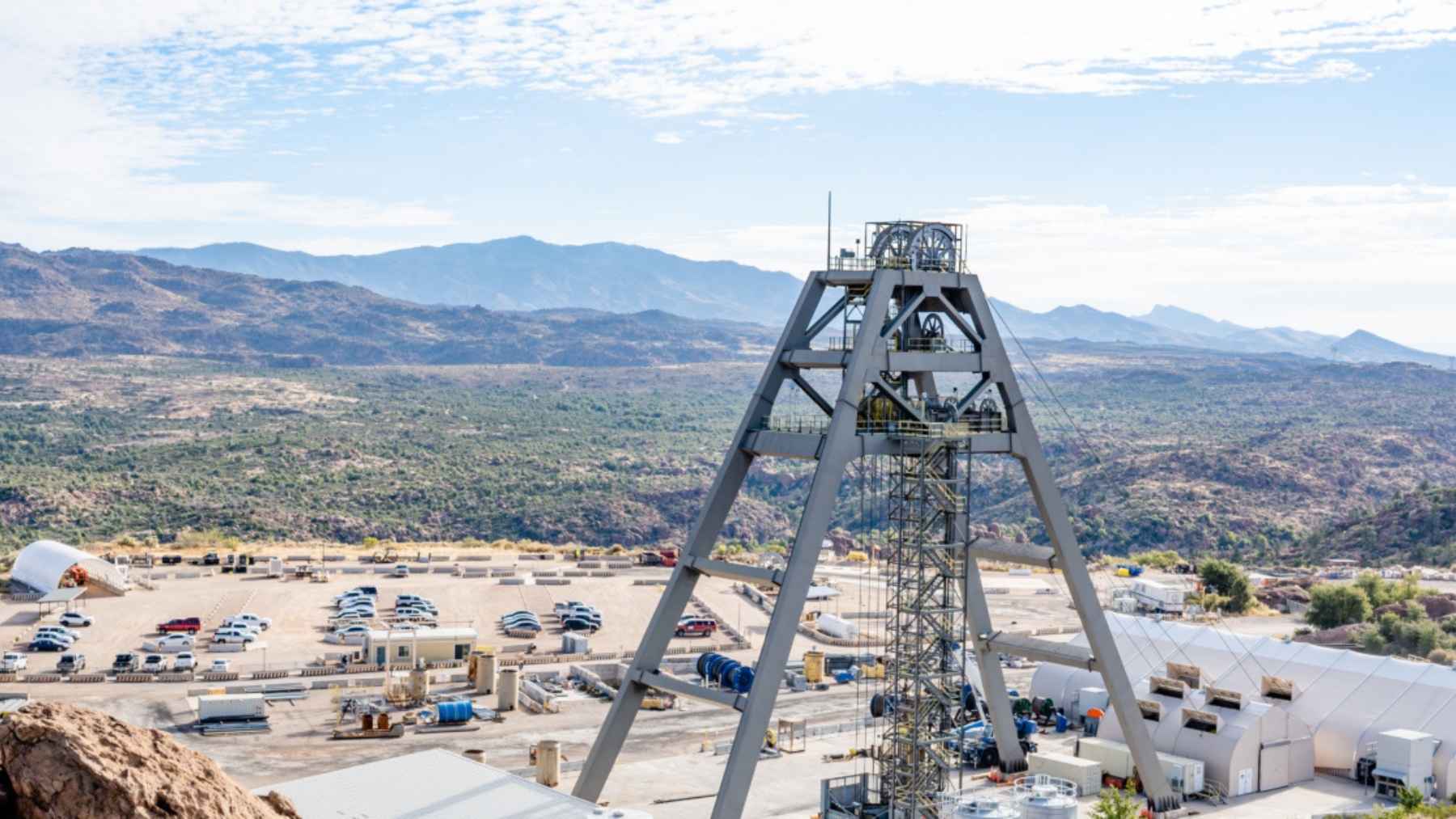

The hole is the part of a mine everyone pictures. Big machine, big shaft, rock comes out, somebody gets rich. At the copper project under Oak Flat in Arizona, the two holes that matter have been finished for months and there is still no mine.
Some of that is permitting and litigation, and there is plenty of both. A lot of it is heat. The rock at the bottom of Resolution Copper’s No. 10 Shaft, 6,943 feet down, sits at roughly 175 degrees Fahrenheit, and so does the water dripping off it.
Nobody works in that. Crews get down there at all because a refrigeration plant on the surface pushes chilled air into the shaft, and has done since the shaft was being sunk.
The plant needed to run a real production mine at that depth is far larger than anything on site today, and it has not been built. What Resolution did sign this month is a contract to keep the existing one serviced through 2030.
Two of the deepest shafts in America, and nothing to hoist yet
No. 10 Shaft was finished in 2014. It is 28 feet across, concrete lined, and drops 6,943 feet in one continuous lift, which makes it the deepest single-lift mine shaft in the United States. Hecla’s Lucky Friday No. 4 in Idaho goes deeper overall, but it is a winze that starts underground rather than at the surface.
Its neighbor is much older. No. 9 Shaft was sunk in 1971 by the Magma Copper Company, ran until the mid-1990s, then sat idle for two decades after Magma closed.
Resolution spent $200 million rehabilitating it and deepening it from 4,800 feet to a final 6,898 feet, at 22 feet in diameter, with Redpath USA as lead contractor. Completion was announced on November 5, 2025.
No. 9 now connects to No. 10, and its job is ventilation and a second way in and out. Bloomberg reporters who visited in 2016 described steam clouds pouring out of the top of it. That is the mine exhaling heat pulled off the bottom of the other shaft.
Vicky Peacey, president and general manager of Resolution Copper, said in the completion announcement that “ongoing litigation continues to stall development” and that the company is ready to advance the project.
The rock gains about 1.5 degrees every hundred feet
Arizona sits on a fairly ordinary geothermal gradient, 2.7 degrees Celsius per 100 meters, which works out to roughly 1.5 degrees Fahrenheit per 100 feet of depth. Ordinary is the problem. Go down far enough and ordinary gets you to numbers that cook.
The prefeasibility ventilation study filed on the Forest Service’s own EIS reference site lists virgin rock temperature level by level, and the spread is narrow and uniformly bad.
Those are undisturbed rock figures, and the distinction is the whole story. A headline claiming people work at 175 degrees would be flatly wrong. With cooling running, the faces are held far below that.
When Arizona Daily Star reporter Emily Bregel rode the cage down in April 2016, she found the pump station at 6,820 feet full of hot fog and standing water, the rock and drips at 175 degrees, and the air itself in the 70s and 80s. Her guides told her a power failure means immediate evacuation.
Randy Seppala, then project manager for shaft development, gave Bloomberg the two-word version in 2016. Without the chilled air, he said, “You’d cook.”
It is the same heat other companies chase on purpose. An MIT spinout is melting granite with a gyrotron beam to reach geothermal energy miles down. Resolution has that resource in its own ore body and treats it purely as a liability.
The plan calls for 140 megawatts of cooling and a dam full of ice
The life-of-mine design was published in 2014 in the Journal of the Southern African Institute of Mining and Metallurgy by Steven Bluhm, Roy Moreby, Frank von Glehn and Chris Pascoe, the engineers who did the work. It is still the clearest public account of what cooling this mine would take.
Their answer is more than 140 megawatts of refrigeration: 105 megawatts of surface bulk air coolers, plus another 35 in secondary coolers underground.
Convert that into the units American HVAC engineers actually use and 140 megawatts is close to 40,000 tons of refrigeration. Call it ten thousand four-ton home air conditioners, running at once, underground, permanently.
Air volume is the other half. The design sends 3,120 kilograms a second down the intake shafts, about three and a half US tons of air every second, delivered at 10.5 degrees Celsius wet bulb.
The smartest piece of it is the ice. Rather than size the plant for the worst hour of an Arizona afternoon, the study puts a thermal storage dam on the surface with tube banks carrying subzero glycol. Ice forms on the outside of those tubes during the cool part of the day and melts during the hot part, so chilled water leaves close to freezing and the machines never chase the peak.
Underground, the plan is five 8-megawatt machines plus a standby, in a chamber cut off the exhaust level so the mine’s own return air carries the rejected heat away. The bulk air cooler at No. 13 Shaft alone is specced at 40 megawatts.
For scale, the 2012 revision of the same study benchmarked Resolution against Palabora in South Africa. Palabora sits 1,200 meters down in rock at 49 degrees Celsius and needed 15 megawatts of air cooler duty for 33,000 tons a day. Resolution’s line in the same table: 127 megawatts for 120,000 tons a day.
What is actually running down there, and who just agreed to maintain it
None of the above exists. What exists is the smaller plant built to keep the sinking crews alive in No. 10, and it went in under pressure.
Sundt, the industrial contractor that built it, says the air temperature underground had already passed MSHA limits for human occupation while the shaft was being sunk, which turned the cooling plant into a fast-track job.
The build list is specific: three York chillers, three banks of condenser cooling towers, 2,000 linear feet of insulated 28-inch Victaulic pipe, a glycol system and tank farm, four 750-horsepower inline pumps and a 72-inch bulk air cooling fan.
York is a Johnson Controls brand, which brings us to the July news.
On July 1, 2026, Resolution entered a Master Supply Agreement with Johnson Controls and United Association Local 469, the Arizona local for pipefitters, plumbers, welders and HVAC techs. Under the project labor agreement, Local 469 members handle preventative and full maintenance on chillers, air handlers and packaged units supporting underground ventilation.
The term runs through April 2030, with options to extend.
So a mine with no production decision, no mining approval and three live lawsuits has a signed, dated maintenance schedule for its air conditioning stretching almost four years out. Rick Hudson, business manager at Local 469, described the work as delivering “high-quality maintenance services that enhance system performance, reliability, and safety.”
The water is hot too, and there was far more of it than the drill holes predicted
Heat is the headline problem. Water is the one that nearly ended the shaft.
Core samples taken 30 feet away had crews planning for about 80 gallons a minute of inflow. At around 6,500 feet in 2013, an aquifer opened up and the peak hit 580 gallons a minute, according to the Star’s account. It took a year to work out how to pump that much water and get the air conditioning installed.
It was not cold water, either. CIM Magazine reported that water at 80 degrees Celsius came out of probe holes drilled on the 1,969-meter bench at 500 liters a minute, into a sinking refrigeration system sized for rock heat and nothing else.
The prefeasibility study treats deep fissure water as the assumption most likely to wreck the numbers. Thirty-eight liters a second adds 7.5 megawatts of heat load, and 152 liters a second adds 30, against a total mine heat load on the order of 100 megawatts. Adding a third again to your cooling bill because you hit water is not a rounding error.
The water that does come up goes somewhere useful. In its quarterly scorecard published July 29, Resolution said it had recycled more than 183 million gallons this year and sent it to the New Magma Irrigation and Drainage District for agriculture.
The argument on the surface has not stopped
The federal process closed this spring. On March 16, 2026, acting Forest Supervisor Ericka Luna signed the record of decision, the congressionally mandated land exchange was recorded, and the Forest Service issued an errata to its final environmental impact statement.
Resolution’s own current status page is careful about what that does and does not mean. NEPA review is finished. The project moves into enabling work, further studies and state-level permitting, with about $500 million committed over two years. No decision has been made to begin mining.
What block caving would eventually do to the surface is not really in dispute, only the exact number. The environmental impact statement estimates a subsidence crater between 800 and 1,115 feet deep and nearly two miles across. Resolution’s own studies put the subsidence zone at 700 to 1,000 feet deep after 40 years of mining.
Oak Flat, Chi’chil Bildagoteel, is sacred to Western Apaches and has been used for ceremony for generations. Three lawsuits over the land exchange are still moving, and Apache Stronghold filed an updated complaint in April seeking to reverse the transfer. Apache Stronghold and the San Carlos Apache Tribe are separate parties with separate positions in that fight.
On July 29, Resolution announced a $54 million Tribal Trust, a perpetual endowment for eleven tribal nations in Arizona and New Mexico administered by Pinnacle Bank. The company states that participation is voluntary and independent of any nation’s position on the mine.
The economic argument is federal policy now too. USGS added copper to the national critical minerals list in November 2025, and Resolution says the deposit could meet about a quarter of US copper demand, a company estimate rather than an audited one. Copper also sits under every motor, charger and grid upgrade, which is why the machines that dig it are going electric themselves.
The part that decides this does not photograph well
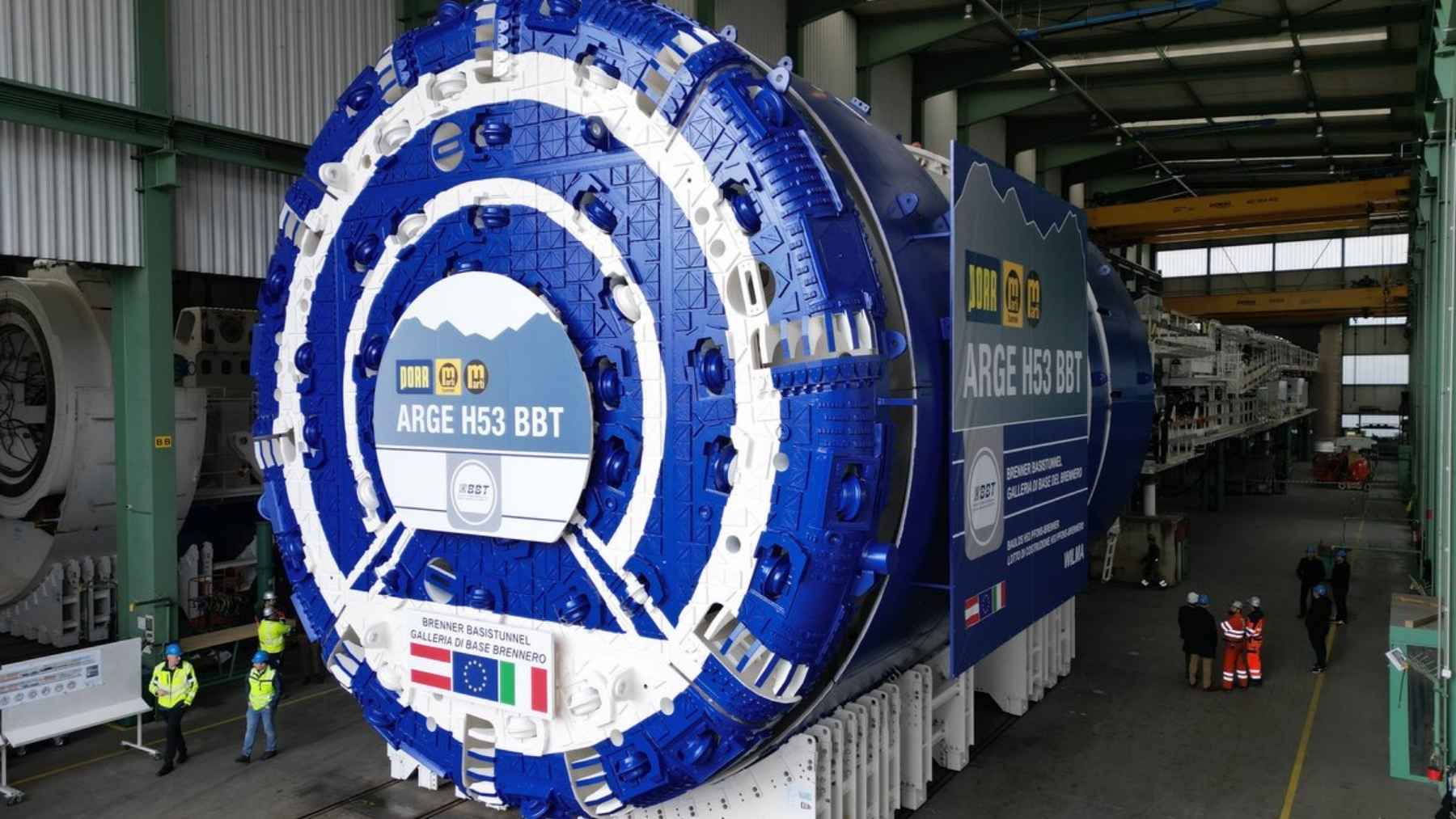
The shafts photograph beautifully. Two headframes on a plateau east of Phoenix, the kind of image that runs with every story about big holes in the ground, including the ones about 3,200-ton borers being assembled inside the Alps.
The thing that actually decides whether copper ever leaves Oak Flat is chillers, cooling towers, insulated pipe and fans. The published life-of-mine plan needs more than 140 megawatts of it. What sits on the ground is a development-phase plant built around three chillers for one shaft.
Everything else about this project is contested, delayed or undecided. The one piece with a firm date on it is the agreement to keep the existing air conditioning running, and that date is April 2030.
 goat ROOKIE2 months ago