
Charging is still the thing that keeps people off EVs. Not the styling, not even the sticker exactly, but the nagging worry about where the next plug is, how long you’ll be stuck beside it, and what that charge actually costs you. That worry has teeth right now. EV sales have slid this year to around 5% of the US market, even as the new-car market overall keeps losing buyers, and “range anxiety” still sits near the top of every survey asking people why they passed on going electric.
Detroit’s answer is a little weird, and in 2026 it’s getting serious. Instead of building more chargers, the city buried the charger under the street. A quarter-mile of 14th Street in Corktown, the same neighborhood where Ford is rebuilding the old Michigan Central train station, is wired with copper coils that push power straight into a moving car. No plug, no cable, no stopping. And the company behind it just spent the first half of this year turning that experiment into a much bigger business.
The company behind it just swallowed its biggest US rival
Start with what’s actually new this year, because the road itself has been quietly running since late 2023. In March 2026, Electreon closed its acquisition of InductEV, an American company that builds ultra-fast stationary wireless chargers for buses and freight trucks. Electreon already owned the dynamic side, charging while you drive, so buying InductEV handed it the whole menu: charge on the move, top up during planned stops, or charge overnight in the depot. The combined lineup now covers everything from passenger cars to light delivery vans to heavy Class 8 trucks, and Electreon showed it off with live demonstrations at the Advanced Clean Transportation Expo in Las Vegas in early May.
The product names tell you where this is going. There’s LINE, the in-road system that charges vehicles at speed on highways and city corridors, and DASH, a semi-dynamic “burst” charger built for places where vehicles already pause, like taxi ranks, bus stops and traffic lights. None of that came out of nowhere. The proving ground for the in-road half of it is that street in Detroit, which is exactly why the Motor City road matters more now than it did when it opened.
Copper coils, a magnetic field, and no plug
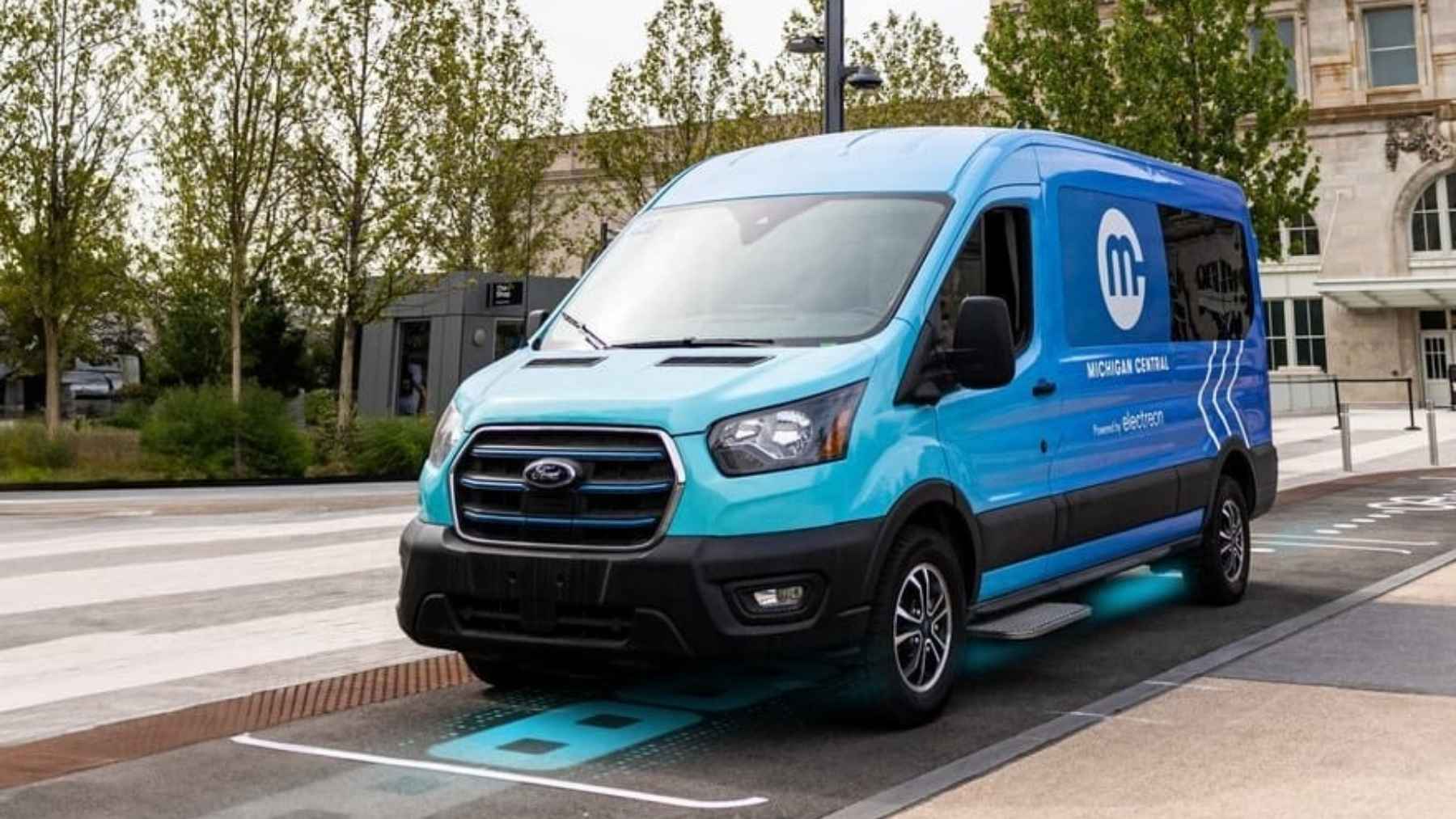
The tech is called inductive charging, and you’ve used a baby version of it if you’ve ever dropped a phone onto a wireless pad. Electreon, the Israel-based company, lays copper coils under the road surface and bolts a matching receiver to the underside of the car. When a vehicle with that receiver rolls over the coils, energy jumps across a magnetic field and into the battery. It works whether the car is moving (dynamic charging) or sitting still (static charging), and the company also dropped two static pads outside Michigan Central Station for parked vehicles.
The part that tends to surprise people is the safety setup. Each coil only switches on when an approved receiver is sitting directly above it, so the road stays inert for pedestrians, pets, and any ordinary car driving over the top. Cold doesn’t break it either. It kept working through ice, snow and Michigan summers, and because the coils live beneath the surface, road repairs and resurfacing don’t touch them.
“We’re excited to spearhead the development and deployment of America’s first wireless charging road,” said Dr. Stefan Tongur, Electreon’s vice president of business development, when the city of Detroit announced the road. The $1.9 million pilot had Governor Gretchen Whitmer’s backing going back to 2021, and Michigan’s transportation department, MDOT, signed a five-year deal with Electreon to find out whether an electric road system actually holds up outside a lab.
It tops you up. It doesn’t fill you up.
There’s an honest catch here, and it matters. This road is not a fast charger. Early test runs in a Ford E-Transit showed the van picking up only a few kilowatt-hours over a short loop, nowhere near enough to fill its battery, which still needed a regular plug to top off. The point of the road isn’t to fully charge you. It’s to keep feeding you a trickle so you arrive with about as much charge as you left with.
That sounds underwhelming until you run the fleet math. On UCLA’s coming version of the system, Electreon says an electric bus gains roughly 4.5 miles of range for every 0.6 miles of electrified lane it drives over. The company’s own case study on the Detroit road claims that with only about 20% of a route electrified, a vehicle can run with what it calls “endless range,” meaning it never stops to plug in because the road keeps quietly refilling the tank. For a city bus, a delivery van or a long-haul truck that runs the same loop all day, that’s the whole ballgame: smaller batteries, less downtime, no depot charger to wait on.
Michigan Avenue is next, and the delivery vans are the point
The Detroit road was always meant to grow into a full mile through Corktown, and the next chunk is the bigger one. It’s a three-quarter-mile run of Michigan Avenue between 17th Street and Brooklyn Avenue, in both directions, folded into the city’s U.S.-12 Corktown Improvement Project, a roughly $70 million rebuild whose underground utility work started in the summer of 2025 and whose major construction is set for 2026. That stretch sits inside a wider plan, the Detroit Mobility and Innovation Corridor, running from Campus Martius downtown out to the I-96 overpass at the edge of Corktown.
Here’s why the commercial angle is the real story. Electreon has a second Detroit project that drops its wireless tech into an Xos stepvan at a UPS facility in the city, and Tongur has said those delivery trucks will be able to draw power off the Michigan Avenue coils while actually running their routes. Xos CEO Dakota Semler framed it as proving the tech in real commercial fleets, the kind of unglamorous, high-mileage duty cycle where shaving downtime turns straight into money. That’s what every version of this is really chasing: buses, vans, trucks and even robotaxis that could in theory run all day without ever stopping to plug in.
Detroit isn’t the only one digging
Other states are watching, and a couple are building. In Los Angeles, UCLA landed a $19.85 million state grant to electrify its BruinBus fleet and install California’s first in-road charging system under Charles E. Young Drive, with the goal of having it running for the 2028 Olympics. Florida is going bigger and faster: a roughly three-quarter-mile charging lane on the new State Road 516 expressway near Orlando, built not by Electreon but by Norwegian firm ENRX, is being designed to push up to 200 kW at highway speed, closer to DC-fast-charger territory, with construction rolling through later this decade.
Electreon, for its part, already runs the world’s first wireless charging highway near Paris, a one-mile test track at Utah State University, and projects across Israel, Europe and China. Add the InductEV deal on top, and the Detroit street stops looking like a one-off science project and starts looking like the company’s American showroom.
So is the plug dead?
Not tomorrow, no. The road still can’t fully charge a passenger car, most EVs on US streets don’t carry the receiver to use it, and the public won’t be driving over it for personal charging for a while yet. Roads that generate or deliver their own power have a rocky history, and the solar-road versions mostly got ripped back up, but this one keeps quietly working. And there’s something fitting about where it’s happening. Detroit built the gas-powered century, and now the Motor City is testing whether the cheapest cure for range anxiety isn’t a bigger battery or a faster charger. It’s a smarter piece of pavement. The plug had a good run. The road is making its case.