
On a Saturday morning in early April, a 7.5-ton unmanned cargo aircraft called the W5000 lifted off the runway at an airport in Zhuzhou, a midsized industrial city in central China’s Hunan province. It climbed to 300 meters — about 985 feet, the kind of altitude small-aircraft traffic in the U.S. operates at over open country — leveled off, and held a cruise of 220 kilometers per hour, roughly 137 miles per hour. Sixteen minutes and 36 kilometers later, it landed. The aircraft did not run on Jet A. It ran on liquid hydrogen, stored at minus 253 degrees Celsius, fed directly into the combustion chamber of a turboprop engine that produces somewhere north of one megawatt of shaft power. The engine is called the AEP100. It was developed by a subsidiary of the state-owned Aero Engine Corporation of China, the Hunan Aviation Powerplant Research Institute, based in Zhuzhou. As of April 4, 2026, it is the first hydrogen turboprop engine in that power class that has actually flown anywhere, and the gap between what a Chinese state lab can put in the air and what Airbus is currently testing in a hangar in Bavaria just became something the rest of the industry has to look at directly.
What the engine actually is
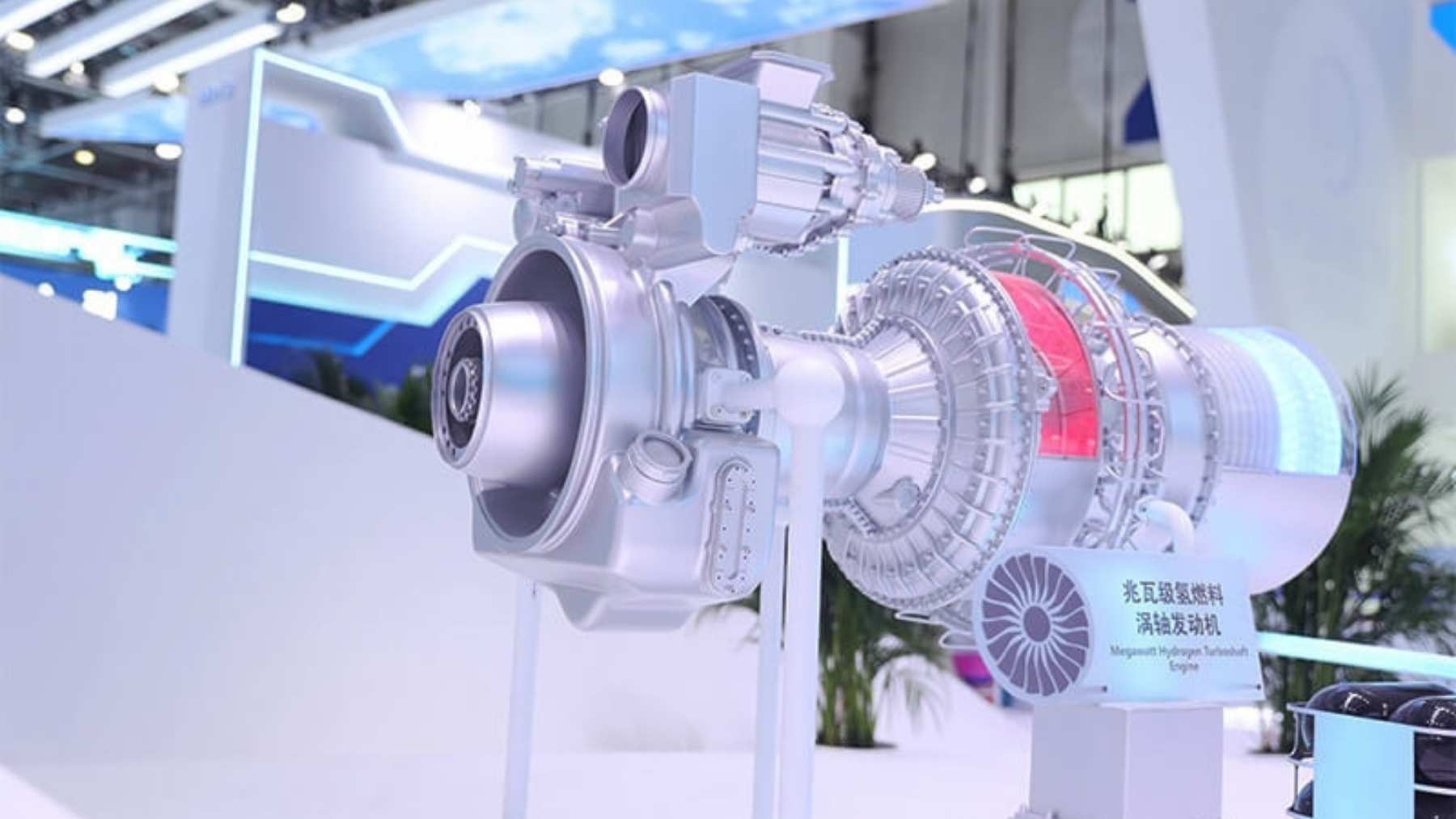
The AEP100 is not a fuel cell. It is a gas turbine. Liquid hydrogen, stored cryogenically in a vacuum-insulated tank, is metered into a combustion chamber where it burns in oxygen drawn from ambient air. The expanding gas drives a turbine that, through a reduction gearbox, spins a propeller. The mechanical architecture is the same one Pratt & Whitney Canada has been refining for forty years on the PT6 and PW100 engine families that power most of the regional turboprops flying today over short-haul markets in North America, Europe, and Southeast Asia. The new part, the part that AECC has now demonstrated in flight, is the fuel system, the modified combustor, and the thermal management required to keep hydrogen liquid at one end of the engine while burning it at three or four thousand degrees Fahrenheit at the other.
I want to be careful about the scale claim here. A megawatt is roughly 1,340 horsepower of shaft output, which is meaningful but is not, on its own, a regional airliner engine. A Bombardier Q400 carries two Pratt & Whitney Canada PW150A turboprops rated at roughly 5,000 shaft horsepower each. An ATR 72 uses two PW127s at around 2,750 shaft horsepower each. A single AEP100 at one megawatt would, by itself, run a King Air 350 or a small commuter aircraft. Two of them on a smaller regional airframe — something in the Dash 8-100/200 class — would do the job. To replace the powerplants on a Q400 or an ATR 72 would still need either a scaled-up version or four engines in place of two. AECC has not published a path to that next step, and as of mid-May, it has not flown one.
Where Airbus actually is
I’ll be plain about this part: I have been hearing the phrase “hydrogen aircraft by 2035” for so long that I had stopped tracking when, exactly, the major Western airframers stopped using it. The answer, in Airbus’s case, is February 6, 2025. That was the date Airbus told its European works council that the ZEROe program, the company’s flagship hydrogen aircraft project unveiled at the height of the COVID-era green-investment cycle in September 2020, was being pushed back by at least five and as much as ten years. The internal memo was reported externally by the French trade union Force Ouvrière, and Airbus confirmed it publicly the following day. Service entry slid from 2035 to 2040 or 2045. Budget for ZEROe was cut by 25 percent. The previously announced plan to flight-test a fuel cell powertrain on the company’s A380 demonstrator was cancelled outright.
What Airbus has actually built, as opposed to what it announced, is a 1.2-megawatt hydrogen-fuel-cell-electric powertrain that ran at full power on a ground test stand at its E-Aircraft System House facility in Ottobrunn, just south of Munich, in late 2023. They call the integrated assembly the “iron pod.” It is, in raw output terms, in the same ballpark as the AEP100. The architecture is completely different — Airbus is converting hydrogen into electricity via fuel cell stacks and then into shaft power via electric motors, where AECC is burning the hydrogen directly. But the headline number is similar. The difference is that the Airbus iron pod has run on a test stand, and the AEP100 has flown.
Airbus, for the record, committed publicly in March 2025 to fuel-cell-electric as the architecture for the eventual ZEROe airframe, walking away from its earlier interest in direct hydrogen combustion. They have their reasons. Fuel cell propulsion produces effectively zero nitrogen oxides at altitude, where NOₓ acts as a more aggressive climate forcer than at sea level. Combustion of hydrogen in a turbine cuts CO₂ to zero but does not eliminate NOₓ, depending on combustor design. Until AECC publishes flight emissions data — and they have not — the “zero-emission” framing being repeated in some of the Western coverage of the AEP100 is technically incomplete.
What Boeing is doing
The American major-airframer position on hydrogen aviation, by the most generous reading, is observational. Boeing has no clean-sheet hydrogen airframe in development. It has published research, contributed engineering support to NASA’s Glenn Research Center on cryogenic hydrogen tankage, and invested through its HorizonX venture arm in ZeroAvia, the U.S./U.K. hydrogen powertrain startup. ZeroAvia’s own timeline for a 40-to-80-seat commercial hydrogen-electric aircraft has slipped past its original 2026 target. None of which is unusual. It is the same kind of slippage every airframer except the Chinese one has been navigating since the post-2020 hydrogen excitement collided with the actual cost curve.
The fueling problem in the United States
The piece of this story that has changed most in the last seven months, and the part most American coverage of the Chinese flight has not caught up with, is the U.S. hydrogen infrastructure picture. The 2021 Infrastructure Investment and Jobs Act authorized $7 billion for seven regional hydrogen hubs, selected by the Biden administration in October 2023. On October 1, 2025, during the first night of a federal government shutdown, the Trump administration’s Department of Energy rescinded $7.56 billion in clean-energy grants, including the full $1 billion award to the Pacific Northwest Hydrogen Hub and the $1.2 billion award to California’s ARCHES hub. Those were the two of the seven hubs designed around green hydrogen made with renewable electricity. The remaining five hubs — in Texas, Appalachia, the Mid-Atlantic, and two in the Midwest — are not, as of this writing, definitively dead, but an internal DOE list obtained by Canary Media the week after the cancellations indicated all seven were under review for termination. Thirteen state attorneys general filed suit in February 2026 over the cancellations. The case is open.
I mention all of that because the easy version of this story is “Chinese state industry is moving fast, Western private industry is moving slow.” That framing is not quite right. The Chinese state has built an engine. The U.S. federal government has spent the past seven months actively dismantling the airport-side hydrogen fueling infrastructure its own predecessor allocated money for. Those are not the same problem.
What the engine doesn’t solve
Even taking AECC’s claims at face value — and the flight has not been independently verified by anyone outside China — a 16-minute test flight at 300 meters in a 7.5-ton unmanned drone is several long, expensive steps short of a certified passenger airliner. AECC has not released a flight test report through any English-language channel. The engine does not yet have a type certificate from the Civil Aviation Administration of China, much less FAA or EASA validation. The liquid hydrogen storage problem — the cryogenic, vacuum-insulated tanks weigh three to four times as much per unit of stored energy as a conventional Jet A tank — is not solved by a 16-minute flight, just demonstrated to be survivable for that duration. And the NOₓ question at cruise altitude, where the climate forcing is most damaging, remains open.
The Chinese research roadmap published alongside the flight, in the Chinese Academy of Engineering’s journal Strategic Study of CAE, lays out three phases: key-technology validation by 2028, regional aircraft application by 2035, mainline commercial aircraft by 2050. Those are roughly the same timeline brackets Airbus is now working with, except Airbus is starting from a 1.2-megawatt fuel-cell-electric powertrain that has run on a stand, and AECC is starting from a one-megawatt hydrogen turboprop that has flown. The 2035 number — regional aircraft on hydrogen — is the one that should make every airline planning committee from Toulouse to Seattle to Beijing recalculate.
Until April, the open question was whether anybody could fly a megawatt-class hydrogen propulsion system in this decade. There is now a partial answer. The answer is yes, and it came out of Hunan, not Toulouse and not Everett. What the rest of the industry does about that, between now and the end of 2026, is the story worth watching.