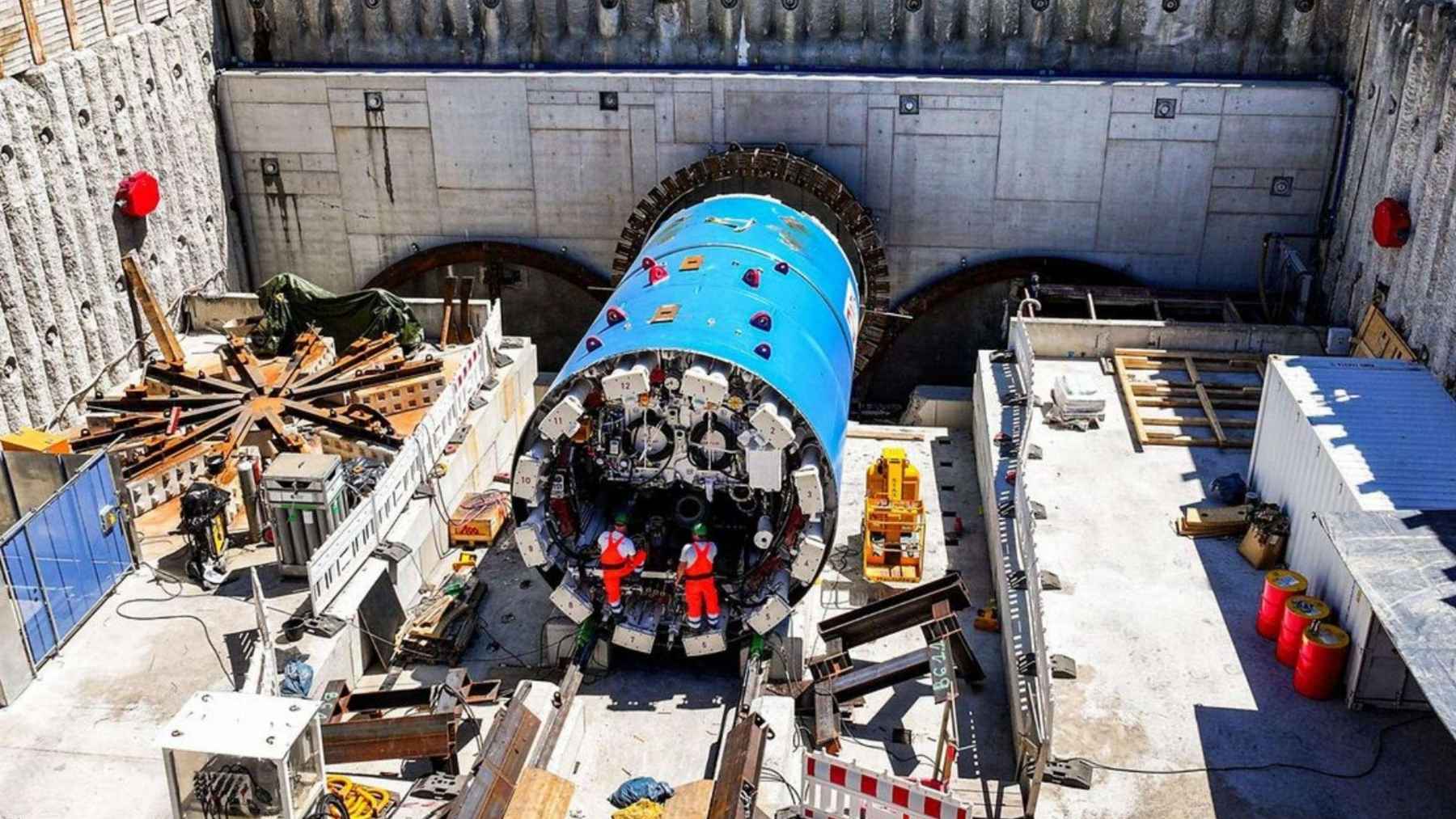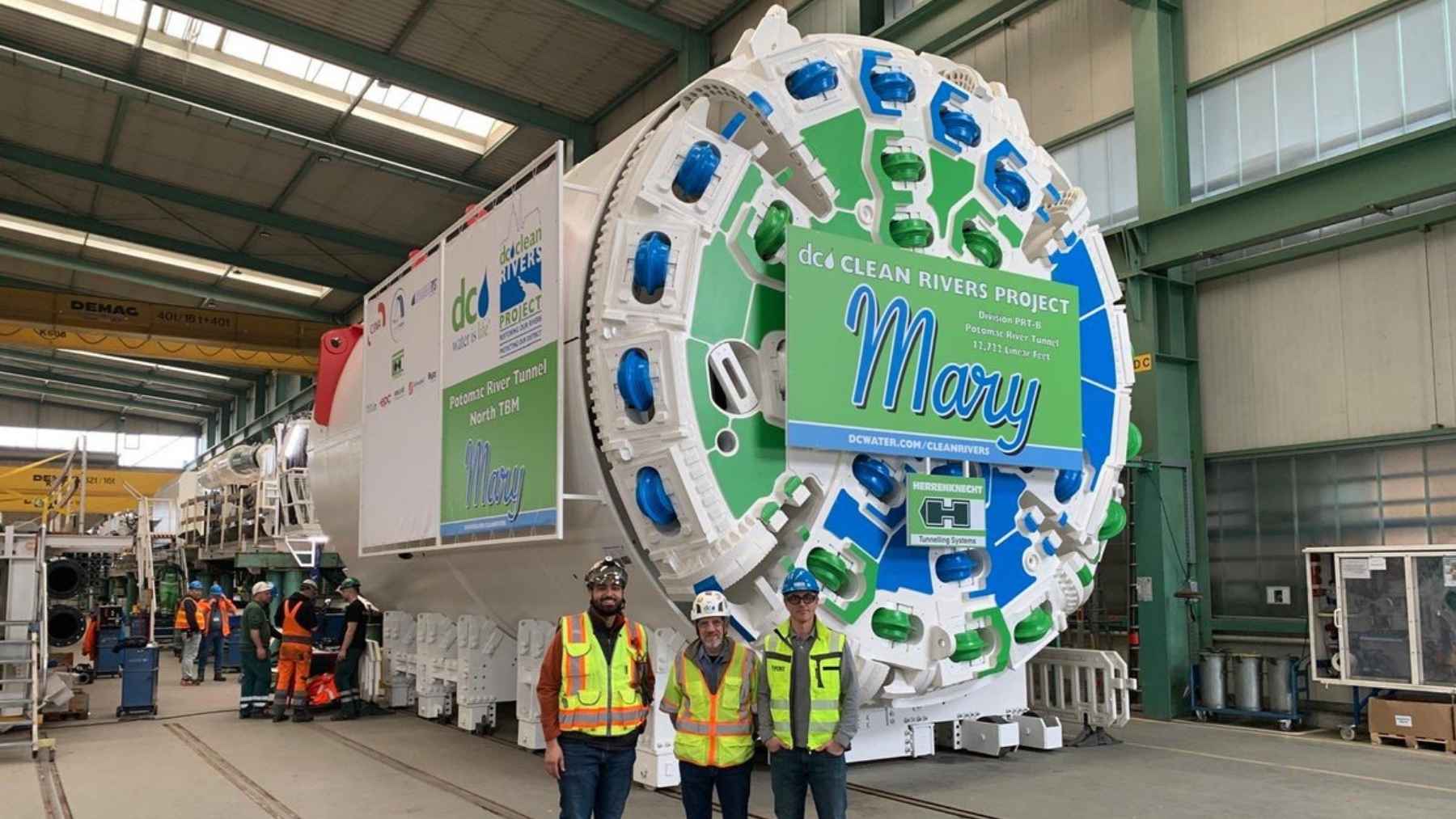

When you picture a tunnel boring machine, you’re probably picturing the front of one. The big round cutting face, teeth all over it, usually photographed with somebody in a hard hat standing next to it for scale. That part does the digging, and it’s a small slice of the machine. The rest of it doesn’t look like a drill at all. It looks like a freight train.
Crews in Washington just bolted on the last car of that train.
DC Water announced on August 27 that the final trailing section behind Mary, the machine cutting the northern leg of the Potomac River Tunnel, had gone down the shaft and been connected. Now that everything’s attached, Mary measures 706 feet end to end, against the 700 feet the utility projected for her back in April. Interim General Manager Matthew T. Brown said DC Water has “a moving factory underground” now, which is a better description than anything I’d have come up with.
Those trailing sections are called gantries. In tunneling that means wheeled platforms loaded with machinery, not the crane-shaped thing the word usually brings to mind.
So why feed it in one piece at a time?
Because the hole’s 100 feet deep and the machine’s 706 feet long. There wasn’t a version of this where Mary went down in one piece.
So a crane picked up each gantry, all 30 tons of it, and lowered it into the shaft at West Potomac Park. A second machine then hauled it in along the tunnel for the crews to bolt onto the back of the line. All of that happened while the front of Mary kept grinding north. She started digging under the river on April 10, which means she spent roughly four and a half months working underground with most of her body still parked up in the daylight.
The gantries are everything that isn’t digging. DC Water says they carry the power and hydraulic systems that push the machine forward, the logistics for moving material, the ventilation, and the space the crew works in. They also haul the excavated dirt and rock back out, and they install the tunnel lining, and that’s what I think most people miss about these machines. A boring machine doesn’t just make a hole and leave it for somebody else. It builds the finished concrete wall behind itself as it goes, ring by ring, so the tunnel’s basically done by the time the machine has passed.
DC Water hasn’t said how many gantries there are in total, which is the one number I’d have liked in the announcement.
Mary has 350 feet of soft ground left
She’s got about 350 feet of digging left before the ground under her changes. She’s in the soft ground beside the river right now. North of that sits the hard bedrock under the District, and cutting rock isn’t the same job as cutting dirt, so the machine has to be set up for it.
She doesn’t come out for that. DC Water says the swap gets done with Mary sitting right where she is underground, and that it runs longer than two months.
So what we’ve got is a machine that just became complete and is about to stop moving. That isn’t a knock on anyone, it’s how the ground works, and the utility put both halves of it in the same announcement. After the changeover she keeps heading north for the rest of the 2.4 miles to Georgetown University.
There’s more than one machine called Mary
Mary and her sister Emily are named for Mary and Emily Edmonson, who tried to escape slavery on the Potomac in 1848 and became well known in the abolitionist movement afterward. Both machines were built by Herrenknecht in Schwanau, Germany, the same firm that supplied the borers for DC Water’s earlier Clean Rivers tunnels.
If the name sounds familiar, it should. A 4,700-ton Mary finished two tubes under Hampton Roads and shipped home to Germany in crates, and another Mary spent the summer under Adelaide. I can’t tell you why that one name keeps winning these things.
Emily is at the site now and will mine roughly 3.1 miles south toward Joint Base Anacostia-Bolling, where this tunnel ties into the Anacostia River Tunnel that’s already down there.
You can go down the shaft yourself
DC Water is throwing the West Potomac Park site open to the public a week from Saturday, on September 19, from 10:30 a.m. to 3 p.m. You get the surface equipment, Emily in person, and activities for kids. For a smaller group who register ahead of time, you get a crane ride 105 feet down the main shaft and a short walk into the tunnel.
That’s the same shaft the 30-ton gantries went down, roughly ten stories of it. If you want to go underground you’ve got to be 18 or older, wear long pants and closed-toe shoes with socks, sign a waiver and sit through a safety briefing. DC Water hands out the protective gear. Everyone else just has to RSVP and show up in flat, fully enclosed shoes.
Is it worth the hassle? I’d do it.
Washington’s sewers still overflow into the river
Most of Washington runs on a combined sewer system, meaning one set of pipes carries household sewage and street runoff together. It was a reasonable idea in the 19th century and it can’t cope with the volume now, so hard rain fills the pipes past capacity and the excess goes into the river instead of to a treatment plant. In an average year that’s about 654 million gallons of stormwater mixed with sewage, spread over roughly 74 separate overflow events.
The tunnel is the catch basin. It sits 100 feet down, it’s 18 feet across, and it holds the combined flow during a storm and then feeds it to the Blue Plains treatment plant once there’s capacity. DC Water expects that to cut overflow volume by 93 percent and drop those 74 events a year to four.
The $819 million job is scheduled to go into service in 2030. DC Water sent the Community Day invitation out on September 9 and said the underground slots are extremely limited.