
Indianapolis Motor Speedway is the loudest thousand acres in American sport. Thirty-three cars, a 2.5-mile oval, 230-plus mph down the straights, and a century of local identity built on the sound of engines that do not care about your fuel bill. It is not where you would go looking for a clean energy landmark.
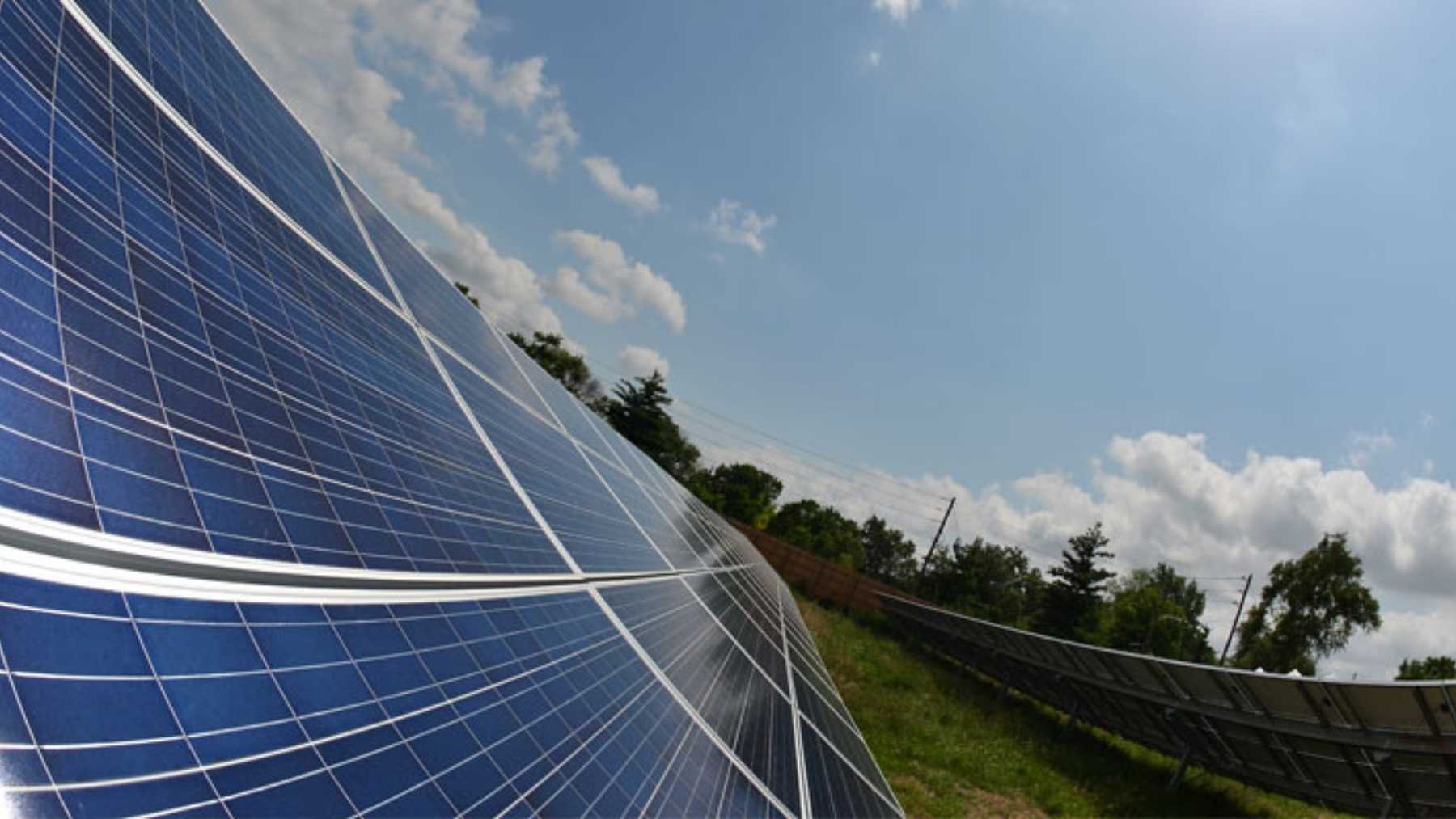
But there is one out there anyway, and it has been running since the summer of 2014. Sitting on a corner of the campus that the track had no other plan for, next to the backstretch of the famous oval, is the largest solar array at any sports venue on the planet. Nine megawatts. Roughly 39,000 panels. Sixty-eight acres of ground that used to do nothing at all.
The Speedway does not own it. The Speedway does not use the power. And on August 14, the company that does own it stopped being a public company, in a deal worth about $6.5 billion that had nothing to do with racing.
Twelve years in, this thing has quietly become one of the strangest pieces of energy infrastructure in the country, and almost nobody has looked at it since the ribbon was cut.
39,312 panels, or 39,314, depending which paragraph you read
The official numbers come from IMS itself. Its July 1, 2014 announcement describes a ribbon-cutting for a solar farm next to the backstretch, carrying 39,312 modules and generating 9.0 megawatts.
Scroll down that same release to the fact sheet and the panel count is 39,314. Two extra panels, in the same document, on the same day. IndyCar’s write-up that afternoon used 39,314 as well. It is a trivial gap, and it is also the first hint that nobody was ever going to audit this thing very hard.
The rest of the fact sheet is more useful. The parcel is 68 acres. The net land the panels occupy is 41.5 acres. The panels themselves cover 21.66 acres, which means most of that footprint is the gaps between rows. Each panel is 48 inches by 72 inches and rated at roughly 230 watts.
That last figure is the one that dates the array. A 230-watt panel was ordinary in 2013. A modern utility-scale module is comfortably double that, and the Cardiff rugby stadium that put 3,296 panels on its roof over one off-season used 455-watt Trina modules to do it. Indy needed about twelve times as many panels to reach six times the capacity.
Federal generator filings fill in what the press release skipped. The array is fixed-tilt at 26 degrees, so there are no trackers following the sun across the sky. It runs about 11.2 megawatts of panels into a 9-megawatt AC connection, which is standard oversizing that keeps the inverters near full output for more hours of the day. It feeds the grid at 13.8 kilovolts and sits inside MISO, the grid operator covering 15 states.
Actual production, according to those same filings, runs around 12.7 gigawatt-hours a year. That ranks it 44th out of 125 solar farms in Indiana. In 2014 it was a world record. In its own state it is now firmly mid-table.
The Speedway leased the land and kept none of the power
This is the part that gets skipped every time the array shows up in a listicle, and it is the whole story.
IMS did not build the solar farm. It rented out a field. Blue Renewable Energy signed a land-lease agreement with the Speedway, SunWize Technologies designed and installed the system, and Clenera and Swinerton Builders finished the engineering and construction on behalf of Centaurus Renewable Energy.
The electricity goes to the utility. Indianapolis Power & Light, which renamed itself AES Indiana in February 2021, is the off-taker under a power purchase agreement, and it also owns the Solar Renewable Energy Credits the system produces. Those credits are the accounting instrument that lets someone claim the clean attribute of the power. The Speedway does not have them.
So when IMS says on its Racing Toward Zero page that it sources 100 percent renewable electricity for all purchased power, that is a separate arrangement from the panels you can see out the window. The track buys renewable power like any other large customer. The field next door sells to the grid.
Both things are true, and they are not connected. The most photogenic solar array in American sport is a merchant power plant that happens to have a racetrack as a landlord.
The record is real, but the category keeps sliding around
In 2014 the language was blunt. IMS called it the largest solar farm at any sporting facility in the world, full stop. That claim took the title off Pocono Raceway, which had dedicated a 3-megawatt, 25-acre array beside its own 2.5-mile track in July 2010 and spent four years as the benchmark.
Today the same claim on the IMS sustainability page reads a little differently: largest solar array on a sports campus in the world. Campus, not facility. It is a smaller word doing more work, and it is the correct one, because the headline-grabbing record moved somewhere IMS cannot follow.
Borussia Dortmund finished 11,132 modules across the roof of Signal Iduna Park, went fully operational in December 2025, and now holds the certified record for the largest solar installation ever built on a stadium roof at more than 5 megawatts peak. Istanbul’s Nef Stadium had it before that at 4.2 MW. Cardiff’s Principality Stadium claims the UK sports venue record at about 1.5 MW.
None of them touch nine megawatts. They also all sit on the building, which is the version of this that photographs well and gets a press conference. A field of fixed-tilt panels on spare land beside a racetrack is the boring version, and the boring version is still winning by a factor of nearly two.
One other thing changed on that page. The 2014 fact sheet said the array could meet the needs of 1,000 homes, based on 1,100 kilowatt-hours per household per month. The current page says it powers 1,100 homes. The panel count went from 39,312 to “nearly 40,000” in the same edit. Nobody has repowered anything. The numbers just drifted.
The date that actually matters is 2029
Ownership of this array has changed hands twice, and the second time was last week.
Centaurus Renewable Energy sold its controlling interest in a seven-plant American solar portfolio to Montreal-based Boralex in a deal announced in November 2020 and closed in early 2021. The portfolio totaled 209 megawatts across California, Alabama and Indiana. The Indiana asset was the Speedway array, and it came with a power purchase agreement running to 2029.
That was the earliest expiry in the whole package. Boralex disclosed contract end dates spanning 2029 to 2046, with a weighted average of more than 21.5 years remaining. Indy was the short one then and it is the short one now, roughly three years out.
Then, on August 14, Brookfield and La Caisse completed their acquisition of Boralex itself, paying C$37.25 per share in cash in an arrangement valued at around C$9 billion including debt. Boralex shares came off the Toronto Stock Exchange on or about August 17.
The largest solar array at any sports venue on Earth is now a line item inside a private Canadian portfolio, three years from the expiry of the only contract that has ever made it money.
What happens next is a genuine open question. Nobody has announced a repowering, an extension or a decommissioning. The panels themselves are unlikely to be the problem. A Swiss rooftop array from the 1980s still has 48 of its original modules feeding the grid, while the inverter underneath has been replaced five times. Solar panels age slowly. Contracts do not.
Nine megawatts used to be a world record. Now it is a rounding error.
Here is the part that puts the whole thing in perspective, and it involves the same utility.
In February 2026, AES Indiana brought its Petersburg Energy Center into service: 250 megawatts of solar from more than 515,000 panels, paired with 180 megawatt-hours of battery storage, built next to a coal plant the company is converting to gas. AES Indiana says it powers over 100,000 homes.
Same buyer. Same state. Roughly 28 times the capacity and 13 times the panels of the array at the Speedway, commissioned twelve years later.
Northwest Indiana went further still. Mammoth Solar’s first 400-megawatt phase came online in 2024 on a 13,000-acre site, heading for 1.3 gigawatts. That one phase is more than 40 times the Speedway array.
That is not a knock on Indy. It is the point. In 2014, nine megawatts on 68 acres was a world record worth a ribbon-cutting and a president’s quote. In 2026, it is what a developer builds on a landfill because the land was cheap, which is exactly what is happening on 240 acres of old Houston dump right now at 52 megawatts. The record did not get beaten at sports venues. The rest of the industry just walked past it.
Repower it, or hand the field back
The trophy is not the number worth watching. Nine megawatts stopped being impressive years ago, and IMS knows it, which is why its sustainability page now leads with 2030 emissions and waste targets rather than the panels.
The number worth watching is 2029. That is when a twelve-year-old fixed-tilt array of 230-watt modules, sitting on leased ground beside a racetrack, finds out whether a new private owner wants to renegotiate, repower, or hand 68 acres back to the Speedway.
Repowering looks like the obvious move. The interconnection is built, the lease exists, and the same footprint with modern modules would clear nine megawatts without laying a single new cable to the grid.
Then again, Brookfield bought a Canadian renewables platform for its wind fleet and its development pipeline, not for a novelty solar field in Indianapolis with three years left on the meter. Either way, the answer lands before the 2029 Indy 500 does.