
2026 Ford Explorer
Overview
What's New for 2026
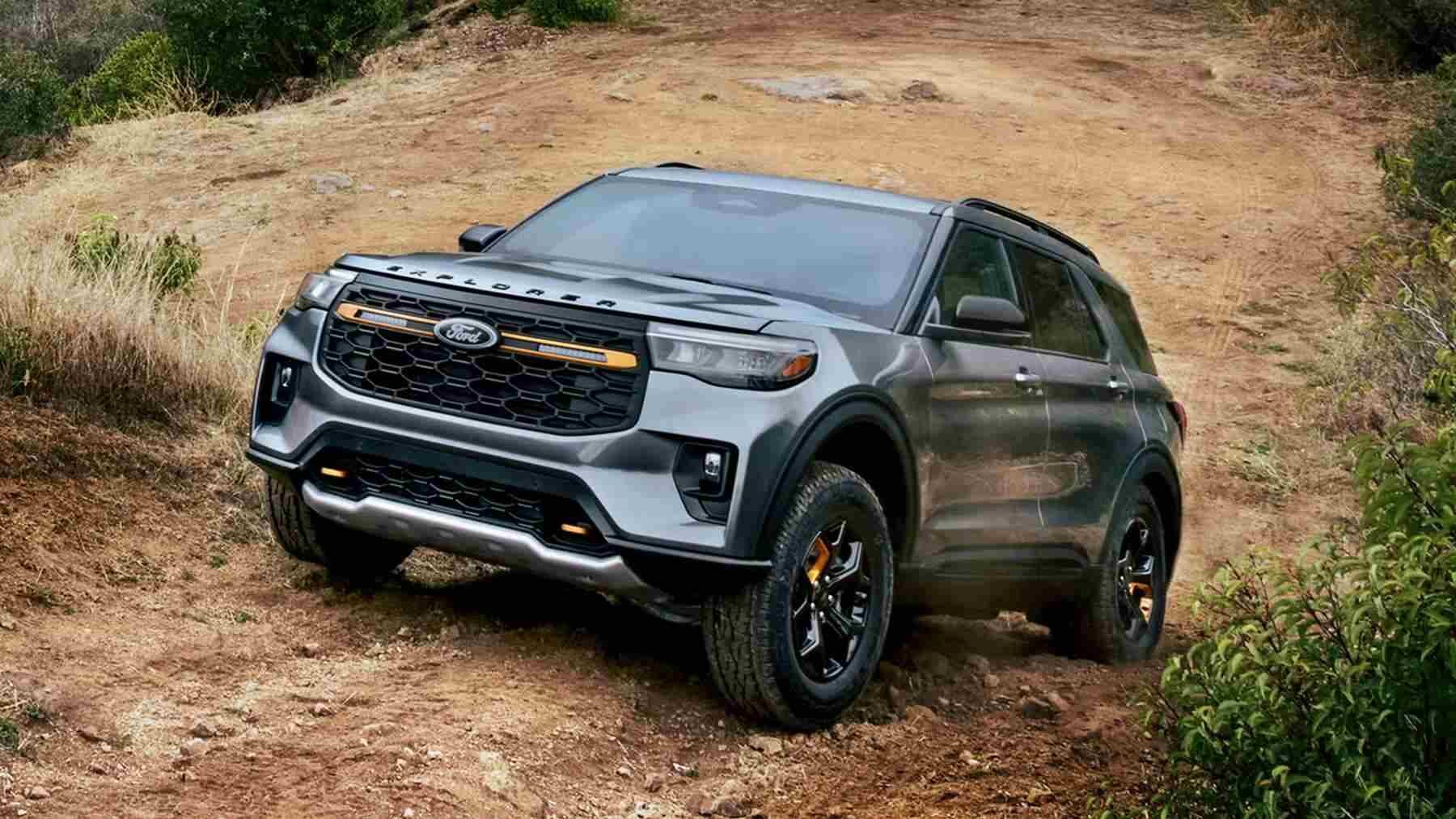
The 2026 Ford Explorer introduces a transformative new trim level: the Tremor, Ford's off-road-focused variant that repositions the Explorer beyond traditional three-row family transportation. The Tremor arrives with lifted suspension, all-terrain tires, locking differentials, and Terrain Management System that genuinely enhances capability on unpaved surfaces. This strategic addition mirrors successful formula deployed across Ford's truck lineup, enabling adventure-minded buyers to equip a three-row SUV without sacrificing vehicle-per-dollar economics or family practicality.
Additional refinements include enhanced BlueCruise Intelligent Active Steering integration with automatic lane-change capability, reducing driver workload during extended highway driving. The powertrain lineup remains anchored by the proven 2.3L EcoBoost four-cylinder and available 3.0L EcoBoost twin-turbo V6, both delivering meaningful performance improvements over competitors' comparable offerings. Interior ergonomics receive targeted refinement including improved seat comfort, upgraded acoustic treatments, and expanded wireless charging to address lifestyle technology demands.
Styling evolution emphasizes purposeful stance over marketing flash. Revised front fascia design improves airflow efficiency while establishing clearer visual differentiation between the entry-level Active, mid-range ST-Line, adventure-focused Tremor, luxury Platinum, and performance-oriented ST variants. This clear trim hierarchy simplifies buying decisions while maintaining a cohesive design language.
Overview
The Explorer occupies the critical three-row SUV segment, competing against Honda's Pilot, Toyota's Grand Highlander, Kia's Telluride, and Hyundai's Palisade. Starting at $40,025 for the Active trim with 2.3L EcoBoost, the Explorer delivers compelling value positioning—undercutting most direct competitors while offering equivalent or superior powertrain options. The lineup extends to $56,465 for the range-topping ST variant, positioning premium pricing for high-output performance. New Tremor sits at $48,330, strategically pricing below Platinum to differentiate capability emphasis from traditional luxury focus.
Dimensionally, the Explorer measures 198.7 inches long, 78.9 inches wide, and 70.8 inches tall, providing genuine three-row seating without excessive overall footprint. The design delivers 19.3 cubic feet of cargo space behind the third row, 43 cubic feet with the third row folded, and exceptional 87.8 cubic feet maximum capacity with second-row seats folded flat. This cargo flexibility accommodates evolving family needs from infant car seats to cross-country moving logistics. Towing capacity reaches 5,300 pounds when properly equipped, adequate for utility trailers and mid-size boat trailers.
All-wheel drive appears standard on most trims (except Active with rear-wheel-drive option), providing meaningful traction advantage during winter driving and light off-road exploration. The independent double-wishbone front suspension and multi-link rear axle deliver composed on-road manners without sacrificing rough-terrain capability, a balancing act that elevates the Explorer above traditional crossovers and approaching truck-based SUV dynamics.
Driving Experience
The base 2.3L EcoBoost four-cylinder produces 300 horsepower and 310 pound-feet of torque, delivered through a ten-speed automatic transmission. Real-world acceleration reaches 0-60 mph in approximately 8.5 seconds, providing adequate highway merging without thrilling performance. The turbocharger enables responsive power delivery at highway speeds, minimizing traditional four-cylinder labor sensations during overtaking maneuvers. EPA fuel economy ratings of 21 city / 26 highway / 23 combined reflect turbocharged four-cylinder efficiency realities; real-world owners report 22-24 mpg combined on mixed driving, reasonable for a three-row 4,400-pound vehicle.
The available 3.0L EcoBoost twin-turbo V6 represents a meaningful step forward, producing 400 horsepower and 415 pound-feet of torque. The 0-60 sprint improves to approximately 6.8 seconds, transforming the Explorer from family hauler to genuinely spirited performer. Highway passing becomes effortless; even fully loaded with passengers and cargo, the V6 maintains responsive power delivery. EPA fuel economy drops to 17 city / 22 highway / 19 combined, a 4 mpg penalty reflecting the additional displacement and twin-turbocharged architecture. Real-world testing reveals 19-21 mpg combined, acceptable for drivers prioritizing performance over economy.
Both powertrains benefit from ten-speed automatic transmission tuning, with aggressive downshifts during spirited driving and efficient highway cruising at lower engine speeds. Tow-haul mode optimizes transmission behavior for trailer dynamics, holding gears during descents and minimizing hunting during sustained towing operations. The transmission demonstrates responsiveness without excessive aggression, finding balance between sport-tuned automatics and purely efficiency-optimized units.
On-road handling reflects three-row SUV realities: composed but not athletic. The independent suspension provides bump compliance without excessive body roll during aggressive cornering. Steering response feels direct but not oversensitive; highway stability remains confident up to legal speeds. The Tremor variant's lifted suspension (0.75-inch height increase) and all-terrain tires (size 255/60R20 on 20-inch wheels) introduce slightly softer ride character compared to Platinum or ST variants wearing summer performance rubber, but off-road clearance improves meaningfully to 8.8 inches versus 8.6 inches on standard Explorers.
Interior, Comfort & Technology
The Explorer cabin emphasizes family-friendly practicality. Soft-touch materials appear on Active trim dash upper surfaces; leather upholstery upgrades on ST-Line and above variants. The infotainment centerpiece is a standard 10.1-inch touchscreen running SYNC 4A, responsive and intuitive with wireless Apple CarPlay and Android Auto standard. Wireless charging appears on mid-level trims and above, eliminating cable clutter. Over-the-air software updates enable annual feature additions and improvements without dealership visits.
Second-row seating accommodates three adult passengers with reasonable comfort; the center seat lacks adult-acceptable lumbar support, reserving it for children during family road trips. Second-row passengers enjoy 36.9 inches of legroom (front-to-rear), adequate for adults on moderate-duration travel. Third-row access requires second-row forward tilting, a manageable inconvenience for occasional child occupants. Third-row legroom measures 32.9 inches, satisfactory for children under 12 or brief adult stints during carpooling.
Climate zones include dual-zone on base models with tri-zone available on premium variants, enabling temperature preferences across cabin sections. Heated and ventilated front seats appear on ST-Line and above; heated second-row outboard seats on Platinum. The panoramic sunroof extends visual space while introducing weight at the expense of some structural rigidity. BlueCruise adaptive cruise control with automatic lane change simplifies highway commuting, enabling hands-off driving during extended highway stretches (with periodic attention requirements)—a meaningful convenience upgrade compared to traditional adaptive cruise.
Technology integration includes available Co-Pilot360 with advanced features like blind-spot monitoring with cross-traffic alert, 360-degree camera system, and automatic parking assistance. The Tremor's Terrain Management System provides selectable drive modes (Normal, Eco, Sport, Tow/Haul, Slippery, and Off-Road) that adjust transmission behavior, engine mapping, and traction control settings for diverse driving conditions.
Trim Levels & Pricing
The 2026 Explorer's trim structure progressively adds equipment and capability focus, from Active's practical foundation through ST's performance emphasis. The new Tremor trim strategically positions adventure capability between established trims, allowing customers to prioritize off-road prowess without luxury-focused Platinum equipment. This structure accommodates diverse buyer priorities effectively.
| Trim | Starting MSRP | Key Features |
|---|---|---|
| Active (2.3L) | $40,025 | 2.3L EcoBoost, 10.1-in SYNC 4A, Co-Pilot360, RWD standard/AWD optional |
| ST-Line (2.3L) | $43,580 | Enhanced styling, wireless charging, leather seating, dual-zone climate |
| Tremor (2.3L or 3.0L) | $48,330 | Lifted suspension, all-terrain tires, Terrain Management System, 3.73 electronic locking diff, standard intelligent 4WD |
| Platinum (2.3L or 3.0L) | $52,145 | Heated/ventilated leather, panoramic sunroof, B&O audio, adaptive suspension, luxury trim focus |
| ST (3.0L V6) | $56,465 | 3.0L twin-turbo V6 (400 hp), performance suspension, Brembo brakes, sport-tuned steering, active exhaust |
Value analysis reveals interesting positioning. The Active at $40,025 provides genuine transportation capability at competitive pricing; buyers prioritizing practical family hauling find excellent value. The ST-Line ($43,580) adds meaningful comfort and technology features for $3,555, providing proportional value. The new Tremor ($48,330) targets adventure enthusiasts seeking off-road capability without luxury focus—competitively priced against Hyundai Palisade and Kia Telluride off-road variants. The 3.0L EcoBoost option adds approximately $2,200 premium cost versus 2.3L base, reasonable for tripling torque delivery from 310 to 415 lb-ft. The ST at $56,465 represents the performance pinnacle, targeting drivers unwilling to sacrifice capability for family practicality.
Safety
The Explorer incorporates comprehensive safety architecture including ten airbags, electronic stability control with rollover mitigation, and hill-descent control. Co-Pilot360 driver-assist features appear standard, providing forward-collision warning with automatic emergency braking, lane-departure warning, lane-keeping assist, and automatic high-beam operation. Available features include blind-spot monitoring with cross-traffic alert, rear parking sensors, and a 360-degree camera system.
Three-row SUVs present unique safety challenges compared to smaller vehicles; the Explorer's substantial 4,400-pound curb weight provides mass advantage during collisions, though the higher center of gravity influences rollover dynamics. The electronic stability control and traction management systems provide meaningful assistance during emergency maneuvers and adverse weather conditions.
For detailed safety ratings and crash test results, visit NHTSA.gov and IIHS.org for the most current independent testing data specific to the Explorer. These resources provide comprehensive information on real-world accident outcomes.
Warranty & Ownership Costs
Ford's warranty coverage provides standard protection across the Explorer lineup. Three-year basic coverage addresses manufacturing defects; the extended powertrain warranty protects critical components through 60,000 miles. Maintenance costs follow predictable patterns for turbocharged engines; synthetic oil changes every 10,000 miles, engine air filter replacement every 15,000-30,000 miles, and transmission fluid service every 100,000 miles represent primary intervals.
| Coverage | Duration |
|---|---|
| Basic Warranty | 3 years / 36,000 miles |
| Powertrain Warranty | 5 years / 60,000 miles |
| Corrosion Perforation | 5 years / unlimited miles |
| Roadside Assistance | 5 years / 60,000 miles |
Real-world ownership costs reflect three-row SUV economics. Annual fuel costs for the 2.3L ($1,400-$1,600 at 23 mpg combined) exceed comparable sedans by 40% but represent reasonable efficiency for three-row capacity. Insurance premiums typically run $1,600-$1,900 annually for comprehensive and collision coverage, depending on driver history and location. Maintenance under warranty proves inexpensive; post-warranty service at independent shops costs 25-35% less than dealership rates for routine items. The 3.0L twin-turbo requires quality synthetic oil (Shell Rotella or Mobil 1 TriSynthetic recommended) and exhibits excellent reliability across three model years of real-world operation. Extended warranties beyond five years rarely provide economical value given the Explorer's established reliability record.
The Bottom Line
The Verdict: The 2026 Ford Explorer successfully bridges three-row family transportation with meaningful capability and spirited performance options. The new Tremor variant is a clever strategic addition that enables adventure-minded families to prioritize off-road capability without sacrificing practicality or interior space. The 3.0L EcoBoost twin-turbo provides legitimate performance capability, transforming the Explorer from family hauler to genuinely fun-to-drive vehicle when equipped on premium trims.
Who Should Buy: Families requiring genuine third-row seating for frequent passengers benefit from the Explorer's spacious cabin and practical design. Adventure-minded buyers should prioritize the Tremor, which adds capability justifying the cost premium. Performance enthusiasts considering the ST variant will appreciate meaningful power delivery. Budget-conscious buyers should target the Active trim, which provides excellent value foundation without compromise on essential features.
Who Should Look Elsewhere: Those unable to compromise on the highest fuel efficiency should evaluate hybrid three-row competitors (if available). Buyers requiring seating for more than six passengers should consider extended versions or traditional minivans. Off-road enthusiasts demanding extreme articulation or rock-crawling ability should consider purpose-built platforms or upgraded trucks. Those prioritizing luxury finishes should evaluate Chevrolet Traverse or Buick Enclave alternatives.
Frequently Asked Questions
Does the 2026 Explorer have a hybrid powertrain option?
No, the 2026 Explorer is exclusively gasoline-powered, utilizing the 2.3L EcoBoost four-cylinder and optional 3.0L EcoBoost twin-turbo V6. Ford has not announced hybrid or electric variants for the Explorer, focusing electrification efforts on the Mustang Mach-E and future platforms. This limits the Explorer's appeal to efficiency-focused buyers; the 23 mpg combined 2.3L rating lags hybrid competitors from Honda, Toyota, and Kia. Buyers prioritizing fuel economy should evaluate the Honda Pilot (28 mpg hybrid) or Toyota Grand Highlander (28-30 mpg hybrid) before committing to the Explorer's gasoline-only powertrain.
How much cargo space is available with all three rows occupied?
With all three rows in use, the Explorer provides 19.3 cubic feet of behind-third-row cargo space—adequate for groceries, luggage, and modest cargo during family road trips. Folding the third-row seats (5 seconds operation) expands capacity to 43 cubic feet; folding the second row enables maximum 87.8 cubic feet. For perspective, a full-size suitcase (22x14x10 inches, 4,928 cubic inches) consumes 3.4 cubic feet, allowing five large suitcases behind the third row. This flexibility accommodates evolving family needs from infant car seats to moving logistics during seasonal transitions.
What real-world off-road capability does the Tremor provide?
The Tremor's 8.8-inch ground clearance, all-terrain tires, electronic locking differential, and Terrain Management System enable genuine unpaved road performance. The vehicle successfully navigates fire roads, rocky terrain, stream crossings (up to 2 feet depth), and sand/gravel surfaces with confidence. The electronic locking rear differential distributes power equally between wheels during low-traction situations, improving extraction capability in mud or deep sand. However, the Tremor is not a rock-crawler; it excels at scenic backcountry exploration and weekend adventure activities rather than extreme technical driving. The standard intelligent 4WD system automatically engages when wheel slip is detected, optimizing traction during challenging sections. Most recreational users find Tremor capability more than adequate; those requiring specialized rock-crawling performance should prioritize trucks or dedicated off-road vehicles.
Is BlueCruise safe for extended highway use without driver attention?
BlueCruise with automatic lane-change provides meaningful highway convenience, enabling hands-free driving on well-mapped divided highways. However, the system explicitly requires periodic driver attention; extended periods without hands on the steering wheel trigger warnings and system disengagement. The system monitors lane markings, vehicle position, and surrounding traffic to enable safe lane changes; malfunctioning lane markings or unusual traffic patterns can disrupt operation. Most owners find BlueCruise valuable for reducing fatigue during extended highway driving (2+ hour stretches) while maintaining legal and safety requirements for attentive operation. The technology is genuinely useful but not autonomous; drivers unable to stay engaged should rely on traditional cruise control instead.
How does the 3.0L twin-turbo V6 compare to naturally-aspirated six-cylinder competitors?
The Explorer's 3.0L EcoBoost twin-turbo produces 400 horsepower and 415 pound-feet of torque, matching or exceeding naturally-aspirated six-cylinder competitors while delivering superior low-end torque. The Chevy Traverse uses a 3.6L naturally-aspirated V6 producing 310 horsepower; the Toyota Grand Highlander uses a 3.5L producing 362 horsepower. The Explorer's twin-turbo delivers comparable horsepower to the Toyota with superior torque, enabling 0-60 mph in approximately 6.8 seconds versus 7.2 seconds for the Grand Highlander. The fuel economy trade-off is real (19 mpg combined versus 25 mpg hybrid), but acceleration response and passing performance clearly favor the Ford. Buyers prioritizing performance should test the 3.0L extensively; the distinctive twin-turbo character and aggressive throttle response may not suit all driving preferences.
Can the third-row seats accommodate adults for extended road trips?
The third row measures 32.9 inches of legroom, adequate for children and teenagers but cramped for adult occupants on extended drives. Adults can sit comfortably for 1-2 hours during regional trips (under 200 miles) but experience noticeable discomfort on longer journeys. The seat design prioritizes space efficiency over back-support padding; sustained sitting requires postural adjustments every 30-45 minutes. Parents frequently relocate children to the more spacious second row during longer road trips, utilizing the third row primarily for occasional use. Buyers planning frequent multi-hour trips with adult third-row passengers should evaluate vehicles offering more spacious third rows, such as the Chevrolet Suburban or GMC Yukon XL, which provide superior legroom and comfort.
Key Highlights
- Three-row midsize SUV with RWD or 4WDn2.3L EcoBoost I4 (300 hp) standard across most trimsn3.0L EcoBoost V6 (385 hp) on ST and TremornNEW Tremor off-road trim with lifted suspension for 2026nBlueCruise with Automatic Lane Change capabilitynPanoramic fixed glass roof available all trims
Powertrain Options
| Engine | Horsepower | Torque | Fuel | MPG |
|---|---|---|---|---|
| 2.3L EcoBoost Turbo I4 | 300 hp | 310 lb-ft | Gasoline | 20 city / 29 hwy / 24 combined |
| 3.0L EcoBoost Twin-Turbo V6 | 400 hp | 415 lb-ft | Gasoline | 18 city / 25 hwy / 21 combined |
Transmission: 10-speed automatic
0-60 mph: 5.5 seconds
Specifications
Pros & Cons
✓ Pros
- 300 hp standard engine is powerful for the segmentnNEW Tremor adds genuine off-road capabilitynBlueCruise hands-free driving impressive on highwaysnThree-row seating serves families wellnPanoramic roof brightens the cabin across all trimsnStrong towing at up to 5,300 lbs
✗ Cons
- Rear-wheel drive standard unusual for SUV segmentnThird-row space tight compared to Pilot and TelluridenStarting above $40,000 is competitive but not value-leadingnFuel economy of 20-24 mpg moderate for four-cylindernNo hybrid or PHEV option availablenSome interior trim materials feel plasticky