
2026 Honda Pilot
What's New for 2026 The 2026 Honda Pilot receives targeted updates that refine an already competitive three-row SUV.
Overview
What's New for 2026
The 2026 Honda Pilot receives targeted updates that refine an already competitive three-row SUV. The lineup now spans seven trims—Sport, EX-L, TrailSport, Touring, Touring Blackout, Elite, and the new Black Edition that tops the range. Google built-in with a three-year unlimited data plan is now standard across all trims, and the 12.3-inch touchscreen carries over with wireless Apple CarPlay and Android Auto. The 3.5-liter V6 returns with 285 horsepower paired with a 10-speed automatic, and the i-VTM4 all-wheel-drive system remains available on Sport and EX-L trims while coming standard from TrailSport upward. Starting price is $42,195 for the Sport.
Overview
The 2026 Honda Pilot occupies a critical position in Honda's SUV lineup as the brand's three-row family hauler. Starting at $42,195 for the base Sport and topping out at $54,995 for the Black Edition, the Pilot offers seating for up to eight passengers in most configurations—or seven in the TrailSport, which replaces the second-row bench with captain's chairs. Seven trims span the range, with the Sport and EX-L serving as the value-oriented options available with front-wheel or all-wheel drive, while the TrailSport through Black Edition come exclusively with AWD and progressively richer equipment.
All trims share the same 3.5-liter V6 producing 285 horsepower at 6,100 rpm and 262 lb-ft of torque at 5,000 rpm, channeled through a 10-speed automatic transmission. At 200.1 inches long on a 113.8-inch wheelbase (the TrailSport measures 200.4 inches due to its unique bumpers), the Pilot is sized to compete directly with the Toyota Grand Highlander, Hyundai Palisade, and Chevrolet Traverse. Cargo volume measures 18.6 cubic feet behind the third row, 87.0 behind the first row, and expands to approximately 112 cubic feet maximum with all rear seats folded. Curb weight ranges from 4,336 pounds for the FWD Sport to 4,722 pounds for the TrailSport.
EPA fuel economy ratings are 20 city / 27 highway / 22 combined for front-wheel-drive trims, dropping to 19/25/21 with all-wheel drive and 18/23/20 for the TrailSport with its all-terrain tires. The 18.5-gallon fuel tank running on regular unleaded provides a real-world range of approximately 390–410 miles depending on configuration. Towing capacity is 3,500 pounds with front-wheel drive and 5,000 pounds with all-wheel drive—competitive figures for the three-row segment. Competitors include the Toyota Grand Highlander (from approximately $40,000), Hyundai Palisade (from around $38,000), and Chevrolet Traverse (from roughly $36,000).
Driving Experience
The Pilot's 285-horsepower V6 delivers smooth, confident power that suits the vehicle's family-hauler mission. Acceleration is strong enough to merge confidently onto highways even with a full load of passengers, and the 10-speed automatic shifts cleanly with minimal hunting between gears. Honda's rev-matching capability on downshifts adds refinement that elevates the driving experience beyond what most three-row SUVs deliver. The naturally aspirated V6's linear power delivery feels more predictable than the turbocharged four-cylinder engines found in some competitors—there's no turbo lag, and throttle response is immediate across the rev range.
The unibody construction, MacPherson strut front suspension, and multi-link rear suspension deliver a composed ride that absorbs road imperfections without the floaty sensation common in large SUVs. Highway cruising is remarkably quiet, with Honda's Active Noise Cancellation system working to minimize engine and road noise intrusion. The electric power steering provides reasonable feedback and accurate turn-in response, and the 37.8-foot turning diameter makes parking lot maneuvers manageable for a vehicle of this size. Body roll is well-controlled through corners, and the Pilot feels more agile than its dimensions suggest.
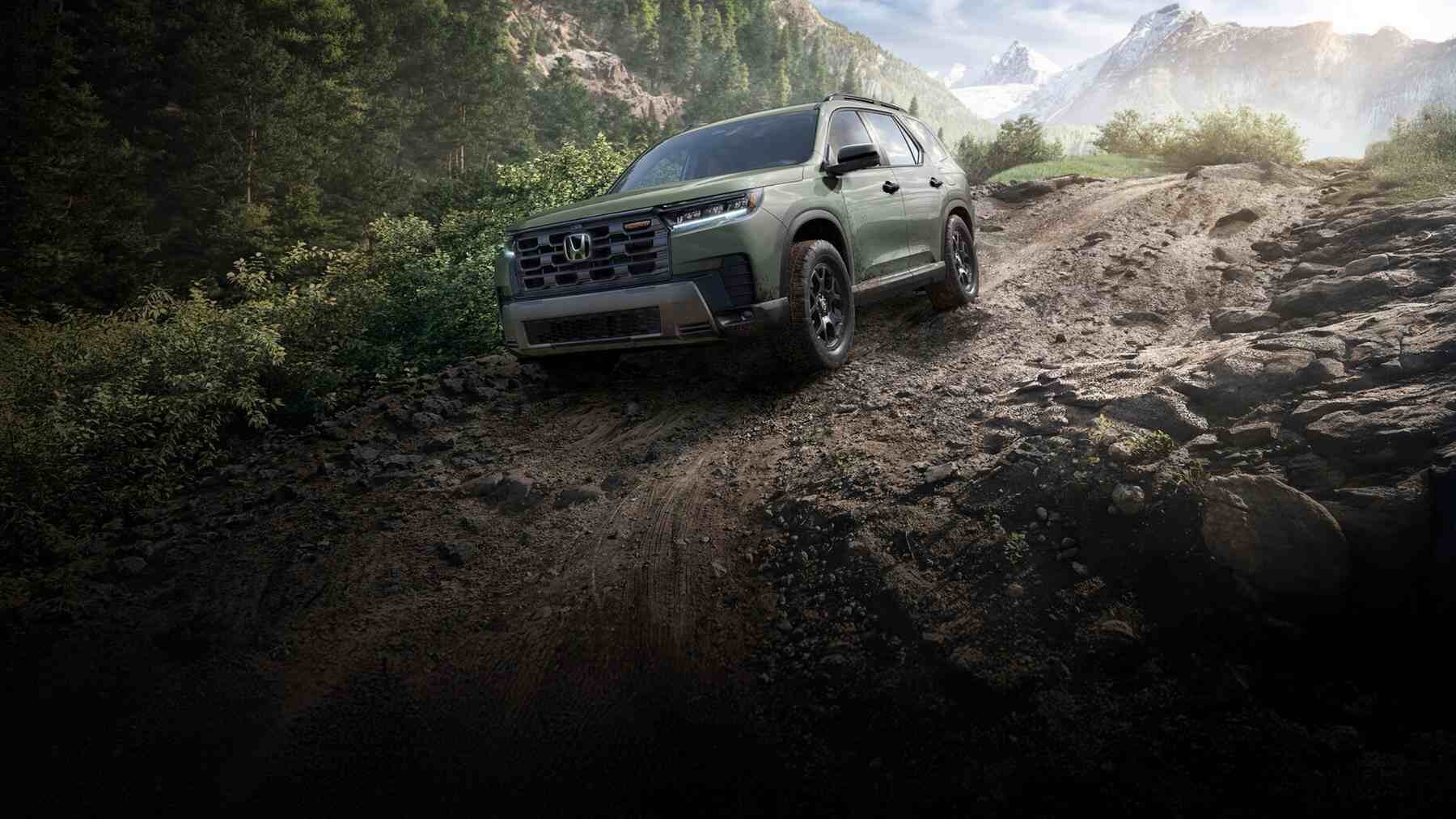
The second-generation i-VTM4 all-wheel-drive system can direct torque to individual rear wheels for improved traction, and the TrailSport adds Trail Torque Logic along with 8.3 inches of ground clearance—up from the standard 7.3 inches. Drive modes vary by trim: Sport and EX-L (2WD) get Normal, Econ, Sport, Snow, and Tow, while AWD-equipped trims from TrailSport upward add Trail and Sand modes. Towing capacity reaches 5,000 pounds with AWD, and the Pilot handles trailer loads confidently thanks to the V6's broad torque curve and the 10-speed's intelligent gear management. Braking from the 13.8-inch ventilated front and 13.0-inch solid rear discs is progressive and reassuring.
Interior, Comfort & Technology
The Pilot's cabin is a well-executed blend of functionality and refinement that serves families well on both daily commutes and long road trips. The dashboard layout is clean and intuitive, with high-quality materials throughout the upper surfaces and a logical control arrangement that minimizes driver distraction. Soft-touch surfaces cover the upper dashboard and door panels, and the overall build quality feels appropriate for the price range.
Three rows of seating accommodate up to eight passengers in most trims, with the TrailSport seating seven thanks to its second-row captain's chairs. Front occupants enjoy 41.0 inches of legroom and 40.5 inches of headroom (39.1 in trims with a moonroof), while second-row passengers get a generous 40.8 inches of legroom. The third row offers 32.5 inches of legroom—tight for adults on long trips but adequate for children. Passenger volume measures 158.4 cubic feet in Sport and EX-L trims, or 154.9 in trims equipped with the panoramic roof. The Multi-Function second row with a removable middle seat provides flexible seating and cargo configurations.
Cargo capacity behind the third row measures 18.6 cubic feet, expanding to 87.0 cubic feet behind the first row and approximately 112 cubic feet to the ceiling with all rear seats folded. The infotainment system centers on a 12.3-inch touchscreen running Google built-in with a three-year unlimited data plan, plus wireless Apple CarPlay and Android Auto. Physical climate controls remain below the screen, and Honda Sensing driver-assist features are standard across the lineup. Higher trims add wireless charging, a Bose premium audio system with 12 speakers, a head-up display, and CabinWatch and CabinTalk systems for monitoring rear-seat passengers.
Trim Levels & Pricing
| Trim | MSRP | Key Features |
|---|---|---|
| Sport | $42,195 | 3.5L V6, 10AT, FWD (AWD available), Honda Sensing, Google built-in, 12.3" touchscreen, 8 seats, 20" wheels, power tailgate |
| EX-L | $44,495 | Adds: leather seats, heated front seats, memory driver's seat, roof rails |
| TrailSport | $50,395 | Adds: AWD standard, Trail Torque Logic, off-road suspension, all-terrain tires, 8.3" ground clearance, skid plates, 7 seats (captain's chairs) |
| Touring | $51,095 | Adds: AWD standard, ventilated front seats, panoramic roof, wireless charging, CabinWatch, rear window sunshades |
| Touring Blackout | $52,295 | Adds: black exterior accents, black wheels, darkened styling elements |
| Elite | $53,495 | Adds: Bose 12-speaker audio, head-up display, heated steering wheel, heated second-row seats, rain-sensing wipers |
| Black Edition | $54,995 | Adds: exclusive black exterior treatment, red ambient lighting, unique interior accents, premium badging |
All prices listed are MSRP before destination charges of approximately $1,345. Front-wheel drive is standard on Sport and EX-L, with all-wheel drive available as an option. TrailSport through Black Edition come exclusively with AWD. The Blackout and Black Edition trims are primarily cosmetic packages that add dark or unique styling to their base counterparts.
Safety
Every 2026 Pilot comes standard with Honda Sensing, which includes collision mitigation braking, forward collision warning, lane keeping assist, road departure mitigation, adaptive cruise control with low-speed follow, and traffic sign recognition. The blind-spot information system with cross-traffic monitor is standard across the lineup. Higher trims add traffic jam assist for semi-autonomous driving in stop-and-go conditions, and the TrailSport and above benefit from expanded drive mode functionality that enhances stability control calibration for varying terrain.
The Pilot's unibody structure incorporates Honda's Advanced Compatibility Engineering (ACE) design, complemented by a comprehensive airbag system including advanced front airbags, front side airbags, side curtain airbags with rollover sensor, and driver's and front passenger's knee airbags. The elevated seating position and relatively thin roof pillars provide good outward visibility, and the available multi-angle rearview camera and parking sensors simplify maneuvering in tight spaces.
For comprehensive crash test ratings, visit nhtsa.gov and iihs.org.
Warranty & Ownership Costs
| Coverage | Duration |
|---|---|
| Basic (Bumper-to-Bumper) | 3 years / 36,000 miles |
| Powertrain | 5 years / 60,000 miles |
| Corrosion Perforation | 5 years / unlimited miles |
| Roadside Assistance | 3 years / 36,000 miles |
Ownership costs are competitive for a three-row SUV with genuine versatility. Annual fuel costs run approximately $2,050–$2,300 depending on drivetrain configuration, and all trims use regular unleaded fuel—a meaningful advantage over competitors that require or recommend premium. Insurance costs typically range from $1,500–$2,300 annually. Honda's maintenance schedule is straightforward, and the naturally aspirated V6 avoids the turbo-related service complexities of some competitors. Tire replacement costs vary by trim—budget $900–$1,200 for standard all-season tires or $1,100–$1,500 for the all-terrain rubber on the TrailSport.
The Bottom Line
The 2026 Honda Pilot remains one of the most well-rounded three-row SUVs on the market, combining Honda's proven 285-hp V6 with genuine versatility across seven carefully tiered trims. The unibody construction delivers a more car-like ride than body-on-frame competitors while still offering up to 5,000 pounds of towing capacity and—in TrailSport form—credible off-road capability with 8.3 inches of ground clearance and Trail Torque Logic. Interior quality and technology are strong, the three rows of seating accommodate families comfortably, and the Google built-in infotainment system keeps everything connected.
Who should buy it: Families who need a capable three-row SUV with strong towing capacity, buyers who want the option of genuine off-road capability in the TrailSport trim, and anyone who values Honda's reputation for reliability combined with a refined daily-driving experience.
Who should look elsewhere: Buyers who need maximum third-row space for adult passengers (consider the Chevrolet Traverse or Kia Telluride), shoppers who prioritize fuel efficiency above all else (hybrid three-row options from Toyota offer better MPG), or budget-conscious buyers who find the $42,195 starting price steep when front-wheel-drive competitors start lower.
Frequently Asked Questions
How many seats does the 2026 Honda Pilot have?
Most 2026 Pilot trims seat eight passengers across three rows, with a second-row bench seat that includes a removable middle section. The TrailSport is the exception, seating seven passengers thanks to its standard second-row captain's chairs. All trims offer generous first and second-row legroom at 41.0 and 40.8 inches respectively, while the third row provides 32.5 inches of legroom—suitable for children but tight for adults on longer trips.
What is the towing capacity of the 2026 Honda Pilot?
The 2026 Pilot can tow up to 5,000 pounds when equipped with all-wheel drive, or 3,500 pounds with front-wheel drive. AWD is standard on TrailSport, Touring, Touring Blackout, Elite, and Black Edition trims, and available as an option on Sport and EX-L. The 3.5-liter V6 and 10-speed automatic handle trailer loads well, and the dedicated Tow drive mode optimizes transmission behavior and stability control for towing conditions.
Does the 2026 Pilot come with all-wheel drive?
All-wheel drive is available on the Sport and EX-L trims and standard on TrailSport, Touring, Touring Blackout, Elite, and Black Edition. The system uses Honda's second-generation i-VTM4 technology that can distribute torque to individual rear wheels for improved traction. The TrailSport adds Trail Torque Logic for enhanced off-road capability, along with 8.3 inches of ground clearance (versus 7.3 inches on other trims) and dedicated Trail and Sand drive modes.
How does the 2026 Pilot compare to the Toyota Grand Highlander?
The 2026 Pilot and Toyota Grand Highlander are direct competitors in the three-row midsize SUV segment. The Pilot's 285-hp V6 provides more power than the Grand Highlander's base turbocharged four-cylinder, and Honda's i-VTM4 AWD system offers sophisticated torque vectoring. The Grand Highlander counters with an available hybrid powertrain delivering significantly better fuel economy, slightly more third-row legroom, and a lower starting price. The Pilot's TrailSport trim offers more genuine off-road capability than anything in Toyota's Grand Highlander lineup. Both offer approximately 5,000 pounds of towing with AWD.
What fuel does the 2026 Honda Pilot require?
The Pilot runs on regular unleaded gasoline (87 octane) across all trims. The 18.5-gallon fuel tank provides approximately 390–410 miles of range depending on drivetrain configuration. EPA-rated fuel economy is 20 city / 27 highway / 22 combined for front-wheel-drive models, 19/25/21 for standard AWD trims, and 18/23/20 for the TrailSport with all-terrain tires. Annual fuel costs range from approximately $2,050 to $2,300 based on 12,000 miles of driving.
Key Highlights
- Seven trims from Sport ($42,195) to Black Edition ($54,995)
- Larger infotainment display and improved soundproofing for 2026
- TrailSport trim adds genuine off-road hardware
Specifications
Pros & Cons
✓ Pros
- Three-row packaging is excellent — the second row is among the most spacious in class
- Honda reliability means lower total ownership costs over 10 years
- Smooth V6 and 10-speed auto deliver effortless power
✗ Cons
- No hybrid option — the Highlander Hybrid gets 36 MPG vs. the Pilot's 22 MPG
- Third row is best suited for children — adults will be cramped on long trips
- Seven trims with two appearance packages make the lineup confusingly complex