
Asian spot markets put battery-quality lithium carbonate at roughly $26,000 a ton in mid-May 2026, well above the late-2024 lows that sat near $13,500 but still a fraction of the late-2022 peak above $80,000. The McDermitt Caldera, a collapsed supervolcano straddling the Nevada-Oregon border, holds an estimated 20 to 40 million tons of the metal. Earth.com and several industry trackers have valued the deposit at about $1.5 trillion at the higher contract prices of recent years. At today’s spot, the math is somewhere closer to $500 billion to $1 trillion. Either way, it is the largest lithium deposit ever identified.
The southern rim of that caldera runs into Humboldt County, Nevada, at a place called Thacker Pass. Lithium Americas Corporation has been building a mine there since March 2023. As of mid-May 2026, the site held roughly 1,300 workers. The U.S. Department of Energy has committed a $2.23 billion loan and, since October 2025, owns a direct 5 percent stake in the project. General Motors owns 38 percent through a joint venture and has locked in 100 percent of the first phase of production for 20 years.
The conventional press framing treats this as a fight about whether America can pull lithium out of the ground without depending on China. That fight is largely over. The mine is being built. What is left is a slower, harder set of questions about timing, technology, tribal land, and the price floor.
What the McDermitt Caldera actually is
McDermitt is possibly the oldest caldera in the Yellowstone hotspot track. The eruption that formed it, about 16.4 million years ago, ejected roughly 240 cubic miles of magma, almost the same volume Yellowstone produced in its last super-eruption 631,000 years ago. After the chamber collapsed, the basin filled with a lake. Volcanic ash, basaltic flows, and hydrothermal fluids spent the next several hundred thousand years cooking lithium into the lakebed clays. Magmatic activity below the caldera ceased about 16.1 million years ago.
Online commentary in the last year has flagged occasional seismic swarms in northern Nevada as evidence that the supervolcano is waking up. The USGS does not share that interpretation. The Yellowstone hotspot has migrated steadily northeast across the Snake River Plain and now sits under Wyoming. The McDermitt area is left behind as geological history. Recent shaking is consistent with normal Basin and Range tectonic extension, the same process pulling apart western North America for the last 17 million years. Popular Mechanics, in a March 2026 piece, described the deposit as “too dangerous to dig up.” The danger the magazine is describing is legal, environmental, and cultural. It is not volcanic.
Thacker Pass is a construction site, not a plan
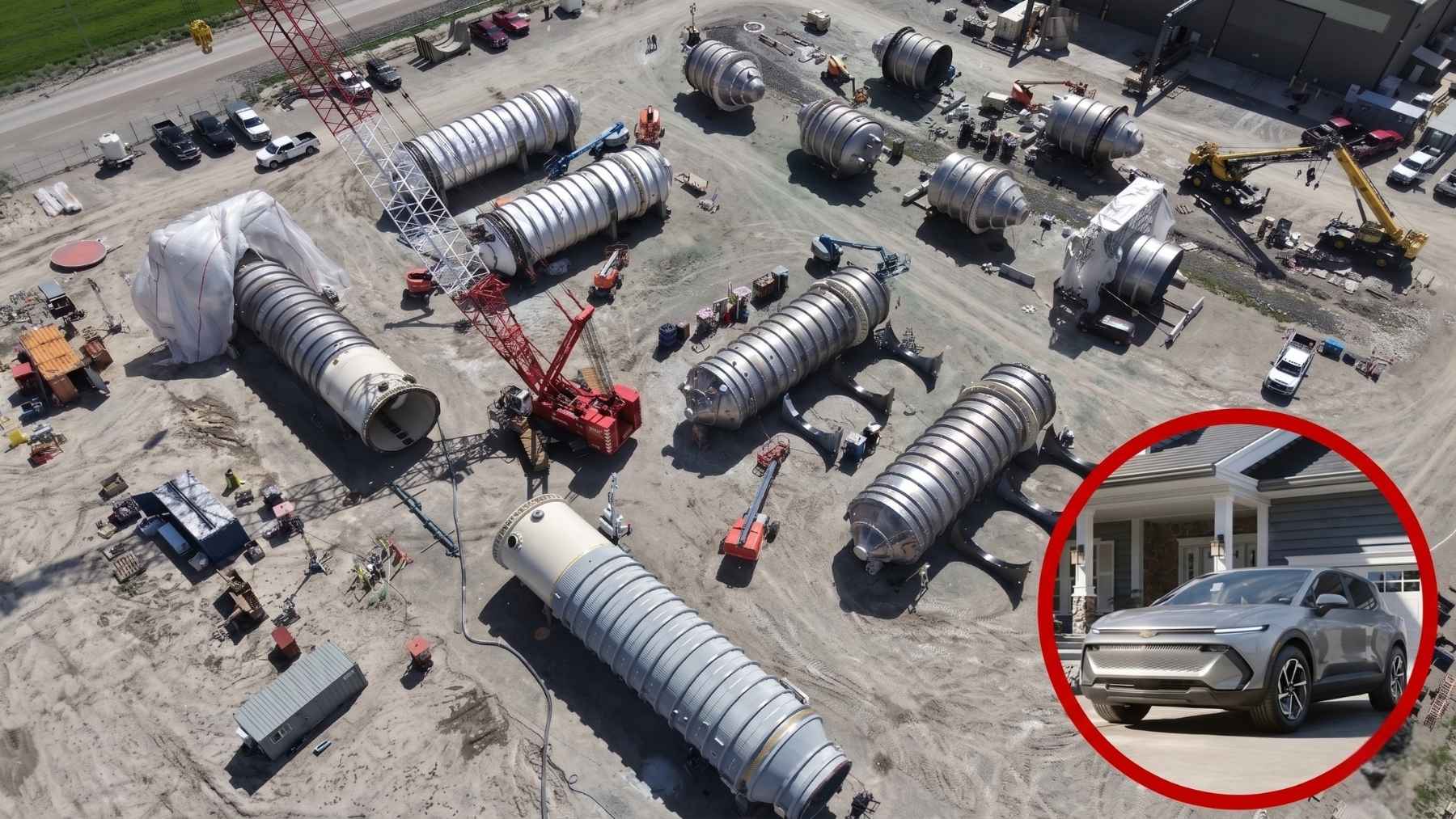
Lithium Americas’ Phase 1 design calls for 40,000 tons of battery-grade lithium carbonate per year, with mechanical completion targeted for late 2027 and full ramp-up through 2028. Total Phase 1 capital expenditure now stands at $2.93 billion. According to the company’s most recent SEC disclosures, $1.3 billion of that had been deployed by March 31, 2026. Detailed engineering design was 95 percent complete. Procurement was over 70 percent complete. The first long-lead items, including a 115KV main transformer, an auxiliary boiler, bicarbonate reactors, and air-cooled heat exchangers, had begun arriving at the site or at a fabrication yard in Winnemucca, Nevada.
Lithium Americas CEO Jonathan Evans said in a May 2026 statement that the workforce was expected to peak at roughly 2,000 craftspeople in the second half of the year. The processing plant is rising. The structural steel, more than 75 percent of which is sourced from the United Arab Emirates, is on site.
When the Department of Energy took its 5 percent direct equity stake in October 2025, the political optics shifted. Walking away from Thacker Pass now is no longer walking away from a private mining venture. It is walking away from a federal balance sheet entry.
GM, the joint venture, and the next 800,000 EVs a year
General Motors first committed $650 million to Lithium Americas in January 2023 through a two-tranche equity agreement. The first tranche of $320 million closed in February 2023, giving GM roughly 15 million common shares of the company. The second tranche, originally set at $330 million, was restructured in October 2024 into a separate joint venture transaction worth $625 million in cash and letters of credit. That deal gave GM a 38 percent asset-level ownership stake in Thacker Pass itself, extended its offtake agreement on Phase 1 production from ten to twenty years, and secured the right to 38 percent of Phase 2 production volumes.
By Lithium Americas’ own estimate, the 40,000 tons of battery-grade carbonate that Phase 1 is designed to produce each year can support production of up to 800,000 electric vehicles, equivalent to a significant share of GM’s projected North American EV volume over the back half of the decade.
The contract feeds Ultium, the platform underpinning the Chevrolet Equinox EV, the Chevrolet Silverado EV, the Cadillac Lyriq, the Cadillac Escalade IQ, and the GMC Hummer EV. That kind of vertical exposure is unusual in the U.S. auto industry. Ford has no comparable lithium offtake. Stellantis does not either. Tesla buys directly from Australian spodumene producers and operates its own refinery near Corpus Christi, Texas. GM, through its position in Thacker Pass, is sitting further upstream than anyone else in the segment.
Peehee Mu’huh, the lawsuits, and what they decided
In Paiute, Thacker Pass is Peehee Mu’huh. The Bureau of Land Management approved the federal permit for the mine on January 15, 2021, in the final week of the first Trump administration. On the same day, Indigenous activists established a protest camp at the site. The Reno-Sparks Indian Colony, the Burns Paiute Tribe, and the Summit Lake Paiute Tribe later filed a joint federal lawsuit alleging that the BLM had violated the National Historic Preservation Act by failing to adequately consult the tribes. The site includes the location of a September 12, 1865, U.S. Cavalry massacre in which between 31 and 50 Northern Paiute men, women, and children were killed in a surprise attack at dawn.
U.S. District Court Judge Miranda Du ruled in the federal government’s favor on key counts. The Ninth Circuit Court of Appeals upheld her ruling and denied an emergency appeal to halt construction.
The position of the Fort McDermitt Paiute and Shoshone Tribal Council, the body closest to the mine site, has shifted over time. In April 2021, the council voted to cancel its existing Project Engagement Agreement with Lithium Nevada and threatened legal action. The position later reversed. The tribe signed a Community Benefits Agreement with Lithium Americas in October 2022, and according to a February 2025 Human Rights Watch report, the council has since issued a letter supporting the mine. Organized opposition continues through the People of Red Mountain group, composed of Fort McDermitt tribal members operating independently of the council, alongside the Reno-Sparks Indian Colony, the Burns Paiute Tribe, and the Summit Lake Paiute Tribe.
Shelley Harjo, a Fort McDermitt tribal member who currently serves as tribal treasurer, has publicly called the planned destruction of the area “the biggest desecration and rape of a known Native American massacre site in our area.” Daranda Hinkey, of the People of Red Mountain group, has publicly described the project as “green colonialism.” Lithium Americas has stated that it has engaged extensively with tribal stakeholders and is committed to following federal environmental and historic preservation standards. No party has alleged that Lithium Americas is in violation of any standing court order.
The lawsuits did not block the mine. They reframed what it means.
The math that still has to clear
A few questions remain genuinely open. The first is technology. McDermitt is a claystone deposit, not a brine or a hard-rock pegmatite. The lithium is structurally bound inside illite, a potassium clay layer that runs roughly 100 feet thick at Thacker Pass and carries 1.3 to 2.4 percent lithium by weight. Pulling it out requires crushing the ore and leaching it with sulfuric acid. No claystone lithium operation has yet produced battery-grade carbonate at the scale Lithium Americas is planning. Phase 1 will be a working proof of concept the industry has not seen elsewhere.
The second is price. The $1.5 trillion valuation assumes a contract price near $37,000 a ton, where lithium carbonate sat in 2023. Prices spiked above $80,000 a ton in late 2022 and collapsed below $13,500 in the late 2024 trough before partially recovering. A protracted price slump could make Phase 2 financially marginal even if Phase 1 succeeds. A sustained rally above $50,000, conversely, would make the deposit one of the most strategically valuable American mining assets of the century.
The third is the Oregon side of the caldera. Lithium Americas’ claim is in Nevada. The Oregon half is being explored by an Australian company, Jindalee Resources, which says the deposit could eventually support a separate mine in Malheur County. No federal permit has been issued there. Tribal opposition on the Oregon side is real and has been organized for years, but it has not yet reached the legal scale that it took at Thacker Pass.
What the next two years actually look like
The 1865 massacre site at Peehee Mu’huh will sit inside the open pit of the Thacker Pass mine. Tribal members organized through the People of Red Mountain group will continue to oppose the project, alongside the Reno-Sparks Indian Colony and the other plaintiff tribes. The Department of Energy will continue to hold its 5 percent stake. General Motors will continue to count on those 40,000 tons a year of carbonate to feed Ultium.
And the next time a Chevrolet Equinox EV rolls off the Ramos Arizpe assembly line in Coahuila, Mexico, in 2028, some share of the lithium inside its battery will be American, dug from the rim of an extinct supervolcano that finished erupting 16 million years before any of the people involved in this story were born. The most affordable EV in GM’s North American lineup is built south of the border. Its raw materials, increasingly, will be dug to the north.
That is the deal Washington and Detroit chose to make. It is being built right now, faster than its critics can file briefs.