
2026 Chevrolet Equinox
Overview
What's New for 2026
The 2026 Chevrolet Equinox benefits from the complete redesign introduced for 2025, delivering a substantially refined platform that competes directly with Honda CR-V, Toyota RAV4, and Ford Escape. The signature powertrain is a 1.5-liter turbocharged four-cylinder engine producing 175 horsepower and varying torque outputs: 184 pound-feet in FWD models paired with a continuously variable transmission, or 203 pound-feet in AWD models paired with an eight-speed automatic transmission. This powertrain combination provides genuine performance while achieving respectable fuel economy, making the Equinox a pragmatic choice for families balancing capability with affordability.
The 2026 model year carries forward the successful design and technology package with only minor refinements. All models standardize on a modern touchscreen interface with wireless smartphone integration, comprehensive safety systems, and significantly improved interior refinement compared to previous generations. The Equinox positions itself as the sweet spot between budget-conscious Trailblazer buyers and those willing to invest in the three-row Traverse, offering substantially more space and power than the smaller model while retaining reasonable pricing discipline.
Overview
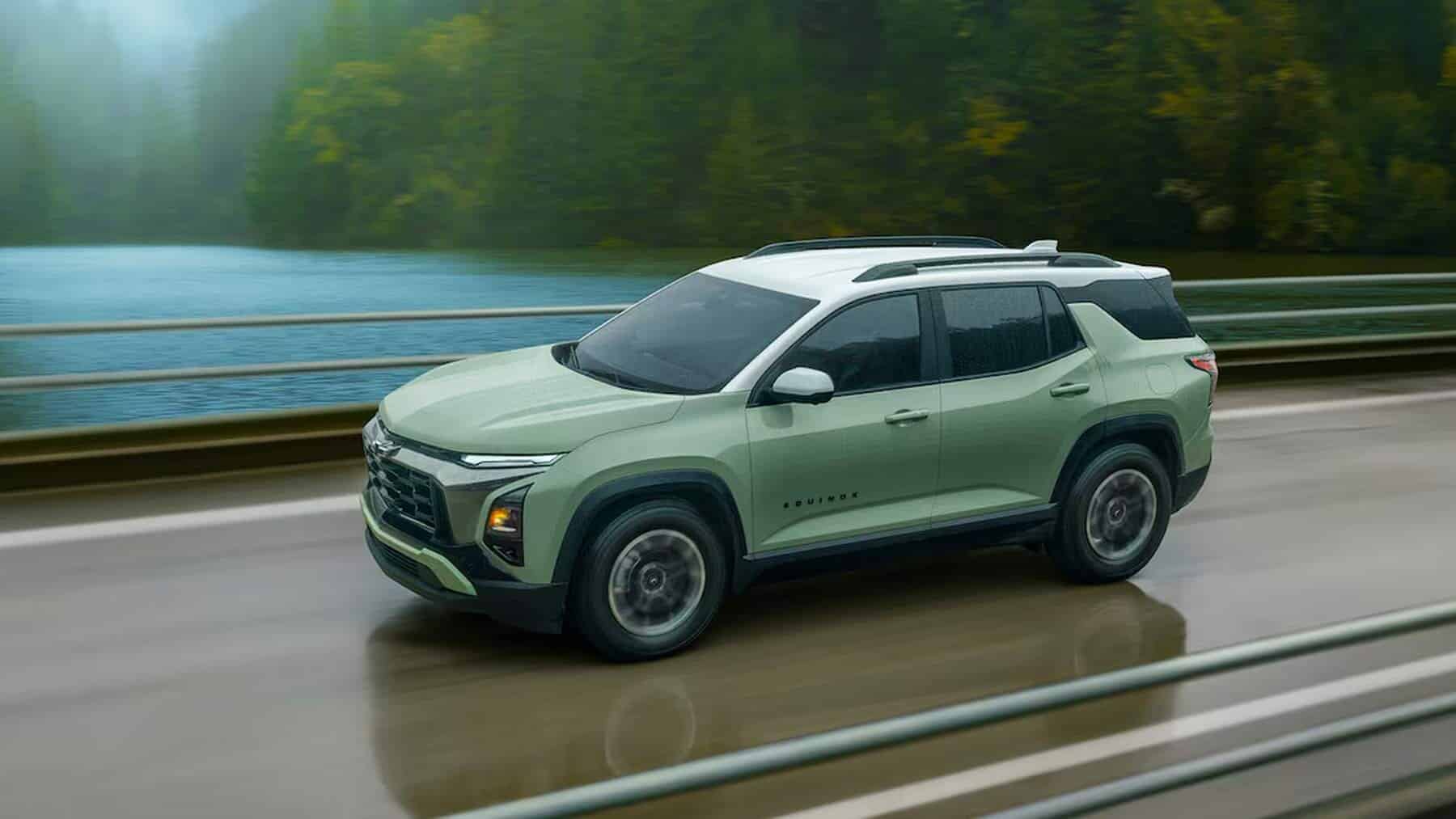
The 2026 Equinox starts at $28,600 for the LT FWD with the 1.5T engine, positioning it as a genuine midsize alternative to Honda's CR-V ($34,000+) and Toyota's RAV4 ($29,500+). The price advantage is meaningful—nearly $6,000 under the Honda while offering comparable interior space, more modern infotainment, and more eager powertrain response. The Equinox spans 188.4 inches in length and weighs approximately 3,600 pounds for FWD models and 3,750 for AWD, balancing sedan-like efficiency with SUV practicality. The lifted driving position provides commanding visibility, and the broader track width compared to smaller Trailblazer (172.4 inches vs. 168.5 inches) translates to noticeably more interior width.
The 1.5-liter turbocharged engine is a thoroughly modern powerplant featuring direct fuel injection, variable valve timing, and a compact turbocharger. In FWD models with the CVT, this engine delivers 175 horses and 184 pound-feet—adequate for normal driving but not particularly thrilling. Real-world acceleration from rest to 60 mph takes approximately 8.5 seconds, respectable for a three-row family hauler but ordinary compared to competitors like the turbocharged Ford Escape. The substantial torque increase to 203 pound-feet in AWD models paired with the eight-speed automatic yields noticeably more compelling acceleration, bringing 0-60 to roughly 8.5 seconds—genuinely quick for the segment. This torque differential explains why serious drivers should prioritize the AWD variant despite its $2,000 price premium and slightly reduced fuel economy.
EPA fuel economy estimates of 26 city/28 highway/27 combined for FWD models drop to 24/29/26 for AWD. Real-world testing by owners reveals slightly lower results: most reporting 23-25 mpg combined during mixed driving, with highway-dominant routes sometimes approaching EPA estimates and aggressive city driving falling to 21-22 mpg. This translates to roughly $1,150 annually in fuel costs at current prices, assuming 12,000 miles of mixed driving—not exceptional for the segment but acceptable given the 175-horsepower power delivery and family-friendly proportions.
Driving Experience
The Equinox occupies an interesting position in the SUV hierarchy: it drives more dynamically than its three-row Traverse sibling yet feels more substantial than the smaller Trailblazer. The steering is properly weighted, providing genuine road feedback while maintaining easy parking maneuverability. The suspension—independent double-wishbone front with multi-link rear—absorbs road imperfections competently, never feeling floaty or over-compliant. Highway speeds inspire confidence; the elevated seating position and wide track provide a commanding driving position, and body control remains composed through spirited cornering. This is not a crossover that will thrill driving enthusiasts, but it competently handles the daily demands of suburban commuting and weekend family excursions.
The transmission behavior differs meaningfully between FWD and AWD variants. The FWD CVT can feel delayed during aggressive acceleration, exhibiting the characteristic rubber-band sensation before power reaches the wheels. Experienced drivers sometimes find this behavior irritating, particularly when merging on highways or accelerating through tight spaces. The AWD eight-speed automatic reacts far more decisively to throttle inputs, providing immediate power delivery and a more conventional driving feel. The extra $2,000 for AWD arguably becomes more justified by transmission choice than by traction alone; many FWD buyers express regret about the CVT after living with it for several months.
Ground clearance of 8.0 inches permits light trail driving and unimproved gravel roads, though serious off-roading is beyond the Equinox's competence. The 1,500-pound towing capacity (AWD models only) limits trailer duty to small utility trailers or compact boat trailers; heavier towing requires stepping up to the Traverse or considering truck-based SUVs. Wind and road noise are present at highway speeds but less intrusive than in smaller crossovers—a function of the larger cabin and more comprehensive acoustic insulation. Highway cruising at interstate speeds feels relaxed and unstrained; the 1.5T engine operates comfortably below peak torque throughout normal driving.
Interior, Comfort & Technology
Step inside the Equinox and the substantial leap from smaller Chevy crossovers becomes immediately apparent. The dashboard adopts a horizontal design emphasizing width and spaciousness, with soft-touch materials on the upper pad and lower plastic sections finished with realistic textures that mimic more expensive materials. The color palette trends toward light grays with subtle blue accent stitching, creating an airy, sophisticated cabin environment. Build quality is decidedly improved compared to smaller models, with tighter panel gaps and more refined assembly suggesting careful manufacturing oversight.
The infotainment system centers on a modern touchscreen interface (size varies by trim) with wireless Apple CarPlay and Android Auto coming standard—a meaningful convenience compared to wired-only integration in some competitors. The system responds quickly to input, and menu organization remains intuitive even for less tech-savvy users. A seven-inch digital instrument cluster displays customizable information, though the resolution is adequate rather than exceptional. Climate control is dual-zone automatic on most trims, with three-zone capability on higher trims. Heated front seats and a heated steering wheel are standard on RS models and available on LT; premium audio systems with surround-view cameras are available on higher trims.
Seating is spacious and comfortable. Front seat passengers enjoy 41.9 inches of legroom with supportive bolstering suitable for all-day highway driving. Second-row passengers benefit from 38.4 inches of legroom, adequate for most passengers but tight for adults on long journeys. The 60/40 split rear bench folds fully flat to reveal 63.9 cubic feet of maximum cargo space—more than the compact Trailblazer and competitive with Honda CR-V. Behind the rear seats, 29.9 cubic feet accommodates substantial weekly shopping, outdoor gear, or weekend luggage. The flat floor maximizes usable space, and tie-down points are well-positioned for securing cargo.
Trim Levels & Pricing
The 2026 Chevrolet Equinox gasoline lineup consists of three main trims (LT, RS, Activ) across FWD and AWD powertrains. The LT represents baseline family transportation with essential features, the RS adds styling and comfort upgrades, and Activ emphasizes capability imagery. Each offers meaningful value progression; buyers should carefully evaluate whether the feature additions justify the price premium.
| Trim | Starting MSRP | Key Additions |
|---|---|---|
| LT FWD | $28,600 | 1.5L turbo, CVT, wireless smartphone integration, 8-inch touchscreen, dual-zone climate, blind-spot monitoring |
| LT AWD | $30,600 | All-wheel drive, 8-speed automatic, 203 lb-ft torque, 1,500-lb towing capacity |
| RS FWD | $33,000 | Distinct RS styling, alloy wheels, heated front seats, heated steering wheel, larger touchscreen |
| RS AWD | $35,000 | RS features plus all-wheel drive and automatic transmission benefits |
| Activ FWD | $33,000 | Terrain modes, all-terrain tires, skid plates, roof rails, Activ-specific exterior styling |
| Activ AWD | $35,000 | Activ package with all-wheel drive and enhanced ground clearance appearance |
Safety
The 2026 Equinox comes standard with Chevy Safety Assist, a comprehensive active safety bundle including forward collision alert, automatic emergency braking, lane keep assist with departure warning, front pedestrian braking, and IntelliBeam automatic high-beam management. These systems function automatically to prevent or mitigate common accident scenarios and have demonstrated real-world effectiveness across insurance industry data. The larger Equinox body provides more substantial impact absorption compared to smaller crossovers, a passive safety advantage that lower curb weight partially offsets.
The sedan-like unibody structure incorporates high-strength steel in critical load paths, optimizing crash energy absorption while minimizing passenger compartment intrusion. The elevated driving position provides superior visibility compared to sedans, reducing blind-spot accidents and enabling earlier detection of pedestrians and cyclists in urban environments. Eight airbags positioned throughout the cabin provide comprehensive occupant protection across varied collision angles.
However, the Equinox lacks some safety features becoming standard in premium competitors: there is no surround-view camera system, no blind-spot monitoring on LT trims, and no adaptive cruise control with lane centering. Buyers should prioritize RS and Activ trims to gain blind-spot monitoring and rear cross-traffic alert, genuinely valuable safety additions for urban driving. For comprehensive crash test ratings and safety data, visit nhtsa.gov and iihs.org.
Warranty & Ownership Costs
Chevrolet's warranty coverage follows industry norms for mainstream brands. Basic warranty extends three years and 36,000 miles, powertrain coverage five years and 60,000 miles, and corrosion protection six years and 100,000 miles—standard protection aligned with most competitors.
| Coverage | Duration |
|---|---|
| Basic Warranty | 3 years / 36,000 miles |
| Powertrain Warranty | 5 years / 60,000 miles |
| Corrosion Perforation | 6 years / 100,000 miles |
| Roadside Assistance | 5 years / 60,000 miles |
Ownership economics favor the Equinox relative to similarly-equipped competitors. Assuming 12,000 annual miles at current fuel prices and achieving 26 mpg combined (FWD realistic figure slightly below EPA estimates), annual fuel costs approximate $1,150. Insurance premiums run competitive with the Honda CR-V and Toyota RAV4, reflecting industry-standard risk assessments. Maintenance requirements include synthetic oil service every 10,000 miles, transmission fluid service at 100,000 miles, and standard brake and battery maintenance. Parts availability is excellent given Chevy's extensive dealer network, and labor costs remain reasonable across most markets. Over a six-year ownership cycle with 72,000 miles of driving, total ownership costs—including fuel, insurance, and maintenance—should approximate $31,000-$32,000 for an LT FWD model, making the Equinox compelling value compared to similarly-equipped Honda CR-V or Toyota RAV4.
The Bottom Line
The Verdict: The 2026 Chevrolet Equinox delivers genuine midsize SUV practicality at pricing substantially below equally-equipped Honda CR-V and Toyota RAV4 competitors. It won't match premium competitors in interior refinement or tech sophistication, but it offers competent daily-driver capability and family functionality for realistic budgets.
Who Should Buy: Budget-conscious families needing more space than the Trailblazer, buyers in moderate climates valuing FWD efficiency over AWD capability, those prioritizing straightforward practicality over premium appointments, and first-time midsize SUV buyers evaluating multiple options. The Equinox particularly appeals to buyers transitioning from compact cars seeking space without luxury pricing.
Who Should Look Elsewhere: Buyers in harsh winter climates should seriously evaluate AWD capability; Subaru Outback offers more refined all-wheel drive. Those seeking cutting-edge technology should evaluate Hyundai Santa Fe or Kia Sorento. Buyers demanding premium interior materials and refined driving dynamics should step up to Toyota RAV4 or Honda CR-V despite higher pricing. Those needing third-row seating should evaluate the Chevy Traverse or longer-wheelbase alternatives.
Frequently Asked Questions
Is the CVT transmission in FWD models a significant drawback?
The continuously variable transmission provides slightly better fuel economy compared to the eight-speed automatic in AWD models but exhibits less responsive acceleration feel. Many drivers find the CVT's delayed reaction irritating during highway merging or passing maneuvers. If responsive acceleration is important, the $2,000 investment in AWD and the eight-speed automatic is justified; FWD CVT buyers often express regret after extended ownership. However, for purely urban commuting and highway cruising at steady speeds, the CVT's efficiency advantage may outweigh dynamic concerns.
How does the Equinox compare to the Honda CR-V?
The Honda CR-V starts at $34,000 compared to the Equinox at $28,600, a $5,400 premium. In return, the CR-V offers slightly more refined interior materials, more responsive turbocharged engine (200 hp), and Honda's reputation for reliability. The Equinox offers more cargo space (63.9 cu ft vs. 76.5 cu ft but with better access), more affordable entry pricing, and a more modern infotainment interface. Choose the CR-V if you prioritize refinement and don't mind paying more; choose the Equinox if value and modern tech matter more than premium appointments.
Should I prioritize the AWD eight-speed automatic for better driving dynamics?
Yes, for drivers valuing responsive acceleration and normal transmission feel, the $2,000 investment in AWD and the eight-speed automatic is justified. The automatic transmission's immediate throttle response dramatically improves highway merging and passing feel compared to the FWD CVT's delayed reaction. For purely urban driving and highway cruising at steady speeds, the FWD CVT's efficiency advantage may be worth the trade-off. However, most drivers find the automatic's superior response worth the modest premium, particularly those doing frequent highway driving or towing small trailers.
What real-world fuel economy should I expect?
EPA estimates of 26 city/28 highway/27 combined for FWD prove optimistic in real-world driving. Expect 23-25 mpg combined in typical mixed city-highway driving, with highway-dominant routes sometimes approaching EPA estimates and aggressive city driving falling to 21-22 mpg. AWD models achieving 24/29/26 EPA estimates likely deliver 22-24 mpg in actual driving. Cold-weather operation reduces efficiency by 2-3 mpg. These figures remain competitive for the segment and translate to annual fuel costs around $1,100-$1,200 for most owners.
How does cargo space compare to competitors?
The Equinox offers 29.9 cubic feet behind rear seats and 63.9 cubic feet maximum with seats folded—competitive with Honda CR-V's 76.5 cu ft maximum but behind Subaru Outback (75.7 cu ft) and Toyota RAV4 (77.8 cu ft). The Equinox's flat floor and well-positioned tie-down points maximize practical utility despite slightly lower maximum volume. For typical weekly shopping and occasional weekend trips, the Equinox cargo space is more than adequate; only regular road-trip planners or hobby enthusiasts hauling large equipment should prioritize competitors' marginally larger capacity.
Is there a third-row seating option?
No. The 2026 Equinox is strictly a two-row, five-passenger vehicle. Chevrolet positions the larger Traverse as the three-row option, starting at roughly $42,000. Buyers requiring frequent third-row seating for additional passengers should either invest in the Traverse or consider Honda CR-V (which offers an optional third row), Toyota Highlander (seven-seater), or Subaru Outback (which offers standard third-row jump seats).
Key Highlights
- All-new redesign delivers modern styling and technologyn1.5L turbo four-cylinder producing 175 hp standardnAvailable AWD system with enhanced winter tractionn11.2-inch diagonal touchscreen with Google Built-innUp to 63.9 cu ft maximum cargo capacitynStarting at $30,795 significantly undercuts Honda CR-V and Toyota RAV4
Powertrain Options
| Engine | Horsepower | Torque | Fuel | MPG |
|---|---|---|---|---|
| 1.5L Turbo I4 (FWD) | 175 hp | 203 lb-ft | Gasoline | 26 city / 28 hwy / 27 combined |
| 1.5L Turbo I4 (AWD) | 175 hp | 203 lb-ft | Gasoline | 25 city / 29 hwy / 26 combined |
Transmission: 8-speed automatic
0-60 mph: 7.2 seconds
Specifications
Pros & Cons
✓ Pros
- Exceptional value starting nearly $6,000 below Honda CR-VnSpacious interior with generous rear legroomnModern infotainment with Google Built-in standardnGood fuel economy at 28 city / 33 hwy (FWD)nAttractive new exterior designnComprehensive standard safety suite
✗ Cons
- 175 hp engine feels underpowered for highway passingnCVT transmission lacks the refinement of traditional automaticsnNo V6 or turbocharged four-cylinder performance optionnInterior materials economy-grade on lower trimsnOnly two trim levels limits personalization options