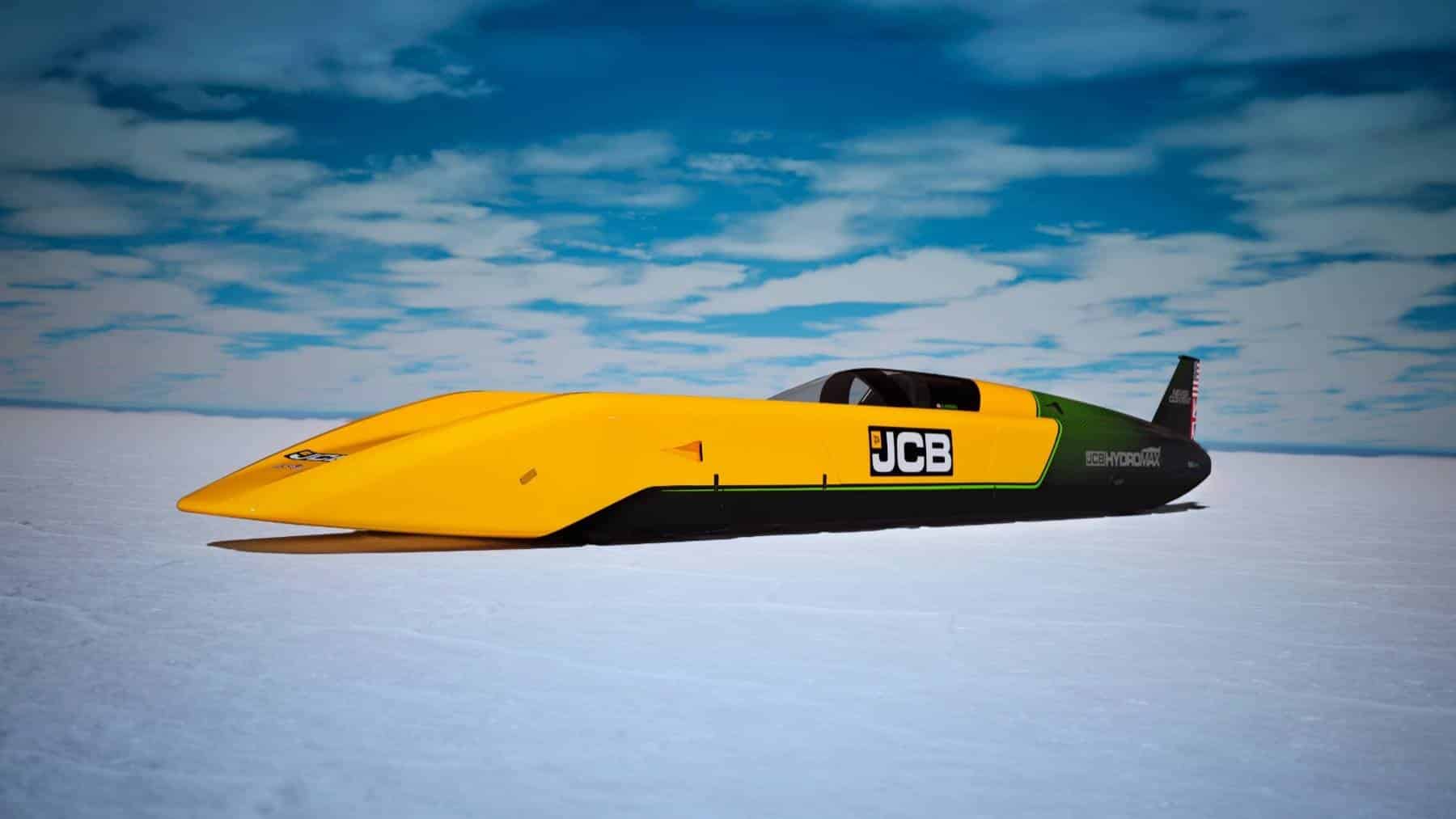

Andy Green is 64 years old, retired from the Royal Air Force, and the only human being on record who has ever gone supersonic on the ground. The last time he did anything truly ambitious behind the wheel of a record car was 20 years ago, when he drove the JCB Dieselmax across the Bonneville Salt Flats at 350.092 mph and walked away with a world record for diesel that nobody has touched since. He is going back to the same patch of Utah salt this August, in another JCB. This one runs on hydrogen.
The car is called the Hydromax, it is 32 feet long, and the FIA confirmed this week it will officiate the runs. JCB has spent five years and £100 million developing the hydrogen combustion engines that sit under the bodywork. Two of them, both four-cylinder turbo units, both derived from the production hydrogen engines JCB is already shipping inside its commercial excavators and telehandlers this year. Together they push out roughly 1,600 horsepower, which is more than three times what a Bugatti Chiron makes, and they do it without burning a drop of diesel.
What the Hydromax actually is
The Hydromax is what land speed people call a streamliner: long, low, flat-flanked, with a single vertical stabilizer behind the cockpit and just enough downforce to keep the front wheels honest at three-figure speeds. The drivetrain feeds all four corners through twin transmissions and twin clutches working in tandem. Chief engineer Lee Harper told Autocar the dyno number is closer to 1,579 bhp than the round 1,600 the FIA release used, which is the kind of margin you get when someone rounds up for a press kit. Either way, it is a lot.
The engines themselves are interesting precisely because they are not exotic. In their standard production form, each one makes around 80 bhp and lives inside a Loadall or a generator skid. To get to roughly ten times that for the salt, JCB rebuilt them with uprated radiators, race-grade intercoolers and oversized turbos. The internals stay very close to series production. That matters because the whole point of the program, for JCB, is to validate the production hydrogen engine under the worst sustained load anyone can throw at it. The salt is, in engineering terms, a stress test with sponsors.
Total CO2 from the tailpipe: zero. The combustion byproducts at the back of the car are water vapor and a small amount of NOx, the unavoidable result of burning anything at very high temperatures in air that is mostly nitrogen. The Hydromax is not a fuel cell. The hydrogen burns inside the cylinders the same way gasoline does inside a normal engine, just with a different combustion behavior and a much wider flammability range. That distinction matters more than people realize and we will come back to it.
The hydrogen records that exist right now
The current hydrogen marks are not where most people assume they are. There are two of them, and they sit at very different speeds.
Hit 350 mph in both directions across Bonneville’s measured mile and three records change hands the same afternoon. The hydrogen combustion record nearly doubles, which is the easy part. The hydrogen overall record falls too, because nothing built around a fuel cell has cracked 303 mph in the 16 years since the Buckeye Bullet 2 set the mark. And the JCB Dieselmax record from August 23, 2006 finally gets erased by the company that wrote it. That last one is more symbolic than technical, but it is the one JCB cares about. Bamford has been pretty open: he wants to break his own record.
Why the call kept going to Andy Green
Green’s CV is shorter than you would expect for someone who has done what he has done. He drove ThrustSSC to 763.035 mph at Nevada’s Black Rock Desert on October 15, 1997, becoming the first and so far only person to break the sound barrier on land. The car had a pair of Rolls-Royce Spey 202 turbojets pulled from a McDonnell Douglas F-4 Phantom and weighed 10 tonnes. He picked up that drive after beating out 32 other candidates. Nine years later he drove the Dieselmax at Bonneville. A decade after that he sat in Bloodhound LSR for its only live high-speed run before the program collapsed.
That is the full list. Four record cars in 28 years, and every one of them came back to the trailer in one piece. JCB has already cleared him medically for Hydromax. Green has said publicly the new car is lighter, more aerodynamic and more powerful than the Dieselmax across every metric that matters, which from him is closer to engineering assessment than marketing. He will be a few weeks short of 65 when the timing lights go on. Nobody at JCB seems bothered by that, and after watching him drive Bloodhound at 628 mph at 57, you can see why.
The salt itself, and why August matters
Bonneville is not a track. It is a 30,000-acre evaporite pan in Tooele County, Utah, about two hours west of Salt Lake City on Interstate 80 and 15 minutes outside Wendover. The salt is a remnant of Pleistocene Lake Bonneville, which covered roughly a third of present-day Utah between 32,000 and 10,000 years ago. The Bureau of Land Management runs the place, and the entire racing operation is set up and dismantled every year by a volunteer-heavy crew that drives thousands of miles of grid across the pan to lay it out.
This is also a salt flat in real trouble. The crust has thinned dramatically since the 1960s, mostly because of decades of potash mining at the southern edge of the basin. The Save the Salt Coalition and Intrepid Wendover Potash run a salt laydown program every spring that pumps brine back onto the racing surface, but you only need to compare aerial photography from the 1950s to the present to see the trend. The 77th annual SpeedWeek, scheduled for August 1 to 7, 2026, will run on a course that is shorter and softer than what Mickey Thompson or Craig Breedlove ran on in the 1960s. JCB does not need the long course to clear 350 mph, but the team will want every foot of salt they can get.
SpeedWeek is run by the Southern California Timing Association, which is the body that has organized Bonneville racing since 1949. SCTA times the meet under its own class rules. After the SpeedWeek week closes, the JCB team stays on the salt for the official FIA-sanctioned runs, which use FIA timekeeping and require two passes through the measured mile in opposite directions inside one hour for any number to count as a world record. Spectator entry at SpeedWeek is around $25 for a day pass, $60 for the week. Bring water and shade.
The San Antonio piece that explains the timing
There is also a reason this is happening this summer and not next. JCB is weeks away from opening a new $500 million factory on a 400-acre site outside San Antonio, Texas. One million square feet of manufacturing space. The biggest North American manufacturing investment in JCB’s 80-year history. The Bonneville attempt lands shortly before that factory cuts the ribbon, and that timing is not a coincidence anyone at the company has tried to hide. American construction fleets are the customers JCB needs to convince that a hydrogen-engined backhoe or telehandler is not science fiction. A 350 mph record on American salt, in August, weeks before the Texas plant opens, is a marketing argument that lands very differently than a press release from Staffordshire.
What numbers are realistic
Lord Anthony Bamford has told reporters a 5% improvement over the Dieselmax would already make him happy. That works out to roughly 367 mph. Green’s “amazed if we don’t break 350” is more aggressive, and Top Gear has reported that the team’s private internal target may be closer to 400 mph. None of those are official numbers. The car has not run yet, even in the UK. The only figure that ends up on the FIA certificate is the one timed across a measured mile twice in opposite directions inside an hour, and that figure will not exist until somewhere between August 8 and the end of the month.
Worth keeping honest: hydrogen combustion under sustained ultra-high load is not the same problem as a five-second drag pass. The whole point of the Hydromax program, from JCB’s perspective, is that the engines have to survive the run. If they do, the data feeds straight back into the production engines already shipping in commercial equipment in Europe and, soon enough, North America. If they don’t, JCB still walks away with five years of extreme combustion telemetry that the next generation of hydrogen excavator engines will quietly inherit.
Either way, on a stretch of Utah salt that has watched everything from Ab Jenkins in a Studebaker in the 1930s to Craig Breedlove in a jet car in the 1960s, a British digger company is about to try and erase its own 20-year-old record with a fuel that emits water. That is the kind of story Bonneville has been collecting for almost a century. The certificate, if it comes, will be just the latest entry in the file.