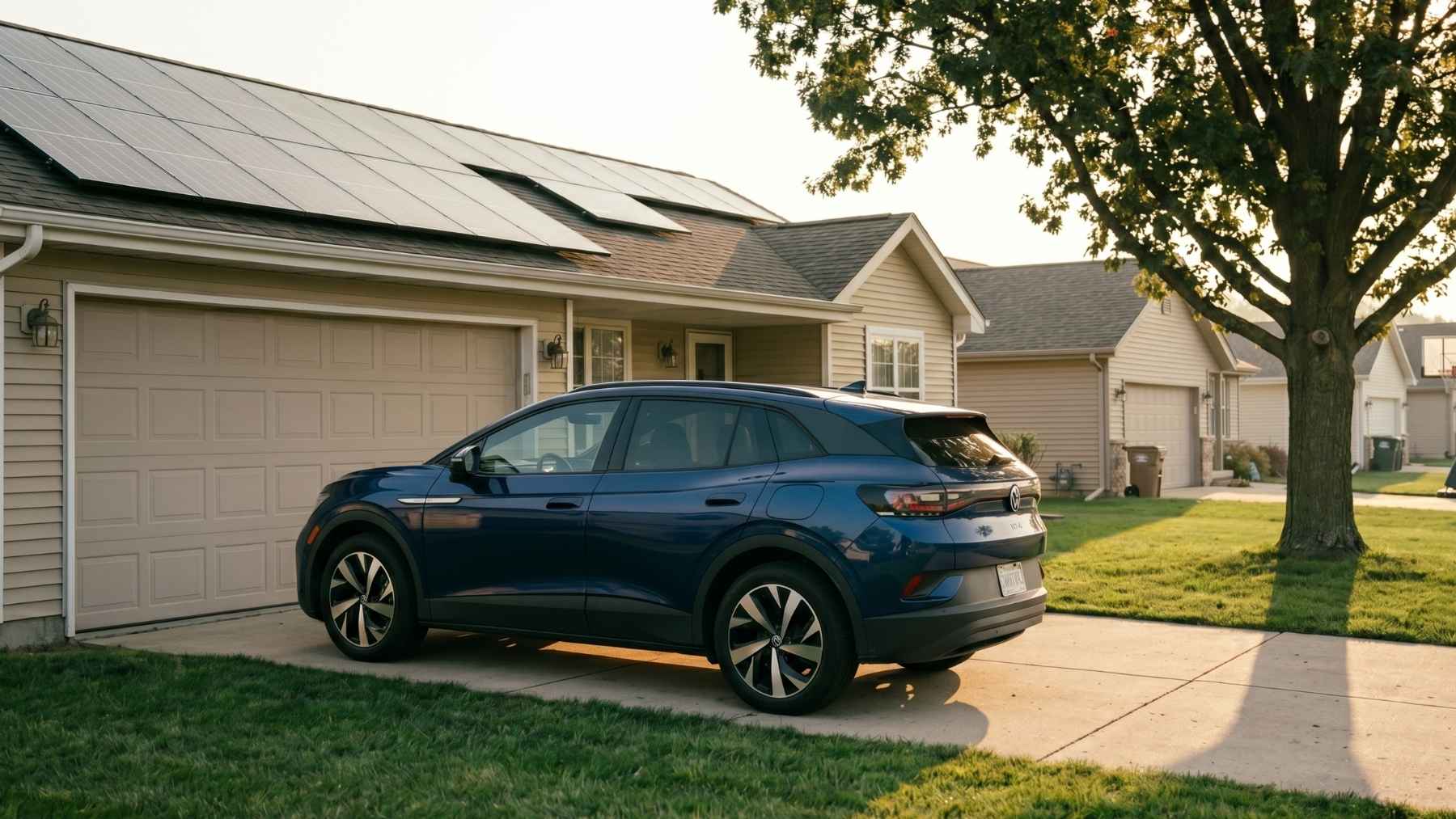

Two things happened to the American homeowner in the spring of 2026, and they happened almost simultaneously, and almost nobody covering either of them noticed they were the same story. In the United Kingdom, the British government cleared the legal path for ordinary citizens to walk into a Lidl, pick up a plug-in solar kit for under £500 (about $635), hang it from their balcony, and connect it to a regular wall socket without an electrician. In the United States, the National Fire Protection Association finalized a new edition of the National Electrical Code that, in most states adopting it, will make it illegal for that same kind of homeowner to install their own Level 2 EV charger.
One country handed its consumers a right they had never had before. The other took one away.
The UK announcement came on March 24 of this year. The government said it had reached an agreement with Lidl, Amazon, Iceland, and the Chinese energy storage company EcoFlow to begin selling “plug-and-play” solar kits in British shops “within months.” The wiring rule change that made it legal, BS 7671 Amendment 4, took effect on April 15 and authorizes any solar generator producing up to 800 watts of alternating-current output to be plugged into a standard 13-amp domestic socket. There are conditions. The microinverter has to be certified to the European EN 50549 standard, which most reputable ones already are. The homeowner has to notify their Distribution Network Operator within 28 days, which is a one-page online form. The final product-certification scheme, run by the British Standards Institution, is expected in July. None of that requires an electrician. A homeowner buys the kit, mounts it on a south-facing balcony or wall, plugs it in, and reduces their household electricity bill.
“Seeing these systems available in stores by summer would be a major win for households,” Lorna Wallace-Smith of EcoFlow told the British solar press in April. A Carbon Brief analysis published on April 2 ran the consumer math: roughly £500 upfront for a two-panel, 800-watt kit (about $635 at current exchange rates), around £110 — about $140 — saved annually against the Ofgem electricity price cap, payback within five years, total net savings around £1,100, or roughly $1,400, over a fifteen-year panel lifetime. None of those numbers are dramatic. They are not supposed to be. The point of plug-in solar is that it does not need to be dramatic to be useful, because the kit sits on a balcony in a flat that was never going to get a rooftop array.
This is not a new idea. The Germans have been doing it for the better part of a decade. According to data published by the European microinverter manufacturer Enphase in 2025, Germany registered 426,269 new balcony solar installations in a single year. Cumulative installations have passed 1.5 million households nationwide.
The kits cost between €300 and €800 — roughly $325 to $865 — in supermarkets and DIY chains. They are sold next to barbecues and Christmas trees. The German experience has produced, mostly, satisfied owners and lower power bills — and one recall, when an Aldi-branded Solovoltaik unit was pulled in 2025 because the microinverter failed VDE certification on a safety relay. The British regulator was paying attention to that recall, which is part of the reason the BSI standard is being finalized before the supermarket rollouts launch in earnest.
What an American homeowner can and cannot do
An American homeowner in 2026 cannot legally do what their British counterpart will be doing in stores at Lidl by July. Plug-in solar systems are legal at the federal level only in a handful of states, and the patchwork is moving fast in opposite directions depending on the state.
Utah was the first to deregulate in March 2025, on a unanimous bipartisan vote, after a Republican legislator named Raymond Ward introduced what is now widely cited as the U.S. template bill. Virginia signed similar legislation in April. Maine signed on April 6 of this year, with the law taking effect on July 15. According to Solar United Neighbors and the nonprofit advocacy group Bright Saver, cofounded by social entrepreneur Cora Stryker, more than twenty states have similar legislation in motion.
New York’s version, called the SUNNY Act, was introduced in 2026 and is one of five bills currently advancing in New York, New Hampshire, Vermont, Maryland, and Pennsylvania. Minnesota’s HF 3555 was introduced in late February of this year with cross-party sponsorship. PBS NewsHour ran a piece on the U.S. plug-in solar movement in early December 2025. The political momentum, at the state level, is real and accelerating.
What is not happening is anything at the federal level that would mirror the UK’s single-stroke clearance. And the federal-level news in 2026, on a closely related question, runs the other way. The National Fire Protection Association approved the 2026 edition of the National Electrical Code last June, and Article 625.4 of that code now requires that “permanently installed electric vehicle power transfer system equipment shall be installed by qualified persons.” A floor motion to remove that requirement, sponsored by the Electric Vehicle Charging Association and the home-charger manufacturer Emporia, failed at the NFPA annual technical meeting on June 20, 2025. The new code language stood. As we covered earlier, the practical effect is that in any state that adopts the 2026 NEC, a homeowner who buys a wall-mounted Level 2 EV charger will, by code, need to hire a licensed electrician to install it. The flat-fee installation cost runs $1,500 to $3,500 nationally. The DIY path is closed.
Put both stories on the same page and you get a peculiar picture. The British government has just opened a residential generation category that did not legally exist before. The American regulatory framework, on a directly adjacent residential category, has just closed one. The British family of four can, this summer, generate their own electricity at the wall socket. The American family of four can still generate their own electricity at the wall socket, but only in a handful of states where the state legislature has explicitly authorized it, and the same family is increasingly losing the ability to plug their own EV charger into their own garage wall.
None of that is conspiracy. It is, in fact, two different regulatory cultures producing two different answers to the same underlying question about how much autonomy a homeowner gets over the electricity they generate and consume in their own house. The British answer, after two years of consultation, was more autonomy. The American answer, in the same window, is less, with the partial exception of the dozen or so states where the legislature has overridden the federal default on plug-in solar.
The reason this matters for the American garage is not that the British model will be imitated overnight. It will not. The reason it matters is that the same homeowner who would benefit from being allowed to install a roughly $635 plug-in solar kit on the porch is the homeowner who is also being told that the new wall charger for their Ford F-150 Lightning needs a licensed electrician with a permit. The autonomy is being handed out on one side of the Atlantic and collected on the other, in roughly the same week, by people who have probably never heard of each other.
 @joe ROOKIE5 months ago