
2026 Honda CR-V
Overview
What's New for 2026
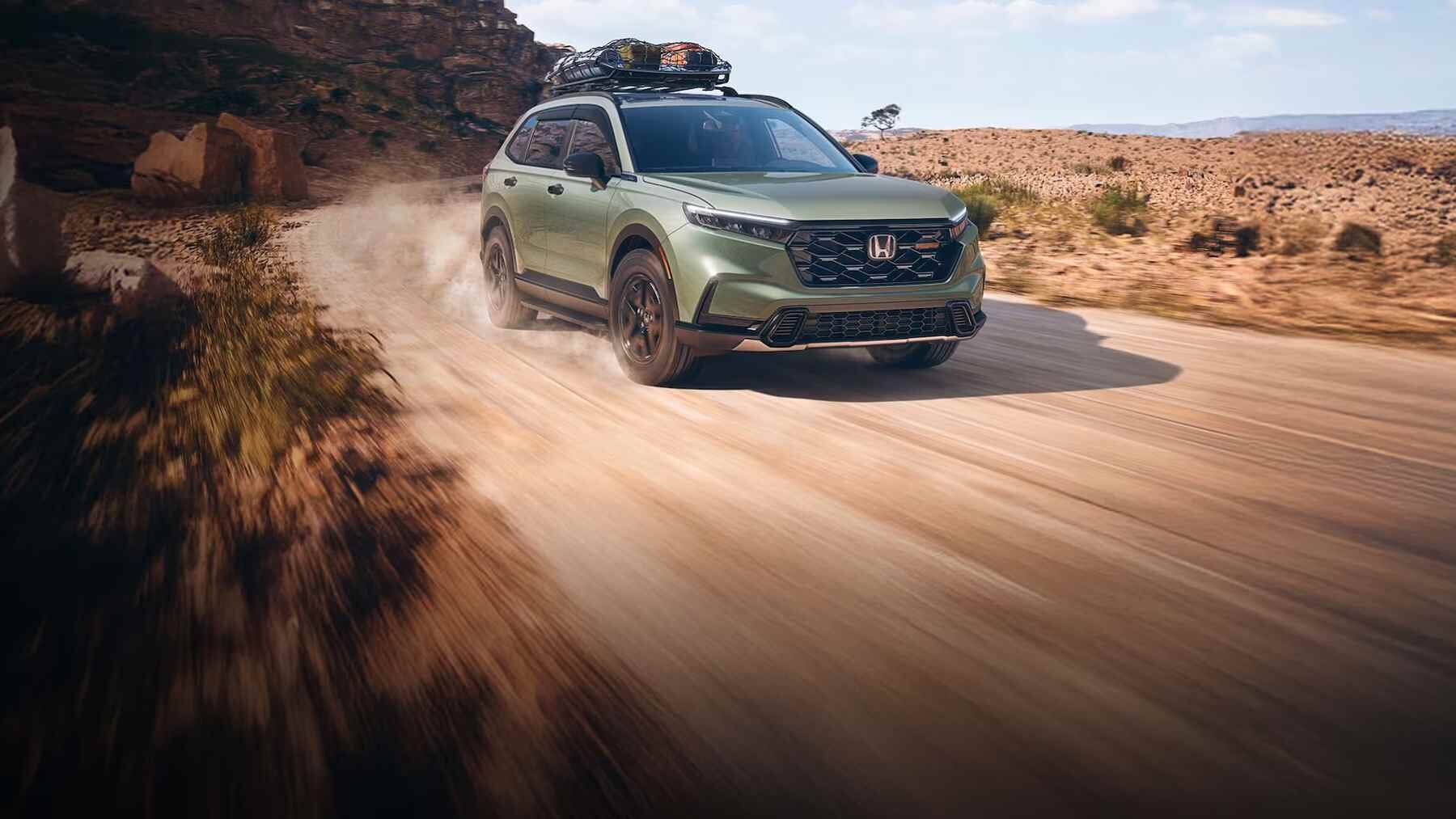
The 2026 Honda CR-V receives a meaningful refresh that addresses several criticisms from prior model years. The biggest news is the addition of the TrailSport Hybrid trim, which slots between the Sport-L Hybrid and Sport Touring Hybrid with rugged styling cues and standard all-wheel drive. Honda has also restructured the trim lineup to more clearly separate gas and hybrid powertrains—the LX, EX, and EX-L remain gas-only with the 1.5-liter turbo, while the Sport, Sport-L, TrailSport, and Sport Touring trims now exclusively use the hybrid system. Pricing starts at $30,920 for the base LX, representing a modest increase over the outgoing model. Updated infotainment software and minor interior trim revisions round out the changes.
Overview
The 2026 Honda CR-V remains one of the most complete compact SUVs you can buy, and the numbers support that claim. Starting at $30,920 before destination for the gas-powered LX and topping out at $42,550 for the fully loaded Sport Touring Hybrid, the CR-V spans a wide price range that covers everything from budget-conscious commuter to feature-rich family hauler. Seven trims in total—three gas, four hybrid—give buyers genuine choice in how much efficiency they want to pay for.
Two powertrains anchor the lineup. The gas models use a 1.5-liter turbocharged four-cylinder producing 190 horsepower at 6,000 rpm and 179 lb-ft of torque between 1,700 and 5,000 rpm, paired with a continuously variable transmission. Hybrid models step up to a 2.0-liter Atkinson-cycle four-cylinder mated to two electric motors for a combined system output of 204 horsepower, routed through Honda's Direct Drive unit. Front-wheel drive is standard on most trims, with Real-Time AWD available as an option—except on the TrailSport Hybrid, where it's mandatory.
At 184.8 inches long on a 106.3-inch wheelbase, the CR-V offers generous interior space within a manageable footprint. Cargo volume measures 39.3 cubic feet behind the rear seats in gas models (36.3 for hybrids due to battery packaging) and expands to 76.5 cubic feet with the rear seats folded. Curb weight ranges from 3,472 pounds for the lightest FWD gas model to 3,900 pounds for the heaviest AWD hybrid. The 14.0-gallon fuel tank delivers a real-world range of roughly 420 miles in gas form and over 500 miles in hybrid configuration.
Direct competitors include the Toyota RAV4 (from approximately $31,800), Hyundai Tucson (from around $30,550), Subaru Forester (from approximately $36,000), and Mazda CX-50 (from roughly $31,400). The CR-V's hybrid option gives it a significant efficiency edge over most rivals, while its cargo space leads the segment.
Driving Experience
The 1.5-liter turbo in the gas models is a known quantity at this point—adequate but not exciting. The 190 horsepower feels sufficient for merging and passing, and the broad torque curve (179 lb-ft available from just 1,700 rpm) means the CVT doesn't have to keep the engine screaming to extract usable power. Honda's CVT does a reasonable job of mimicking stepped gears under acceleration, though it still exhibits the droning behavior common to the breed during sustained climbs or heavy-throttle passes.
The hybrid powertrain is the more interesting package. The 204-hp combined system delivers noticeably stronger off-the-line acceleration thanks to the electric motor's instant torque, and the transition between electric-only, hybrid, and engine-direct-drive modes is nearly seamless at normal driving speeds. Around town, the CR-V Hybrid frequently operates in pure EV mode at low speeds, contributing to its 43 city / 36 highway / 40 combined MPG rating in FWD form. Even the AWD hybrid manages an impressive 40/34/37. The TrailSport Hybrid sacrifices a few MPG (38/33/35 AWD) for its more aggressive tire compound and slightly different final drive ratio.
The chassis rides on a MacPherson strut front and multi-link rear suspension, which delivers a composed, comfortable ride that absorbs most road imperfections without drama. Body roll is well-controlled for a compact SUV, and the dual-pinion electric power steering provides reasonable feedback—not sporty, but accurate and well-weighted for the segment. Ground clearance measures 7.8 inches in FWD or 8.2 inches with AWD, which is adequate for light off-road use but won't match a Subaru Forester's capability. Towing capacity is 1,500 pounds for gas models and 1,000 pounds for hybrids—enough for a small utility trailer but not much more.
Road noise is one area where the CR-V could improve. Wind noise is well-managed, but tire roar on coarser pavement surfaces intrudes into the cabin more than you'd expect in this class, particularly on the larger wheel options. The gas models are quieter overall than the hybrids, which exhibit occasional engine drone during battery charging cycles.
Interior, Comfort & Technology
Inside, the CR-V presents a clean, modern cabin that prioritizes usability. The dashboard design uses a prominent honeycomb mesh accent that divides the upper and lower sections, with soft-touch materials on most surfaces you'd actually contact. Build quality is strong—panel gaps are tight, and the material choices feel appropriate for the price range.
Front passengers enjoy 41.3 inches of legroom and up to 40.0 inches of headroom (38.2 with a moonroof), while rear-seat occupants get a generous 41.0 inches of legroom and 38.2 inches of headroom. Those numbers put the CR-V near the top of the compact SUV segment for passenger space, and real-world comfort matches the measurements—three adults can sit abreast in the rear without shoulder complaints thanks to 55.9 inches of rear shoulder room.
The infotainment system centers on a 7-inch or 9-inch touchscreen depending on trim, running Honda's latest software with wireless Apple CarPlay and Android Auto compatibility. Physical climate controls remain below the screen, which is a welcome departure from the all-touchscreen trend. The interface is logical and responsive, though it lacks the visual polish of some competitors' systems. Higher trims add a 12-speaker Bose audio system that delivers impressive sound quality for the segment.
Cargo versatility is a CR-V strong suit. The 39.3 cubic feet behind the rear seats in gas models (36.3 in hybrids) accommodates bulky items with ease, and the fold-flat rear seats create a usable 76.5 cubic feet (71.8 hybrid) of flat load floor space. A power tailgate with programmable height is available from the EX trim upward. Storage throughout the cabin is generous, with a large center console bin and door pockets that can hold large water bottles.
Trim Levels & Pricing
| Trim | MSRP | Key Features |
|---|---|---|
| LX | $30,920 | 1.5L turbo, CVT, FWD, Honda Sensing, 7" display, wireless CarPlay/Android Auto, LED headlights, 17" wheels |
| EX | $33,150 | Adds: power tailgate, remote start, blind-spot monitoring, heated front seats, 9" display, 18" wheels |
| EX-L | $35,400 | Adds: leather seats, power driver's seat, heated rear seats, Bose 12-speaker audio, wireless charging |
| Sport Hybrid | $35,630 | 2.0L hybrid (204 hp combined), FWD, 9" display, sport styling, deceleration selectors, 18" wheels |
| Sport-L Hybrid | $38,725 | Adds: leather, heated/ventilated front seats, Bose audio, hands-free tailgate, memory driver's seat |
| TrailSport Hybrid | $38,800 | AWD standard, TrailSport styling, all-terrain tires, unique suspension tuning, orange accent stitching |
| Sport Touring Hybrid | $42,550 | Top trim: panoramic roof, head-up display, navigation, adaptive dampers, premium LED fog lights, 19" wheels |
All prices listed are MSRP before destination charges, which add approximately $1,345. Front-wheel drive is standard on all trims except the TrailSport Hybrid, which comes with AWD. Real-Time AWD with Intelligent Control System is available on all other trims for an additional charge. Honda's single-option philosophy means trims are well-equipped without requiring complex package configurations.
Safety
Every 2026 CR-V comes standard with Honda Sensing, the brand's comprehensive suite of driver-assistance technologies. This includes collision mitigation braking, forward collision warning, lane keeping assist, road departure mitigation, adaptive cruise control with low-speed follow, and traffic sign recognition. Higher trims add blind-spot information system with cross-traffic monitor and traffic jam assist, which provides semi-autonomous driving capability in stop-and-go traffic.
The CR-V's Advanced Compatibility Engineering (ACE) body structure is designed to distribute crash energy across the front of the vehicle, reducing intrusion into the passenger compartment. The airbag complement includes front, side, knee (driver and passenger), rear outboard side, and side curtain airbags with rollover sensor coverage for all seating positions. A post-collision braking system and seat-belt reminders for all positions are also standard.
For comprehensive crash test ratings, visit nhtsa.gov and iihs.org.
Warranty & Ownership Costs
| Coverage | Duration |
|---|---|
| Basic (Bumper-to-Bumper) | 3 years / 36,000 miles |
| Powertrain | 5 years / 60,000 miles |
| Corrosion Perforation | 5 years / unlimited miles |
| Roadside Assistance | 3 years / 36,000 miles |
Running costs favor the CR-V, particularly in hybrid form. The gas model's 29-30 combined MPG rating translates to roughly $1,450 in annual fuel costs based on 12,000 miles and current gas prices. The hybrid drops that to around $1,100 annually at 37-40 combined MPG. All trims run on regular unleaded fuel, which is a genuine cost advantage over turbocharged competitors that recommend or require premium. Insurance typically runs $1,400-$2,000 annually depending on your profile, which is competitive for the segment. Honda's maintenance intervals are standard, and the hybrid system uses proven technology that hasn't shown unusual reliability concerns. Tire replacement costs are moderate—expect $600-$900 for a full set depending on trim-specific tire size.
The Bottom Line
The 2026 Honda CR-V is the compact SUV equivalent of a Swiss Army knife—it does nearly everything well and nothing poorly. The hybrid powertrain is the standout, combining genuine efficiency (up to 40 combined MPG) with stronger acceleration than the gas engine, all while running on regular fuel. Interior space is class-leading, build quality is strong, and the Honda Sensing safety suite is comprehensive. The main drawbacks are moderate towing capacity (especially the hybrid's 1,000-lb limit), some road noise on coarser surfaces, and a price that climbs steeply toward the $44,000 mark when you option up a Sport Touring Hybrid with AWD.
Who should buy it: Families who need maximum versatility from a compact footprint, commuters looking for hybrid efficiency without range anxiety, and buyers who value long-term reliability and resale value above all else.
Who should look elsewhere: Enthusiast drivers wanting a more engaging experience (consider the Mazda CX-50), off-road adventurers needing more ground clearance and capability (look at the Subaru Forester), or budget shoppers who find the upper trims overpriced relative to the competition.
Frequently Asked Questions
Is the 2026 Honda CR-V Hybrid worth the extra cost over the gas model?
The hybrid premium is relatively modest—the Sport Hybrid starts at $35,630 versus $35,400 for the gas EX-L, making the entry-level hybrid essentially price-competitive with the top gas trim while adding significantly better fuel economy (40 vs. 30 combined MPG) and more horsepower (204 vs. 190). Over a five-year ownership period, the fuel savings alone can offset the price difference depending on your driving habits. The hybrid also provides stronger low-speed acceleration and a more refined driving experience around town.
How does the 2026 CR-V compare to the Toyota RAV4?
The RAV4 and CR-V are the segment's two dominant players, and each has strengths. The CR-V offers more cargo space (39.3 vs. roughly 37.6 cubic feet), a more refined hybrid system, and slightly better interior materials. The RAV4 counters with a more affordable hybrid entry point, available plug-in hybrid (RAV4 Prime) for those wanting EV capability, and arguably stronger off-road credentials in TRD Off-Road trim. Both offer excellent reliability records and strong resale values. The CR-V's driving experience is more polished, while the RAV4 feels slightly more rugged.
What is the towing capacity of the 2026 Honda CR-V?
Gas-powered CR-V models (LX, EX, EX-L) can tow up to 1,500 pounds, while hybrid models are rated at 1,000 pounds. Neither figure is segment-leading—the Toyota RAV4 can tow 1,500 pounds across all variants, and the Chevrolet Equinox offers 1,500 pounds as well. The CR-V's towing capacity is sufficient for small utility trailers, bike racks, or lightweight watercraft, but larger boats or campers will require a midsize SUV.
Does the 2026 CR-V require premium fuel?
No. All 2026 CR-V trims—both gas and hybrid—run on regular unleaded gasoline (87 octane). This is a genuine cost advantage over some competitors like the Mazda CX-50, which recommends premium fuel for its turbocharged engine. Using regular fuel keeps the CR-V's annual operating costs lower than many similarly priced rivals, saving roughly $200-$400 per year compared to premium-fuel vehicles.
How much cargo space does the CR-V have?
Gas models offer 39.3 cubic feet behind the second row and 76.5 cubic feet with the rear seats folded flat. Hybrid models sacrifice some space to battery packaging, with 36.3 cubic feet behind the second row and 71.8 cubic feet maximum. Both figures are among the best in the compact SUV segment. The flat load floor when the rear seats are folded makes loading large items straightforward, and the available power tailgate with programmable height adds convenience for daily use.
Key Highlights
- Honda's best-selling model — the most successful SUV in brand history
- New TrailSport Hybrid trim adds off-road capability for 2026
- Seven trim levels from $30,920 to $42,550
Specifications
Pros & Cons
✓ Pros
- Hybrid efficiency of 37 MPG combined without sacrificing power or space
- TrailSport Hybrid adds real off-road hardware, not just cosmetic upgrades
- Interior quality and practicality are class-leading
✗ Cons
- Gas 1.5L turbo has documented reliability concerns — buy the hybrid if possible
- CVT can drone under hard acceleration
- Starting price has crept up — the CR-V is no longer a budget option