
2026 Genesis GV80
Overview
What's New for 2026
Genesis has refreshed the GV80 lineup for 2026 with a striking new centerpiece: a massive 27-inch curved display that dominates the dashboard and sets a new standard for in-cabin technology. The expanded model range now encompasses seven distinct trim levels, from the entry-level 2.5T through the pinnacle 3.5T Prestige Black, offering customers unprecedented flexibility to configure a luxury SUV precisely matching their needs and budget. This broadened lineup solidifies the GV80's position as a compelling alternative to established German rivals, delivering Korean engineering excellence at prices that undercut the BMW X5 and Mercedes-Benz GLE by thousands of dollars while maintaining comparable interior sophistication and real-world capability.
Overview
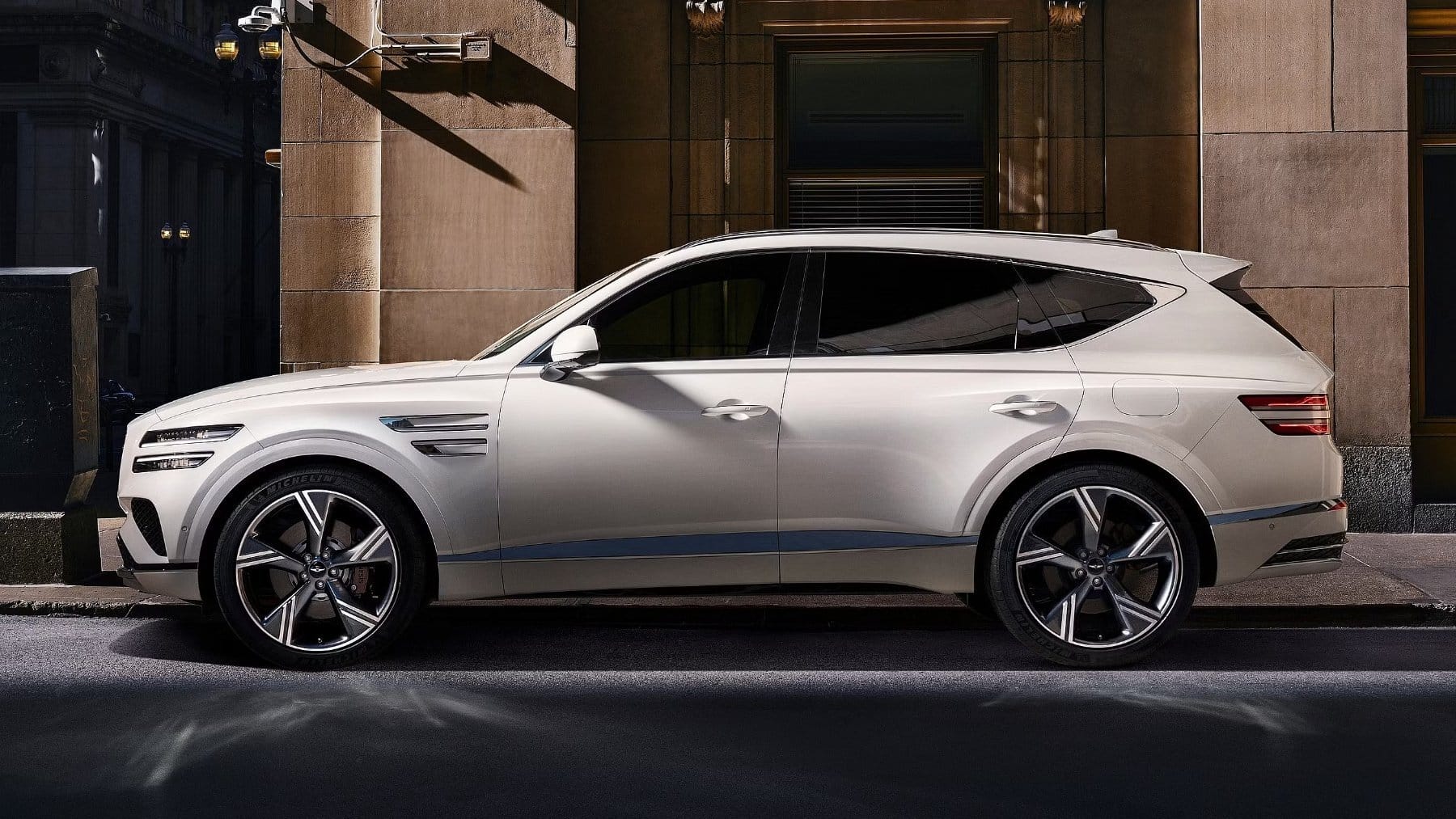
The 2026 Genesis GV80 represents a thoughtfully executed entry into the premium three-row SUV segment, squarely confronting the traditional stronghold of European manufacturers. Where a BMW X5 xDrive40i starts at approximately $80,000 and the Mercedes-Benz GLE 450 begins around $77,000, Genesis undercuts both with a starting MSRP of $57,700 for the rear-wheel-drive 2.5T—a $20,000 advantage that grows even more pronounced when comparing similarly equipped models. All-wheel drive availability across the lineup ensures traction in varied climates, with the 2.5T AWD commanding a modest $59,850 before the $1,495 destination charge.
The GV80's flexibility extends beyond pricing. The model offers both five-seat and seven-seat configurations, allowing buyers to prioritize cargo space and ride comfort for smaller families or maximize occupancy for active households with children and frequent passengers. The seven-seat models sacrifice some third-row legroom to the laws of physics—this is genuinely tight quarters for adults—but provide genuine utility for occasional use, school runs, or emergency seating. All variants deliver 6,000 pounds of towing capacity when properly equipped, sufficient for most boat trailers, lightweight horse trailers, or enclosed cargo haulers, positioning the GV80 as a legitimate jack-of-all-trades for buyers balancing luxury daily driving with practical demands.
At 194.5 inches long and 77.8 inches wide, the GV80 claims a substantial footprint that translates to commanding road presence and spacious interiors, though the 39.3-foot turning radius reminds drivers that this is genuinely a full-size luxury vehicle, not a compact urban commuter. The 8.1 inches of ground clearance provides adequate approach angles for gravel roads and modest off-road situations, though this is fundamentally a paved-surface luxury cruiser. Curb weight ranges from 4,709 pounds in the lightest 2.5T RWD configuration to 5,338 pounds for the power-laden 3.5T Prestige Black, a significant mass that influences ride dynamics and fuel economy across the range.
Driving Experience
The 2.5-liter turbocharged inline-four produces 300 horsepower at 5,800 rpm and 311 pound-feet of torque arriving at just 1,650 rpm, delivering sufficient punch for daily commuting and highway merging with spirited authority. Paired with an eight-speed automatic transmission, the 2.5T exhibits smooth, predictable behavior in both city driving and highway cruising, though drivers seeking genuine performance will notice the turbo lag characteristic of forced-induction four-cylinder engines, particularly when accelerating from a rolling start. The 2.5T RWD achieves approximately 20 city / 26 highway / 22 combined mpg—respectable for a vehicle of this size and weight—while the AWD variant drops to 19/24/21, reflecting the mechanical losses inherent to all-wheel-drive systems.
The 3.5-liter twin-turbocharged V6 transforms the GV80 into a genuine performance contender, generating 375 horsepower at 5,800 rpm and 391 pound-feet of torque from just 1,300 rpm. This substantial power delivery eliminates turbo hesitation entirely, providing immediate throttle response and genuine acceleration capability that justifies the model's premium positioning. The eight-speed automatic responds with crisp shifts under spirited driving and seamless comfort during gentle cruising. However, the premium fuel requirement and the brutal 16/22/19 mpg penalty demand serious consideration; at current fuel prices, the 3.5T driver faces an annual fuel cost approaching $3,200 compared to roughly $2,600 for the 2.5T—an $600 annual tax on that extra 75 horsepower that many buyers will find difficult to justify without genuine towing needs or passionate performance interest.
The Prestige and 3.5T Prestige models benefit from Genesis's road-scanning adaptive suspension technology, which continuously monitors pavement conditions ahead and preemptively adjusts damping to maximize ride comfort and handling balance. In real-world driving, this system delivers tangible benefits over rougher roads, filtering out impacts that would disturb drivers and passengers in lesser vehicles. The broader GV80 lineup exhibits composed ride quality appropriate to its size and mission—this is a car that soaks up freeway expansion joints and parking-lot transitions without fuss, though performance-focused buyers accustomed to sportier platforms may find the tuning slightly detached.
Interior, Comfort & Technology
The centerpiece of the 2026 GV80 is unquestionably the 27-inch curved display—a sweeping, panoramic screen that stretches nearly across the entire dashboard width, combining digital instrument cluster, infotainment system, and climate control interface into one seamless visual ecosystem. This dramatic presentation immediately signals the GV80's premium positioning, though the control integration requires some learning curve for owners transitioning from traditional button-and-dial layouts. The system supports wireless smartphone integration, voice commands, and over-the-air software updates, ensuring the GV80 remains current throughout its ownership lifecycle.
Seating configurations directly influence the interior experience. The five-seat models prioritize rear passenger comfort with 38.7 cubic feet of cargo volume behind the rear seat—substantially more than the seven-seat variants. The three-row configuration divides usable space between the 11.6 cubic feet behind the third row (genuinely limiting for grocery bags and sports equipment) and the 36.5 cubic feet when the third row folds flat, requiring deliberate trade-offs between occasional occupancy and practical daily cargo capacity. The tri-zone automatic climate control maintains independent temperature preferences across three seating areas, eliminating family debates about cabin comfort while accommodating diverse seasonal preferences.
Material quality escalates through the trim hierarchy. The base 2.5T provides a competent upholstery and solid-feeling cabin that punches above its $57,700 price point when compared to equivalent-priced German competitors. The 2.5T Select introduces 20-inch wheels, heated steering wheel, and a panoramic sunroof that fundamentally transforms the cabin atmosphere. The Advanced trims bring full leather seating, ventilated front seats to manage summer heat, B&O's 18-speaker premium audio system that transforms the listening experience with genuine clarity and dimensionality, and surround-view cameras that eliminate parking anxiety. The Prestige models escalate to premium leather upgrades, massaging front seats that provide genuine therapeutic benefit on longer drives, heated rear seating for passenger comfort, and in the 3.5T Prestige variant, a suede headliner that conveys wealth through tactile sensation. The Prestige Black model's power second-row seats and exclusive black trim package complete the material hierarchy, though the aggressive five-seat configuration sacrifices the versatility that appeals to many buyers in this segment.
Hands-free liftgate operation, parking sensors across the lineup, and available automated parking functionality (Advanced and above) address practical convenience. The surround-view camera system (Advanced trims and higher) eliminates blind spots during low-speed maneuvering, while the available blind-spot camera (Advanced and above) provides direct video feed to the instrument cluster when activating the turn signal—a genuinely useful feature that improves safety in dense urban traffic. The digital rearview mirror available on 3.5T Prestige models prioritizes forward visibility over traditional mirror reflections, a subtle feature that experienced drivers appreciate.
Trim Levels & Pricing
| Trim | MSRP | Drivetrain | Seats | Key Features |
|---|---|---|---|---|
| 2.5T | $57,700 | RWD (AWD $59,850) | 5 | 27" display, tri-zone climate, parking sensors, hands-free liftgate |
| 2.5T Select | $63,750 | AWD | 5 | 20" wheels, heated steering, panoramic sunroof |
| 2.5T Advanced | $68,600 | AWD | 7 | Leather, ventilated seats, B&O 18-speaker, surround-view, automated parking, blind-spot camera |
| 2.5T Prestige | $73,500 | AWD | 7 | Adaptive suspension, 22" wheels, massaging seats, heated rear, HUD |
| 3.5T Advanced | $75,950 | AWD | 7 | 375 hp V6, leather, ventilated seats, B&O, surround-view, automated parking, blind-spot camera |
| 3.5T Prestige | $82,330 | AWD | 7 | eLSD, premium leather, digital rearview, ventilated rear, suede headliner, HUD |
| 3.5T Prestige Black | $83,250 | AWD | 5 | Power 2nd row, black trim package, exclusive styling |
The pricing strategy reveals Genesis's sophisticated market positioning. The base 2.5T RWD at $57,700 represents the sole rear-wheel-drive offering—a budget-conscious choice for warm climates or drivers with minimal winter driving, though the $59,850 AWD upgrade provides all-season confidence for minimal additional investment. The $6,050 jump to the 2.5T Select introduces meaningful upgrades in wheel design, climate control, and openness through the panoramic sunroof, positioning this trim as the true entry point for buyers seeking the complete GV80 experience without the complexity of seven-seat configuration.
The 2.5T Advanced at $68,600 crosses the critical seven-seat threshold, delivering the B&O audio system, surround-view camera suite, and automated parking functionality that justify its $4,850 premium over the Select. This trim represents exceptional value compared to Mercedes-Benz GLE pricing—competitors charging $77,000 struggle to match this content at this price point. The 2.5T Prestige ($73,500) introduces the adaptive suspension system and moves to 22-inch wheels, though the $4,900 premium may feel steep for buyers unbothered by enhanced damping or subtle wheel upgrades.
The 3.5T Advanced ($75,950) delivers the turbocharged V6 performance advantage at an intriguing price point—just $2,350 above the 2.5T Prestige and $7,350 above the 2.5T Advanced—for those prioritizing power and towing capability over the subtleties of adaptive suspension technology. The 3.5T Prestige ($82,330) climbs substantially, now commanding a $8,830 premium over the 3.5T Advanced, justified by the electronic limited-slip differential, premium leather upgrades, and road-scanning suspension enhancements that appeal to enthusiasts. The controversial 3.5T Prestige Black ($83,250) abandons the third row entirely, pricing higher than the seven-seat Prestige while sacrificing seating versatility—a bold choice targeting a specific buyer profile unconcerned with occasional passenger accommodation.
Remember that all MSRPs exclude the approximately $1,495 destination charge, which should be factored into true ownership costs when evaluating total acquisition expense.
Safety
The 2026 Genesis GV80 comes standard with forward collision warning and automatic emergency braking, technologies that have become industry baseline yet remain genuinely effective at mitigating low-speed accident severity. Lane keeping assist actively manages steering to prevent unintended lane departures during highway driving, while lane centering maintains the vehicle's lateral position within the lane without requiring constant steering input—a genuine fatigue reducer during extended drives. Adaptive cruise control maintains distance from vehicles ahead, functioning smoothly during stop-and-go traffic through predictive algorithms that anticipate deceleration patterns and adjust brake application seamlessly.
Blind-spot intervention provides automatic steering correction if the driver attempts lane change maneuvers with undetected vehicles nearby, a safety net that appeals particularly to drivers with large vehicles and limited peripheral visibility. Rear cross-traffic alert detects vehicles or pedestrians approaching from the sides during reverse maneuvers, critical when backing from parking spaces in busy lots. The parking sensor array provides proximity warnings at speeds below 5 mph, eliminating surprise contact with low-hanging obstacles, garage door frames, or neighboring vehicles during tight maneuvering.
The surround-view camera system (Advanced trims and higher) and automated parking functionality (Advanced and above) further enhance practical safety by minimizing driver blind spots and removing the guesswork from parallel parking situations where limited visibility might otherwise compromise safety judgment. For detailed safety ratings and comprehensive crash-test data, consult the National Highway Traffic Safety Administration at nhtsa.gov and the Insurance Institute for Highway Safety at iihs.org.
Warranty & Ownership Costs
| Coverage Type | Duration | Mileage |
|---|---|---|
| Basic (parts/labor) | 3 years | 36,000 miles |
| Powertrain | 5 years | 60,000 miles |
| Corrosion/Rust | 5 years | Unlimited miles |
| Roadside Assistance | 3 years | 36,000 miles |
| Complimentary Maintenance | 3 years | 36,000 miles |
Genesis's warranty structure positions the brand competitively within the premium segment. The three-year basic coverage aligns with industry norms, providing comprehensive protection for defects in materials and workmanship. The industry-leading five-year powertrain warranty—matching or exceeding most German competitors—reflects manufacturer confidence in engineering durability and provides genuine peace of mind for buyers concerned about expensive engine, transmission, or drivetrain repairs. The unlimited-mileage corrosion warranty addresses the specific concern of rust development in regions with aggressive winter salt application, a real concern in northern climates where road treatments accelerate body panel degradation.
The three-year complimentary maintenance program eliminates predictable ownership costs for scheduled service, a significant benefit compared to competitors who charge substantial fees for oil changes, filter replacements, and fluid top-ups. This program effectively defrays the first three years of ownership costs, offsetting some of the premium pricing advantage eroding over time.
Annual fuel costs vary substantially across the lineup. The 2.5T RWD model, achieving approximately 22 mpg combined and consuming 956 gallons annually at 12,000 miles yearly, costs roughly $2,600 annually assuming $2.72 per gallon premium fuel pricing. The 2.5T AWD increases to approximately $2,700 annually, while the thirsty 3.5T variant, averaging 19 mpg combined and consuming 632 gallons yearly, escalates ownership costs to approximately $3,200 annually—a meaningful $600 per-year premium demanding serious consideration.
Insurance costs for the 2026 GV80 typically range from $1,600 to $2,600 annually depending on driver age, coverage selections, deductible preferences, and regional cost variations. Premium models with sophisticated technology and complex repair procedures trend toward the upper end of this range, while base 2.5T models remain more affordable. Collision and comprehensive coverage should be prioritized given the substantial acquisition cost, though liability minimums should exceed state-mandated requirements given the GV80's significant mass and potential damage exposure in at-fault accidents.
The Bottom Line
The 2026 Genesis GV80 delivers compelling value within the premium three-row SUV segment, offering meaningful advantages over the BMW X5, Mercedes-Benz GLE, and Audi Q7 through aggressive pricing, sophisticated technology integration, and genuine engineering competence. The 27-inch display represents a technological leap that competitors have yet to match at comparable price points, while the expanded seven-trim lineup ensures that buyers at vastly different budget points can access the GV80's fundamental qualities. The dual-engine strategy—turbocharged inline-four for efficiency-minded buyers and twin-turbocharged V6 for performance enthusiasts—provides legitimate differentiation across the lineup without forcing compromises on those unconcerned with maximum power output.
The 2.5T Advanced emerges as the value champion, delivering seven-seat configuration, leather seating, surround-view cameras, and B&O audio at $68,600—territory where German competitors offer substantially fewer features at equivalent pricing. This trim alone justifies strong consideration from families balancing luxury expectations with practical budget constraints. The 3.5T Advanced represents an intriguing proposition for buyers prioritizing towing capability and spirited acceleration, though the fuel economy penalty demands honest acknowledgment of $600 annual fuel cost premiums.
Who should buy the GV80? Buyers seeking prestigious luxury SUV positioning without German marquee price premiums; families prioritizing seven-seat configuration flexibility; those appreciating the latest infotainment technology and willing to embrace learning curves; and drivers in regions where all-wheel-drive confidence justifies acquisition costs. The adaptive suspension and premium material escalations particularly appeal to those accumulating significant annual mileage—the GV80 truly excels during extended highway journeys where its composed ride quality, efficient turbocharged engines, and feature-rich cabin transform driving experience beyond utilitarian transportation.
Who should look elsewhere? Buyers in warm climates unwilling to compromise on real-wheel-drive sportiness may find the RWD-only base 2.5T limiting, particularly without the performance justification of the twin-turbo V6. Those uncomfortable with large-screen digital interfaces or preferring traditional button-controlled climate systems may find the 27-inch display philosophy overwhelming rather than liberating. Buyers genuinely committed to three-row seating for regular adult passengers should honestly assess whether the tight third row—genuinely insufficient for comfortable adult long-distance travel—meets expectations. Finally, those prioritizing rock-bottom fuel consumption should seriously evaluate the 2.5T's 19-22 mpg reality rather than chasing the 3.5T's performance unless towing needs justify the premium.
The 2026 Genesis GV80 represents a genuine challenger to German dominance, offering sufficient sophistication, performance, and technology integration to satisfy discerning buyers while maintaining pricing discipline that respects the reality of diminished value propositions at premium price tiers. This is unquestionably the SUV to compare against when evaluating the competitive set.
Frequently Asked Questions
What is the base price of the 2026 Genesis GV80?
The 2026 Genesis GV80 base model, the 2.5T RWD, starts at $57,700 before the approximately $1,495 destination charge. Adding all-wheel drive increases the starting price to $59,850. This positions the GV80 significantly below competitors like the BMW X5 and Mercedes-Benz GLE at comparable equipment levels, making it one of the strongest value propositions in the midsize luxury SUV segment.
How many seats does the 2026 Genesis GV80 offer?
The 2026 GV80 is available in both five-seat and seven-seat configurations. The base 2.5T, 2.5T Select, and 3.5T Prestige Black models feature five seats with 38.7 cubic feet of cargo volume behind the rear seat. The 2.5T Advanced, 2.5T Prestige, 3.5T Advanced, and 3.5T Prestige offer seven-seat capacity, though the third row provides genuinely tight quarters more suitable for children or occasional use than regular adult occupancy.
What are the key differences between the GV80 2.5T and 3.5T engines?
The 2.5L turbocharged inline-four produces 300 horsepower and 311 lb-ft of torque, achieving 21 combined mpg with all-wheel drive. The 3.5L turbocharged V6 generates 375 horsepower and 391 lb-ft of torque, delivering substantially more performance but at the cost of 19 combined mpg on premium fuel. Both engines pair with an eight-speed automatic transmission and deliver up to 6,000 pounds of towing capacity when properly equipped. The 3.5T costs approximately $600 more annually in fuel expenses.
Which 2026 GV80 trim level offers the best value?
The 2.5T Advanced at $68,600 represents the strongest value proposition, delivering seven-seat configuration, leather seating, ventilated front seats, the 18-speaker Bang & Olufsen audio system, surround-view camera, automated parking, and blind-spot camera at a price substantially below German competitors offering comparable features. For buyers seeking five-seat luxury without seven-seat complexity, the 2.5T Select at $63,750 provides a heated steering wheel, panoramic sunroof, and 20-inch wheels at compelling value.
Is the GV80's 27-inch display easy to use?
The 2026 GV80's 27-inch curved display integrates the digital instrument cluster, infotainment, and climate controls into one panoramic interface. While the presentation immediately signals premium positioning, the all-in-one approach requires a learning curve for drivers transitioning from traditional button-and-dial layouts. Once familiar with the system, most owners find it intuitive, and it supports wireless Apple CarPlay and Android Auto, voice commands, and over-the-air software updates that keep the vehicle current throughout ownership.
Key Highlights
- 2.5L Turbo I4 or 3.5L Turbo V6
- RWD or AWD (AWD standard most trims)
- 300 hp or 375 hp
- 27-inch integrated display
- 5- or 7-seat configurations
- 6,000-lb towing capacity
- Up to 22 mpg combined (2.5T RWD)
Powertrain Options
| Engine | Horsepower | Torque | Fuel | MPG |
|---|---|---|---|---|
| 2.5L Turbo I4 | 300 hp | 311 lb-ft | Gasoline | 19 city / 24 hwy / 21 combined (AWD) |
| 3.5L Turbo V6 | 375 hp | 391 lb-ft | Gasoline | 16 city / 22 hwy / 19 combined |
Transmission: 8-speed auto
0-60 mph: 5.3 seconds
Specifications
Pros & Cons
✓ Pros
- 7-seat option with available third row
- 6,000-lb towing capacity
- Massive value advantage over BMW X5 and Mercedes GLE
- 27-inch curved display
- Road-scanning adaptive suspension available
- Complimentary 3-year scheduled maintenance
✗ Cons
- Third row is tight for adults
- 3.5T fuel economy poor at 19 combined mpg
- Heavy curb weight up to 5,338 lbs
- Base model RWD only
- Premium fuel recommended
- Top trim exceeds 83,000 dollars