
2026 Ford Bronco
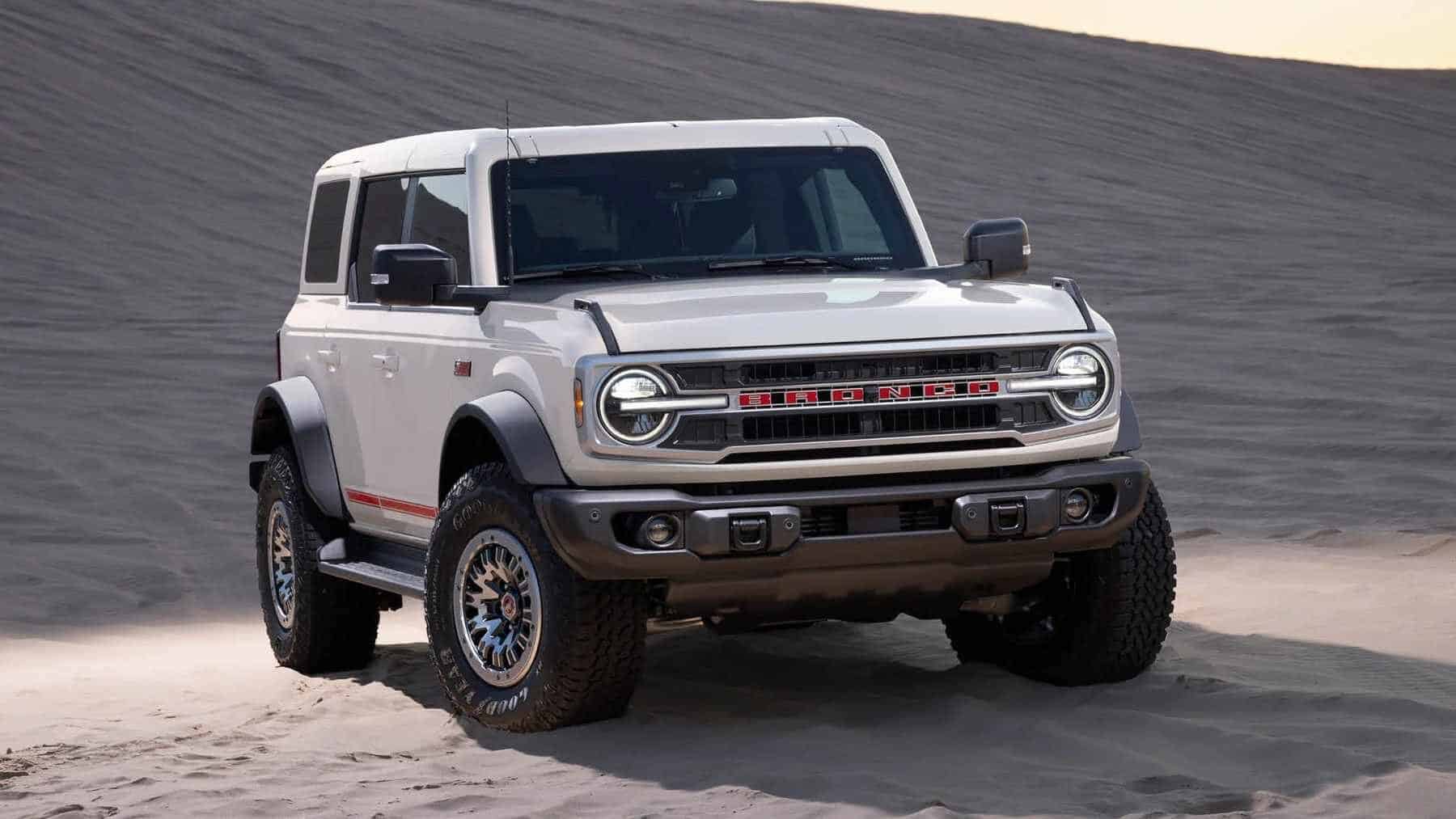
Overview
What's New for 2026
Ford's modern Bronco enters its third model year with meaningful refinements that address early-production challenges while solidifying its position as the segment's most capable factory-stock off-roader. The most significant powertrain change: the 2.3L EcoBoost turbo four-cylinder receives calibration updates improving low-end torque delivery, addressing criticism that base models felt underpowered during steep terrain driving. The turbo now generates 275 horsepower on regular fuel (versus 300 on premium) with improved spool response during trail acceleration. The 2.7L EcoBoost V6 (330 hp/415 lb-ft) becomes available on Big Bend and Outer Banks trims (previously Badlands-exclusive), democratizing genuine power across a broader customer base.
Ford refined the electronic locking differential's engagement response for 2026, reducing the slight delay between activation and wheel lockup that plagued earlier models. The transmission tuning improved particularly for off-road applications: the available 10-speed automatic now holds gears longer during trail driving, providing more consistent engine braking and reducing unnecessary upshifts during steep descents. The terrain management system received algorithm refinement enabling smoother transitions between G.O.A.T. modes (Gravel/Off-road/Average/Terrain), with driver feedback integration allowing mode override based on real-time conditions.
Interior refinement includes improved door panel materials using more durable fabrics resistant to dirt and staining—a practical consideration for owners who regularly remove doors and expose the cabin to trail dust. The SYNC 4A infotainment system gained expanded topographic mapping showing trail difficulty ratings and waypoint management for expedition planning. Visually, updated trim-specific grille designs differentiate trim levels while maintaining Bronco's iconic forward-mounted grille design. The heritage of this platform—built upon the original 1966 Bronco's unibody-removed-doors-and-removable-roof philosophy—remains the design's defining characteristic.
Overview
The 2026 Ford Bronco occupies a unique market position: a factory-stock, removable-doors-and-roof off-roader that balances daily drivability with genuine adventure capability. Starting at $40,495 for the Base 2-door model with the 2.3L EcoBoost turbo, the Bronco undercuts the Jeep Wrangler Unlimited four-door ($45,000+) while delivering superior interior refinement and more modern technology integration. The Bronco's body-on-frame architecture, combined with removable doors, roof panels, and folding windshield, creates genuinely authentic outdoor-access capability unavailable in crossover SUVs or vehicles with permanently fixed tops.
Engine selection defines Bronco experience. The 2.3L EcoBoost turbo (275-300 hp depending on fuel) delivers sufficient power for trail driving and daily commuting, achieving approximately 21-23 mpg combined in real-world testing. The 2.7L EcoBoost V6 (330 hp/415 lb-ft) transforms the Bronco into a genuine performance SUV, enabling rapid acceleration and effortless highway cruising while maintaining off-road capability. The 3.0L EcoBoost V6 Raptor (418 hp/440 lb-ft) remains reserved for the Raptor trim at $83,080, delivering supercar-level acceleration (0-60 in approximately 4.8 seconds) that serves primarily as performance bragging rights rather than essential trail capability.
Towing capacity reaches 3,500 lbs (2.3L turbo) or 3,700 lbs (2.7L V6)—respectable for small trailers and boat hauling but limited compared to pickup trucks. Payload capacity maxes at 880 lbs across configurations, reflecting the Bronco's SUV architecture rather than truck-focused design. The critical advantage over traditional pickups: the removable doors and roof panels enable true outdoor recreation access—removing the roof creates an open-air experience impossible in any pickup truck, while removable doors allow beach/trail driving with minimal barriers between occupants and scenery.
Driving Experience
The Bronco's character depends fundamentally on powertrain selection. The 2.3L EcoBoost turbo (275 hp on regular fuel) feels adequate rather than inspiring during highway driving: zero-to-60 acceleration requires approximately 8.9 seconds, and turbo spooling introduces a slight delay in initial throttle response. Highway cruising at 70 mph requires approximately 2,100 rpm, enabling reasonable fuel economy but lacking the authority that makes merging traffic-intense highways feel effortless. Trail driving with the base turbo feels competent but occasionally strained on steep rocky sections where the power band struggles to maintain momentum. The transmission holds gears appropriately during technical terrain, providing useful engine braking during descents.
The 2.7L EcoBoost V6 (330 hp/415 lb-ft) elevates the experience substantially. Zero-to-60 acceleration drops to approximately 7.2 seconds, delivering linear power delivery that makes highway merging effortless. Trail performance improves noticeably: the additional 130 lb-ft torque and higher displacement enable the Bronco to maintain momentum through rocky sections without requiring downshifts and engine strain. Towing feels controlled and stable, with the V6's torque provision exceeding the 2.3L's capability for boat hauling or utility trailer management. Real-world fuel economy drops to 19-21 mpg combined, a modest penalty for the genuine capability uplift.
The Raptor's 3.0L supercharged V6 (418 hp/440 lb-ft) delivers unnecessary performance: zero-to-60 in under 5 seconds makes the Bronco faster than most sports cars while adding $10,000+ to the purchase price. This powertrain serves performance enthusiasts rather than practical off-road users—the additional power provides no trail advantage beyond the 2.7L and sacrifices real-world fuel economy (18-19 mpg) for bragging rights. For pure Bronco enthusiasm unrelated to actual adventure demands, the Raptor appeals; for optimization-focused buyers, the 2.7L V6 delivers all necessary capability at lower cost.
Off-road performance represents the Bronco's defining characteristic. The standard Dana 44 axles (rear) and electronic locking differentials enable genuinely impressive terrain capability. The G.O.A.T. terrain modes (Gravel, Off-road, Average Terrain, and dynamic custom) adjust suspension, transfer case engagement, brake pressure distribution, and throttle response algorithmically. Normal pavement driving benefits from Average Terrain mode's refined suspension tuning, while Gravel mode modifies brake response for loose surfaces, Off-road activates electronic locking and increases ground clearance, and Terrain adjusts dynamically based on real-time driving dynamics. The system proves effective, though experienced off-roaders occasionally override algorithmic decisions based on specific terrain challenges.
Ride quality demands context. On pavement, the Bronco's sturdy suspension tuning reflects its off-road focus: body roll during cornering exceeds crossovers, and the suspension feels noticeably stiffer than car-like SUVs. This is intentional—increased suspension compliance on trails proves critical for obstacle navigation and weight distribution. Highway driving feels mature and composed despite the focus on terrain capability. Off-road, the suspension shines: articulation reaches impressive levels, and the independent front suspension combined with leaf-spring rear creates balanced terrain navigation. The truck-like driving position (compared to car-like crossovers) requires acclimation but becomes intuitive during actual trail driving.
Interior, Comfort & Technology
The Bronco's cabin balances outdoor functionality with modern comfort. The standard 8-inch touchscreen with SYNC 4A operates responsively, with topographic mapping and trail waypoint management proving useful for expedition planning. Wireless CarPlay and Android Auto integration comes standard on Big Bend and above, enabling smartphone integration without USB cables. The available 12-inch digital instrument cluster (Outer Banks and above) displays real-time consumption data, battery voltage (useful for monitoring electrical loads when doors are removed), and navigation integration with improved clarity.
Seat comfort addresses long-distance driving requirements. The driver's seat features 10-way power adjustment on Big Bend and above, with supportive bolstering accommodating extended trail drives. Cloth upholstery on base models resists staining from typical trail dust and mud—a practical consideration for owners planning regular off-road adventures. Leather availability on higher trims offers premium feel but sacrifices trail practicality. Rear legroom measures 36.8 inches—adequate for two adults for moderate distances, though extended road trips challenge middle-rear passengers.
Storage functionality accommodates outdoor gear: a 1.5-cubic-foot center console bin, door pockets accommodating water bottles, and available roof-rack integration enabling expedition equipment transport. The removable doors eliminate traditional window controls—manual crank mechanisms replace power windows when doors are removed, a pragmatic design choice reflecting the vehicle's off-road heritage. The removable roof panels fold neatly into the cargo area, allowing open-air driving while maintaining storage capacity.
Climate control operates differently when doors and roof panels are removed. The standard air conditioning provides marginal cooling with an open cabin—a trade-off accepted by owners prioritizing outdoor immersion. Heating operates effectively despite removed components. Wind and tire noise become pronounced during highway driving, particularly with doors removed, requiring acceptance that the Bronco prioritizes adventure access over highway refinement. Cabin quietness with doors/roof installed matches comparable SUVs, demonstrating that the noise characteristic reflects architectural flexibility rather than fundamental design limitation.
Trim Levels & Pricing
Ford's 2026 Bronco lineup spans six primary trims, with body style (2-door vs 4-door) and powertrain creating meaningful pricing variations. The Base 2-door ($40,495) with 2.3L EcoBoost delivers core Bronco capability: removable doors, folding roof panels, electronic locking rear differential, and Dana 44 axles. Big Bend ($45,295) adds creature comforts: power windows, upgraded upholstery, and wireless smartphone integration. Outer Banks ($51,175) introduces premium materials and expanded technology. Badlands ($51,975) positions as the off-road focused trim with all-terrain tires, skid plates, and terrain management optimization. Heritage ($54,810) emphasizes special edition design cues and heritage appointments. Raptor ($83,080) represents the performance extreme with supercharged V6 and aggressive styling.
The 4-door variants command $4,000-6,000 premiums over comparable 2-door models, reflecting additional weight and complexity. The 2.7L EcoBoost adds approximately $2,500 across trims. This pricing structure rewards buyers considering their actual needs: budget-conscious adventurers can start at $40,495 for genuine off-road capability, while premium-focused buyers can reach $83,080 for maximum performance and feature content.
| Trim | Starting MSRP | Key Additions |
|---|---|---|
| Base 2-Door (2.3L EcoBoost) | $40,495 | Removable doors, roof panels, electronic locking diff, Dana 44 axles, manual windows |
| Big Bend (2.3L EcoBoost, 4-Door) | $45,295 | Power windows, upgraded upholstery, wireless CarPlay/Android Auto, 4-door body |
| Outer Banks (2.7L V6, 4-Door) | $51,175 | 2.7L V6 (330 hp), premium materials, 12-inch digital cluster, advanced technology |
| Badlands (2.7L V6, 4-Door) | $51,975 | All-terrain tires, skid plates, terrain management optimization, off-road focus |
| Heritage (2.7L V6, 4-Door) | $54,810 | Special edition design, heritage appointments, premium comfort upgrades |
| Raptor (3.0L Supercharged V6, 4-Door) | $83,080 | 418 hp supercharged V6, performance tuning, aggressive styling, premium everything |
Value consideration: the Base 2-door at $40,495 delivers genuine removable-doors-and-roof off-roader capability exceeding the Wrangler Unlimited at $45,000+. The Outer Banks/Badlands pricing of $51,000-52,000 positions meaningful capability at a competitive price point for buyers planning regular trail adventures. The Heritage trim's special edition positioning appeals to collectors and brand enthusiasts, though mechanical capability remains identical to the V6 Badlands. The Raptor's $83,080 price represents a significant premium for performance capability that provides minimal trail advantage over the 2.7L V6 Badlands.
Safety
The Bronco's safety architecture accommodates removable doors and roof panels, creating unique considerations compared to conventional vehicles. Standard equipment includes forward collision warning, automatic emergency braking, lane-keeping assist, blind-spot monitoring, and cross-traffic alert. When doors are attached, the system operates conventionally. With doors removed, the driver gains direct visibility to blind spots but loses the passive safety benefit of door-integrated side-impact protection. This represents a deliberate design trade-off accepted by owners prioritizing outdoor access: doors provide safety protection when attached, but their removability enables the adventure capability that defines Bronco ownership.
Structural safety benefits from the body-on-frame architecture. The welded frame distributes frontal impacts through reinforced channels, while the removable roof and door design distributes lateral forces across the structural frame rather than concentrating them on fused body welds. This architecture differs fundamentally from unibody competitors and reflects engineering optimization for both on-road safety and adventure-access capability. However, NHTSA and IIHS crash ratings remain the definitive safety evaluation standards. Interested buyers should consult nhtsa.gov and iihs.org for the latest 2026 Bronco test results before purchase, noting that removable-door architecture may present unique testing challenges.
One practical consideration: the Bronco's elevated seating position provides superior visibility to surrounding traffic during conventional driving, and the narrow body width reduces forward blind spots compared to full-size trucks. For buyers acclimated to car-like crossovers, the truck-like driving position requires habituation but generally improves spatial awareness once familiar.
Warranty & Ownership Costs
Ford's coverage structure for the Bronco aligns with brand-wide standards, providing protection across the critical early-ownership period.
| Coverage Type | Duration |
|---|---|
| Basic (Bumper-to-Bumper) | 3 years / 36,000 miles |
| Powertrain | 5 years / 60,000 miles |
| Corrosion (Rust-Through) | 5 years / Unlimited mileage |
| Roadside Assistance | 3 years / 36,000 miles |
Ownership costs depend significantly on powertrain. The 2.3L EcoBoost turbo averages 21-23 mpg combined, costing approximately $1,950 annually in fuel at $3.50/gallon and 15,000 miles/year. The 2.7L V6 (19-21 mpg combined) costs approximately $2,150 annually—only $200 more despite significant capability gains. The Raptor's 3.0L supercharged engine (18-19 mpg) reaches approximately $2,300 annually. Insurance premiums remain stable across powertrains at approximately $1,500-1,800 annually for full coverage. Maintenance costs follow Ford's standard schedule: synthetic oil changes every 10,000 miles ($75-90), differential service every 50,000 miles ($150-200). The removable doors and roof require periodic inspection and lubrication—a minor but ongoing maintenance consideration—ensuring hinges remain functional and seals remain weatherproof.
Resale value remains strong for Broncos given the design's authenticity and growing collectibility. Early production models (2021-2022) are retaining 65-70% of original value at four years, suggesting robust used-market demand. The brand's heritage appeal and limited off-road competition ensure consistent market interest through ownership cycles.
The Bottom Line
The Verdict: The 2026 Ford Bronco represents the modern evolution of authentic removable-doors-and-roof off-road capability, executed with contemporary engineering and technology integration. The democratized 2.7L V6 availability across broader trim levels ensures buyers can match genuine capability to actual adventure needs without premium trim pricing forcing overspecification. The Bronco excels for outdoor enthusiasts who view their vehicle as an adventure platform rather than transportation appliance. The removable doors and roof panels enable genuine outdoor immersion impossible in conventional SUVs, while the Dana 44 axles and terrain management systems provide factory-stock capability rivaling heavily modified competitors. For buyers who have fantasized about Wrangler ownership but rejected Jeep's interior refinement limitations, the Bronco delivers superior comfort alongside comparable adventure capability.
Who Should Buy: Off-road enthusiasts prioritizing authentic removable-doors-and-roof capability; outdoor adventurers seeking factory-stock capability without extreme modification; buyers valuing interior comfort and modern technology alongside trail performance; first-time off-roaders wanting proven, supported hardware rather than experimental electric alternatives; weekend explorers and backcountry enthusiasts.
Who Should Look Elsewhere: Buyers requiring maximum towing capacity (Ranger or F-150 exceed Bronco's 3,700 lb limit); those prioritizing fuel efficiency (Maverick hybrid exceeds Bronco by 15+ mpg); daily commuters uncomfortable with truck-like driving characteristics; buyers seeking unibody crossover ride quality; those unwilling to embrace removable-doors-and-roof maintenance requirements; performance-focused buyers uninterested in authentic off-road capability (Raptor R remains overpriced for actual performance advantage).
Frequently Asked Questions
Is the 2026 Bronco truly more capable than a Jeep Wrangler Unlimited off-road?
Both vehicles offer comparable factory-stock off-road capability, with subtle differences. The Bronco features Dana 44 rear axles and electronic locking differentials standard, enabling impressive terrain management. The Wrangler Unlimited uses 44-model axles on Rubicon trim (higher-tier) or 30-model axles on base models. The Bronco's 67.9:1 crawl ratio (Badlands) exceeds Wrangler's 76:1 ratio, providing better low-speed obstacle navigation. Bronco's G.O.A.T. terrain modes offer algorithmic terrain adjustment, while Wrangler relies on driver engagement of locking differentials. Real-world performance proves comparable—both vehicles navigate moderate trails, rocky terrain, and steep inclines with confidence. The Bronco's advantage centers on interior comfort and modern technology, not absolute terrain capability. For pure off-road extremism, both vehicles require modification beyond factory specifications for equal performance levels.
Should I choose the 2-door or 4-door Bronco?
The 2-door ($40,495 base) delivers authentic small-footprint maneuverability and lighter weight, enabling impressive trail performance and parking simplicity. The 4-door ($4,000-6,000 premium) provides rear passenger space and convenient entry/exit, essential for family adventuring. Real-world testing shows the 2-door's shorter wheelbase (93.7 inches versus 110.6 inches 4-door) provides superior articulation on extreme trails and easier obstacle navigation. The 4-door's additional length creates slightly more ground contact during steep climbs but offers negligible practical difference for moderate trail driving. For solo adventurers or couples prioritizing maneuverability, the 2-door offers compelling value. For families planning regular trail adventures, the 4-door's practicality justifies its premium despite slightly reduced terrain agility.
How practical is the 2026 Bronco for daily commuting with removable doors?
Removing doors reduces practicality for regular commuting but remains viable for part-time door-off driving. Wind and tire noise dramatically increase with doors removed—highway driving demands acceptance that noise isolation drops to levels more appropriate for open convertibles than modern SUVs. Weather protection disappears: rain, snow, and weather elements enter the cabin directly. Storage becomes challenging: the open cabin eliminates door pockets and window controls. Most owners keep doors attached during winter months and regular commuting, removing them seasonally for warm-weather adventures. Door removal remains practical for weekend trips rather than daily commuting. The Bronco excels as a seasonal adventure vehicle with doors attached for practical daily use, enabling two-mode ownership—refined SUV when doors are secured, open-air adventure platform when removed.
What's the real difference in off-road capability between the 2.3L turbo and 2.7L V6?
Both powertrains handle moderate trail terrain competently. The 2.3L turbo (275 hp on regular fuel) provides sufficient power for technical driving but occasional strain during steep rocky sections. The 2.7L V6 (330 hp/415 lb-ft) maintains momentum through challenging terrain without requiring downshifts and delivers superior confidence on steep inclines. Real-world trail testing shows the V6 enables consistent speed maintenance where the turbo occasionally requires gear selection adjustments and engine strain. For weekend trail exploring on established routes, the 2.3L turbo proves adequate. For regular challenging terrain or ambitious backcountry expeditions, the 2.7L V6 delivers noticeably superior performance and long-term ownership satisfaction. The $2,500 premium for the V6 justifies itself through improved capability and reduced mechanical stress.
How much regular maintenance is required for the removable doors and roof panels?
Minimal ongoing maintenance proves necessary for the removable door system. Hinge lubrication twice annually (before summer and winter driving seasons) prevents stiffness and ensures smooth removal/installation. Seal inspection before seasonal transitions ensures weatherproofing remains effective. Door storage requires protected space—keeping doors indoors prevents element exposure and UV degradation. Real-world testing shows properly maintained door hinges remain functional for the vehicle's ownership cycle without replacement. The simplicity of the mechanical system (compared to power windows and integrated controls) proves durable. Roof panels require protection from bent flanges during storage—a simple rubber edge cover prevents damage. These maintenance requirements prove minimal compared to traditional power windows and motors, reflecting the Bronco's mechanical simplicity in critical systems.
Is the Raptor's 3.0L supercharged V6 worth the $31,915 premium over the Badlands?
The Raptor's 3.0L supercharged V6 (418 hp/440 lb-ft) delivers unnecessary performance for off-road applications. Zero-to-60 acceleration of 4.8 seconds makes the Bronco faster than most sports cars, but this performance provides zero trail advantage beyond the 2.7L V6 Badlands. Real-world fuel economy drops to 18-19 mpg versus 19-21 mpg for the V6 Badlands, costing approximately $150+ annually in additional fuel. The Raptor premium justifies itself primarily through performance bragging rights and aggressive styling rather than practical capability improvements. For optimization-focused buyers, the 2.7L V6 Badlands at $51,975 delivers all necessary off-road capability at $31,105 lower cost. The Raptor appeals exclusively to performance enthusiasts who value acceleration thrills alongside adventure capability—a valid choice, but not optimized for actual Bronco usage patterns.
Key Highlights
- True off-roader with removable doors, roof panels, and fender flaresnThree engine options from 275 to 418 hpnAvailable in 2-door and 4-door configurationsnG.O.A.T. Modes with seven terrain management settingsnRaptor with FOX Live Valve 3.1-inch shocks and 37-inch tiresnUp to 67.9:1 crawl ratio on Badlands with Sasquatch packagenDana 44 front and rear axles standard
Powertrain Options
| Engine | Horsepower | Torque | Fuel | MPG |
|---|---|---|---|---|
| 2.3L EcoBoost Turbo I4 | 300 hp | 325 lb-ft | Premium Gasoline | 20 city / 21 hwy / 20 combined |
| 2.7L EcoBoost Turbo V6 | 330 hp | 415 lb-ft | Gasoline | 19 city / 20 hwy / 19 combined |
| 3.0L EcoBoost Turbo V6 (Raptor) | 418 hp | 440 lb-ft | Gasoline | 16 city / 17 hwy / 16 combined |
Transmission: 7-speed manual / 10-speed automatic
0-60 mph: 6.3 seconds
Specifications
Pros & Cons
✓ Pros
- Genuine off-road capability rivals Jeep WranglernRemovable doors and roof create open-air experiencenThree engine options cover daily driving to extreme off-roadn7 G.O.A.T. terrain modes handle diverse conditionsnStrong aftermarket support for customizationnRetro-modern styling is distinctive and appealing
✗ Cons
- On-road ride quality rougher than unibody competitorsnBody-on-frame construction creates higher center of gravitynRaptor at $83,080 is expensive for a midsize SUVnRemovable panels can create wind noise when sealednInterior materials basic on lower trimsnFuel economy poor at 15-19 mpg across lineup