
AI is stealing our jobs, our spouses, and now it’s taking over our vehicles. Artificial intelligence has become the latest race in the automotive industry, with more carmakers joining in to beat Tesla.
Tesla recently introduced Grok integration into its software, intended to add conversational AI to your driving experience. With Premium Connectivity ($10 per month or $100 per year), you can get an AI-powered assistant that can help you navigate or answer your burning questions. You can choose from a variety of personalities. I watched a YouTube video of a guy using the Grok Beta, who felt it had the potential of being “immensely capable.” And Tesla is the king of “potential.”
Those who love Tesla no matter what have a lot of positive things to say about having Grok in the car. They like interacting with Grok and learning a language while driving. Said one review: “Just tried it out today and was blown away. Amazing what it can do just in the car, tell me the news, read me a story, sing a song, speak to it in Chinese, and it spoke back.”
Listening to the super rude Grok personality was quite entertaining, I’ll admit. The insults were actually pretty clever. I could see myself having fun with it. Anyway, Tesla may not be the only one with AI very soon. So even more people can start arguing with their car while attempting to drive. Lovely!
EV automakers race to bring AI assistants to their lineup
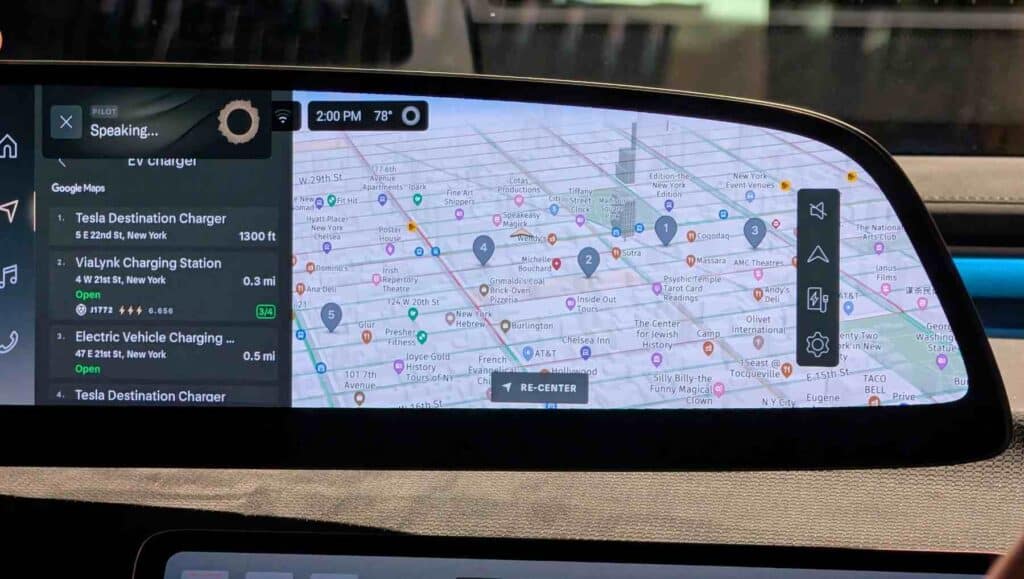
Recently, Volvo and Polestar announced they would introduce Google Gemini across their lineups. It will start with vehicles in the United States that already have Google built in (which was done around 2020). For anyone confused with all this AI stuff, Gemini is Google DeepMind’s conversational chatbot. It’s basically the same thing as Grok, without the sexual harassment drama over on X.
A lot of these brands already have command-based voice inputs and similar assistance, but this marks a distinct shift toward more conversational AI technology. Drivers will be able to chat to their car, ask follow-up questions, and basically have more natural interactions than they were having before. Gemini can plan trips, suggest destinations, locate stops along your route, and do just about anything else useful in real time. This includes translating stuff, just like Grok.
And Volvo and Polestar aren’t alone. BMW is making an AI assistant in partnership with Amazon. And Lucid is also making its own AI assistant, which uses Gemini, ChatGPT, and other existing programs to basically provide you with all the tools necessary.
If you haven’t caught on by now, all of these AI assistants are basically the same exact thing. It’s all part of the race to further connectivity and software-as-a-service. As vehicles become more high-tech and automakers assume we want more and more features, they are giving as even more things to pay for that can be easily updated over-the-air. It has become another revenue stream for automakers that are struggling to make a profit after dealing with tariffs and constantly pivoting markets.
The thing is, I said “assume.” Most Americans do not want all these extra things, especially if it means another subscription or increasing car prices. A lot of automakers are even having to go back to the basics, stripping things away and streamlining production to create cost-effective vehicles that families can actually afford. The race towards more AI is a bit silly, as it’s the least-used feature in modern cars. Most drivers prefer manual controls, annoyed with all of the back-and-forth and even feeling a bit spied on.
In the video I mentioned above, the guy asked: “Are you always listening to me?” Grok claimed no, but that’s tough to say.
I personally love social robotics and would love to speak to my car. But I would not pay for it. Then again, I don’t think I’d get one of these plush, sterile luxury EVs to begin with.