2026 Genesis G70
Overview
What's New for 2026
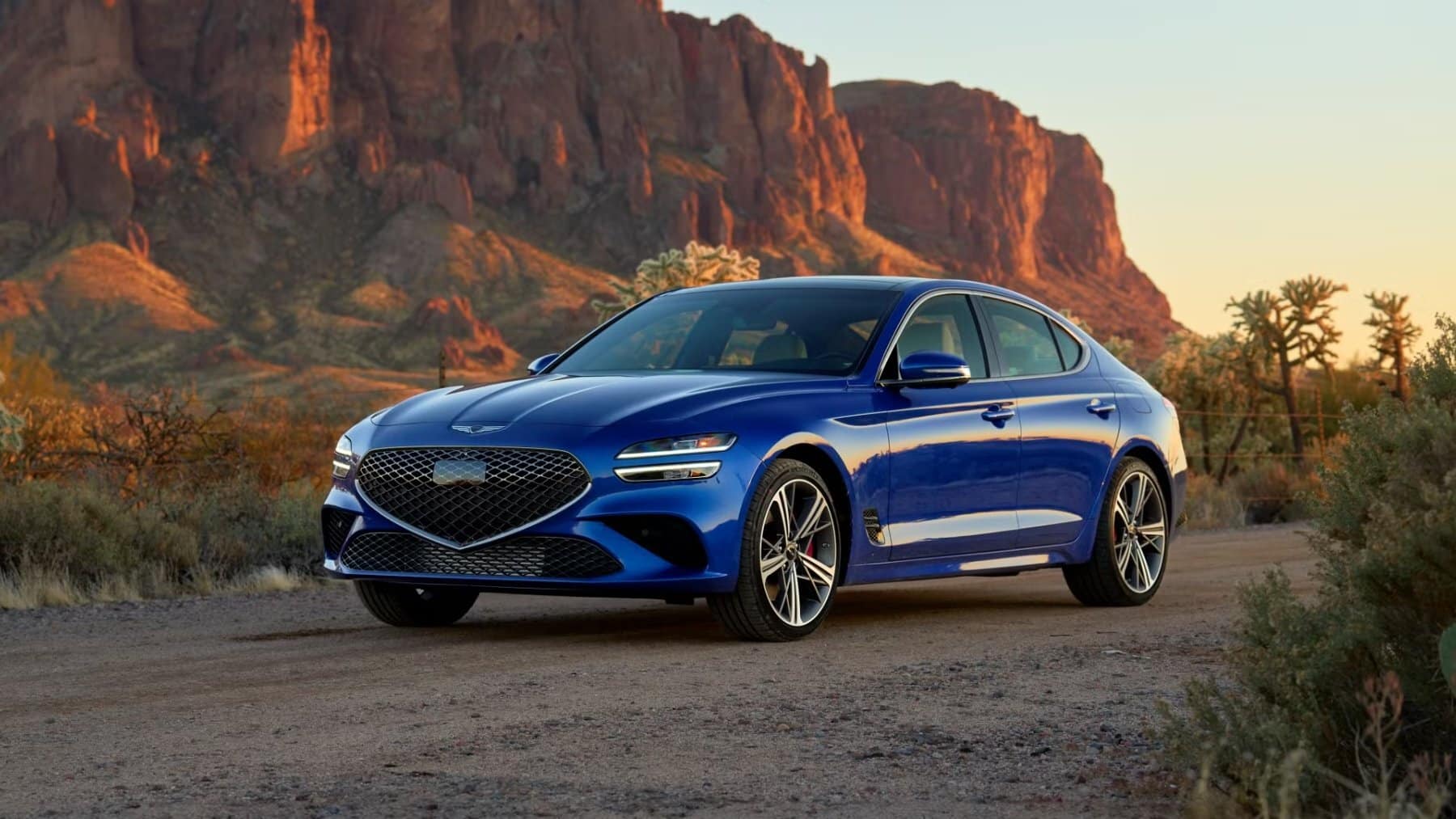
Genesis continues to sharpen the G70's focus as a driver-centric luxury sedan, introducing the Prestige Graphite limited edition that adds visual drama to the lineup. This exclusive variant arrives with distinctive graphite-accented exterior detailing and premium leather appointments, marking a subtle but meaningful refresh for the model year. The broader 2026 lineup maintains its three-trim structure with the 2.5T base, the 2.5T Prestige, and the performance-oriented 3.3T variants, each available in both rear-wheel and all-wheel-drive configurations.
Overview
The 2026 Genesis G70 slots directly into the heart of the compact luxury sedan segment, where it faces fierce competition from the BMW 3 Series, Mercedes-Benz C-Class, Audi A5, and Lexus IS. Starting at $43,450 for the 2.5T RWD base model—before the $1,395 destination charge—the G70 undercuts the 3 Series by roughly $4,000 and the C-Class by even more, positioning Genesis as a value proposition in a market increasingly skeptical of six-figure luxury purchases. The AWD variants add approximately $2,000 to $2,100 depending on trim, bringing the top 3.3T Prestige Graphite AWD to $58,900 base.
Dimensionally, the G70 measures 184.4 inches long, 72.8 inches wide, and 55.1 inches tall with a 111.6-inch wheelbase—placing it in the upper echelon of compact sedans, with more interior space than you might expect from the category name. The 5.1-inch ground clearance is respectable for a sport sedan, though not designed for anything approaching off-road duty. Curb weight ranges from 3,781 pounds for the turbocharged four-cylinder models to 3,918 pounds for the 3.3T twins, reasonable figures that support the claimed handling balance.
Two engine options serve distinct buyer priorities. The 2.5-liter turbocharged four-cylinder delivers 300 horsepower and 311 pound-feet of torque, arriving at peak power at 5,800 rpm and peak torque as early as 1,650 rpm—the kind of mid-range punch that makes daily driving feel responsive without demanding constant revving. The 3.3-liter twin-turbocharged V6, meanwhile, produces 365 horsepower and 376 pound-feet with torque arriving even earlier at just 1,300 rpm, offering genuinely distinct performance character for buyers who prioritize acceleration. Both engines mate to an eight-speed automatic transmission, and Genesis long ago abandoned any manual transmission pretense—a pragmatic decision that will disappoint purists but reflects market reality.
Fuel economy reflects the reality of turbocharged engines and premium-fuel requirements. The 2.5T RWD manages a respectable 21 city / 29 highway / 24 combined, while the AWD version falls to 20/28/23. The 3.3T feels the weight of 365 horsepower and delivers 17/25/20 with RWD and 17/23/19 with AWD. All models require premium unleaded fuel—a compliance cost that adds roughly $0.30 to $0.50 per gallon depending on your market.
Driving Experience
Behind the wheel, the G70 delivers the kind of composed, predictable handling that should define a luxury sport sedan. The 2.5T four-cylinder feels genuinely adequate rather than merely sufficient, with that early torque bump making the sedan feel energetic from standstill through city speeds. You'll recognize the turbo's presence on hard acceleration, with a whisper of boost lag barely perceptible before the engine settles into its delivery. Highway merging and passing maneuvers feel assured, and the engine never feels outgunned in real-world driving—it's not an M340i, but it never pretends to be.
The 3.3T twin-turbo V6 is where Genesis genuinely separates from the competent-but-conservative narrative. With 365 horsepower and torque arriving at just 1,300 rpm, this engine feels like a proper sports engine, with legitimate thrust that carries through the mid-range and a refined surge in the upper register. The acceleration differential between the two engines is substantial enough that buyers choosing the 3.3T will actually feel the $9,000 to $11,000 premium justified—this isn't a marginal upgrade, it's a step into genuine performance territory. The engine's response to throttle inputs feels immediate and linear, without the hesitation that sometimes plagues heavily turbocharged smaller units.
The eight-speed automatic transmission deserves specific mention because it demonstrates how contemporary transmissions should operate. Shifts are smooth enough that you rarely notice gear changes during normal driving, yet the transmission proves willing to kick down aggressively when you demand acceleration. Sport mode sharpens both throttle response and shift characteristics, and the gearbox exhibits enough logic to avoid hunting between gears on the highway. This is competent engineering dressed up without pretense.
The G70's handling character reflects a manufacturer determined to challenge the establishment sedans. The multi-link suspension provides a genuinely composed ride—not the disconnected float of large American sedans, but not the spine-cracking rigidity of track-focused sport cars either. Body roll is well-controlled without feeling nervous, and the sedan maintains composure through sustained cornering. The steering offers appropriate weight and feedback without the artificial heaviness sometimes deployed by lesser competitors; variable-ratio steering on the 3.3T Sport Prestige trim adds an extra dimension of sharpness for drivers who genuinely engage with their cars. All models wear Brembo brakes as standard equipment—substantive hardware that stops with authority and consistency rather than the occasional wooden feel of lesser systems.
A sport-tuned suspension carries through all models, though the 3.3T variants add performance summer tires and an exhaust system tuned for reduced back-pressure that genuinely enhances engine sound without entering the cacophony territory. This is a sedan that wants to be driven rather than simply occupied.
Interior, Comfort & Technology
Step inside and the G70 maintains Genesis's commitment to material quality and refined execution. The 10.25-inch infotainment display dominates the dashboard with a clean interface that avoids the complexity sometimes plaguing luxury manufacturers. Navigation functions intuitively, and the system responds to inputs without lag or frustration. Voice control works competently for the basics, though like all manufacturer systems it remains less capable than smartphone integration for extensive tasks.
Base models feature cloth upholstery with acceptable ergonomics, but the jump to Prestige trim brings full leather seating with 16-way driver adjustment on the 3.3T models—enough configurations to dial in precise comfort for drivers of varying sizes and preferences. Prestige variants also include ventilated front seats, a feature that separates the truly refined from the merely competent on warm days. A power sunroof comes standard on Prestige models, opening up the cabin both literally and perceptually.
The audio system demonstrates Genesis's supplier choices: base models include a decent unit, while Prestige trims upgrade to a Lexicon-brand system with more drivers and processing power that actually resolves detail in music rather than merely playing it loud. Wireless smartphone charging appears on Prestige models and above, a convenience that saves you from yet another cable cluttering your cupholders.
Cargo capacity measures just 10.5 cubic feet—modest by today's standards and a trade-off inherent to the sedan form factor. The trunk opening is reasonably wide, but the pass-through is limited, making moving large objects problematic compared to SUVs that increasingly dominate the segment. A 15.8-gallon fuel tank provides meaningful range with the more efficient engines but requires more frequent stops if you live in the 3.3T and spend time on highway drives.
The driver benefits from multiple viewpoints of the car's surroundings. A surround-view camera system on Prestige models and above provides a bird's-eye perspective invaluable for parking and low-speed maneuvering, while a blind-spot camera displays feed from the side mirrors when you activate the turn signal—a feature that genuinely improves confidence in tight quarters.
Trim Levels & Pricing
| Trim Level | RWD MSRP | Key Features |
|---|---|---|
| 2.5T | $43,450 | 300 hp turbo I4, 8-speed auto, 19" wheels, Brembo brakes, 10.25" infotainment, adaptive cruise control, intersection collision mitigation, safe exit assist |
| 2.5T Prestige | $48,450 | Same engine, leather seating, ventilated front seats, 16-way driver adjustment, sunroof, Lexicon audio, wireless phone charging, surround-view camera, blind-spot camera |
| 3.3T Sport Prestige | $53,600 | 365 hp twin-turbo V6, limited-slip differential, variable-ratio steering, sport exhaust, heads-up display, red brake calipers, summer performance tires, all Prestige features |
| 3.3T Prestige Graphite | $56,900 | Same as Sport Prestige, graphite-accented exterior details, exclusive premium leather, limited availability |
All-wheel drive is available across every trim level and adds approximately $2,000 to $2,100 depending on specification, bringing the top 3.3T Prestige Graphite AWD to $58,900 before the $1,395 destination charge. The $43,450 base price assumes RWD; the 2.5T AWD starts at $45,550. When budgeting, remember that premium fuel is mandatory across the lineup, adding material cost over the ownership period.
Safety
The 2026 G70 arrives with comprehensive safety features as standard equipment. All models include adaptive cruise control that maintains following distance while monitoring traffic flow, intersection collision mitigation that applies brakes when sensors detect imminent cross-traffic impact, and safe exit assist that alerts occupants to approaching traffic or cyclists before opening doors. Forward collision avoidance with automatic emergency braking provides another layer of protection during panic moments, while lane-keeping assist and lane departure warning work together to keep you between the lines during highway driving.
Prestige models and above add surround-view camera systems that provide 360-degree perspective of the vehicle's surroundings, and blind-spot cameras that display real-time feed when engaging turn signals. These systems remove the traditional blind spots that have plagued sedans for decades, translating to measurably improved safety in parking and lane-change scenarios.
The standard Brembo brake system provides the hardware foundation for confident stopping power. Eight airbags, electronic stability control, and traction control round out the specification sheet. For comprehensive crash test ratings and detailed safety analysis, visit nhtsa.gov and iihs.org.
Warranty & Ownership Costs
| Coverage Type | Duration | Mileage |
|---|---|---|
| Basic Bumper-to-Bumper | 3 years | 36,000 miles |
| Powertrain | 5 years | 60,000 miles |
| Corrosion/Rust | 5 years | Unlimited miles |
| Roadside Assistance | 3 years | 36,000 miles |
Genesis distinguishes itself in the luxury segment by including complimentary scheduled maintenance covering the first three years and 36,000 miles. This removes the uncertainty around service costs for the initial ownership period and provides meaningful value when depreciation typically hits hardest. Beyond that complimentary window, expect typical luxury sedan service costs of roughly $150 to $300 per visit depending on the specific service, with oil changes falling toward the lower end and more extensive work commanding premium labor rates.
Annual fuel costs run approximately $2,200 to $2,800 depending on which engine you choose, your driving mix, and local premium fuel pricing. The more efficient 2.5T RWD can approach the $2,200 figure, while the 3.3T with its heavier appetite pushes toward the $2,800 range. Insurance estimates for similar coverage typically range from $1,500 to $2,400 annually, depending on your age, driving record, location, and the specific coverages selected. These figures position the G70 as moderately expensive to operate compared to non-luxury competitors but significantly cheaper than established German brands in the same segment.
The Bottom Line
The Bottom Line
The 2026 Genesis G70 deserves serious consideration from buyers seeking a compact luxury sedan that prioritizes driving engagement without inflicting German pricing on your wallet. This is a vehicle that refuses to phone in the basics—the suspension tuning is genuinely thoughtful, the engine options are substantively different in character rather than merely in horsepower, and the material quality avoids the plastic-heavy disappointments that plague some competitors at this price point.
The 2.5T RWD makes undeniable sense for buyers who value efficiency and appreciate the $43,450 entry point as a genuine value proposition. You're not compromising here—the four-cylinder delivers adequate performance for genuine driving enjoyment, and 24 mpg combined on a luxury sedan remains respectable. The Prestige variant adds tangible refinement with leather and technology features that justify the step, while the all-wheel-drive option appeals to buyers in climates where winter traction proves necessary.
The 3.3T represents a different conversation entirely. For an additional $9,000 to $11,000, you're acquiring a genuinely sports-minded sedan with acceleration that exceeds competent and enters entertaining territory. If you appreciate cars for how they drive rather than merely as A-to-B conveyance, the 3.3T's twin-turbo V6 and performance-tuned chassis justify the premium. The Prestige Graphite edition's limited availability and graphite detailing add exclusivity for buyers seeking visual distinction beyond conventional luxury.
The G70 is less suitable for those seeking maximum cargo capacity—sedans inherently trade practicality for the form factor, and the 10.5-cubic-foot trunk reflects that reality. Buyers requiring more space should evaluate crossovers instead. Likewise, the mandatory premium fuel requirement adds approximately $600 to $1,000 annually compared to regular-grade consumption, an ongoing cost that deserves acknowledgment in ownership budgeting. And if you absolutely demand a manual transmission, Genesis abandoned that cause years ago across their entire lineup.
Who should buy? Enthusiasts who value driving character over badge prestige, drivers in regions with harsh winters who need AWD capability but lack the need for SUV height, and luxury seekers priced out by three-letter German manufacturers. Who should look elsewhere? Families needing seven-seat capacity, buyers on a strictly regular-fuel diet, and those who conflate price tag with driving pleasure.
Frequently Asked Questions
Is the 2.5T enough power for highway driving?
Yes, absolutely. The 2.5-liter turbocharged four-cylinder produces 300 horsepower with peak torque arriving at just 1,650 rpm, meaning the sedan feels responsive from low speeds all the way through highway cruising. Passing maneuvers require no special planning or patience—the engine delivers adequate thrust for merging and overtaking without drama. The real advantage of the 3.3T isn't that the 2.5T feels inadequate, but rather that the twin-turbo V6 feels genuinely entertaining by comparison. Choose the 2.5T if you value fuel efficiency and appreciate responsive performance; choose the 3.3T if you want genuine sports car acceleration from a sedan form factor.
How does the G70 compare to the BMW 3 Series and Mercedes-Benz C-Class?
The G70 undercuts both competitors significantly on price—starting at $43,450 versus roughly $47,500 for the BMW 3 Series and $49,000 for the Mercedes C-Class. The G70's suspension tuning prioritizes engagement and feedback, delivering a more connected driving experience than either German competitor at comparable price points. Where the Germans emphasize heritage and badge prestige, Genesis focuses on value and genuine driving dynamics. The G70 offers more standard safety technology than both competitors at lower price tiers, though the established brands offer marginally more customization options. Most importantly, the G70 consistently ranks among the segment's most reliable vehicles, while BMW and Mercedes historically require more warranty service claims.
What's the real-world fuel economy in city driving?
EPA estimates list 21 mpg city for the 2.5T RWD, with the AWD version managing 20 mpg city. Real-world city driving often slightly underperforms EPA estimates, so budget for 18-20 mpg in typical urban conditions with mixed highway. The 3.3T drops to 17 mpg city, a noticeable gap that reflects the heavier engine's appetite. Highway driving dramatically improves all figures—the 2.5T RWD regularly achieves EPA's 29 mpg highway estimate or even exceeds it on steady-pace highway driving. Remember that premium fuel is mandatory, adding material cost over regular-grade consumption, so factor that into your ownership budget from the start.
Is all-wheel drive worth the $2,000-$2,100 premium?
That depends entirely on your climate and driving conditions. If you live in regions with significant snow or ice, AWD provides measurably improved safety and reduced stress in winter driving. If you live in temperate climates and rarely encounter snow, RWD delivers superior fuel economy and slightly lower cost with no genuine disadvantage. The G70's suspension is well-tuned enough that RWD models never feel twitchy or nervous—they simply deliver better efficiency. AWD does add roughly 100 pounds of weight, which slightly impacts both acceleration and fuel economy. If winter traction is relevant for you, the premium is justified; if not, save the money and apply it toward the Prestige trim for interior upgrades.
What makes the Prestige Graphite edition special?
The Prestige Graphite is a limited-edition variant exclusive to 2026 that combines the 3.3T's performance credentials with distinctive graphite-accented exterior detailing and premium leather appointments. This edition prioritizes visual distinction without compromising functionality—it's not a special engine or suspension configuration, but rather exclusive styling and material choices that elevate the visual and tactile experience. The graphite accents on the exterior trim and wheels provide sophisticated visual continuity with the premium leather cabin, creating a more cohesive and purposeful design narrative than standard Prestige variants. If you value exclusivity and aesthetic refinement alongside performance, this limited edition justifies the approximately $3,300 premium over the 3.3T Sport Prestige.
Key Highlights
- 2.5L Turbo I4 or 3.3L Twin-Turbo V6
- RWD standard, AWD available
- 300 hp or 365 hp
- Brembo brakes standard
- 8-speed automatic transmission
- 10.25-inch infotainment screen
- Up to 24 mpg combined (2.5T RWD)
Powertrain Options
| Engine | Horsepower | Torque | Fuel | MPG |
|---|---|---|---|---|
| 2.5L Turbo I4 | 300 hp | 311 lb-ft | Gasoline | 21 city / 29 hwy / 24 combined (RWD) |
| 3.3L Twin-Turbo V6 | 365 hp | 376 lb-ft | Gasoline | 17 city / 25 hwy / 20 combined (RWD) |
Transmission: 8-speed auto
0-60 mph: 4.7 seconds
Specifications
Pros & Cons
✓ Pros
- Engaging driving dynamics with rear-wheel drive bias
- Strong value vs BMW 3 Series and Mercedes C-Class
- Brembo brakes standard on every trim
- Well-tuned 8-speed automatic
- Generous standard safety features including intersection collision mitigation
✗ Cons
- Small 10.5 cu ft trunk
- Premium fuel required
- No manual transmission option
- Rear seat space tight for adults