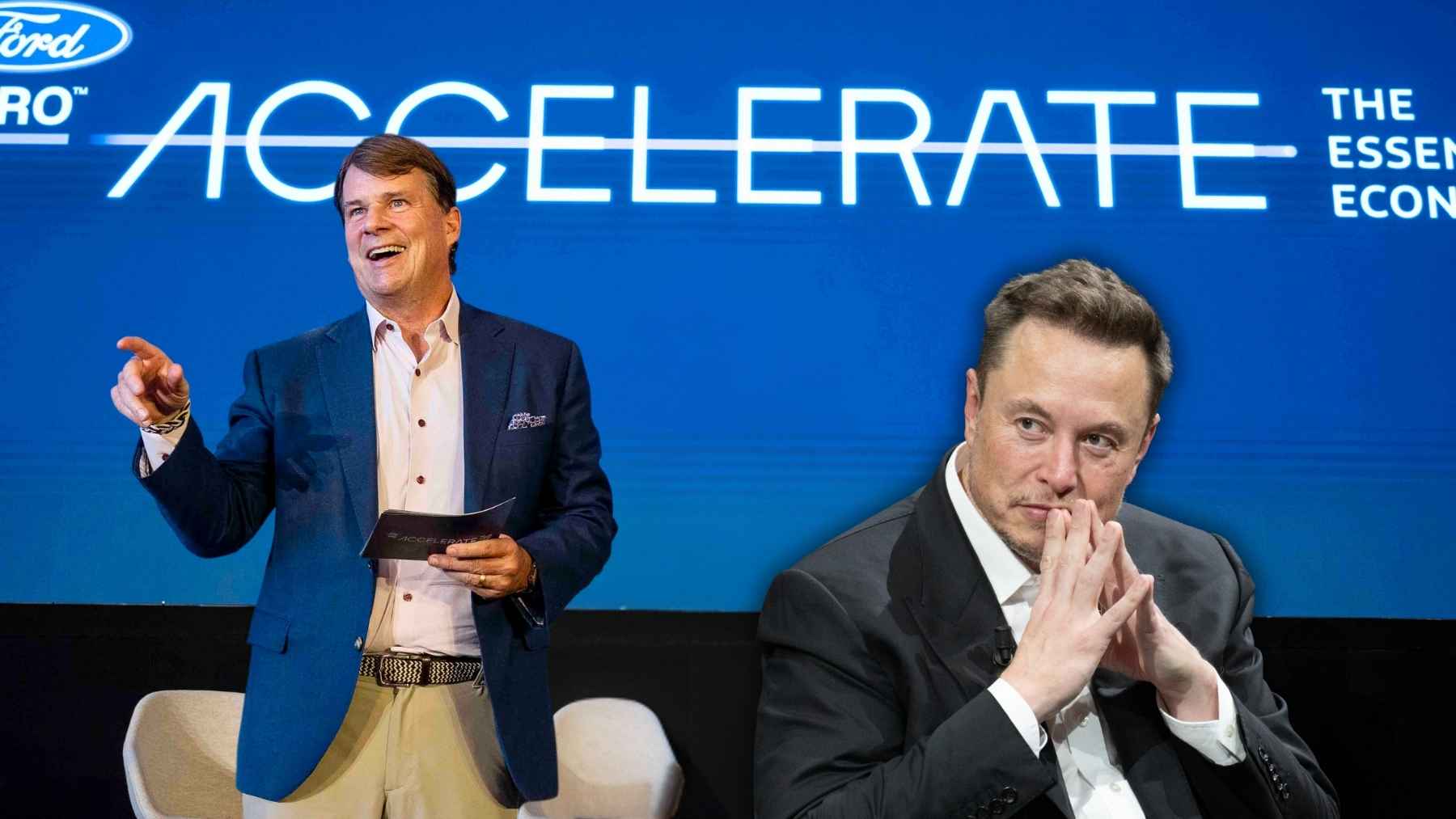

Ford is determined to beat China in the electric vehicle segment. CEO Jim Farley recently spoke with Fast Company about what it would take to beat China’s cheap EVs, and part of it is studying the competition. No, not Tesla: BYD.
It’s been a bit confusing to keep track of Farley’s stance on Chinese EVs. One month ago, the carmaker was begging President Donald Trump to consider allowing Chinese automakers to partner with domestic brands in the United States. The next, Ford is claiming that allowing Chinese EVs in would “devastate” America. However, a recent interview may have clarified what’s going on in Farley’s mind: He respects Chinese automakers, but he also fears them.
Meanwhile, he is not too impressed with Tesla at all.
Tesla is out-selling the competition (somewhat), but that’s not what Ford’s CEO cares about
While speaking on what will help American automakers beat Chinese automakers in the car business, Farley said you’ll need to “pay attention.” But not to Tesla. In fact, that may be a detriment.
“Nothing against Tesla — they’ve been doing great — but they really don’t have an updated vehicle,” Farley said. While this quote riled up the Tesla fans on X (formerly Twitter), he isn’t necessarily wrong. Tesla is the best-selling EV automaker in the United States by a long shot (although competitors have started taking some sales), but its vehicle models have largely remained the same up until their discontinuation. Even the special-edition send-off versions of the Model S and Model X only have a color change, pretty much. It’s almost like Elon Musk lost interest in innovating its passenger vehicles once he decided to focus on robots and taxis.
On top of that, Tesla’s vehicles are not necessarily super affordable. And to beat China, you gotta be. This is why Farley thinks the real brand to study is China’s own BYD.
He said: “The best in the business for us, cost-wise and competition-wise, supply chain, manufacturing expertise, and the IP in the vehicle, was really BYD. In this next cycle of EV customers in the U.S., they want pickups and utilities and all these different body styles. But they want them at $30,000, not $50,000. Like the first inning, they want them affordably.
“That is the gift that China gave us: to be fearful and respectful enough of their progress that we could not organically just phone it in. We needed to do what Americans sometimes do great, which is use innovation to compete against the best in the world.”
While there were a few Tesla fanboys that defended Tesla against BYD, it should be noted that Farley is, again, not talking about sales alone. He is talking about what it takes to sell an EV in the United States as competition continues to rapidly produce innovative, affordable vehicles worldwide.
And he’s not wrong: Americans want cheap cars. Time and time again, drivers in the United States have expressed interest in super cost-effective EVs over luxury EVs. While the wealthy will always pay for the most expensive options, regular Americans can’t afford the rising prices of new cars and are left with no options.
Ford learned this the hard way: the carmaker saw the Ford F-150 Lightning (a pretty neat truck) fail due to its high cost. Said Farley: “We got out of our high-end EVs, but what we decided to do is double down on our affordable ones. And that is what’s selling today around the world, not just in the U.S. You look at Australia, you look at China, you look at Europe. All those markets are moving to a pure EV being more of a commuter-type, low-cost vehicle. That’s really where the market has already gone.”
Ford has been hard at work making an EV lineup that will all be priced under $40,000. This would undercut some of BYD’s most popular models, like its $58,000 BYD Shark 6 electric pickup or the BYD Seal’s $47,000 starting price. Unfortunately, I don’t think $40,000 is low enough to appeal to Americans who have given up buying a new car. I think he’d have to compete with Chery’s $18,000 pickup rather than BYD to get these drivers back on the EV train. Still, studying the competition is a smart start, allowing Ford to stay aware of China’s rapid-paced production, fast tech implementation, and extremely low price points.
Even if it doesn’t work, it’s still funny to see how riled up Ford got the Tesla drivers on X. One funny response: “Nothing you’ve ever made comes even remotely close to the technology in the Cybertruck.”