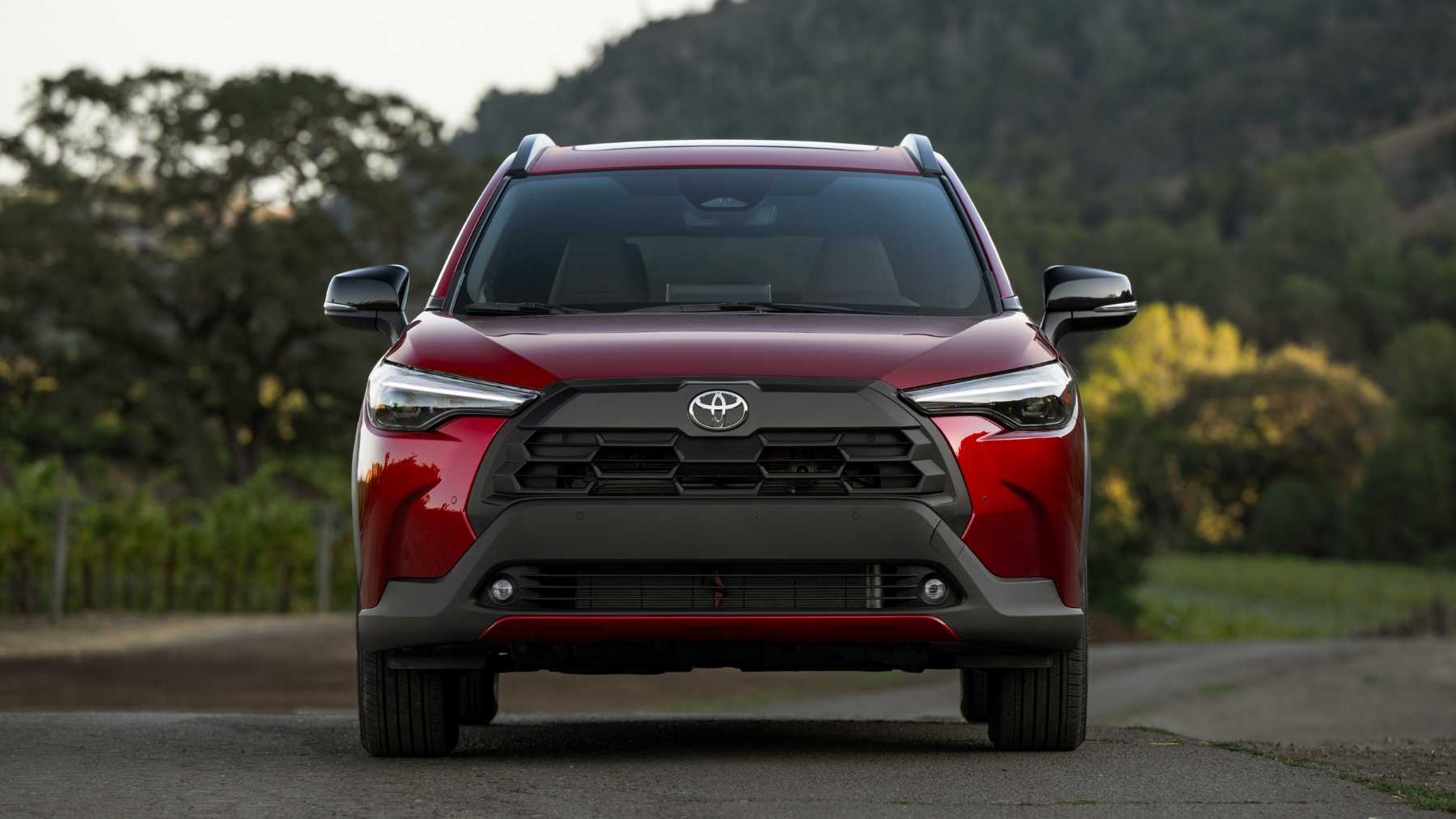

America loves its SUVs. Maybe too much. SUVs like the Honda CR-V continue to dominate the U.S. market thanks to their convenience, cost-effectiveness, and fuel efficiency. But you can have convenience, cost-effectiveness, and fuel efficiency without being bored. You can still have something a bit more stylish and more fun to drive.
May I introduce: the 2026 Toyota Corolla Cross. The Honda CR-V comes in at $31,000 for the base model and $35,600 for the hybrid, but the Cross is $24,600 for the base model and $29,000 for the hybrid. And despite being cheaper, the 2026 Toyota Corolla Cross offers everything you need — plus chutzpah. Stop going with the flow and cross over to the other side.
Honda CR-V Hybrid vs. Toyota Corolla Cross Hybrid: Miles per gallon
Okay, let’s be real for a second to start with. Most people get hybrid SUVs to save on gas. Nobody is getting a hybrid SUV because it’s flashy and luxurious or because it’s exciting and sporty. There’s a reason that the CR-V has become one of the best-selling cars in America despite being one of the plainest and unassuming vehicles on the road. But again, it doesn’t have to be this way, I’m telling you.
The Honda CR-V gets 40 miles per gallon combined for front-wheel-drive models (43 for city and 36 for highway), while all-wheel-drive models get 37 combined (40 for city and 34 for highway). The higher trims are even worse, so I won’t bother mentioning them here. We’re trying to save some money anyway, alright? Plus, the Toyota Corolla Cross can easily beat that. The Hybrid model gets 42 mpg combined (46 for city and 39 for highway). You not only save money at the dealership, but at the pump.
Honda CR-V vs. Toyota Corolla Cross: Driving experience
The Honda CR-V pairs a 2.0-liter four-cylinder with two electric motors, producing 204 horsepower. It’s a bit more than the Cross’ 196 hp, produced by a 2.0L four-cylinder with three electric motors. This gives the CR-V a bit of a boost when it comes to 0-60 times: it’s 7.1 seconds compared to the Cross’s 7.4 seconds. However, the CR-V can only be described as “pleasant.” Car and Driver described the experience as “smooth” despite a loud cabin at higher speeds.
You’re not gonna take the Cross to the track or anything, but it can do you one better than the CR-V. It’s considered a pretty fun drive for a subcompact SUV, with the hybrid model feeling zippy and responsive. With sports-tuned suspension and sharp steering, the Toyota Corolla Cross is engaging while taking the back roads to work.
The Toyota Corolla Cross also has a bit of a sportier look to match — although let’s use the term “sporty” loosely, Toyota. Don’t get too excited. It’s still an SUV, but it has a much sleeker and slimmer look than the CR-V, which looks like a lifeless box. The Corolla Cross is more oversized sedan than generic SUV in the looks department.
Honda CR-V vs. Toyota Corolla Cross: Cargo fiasco
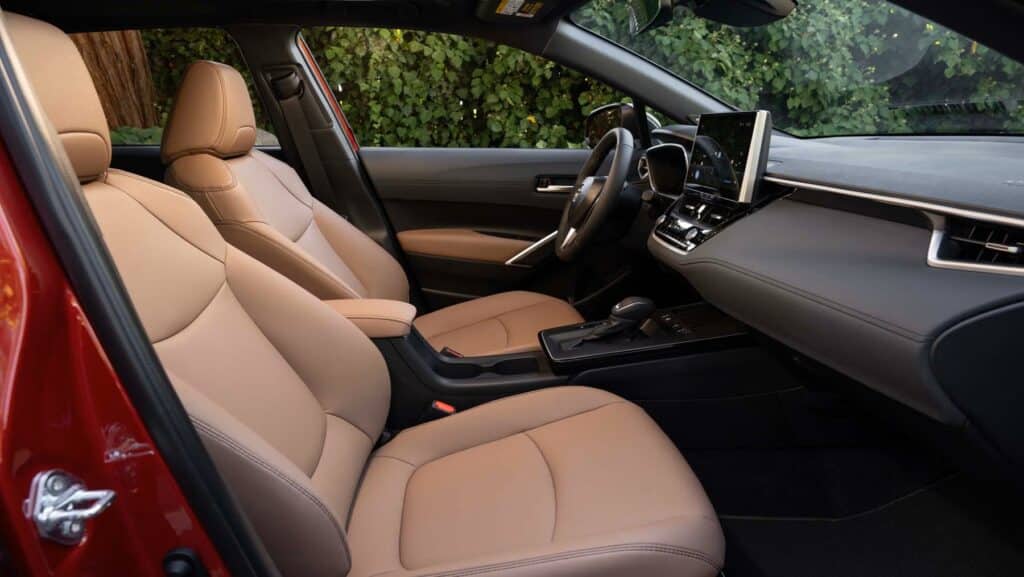
To bring it back to an SUV staple, let’s take a look at the interior comfort. The CR-V is described as “pleasant” once more. It’s spacious, has nice materials and design touches throughout the cabin, and the infotainment system is straightforward. And the cargo space? You’re getting 34.7 to 36.3 cubic feet, which is quite impressive for its class.
And this is where the Toyota Corolla Cross shows why it’s priced lower. The inside is minimal and relaxing, with a nice tan style, but the cheap plastic touches take away from the comfort factor. Still, the 2026 model features a larger center screen, enhancing its practical appeal. It offers 21.5–24 cubic feet of cargo room, which is also a bit less tahn the CR-V. However, you can still fit “11 carry-on suitcases,” according to Toyota. Not sure when that would ever be a thing, but good to know.
So, that’s the thing. The Honda CR-V is going to get you a slightly nicer interior and a bit more room. But is that worth $5,000 more when it’s lacking in other (more important) areas? The Toyota Corolla Cross may be under $30,000, but the hybrid offers impressive fuel efficiency and a fun ride, making it a far better bang for your buck if you want road trips to cost less and make you smile more. Plus, you’re not inside a depressing, oversized shoe box.