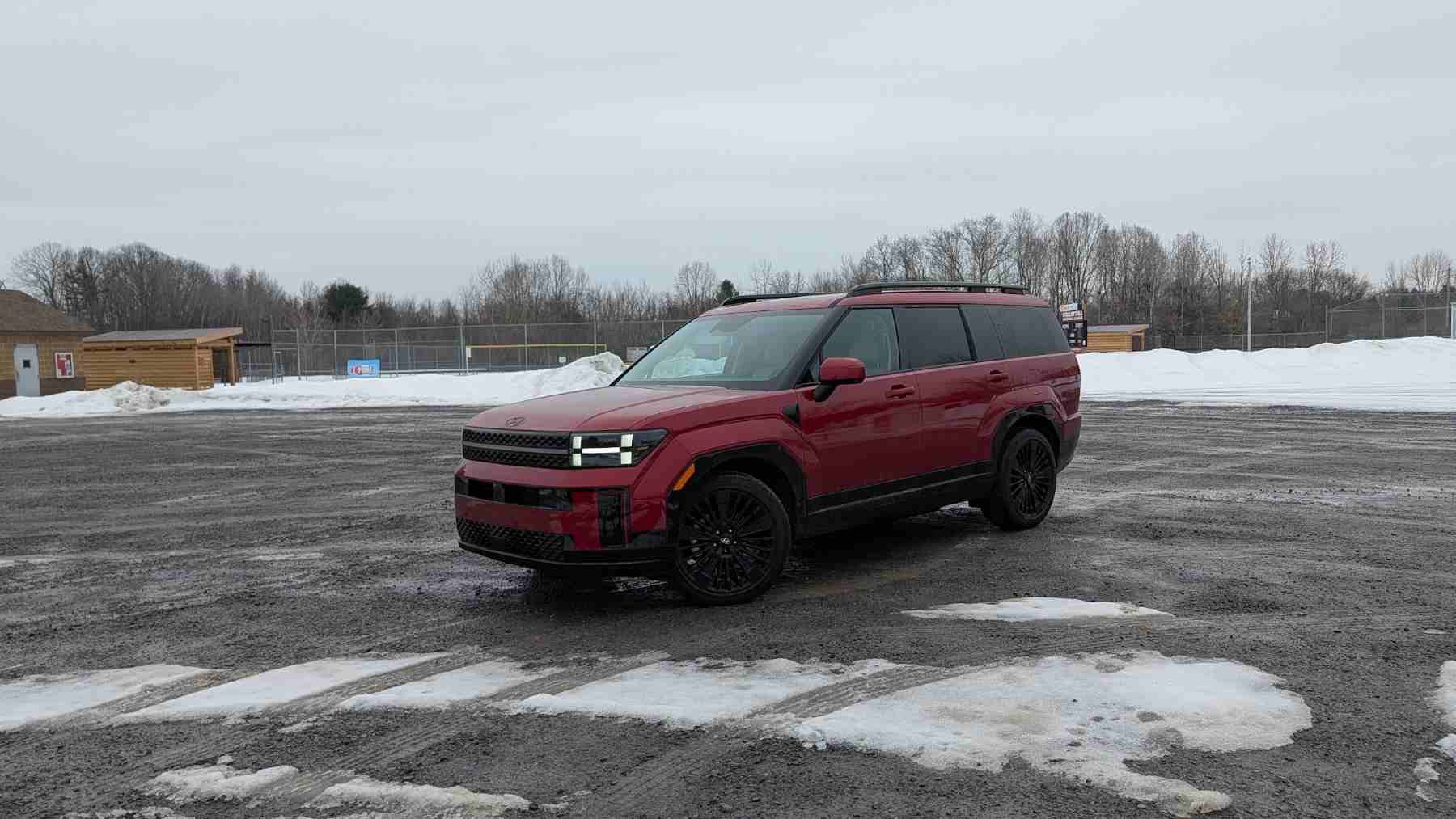

- Hyundai's Santa Fe makes a compelling case as the best midsized SUV you can buy right now, as long as you're willing to forget about driving thrills entirely.
- The interior quality on the Calligraphy trim punches so far above its price class that it exposes visible corners cut by German luxury brands charging tens of thousands more.
- With 35 MPG combined from the hybrid and gas prices climbing, this is the kind of practical math that should make every two-row SUV shopper pause before signing anywhere else.
Hyundai has been absolutely nailing it in recent years. The 2026 Palisade rolled out in a fit of a retro-futuristic brilliance like a cassette tape on all-terrain tires. The Elantra N may be the last affordable, fun, sport sedan on the market. And then there’s the Santa Fe.
The South Korean automaker’s midsized offering is competing in a saturated and broad ranging market. You have Mazda offering polished budget options with the CX70 and CX90, the Ford Explorer is always a popular mid-range option, and then you have the likes of BMW, Volvo, and Mercedes dominating the luxury end of the spectrum. So it may shock you when I say, if you don’t really care about on road performance the 2026 Hyundai Santa Fe might be the best option on the road right now.
The Hyundai Santa Fe isn’t really built for performance
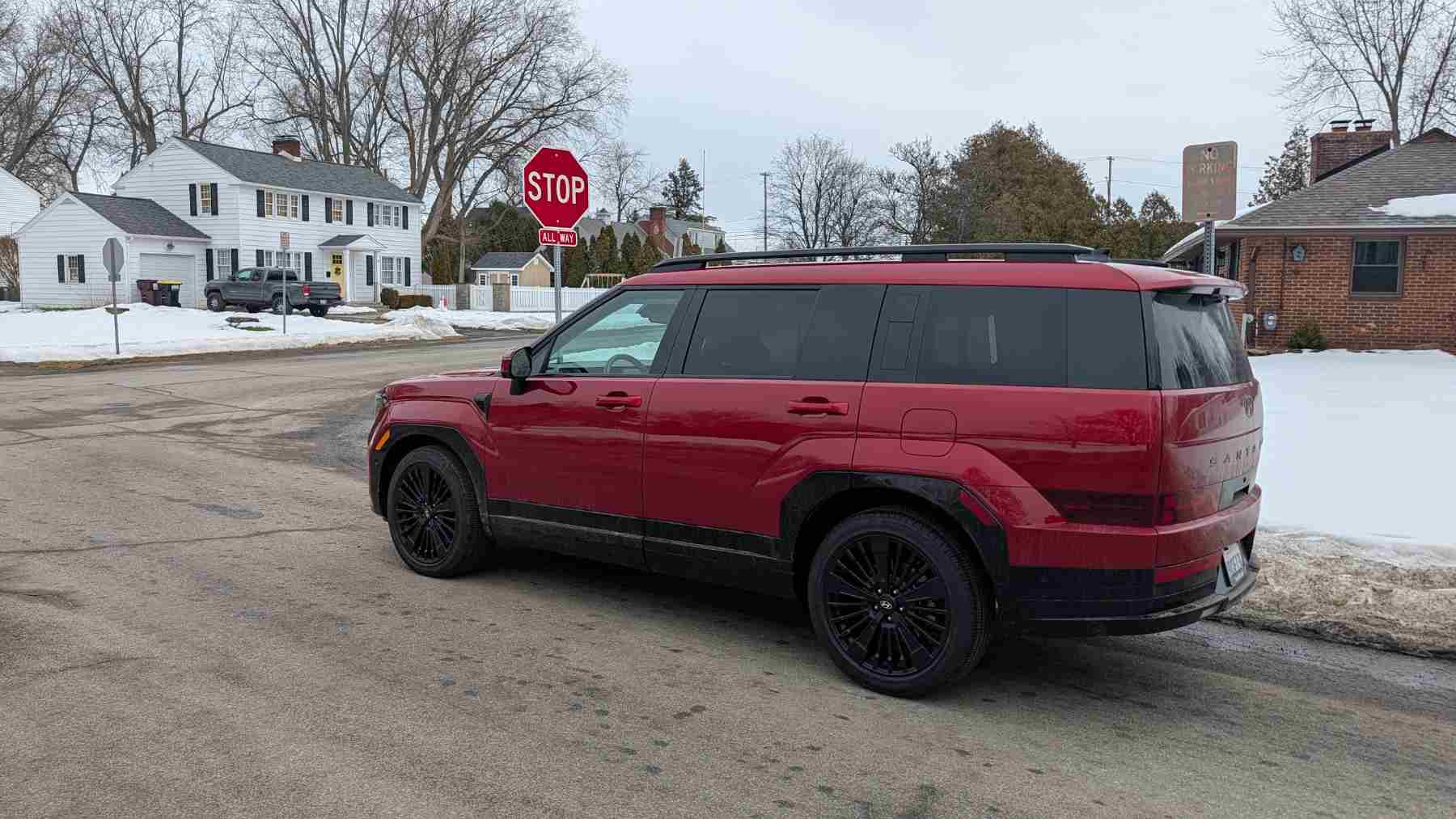
Having driven a couple of Hyundai Santa Fes the best part of 1,000 miles combined, I can say with a lot of certainty that they’re absolutely fine on the road. Not exciting (though I did have a bit of a nail biting moment stopping a Santa Fe rental on ice), not something you’ll drive for the sake of it, but perfectly fine.
You tend to get two powertrain options, a 2.5 liter turbocharged inline-four or a 1.6 liter mild hybrid. The hybrid is configured more for fuel economy than speed, with a 0-60 time approaching 8 seconds. The ICE-option is only a second or so faster, and not breaking any drag racing records. With a fuel economy hovering around 35 MPG combined, the hybrid is a pretty solid choice. Especially at a time when gas prices are through the roof.


AWD is an option on the midsized SUV, and Hyundai’s suite of safety features also makes an appearance. That’s all there is to say performance wise, really. It’s a safe, sensible, family SUV. And it drives like one.
Hyundai is doing a fantastic job with interiors these days
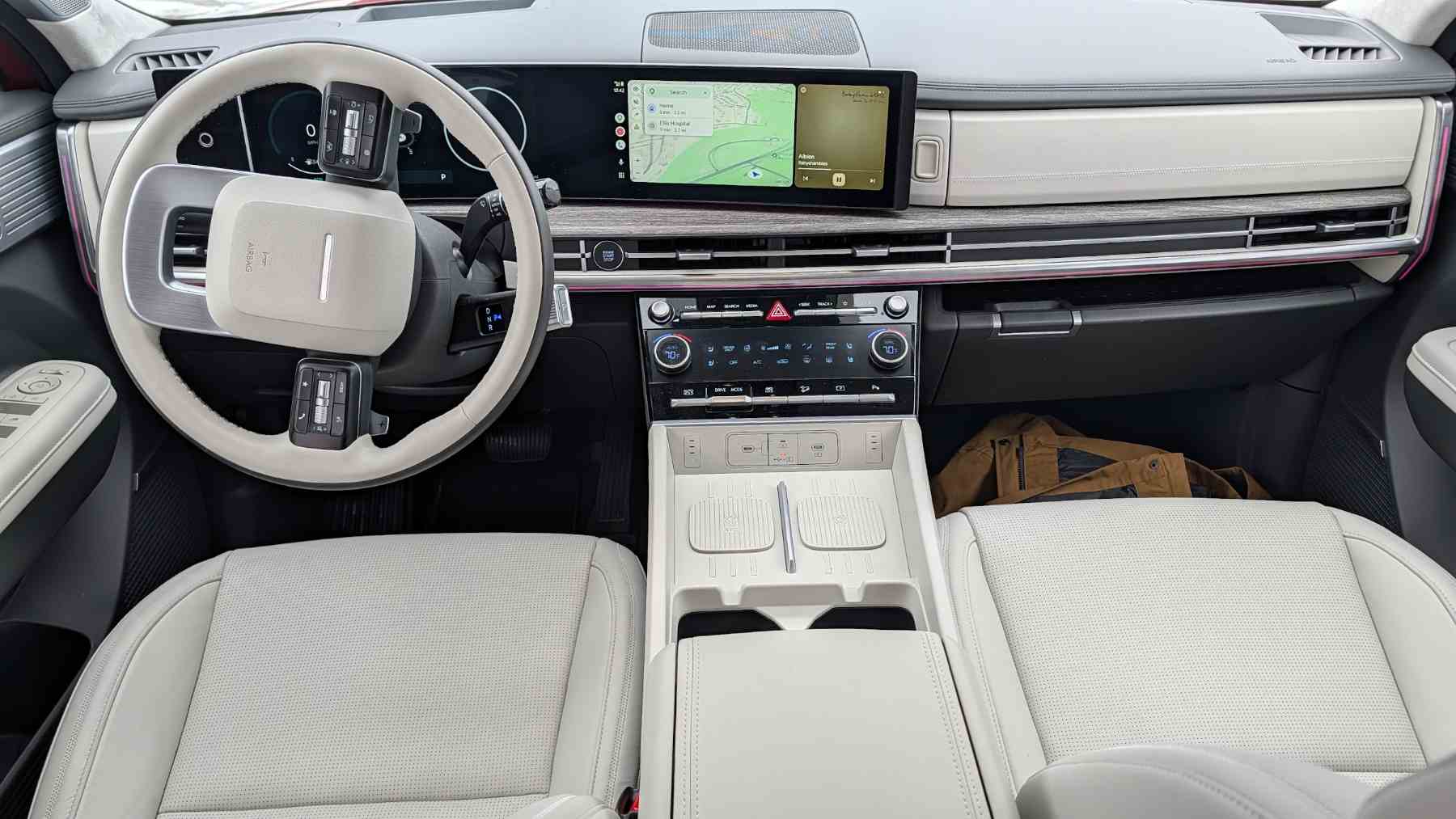
This particularly stood out on the Calligraphy trim I tested. There’s a surprising amount of wood and leather on the inside. It all has a high-quality feel to it, and the finish is frankly excellent.
There’s nothing worse than a “premium” vehicle having something like a visible imperfection on a piece of trim, or frayed stitching on a steering wheel, or a panel that doesn’t quite line up properly. The Hyundai didn’t suffer from any of that, from what I could see it was flawless.
Yes, you do get a good amount of plastic too. But everything is plastic-laced these days, including luxury German cars, the polar ice caps, and your gonads. Hyundai does do plastic right. It doesn’t feel thin, or cheap, or overly smooth like a $2 piece of junk from Temu. Hyundai’s plastic is nicely textured and fits the cabin’s aesthetic perfectly.
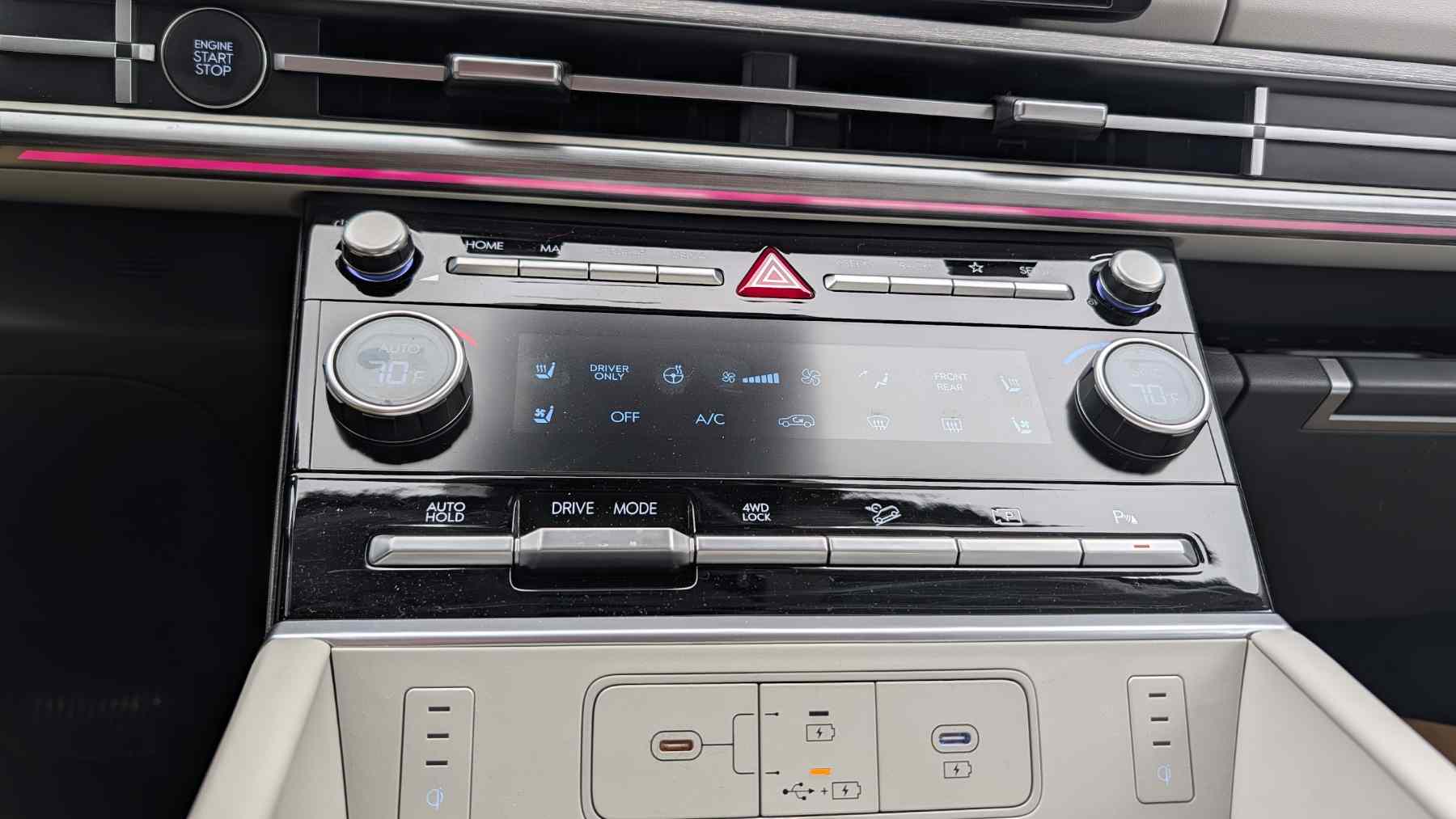
A good amount of physical buttons are also present on the dash of the Santa Fe. While many manufacturers have opted for touchscreen-only configurations to save costs, or will lob a few HVAC controls in if you’re lucky, Hyundai has really gone all out. There are the usual HVAC buttons and dials, alongside physical controls for the audio system and buttons related to vehicle functions. This includes a button to activate the parking cameras, which makes pulling into difficult spots and navigating tight spaces easy.
When it comes to touchscreens, Hyundai has gone with a stylish half-dash length display consisting of two screens. One has information for the driver, the other managing infotainment. Some of the physical button controls double up here if you prefer it. All in all, the 12.3 inch infotainment screen is pretty much all you need, and is stylishly integrated into the vehicle.
In the center tray, there are a couple of USB-C ports and wireless charging pads, which makes topping up your phone quite simple. Which helps if it’s getting drained by Android Auto or Car Play, both of which are included as standard. While both infotainment services can be accessed via Bluetooth, the driver’s USB-C port can carry data if you prefer a wired connection. That USB-C port doubles as a button which you can use to switch between data + charging and just charging. Which is handy if you don’t want to deal with annoying pop up messages every time you plug your phone in.

So in short, the Santa Fe’s interior punches well above its weight. On the top-trim anyway. I find this particularly impressive in Hyundai’s case, as their interiors used to be awful. As did their vehicles in general. The level of improvement Hyundai and its subsidiaries Kia and Genesis have shown over the past decade or so is nothing short of remarkable. What’s even more amazing is how reasonably priced the vehicles still are.
Yes, most of them aren’t particularly exciting to drive. But if you’re looking for something comfortable, stylish, economical, and priced at a point where a middle class household could buy one outright without jeopardizing the family finances, then the Hyundai Santa Fe is pretty hard to overlook. There is one glaring issue with it, though.
Cargo space is a bit of an issue in the Hyundai Santa Fe
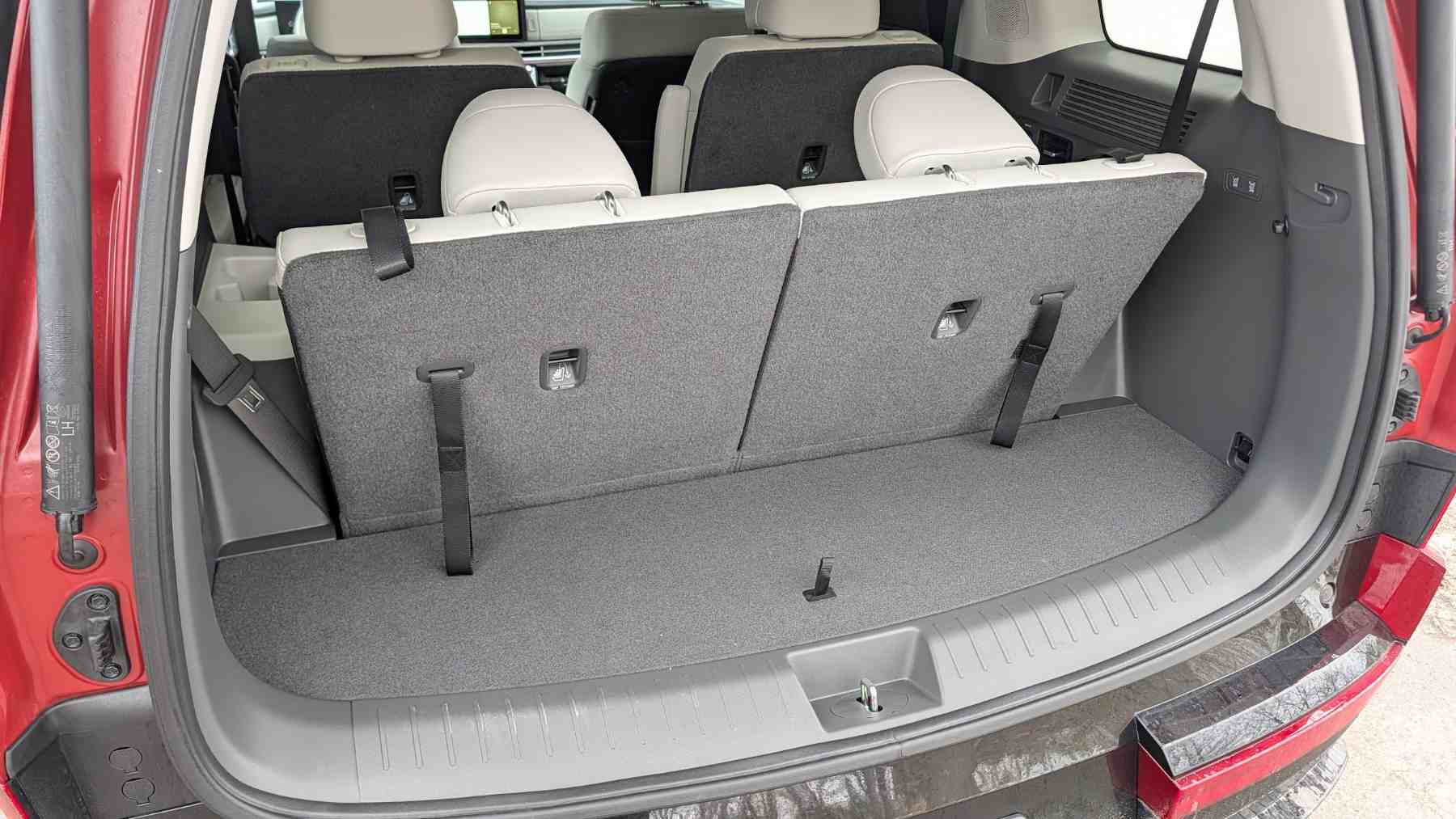
With all three rows of seats up, the Hyundai Santa Fe has a paltry 14.6 cubic feet of cargo space. To put this into perspective, the “frunk” of the now discontinued Ford F-150 Lightning has 14.1 cubic feet of cargo space. So a Santa Fe with all of its seats in use only has a little bit more storage space than you get under the hood of an electric pickup trunk in a spot you’ll probably forget about.
To mitigate things slightly, you do get 40.5 cubic feet of space when you put the third row of seats down. And it is a very cramped third row anyway, so you can only fit a small child in it. Or someone without any legs. Or as you’ll find out in the next section, a nurse that was stranded at an airport. So two rows, and somewhat ample storage, should be the default setting if you do buy one of these, and any purchase should be made with that in mind.
With both rows down, storage space shoots up to 79.6 cubic feet, which is pretty generous. So again, space is only an issue if you insist on keeping the third row up. Incidentally, while the second row on the Santa Fe I tested was powered, the third row seats had to be dropped and raised via a belt you tug at the back. Which again, makes me think these are a bit of an “emergency use only” feature. Incidentally, I did get to test out the Santa Fe in a bit of an emergency situation.
I accidentally tested the Santa Fe’s capacity to the extreme
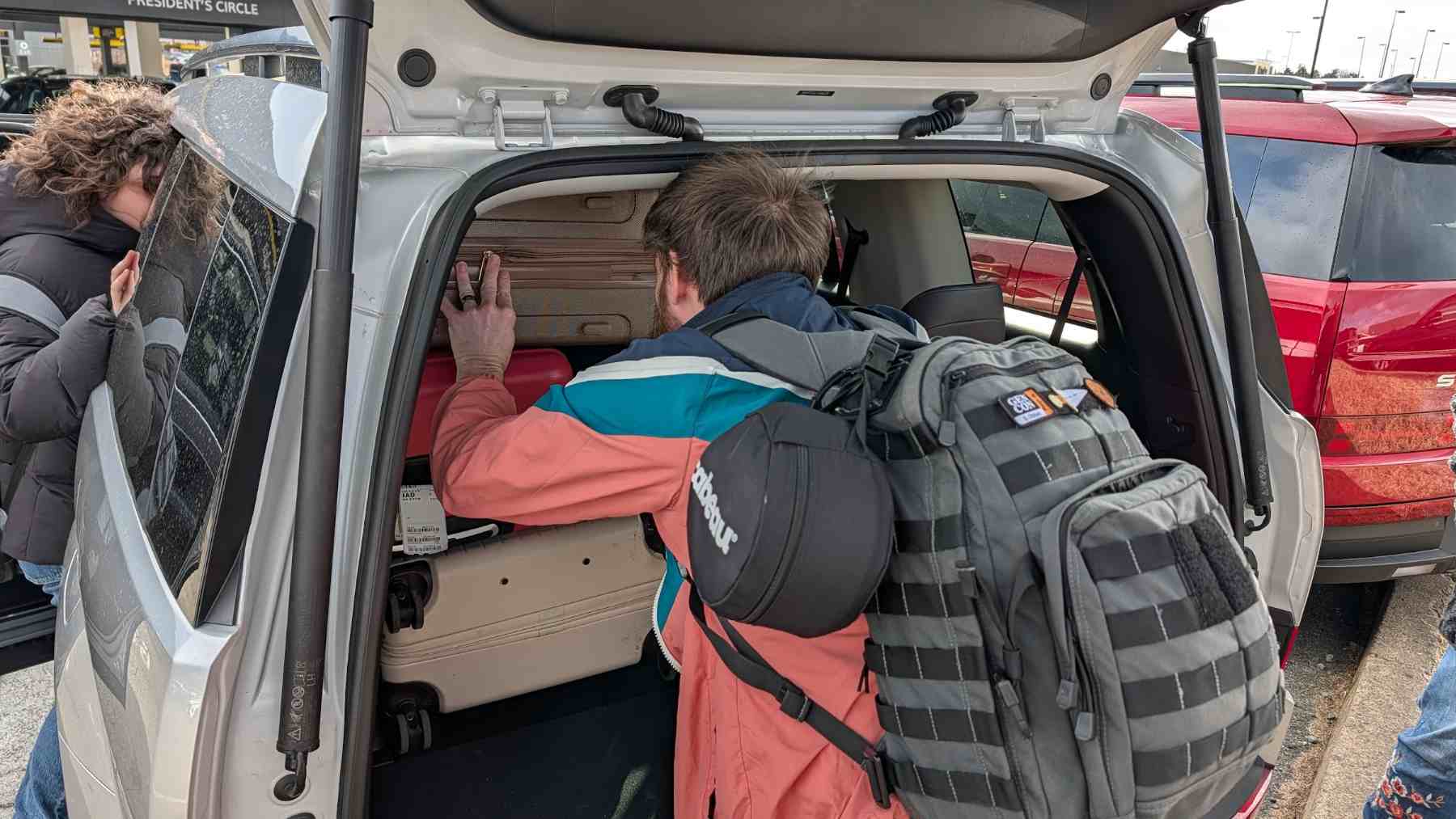
A few months before the review unit arrived, I actually found myself crammed into a Hyundai Santa Fe alongside five other people and a whole heap of luggage. This wasn’t planned, in fact it was mostly United Airlines’ fault.
My flight was canceled due to a crew shortage, and this was bang in the middle of the New Years’ weather delays. So, instead of risking another day sat in an airport, I along with five random new friends I’d just met at baggage claim decided to rent a car and make the drive back from D.C. to Upstate New York.
Unfortunately, several other people seem to have had a similar idea. All of the full-sized SUVs were gone and the best we could manage was a Hyundai Santa Fe. As discussed, they aren’t particularly large for a three-row, and they’re definitely not known for their cargo space.
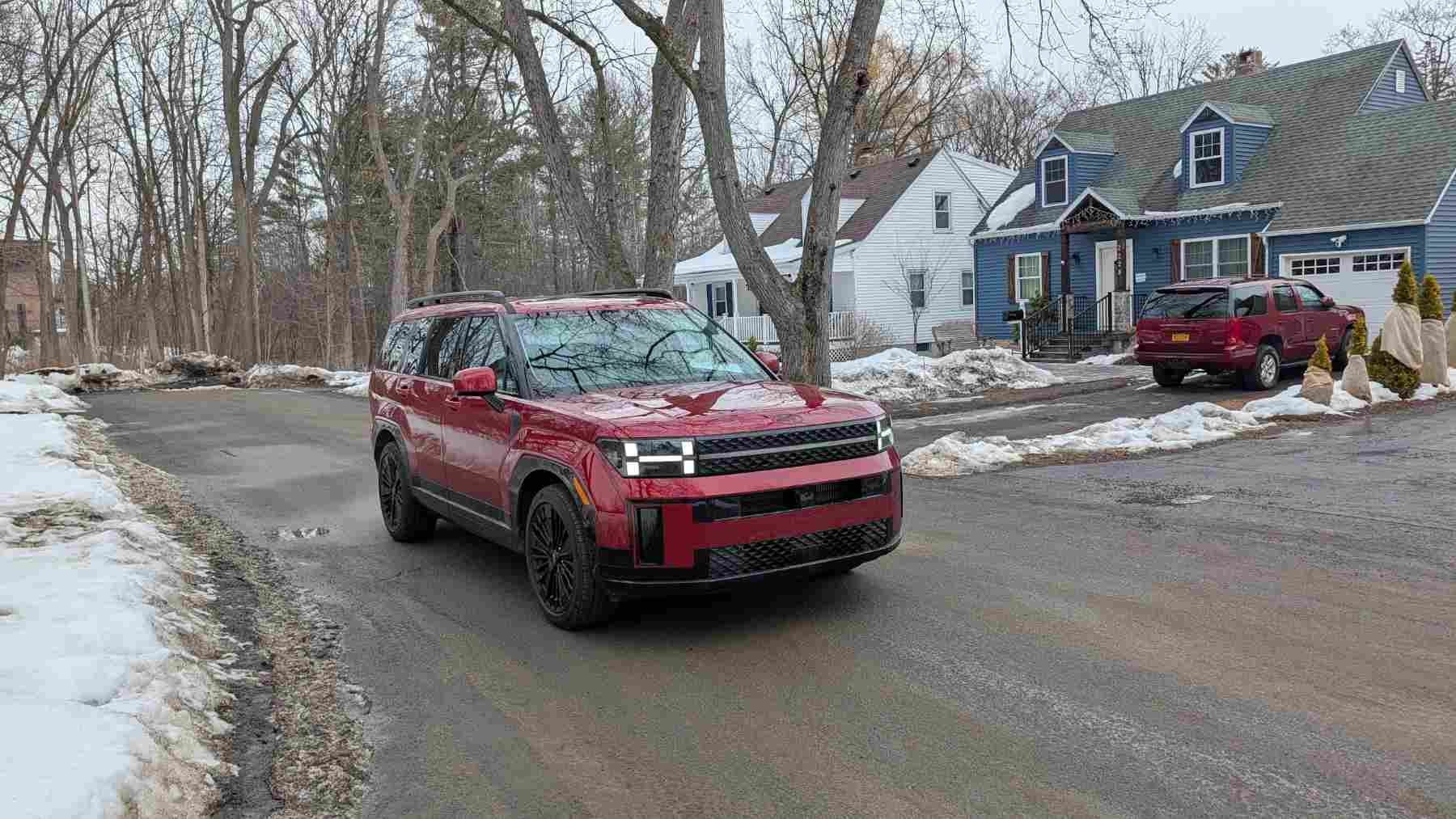
But after dropping two of the back seats, playing a little luggage Jenga, and thanking whatever deities would listen for that second-row bench, we managed to get everyone and everything in. I was pretty comfortable, but I also got a front seat for agreeing to do half of the 8-ish hour drive ahead of us. I can’t say the lady who volunteered to take the back seat had as pleasant a journey, even though she didn’t seem to complain.
In total, we only spent around $70 on gas in the trip back. Gas was a lot cheaper in January, but that’s not bad for a 400-mile trip. Especially in a slightly older model. I don’t believe it was the hybrid, either.
Still, the Santa Fe got us all home despite the weather. I checked my phone along the way, and if I hadn’t done this I’d have spent at least one more night in a budget hotel near Dulles and one more day sat in an airport terminal wondering why I wasn’t home yet. So buy a Hyundai Santa Fe. It’s not perfect, but it’s a lot more reliable than a “Big Four” airline. It’s also less likely to steal your favorite water bottle and dodge paying out any compensation based on a technicality.
Technical Specs
| Trim | Calligraphy |
|---|---|
| Engine Displacement | 1.6L (1,598 cc) turbocharged inline-4 |
| Power (hp) | 231 |
| Torque (lb-ft) | 271 |
| 0–62 mph | 7.8 seconds |
| Top Speed | 116 mph |
| Curb Weight | 4,575 lbs |
|---|---|
| Dimensions (L/W/H) (mm) | 4831 / 1900 / 1770 |
| Cargo Capacity (cu ft) | 14.6 (behind 3rd row) / 40.5 (behind 2nd row) / 79.6 (all rear seats folded) |
| EPA Fuel Economy (combined) | 34 MPG (AWD) / 36 MPG (FWD) |
|---|---|
| CO₂ Emissions (g/km) | ~160 g/km (estimated based on EPA combined ratings) |
| Starting MSRP | $50,250 |
|---|