
- Volkswagen's second-generation Atlas pairs a significantly torquier 2.0-liter turbo four with claimed fuel economy gains, a rare feat that could reshape the three-row SUV value equation.
- The jump from 273 to 528 lb-ft of torque is the kind of number that demands a double-take and a closer look at what VW's evo5 engine is actually doing.
- If you're cross-shopping a Palisade, Telluride, or Pilot for your next family hauler, the 2027 Atlas just made your decision a lot harder — and the standard-equipment list alone tells you why.
We’ve definitely entered an era where vehicles, and SUVs in particular, are starting to look interesting again [Editor’s Note: Rejoice!!!!]. After a decade of generic nonsense, Hyundai broke the mold a little when unveiling the Palisade at the 2025 New York International Auto Show. Now, one year on, Volkswagen has cracked it even further with the new Atlas.
Technically, the covers have come off the 2027 Volkswagen Atlas just before the 2026 New York Auto Show, with Dave McQuilling getting a hands-on experience at the launch. The press days actually start on April 1st, with the show opening to the public on April 3rd. But to be honest, it’s interesting enough to hog the spotlight for a little while.
So, let’s ignore the outside for now; you’ve seen the pictures. It’s time to take a look at the new powertrain. A lot of the time, manufacturers have to choose between ramping up power and improving fuel economy. Occasionally, though, you can do both.
Volkswagen’s new “A888 evo5 turbocharged and direct-injection 2.0-liter four-cylinder TSI engine” is more than just a mouthful to say. It produces 282 horsepower and 528 lb-ft of torque. That’s a 13-horsepower improvement on the 269-horsepower and 273 lb-ft of torque offered by the last generation of Atlas. All-wheel drive still isn’t standard on the Atlas, though, with cheaper models being relegated to front-wheel drive.
Despite upping the power, VW also claims fuel economy has improved. The German manufacturer has yet to issue an estimate on the new fuel economy, and the EPA’s official figures are likely a short while away. But making an engine more efficient overall does not break the laws of physics.
While fuel economy has improved, other practical points, like the vehicle’s 5,000-pound towing capacity, remain unchanged from the last generation. It’s still enough to tow a trailer or boat along for a family vacation, though. And other family-friendly features have also improved.
The new Volkswagen Atlas is playing into the family-friendly side
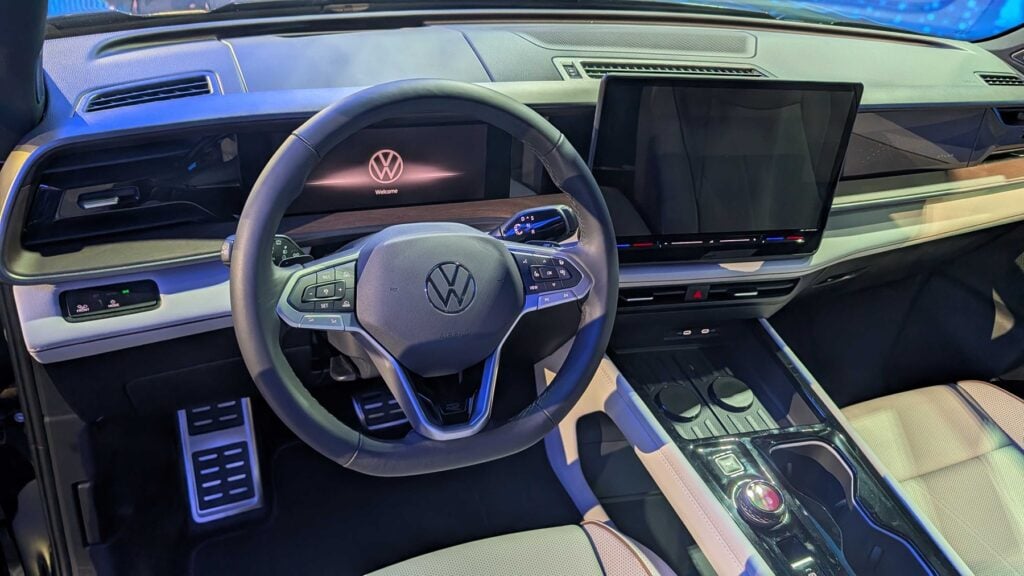
Performance boosts are always nice, but let’s be real. The Volkswagen Atlas is a family car at its core. Unsurprisingly, it’s this aspect that’s seen the most improvement. A power liftgate is now standard, as are rear sunshades, an auto-dimming driver’s side mirror, dual hatch lights, and park distance control at both the front and rear of the vehicle.
The speaker system has also received a boost, which will be welcome news to parents who want to drown out the irritating sounds of bored children emanating from the second-row captains chairs. You now get nine speakers as standard, though you can upgrade to a 14-speaker Harmon Kardon system if you get the top trim.
New air vents in the B-pillars pair with the existing vent system to keep the bored, undersized individuals in the second row warm or chilled. A few safety features have also been added, including an extra airbag in the front center.
Whoever is doing the driving is rewarded with a 12-way ergonomic seat with enhanced four-way lumbar support, which is now standard. Massage functions for the front seats also appear on the top trims. VW’s self-driving system is still hands-on with this generation of Atlas, but it now handles driver-initiated lane changes. Emergency assist is now capable of safely pulling the car over on the roadside if it believes the driver has suffered a medical emergency.
The interior itself has been reworked. Now it’s covered in soft-touch surfaces, and has what VW describes as a “bold loop unifying the cockpit.” All trims have wooden elements, which is a nice luxury touch. Base models are stuck with leatherette, though buyers have to splash out for premium Varenna or Nappa leather options. The leather and wood are a massive upgrade, with the wood around the dash particularly pleasant. The leather is high quality as well, adorning almost every panel. Unfortunately, it’s all spoiled by the hard, shiny plastic on the center console, cheapening the whole experience.
Ambient lighting settings now link to the audio system, and outside of the base trim (which features a smaller 12.9-inch display), the infotainment centers on a 15-inch central touchscreen. There are physical controls too, namely a “driver experience dial” in the center, which can be used to control things like volume, drive modes, and the interior’s atmospheric features.
Like many other manufacturers, Volkswagen has pivoted hard towards AI assistance and software-as-a-service. As an odd bonus, or perhaps as an attempt to draw you in, the new Atlas comes with a free one-year subscription to the company’s generative AI service “Premium Speech.”
The 2027 VW Atlas is slightly larger than its predecessor
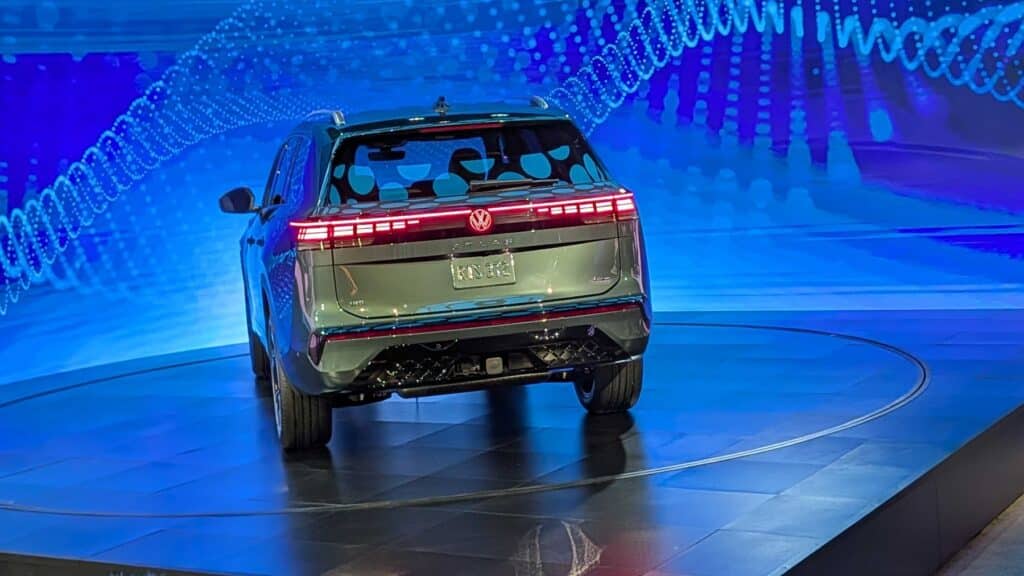
The 2027 Volkswagen Atlas is ever so slightly larger than its predecessor. The wheelbase, height, and width remain the same, but the vehicle is around an inch longer than the Mk I model. Volkswagen has openly bragged about maintaining space in the vehicle’s “generous third row” and considers the interior’s overall volume a major talking point. The shift lever has also moved, creating a little more space up front. This all comes as Volkswagen switches to the new MQB evo platform for its upcoming SUV.
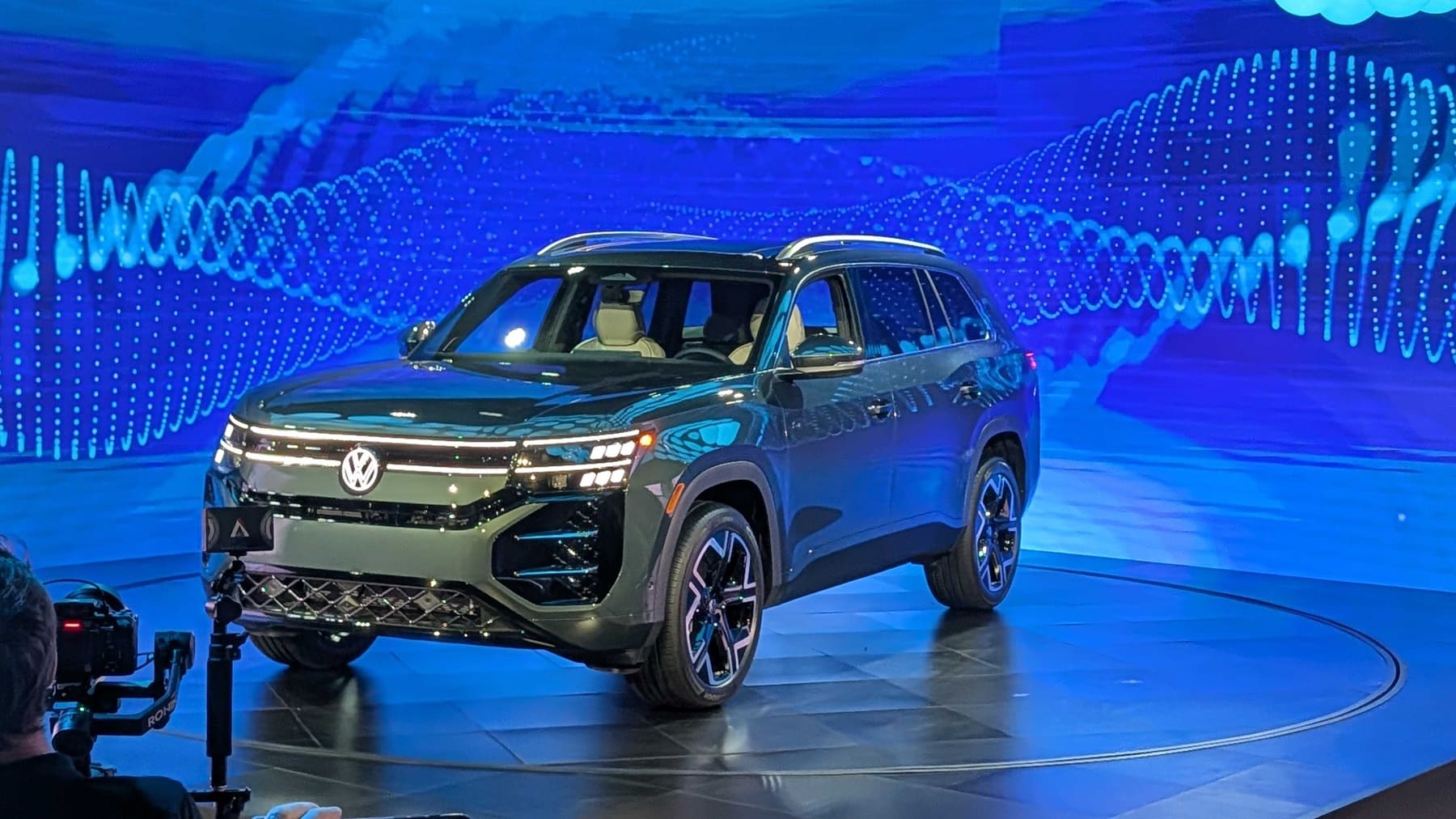
Okay, enough about all of that, let’s talk about how it looks. The most standout features are the redesigned front and rear lights, giving the vehicle a more modern, even futuristic, look. Volkswagen has compounded on this by adding stronger proportions overall, and beefing up areas like the fenders.
Volkswagen claims the new Atlas looks best from the side, but those lights are more likely to stand out as the sun goes down. The double-stacked LED headlights will definitely stand out against the masked upper grille. And the VW badge lights up too, but it fits in with the whole aesthetic. So there you have it, the 2027 VW Atlas. A stylish, family-centered look into the future from Volkswagen.
The new VW Atlas is expected to launch in the fall of 2026. Exact specs will obviously surface between now and then, so watch this space.