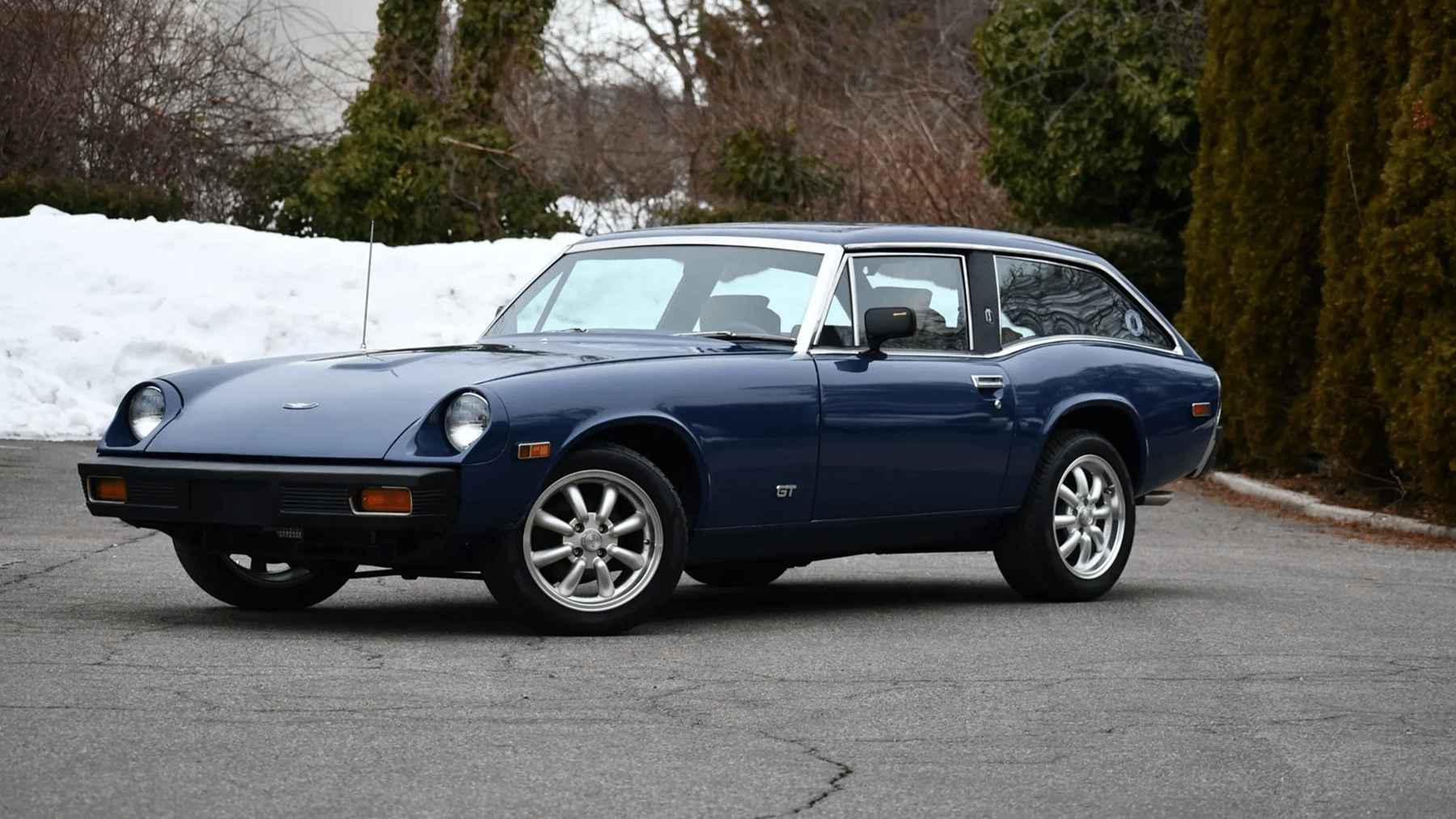

There is something bittersweet about the 1976 Jensen GT that recently sold at auction. The winner now owns the final Jensen model ever made — or perhaps the reason it all came to an end.
The Jensen GT that sold on Bring a Trailer in March 2026 is one of 511 ever made. While repainted dark blue, the Jensen GT still has the same 2.0L Lotus twin-cam inline-four engine with dual Weber carburetors and a five-speed manual transmission, which made the Jensen GT promisingly zippy and practical. It also has a distinct shooting brake roofline and chrome trim that had the industry hopeful back in the ’70s. But the fully restored, eye-catching 1976 Jensen GT only sold for $17,700 at auction for the same reason it failed the first time around: it’s unreliable.
Even though the seller had poured a lot of time and money into ensuring this particular Jensen was free of its former issues.
In the late 1960s, Carl Duerr decided he wanted to create an affordable two-seat roadster, creating the X500 prototype with a 1975-cc Vauxhall engine. British sports car importer Khell Qvale liked Duerr’s vision and joined the project, hoping to develop a new version better suited to the American marketplace. The biggest issue was the engine: the Vauxhall one just wasn’t powerful enough. It couldn’t even go past 100 miles per hour. Ford, Mazda, and BMW were no help, but Lotus engineer Graham Arnold overheard the problem and said offered up an engine.
In 1972, the Jensen-Healey Roadster was revealed, powered by Lotus’ twin-cam 907 engine. Unfortunately, this engine was ultimately extremely unreliable. This overshadowed any positives about the car and its design, leading to significant negative press. The water-soluble bodywork and leaky roof were ongoing ailments, but the ongoing engine problems were the killer. At this point, Donald Healey walked out. Jensen continued for a few more years, introducing the short-lived Jensen GT.
The GT had a few changes, like getting an overall stiffer structure, two more inches in overall length, and 100 more pounds. The cabin was more refined, including a walnut dash, quality seat trim, and a four-speaker stereo system. Reviews were a lot more positive and many enjoyed the drive.
At the time, Autocar wrote: “The Jensen is a qualified success. It is a fast, reasonably economical and comfortable car for two. Its hatchback design is a useful feature enabling large objects to be carried (though the rear seats are far too cramped for adults), and Jensen has made the GT quieter and more refined than the earlier Jensen-Healey. The engine is still too noisy when extended, though, and the car is not as quiet as the Lotus Elite, which has the same engine.”
Unfortunately, Jensen’s existing reputation for unreliability held the GT back from attracting more interest, along with its $10,000 price tag, and the sinking company went bankrupt. So no, it wasn’t the GT that killed Jensen. In fact, it was the right vehicle to save the carmaker. But the global economy and having to continuously pay for Jensen-Healey Roadster warranty repairs were too much for the carmaker. The GT wasn’t enough. Five hundred and eleven GTs later, Jensen was gone.
Technical Specs
| Engine Displacement | 2.0-liter DOHC 16-valve Lotus 907 engine |
|---|---|
| Power (hp) | 144 |
| 0–62 mph | 8.7 seconds |
| Top Speed | 115 mph |
























“Yes, it is the Lotus engine, and it now has all the fixes that caused nightmares for me when I had my GT in ’77. Overheating, coolant circulation problems, head gasket issues, and electrical gremlins. Had it less than a year, fixed it, and sold it. I just texted the guy I sold it to. He misses that car. I told him to bid on this one,” said one former owner.
Added another: “Typical Jensen bidding: the cars get no respect due to Lotus putting the screws to Qvale at Jensen offering NO WARRANTY for his 15,000 engines and leaving the Jensen folks holding the bag to repair all of them. That issue was the death knell for Jensen and the cars, too (public condemnation, even though Jensen fixed all the engine issues for $$$). This PO probably put $50-$100K into this restoration (sure, not smart) and will never get much more than $10-$15K out of it. These cars were finished way better than any MG or TR at the time, and if one drove one, they would see the value. Sad epilogue for a proud manufacturer.”
The 1976 Jensen GT was good, but it wasn’t enough