
Mercedes-Benz-owned YASA has been working on some insane tech that could create electric vehicles that are lighter, more efficient, and more powerful than anything we’ve seen before. It has taken its record-smashing axial flux motor and turned it into an in-wheel system prototype that could deliver 1,000 horsepower per wheel.
Do we need that? No. Do we want that? Yes.
What are we even doing here, YASA?
YASA, which stands for Yokeless and Segmented Armature, has been refining motor designs since it was founded by Tim Woolmer, resulting in compact fide axial flux motors that are set to replace the conventional radial motors found in EVs. And it’s not just an idea. YASA has proven it’s possible. Back in July 2025, YASA declared its own unofficial world record in power density after its prototype axial motor delivered 550 kW of power despite being just under 29 pounds — or 19 kW per pound, about double the current industry standard.
But that was just the beginning for YASA, which set another (personal, unofficial) record in October 2025 with an even lighter axial flux motor. Those tests delivered 1,000-plus horsepower, or a bit over 22 kW per pound — a power density increase of 40%.


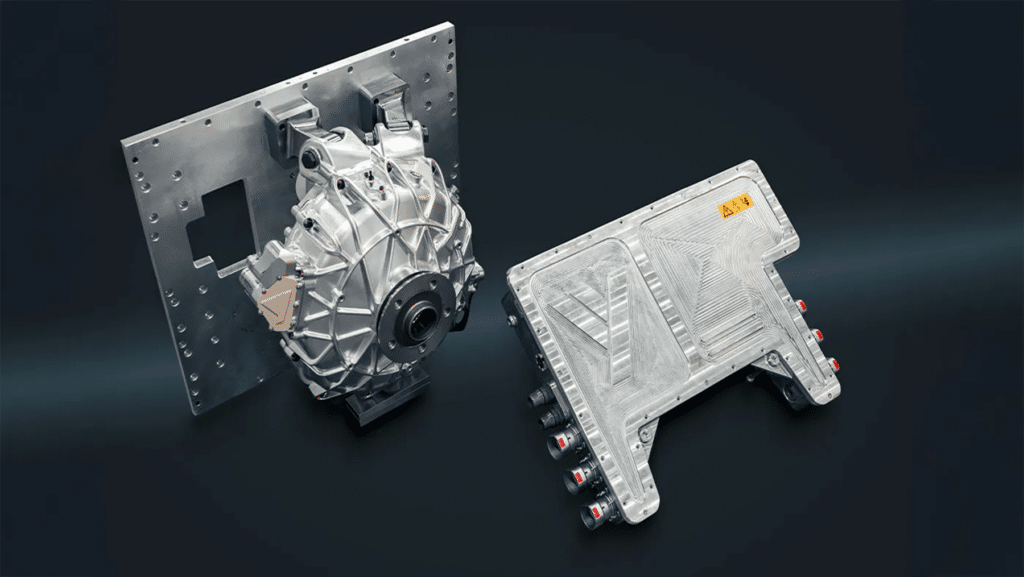
So why are we talking about this now? Well, YASA recently put this motor into an in-wheel electric powertrain. This is another unofficial record for YASA: the world’s first mass-neutral in-wheel motor.
It’s cool to break records, of course, even if they are sorta made up by the person setting and breaking them. But setting a record doesn’t actually equate to technology being used in the real world. I mean, I can announce that I’m the person who can break the most eggs in an hour using a Wiimote while repeatedly saying, “We talkin’ or we racin’?” It’s probably true (since nobody else has done it) but it doesn’t really translate to something useful that will get me any jobs or friends.
In other words: What electric vehicle can handle a combined 3,944 horsepower? And what electric vehicle needs it?
I feel like we’re not really getting any answers about that from YASA either. Woolmer has called this technology a “breakthrough” and “a first.” But just like me smashing eggs with a Wiimote, maybe they are first for a reason. Then YASA CEO Joerg Miska added that it’s “continuing to push the electrification envelope” and is “world breaking.” Okay, yes… He then echoed Woolmer that this makes in-wheel motor systems lighter, more efficient, and more powerful. Okay, yes, we know. But do we need this? Especially this specific one?
One thing that YASA mentioned that makes sense is the possibility of downsizing rear EV breaks, or even eliminating them altogether. There is obviously something here within this technology that could improve electric vehicles. However, the actual record-breaking version of the compact fide axial flux motor? There is no vehicle on earth that has the frame, tires, or anything needed to handle that amount of power and torque.
It reminds me of when these two teenage boys came up to me when they saw my Lotus Elise and were so curious what kind of horsepower and speed it had due to its exotic, aerodynamic looks. You can imagine their disappointment when I told them. There’s an obsession with horsepower going on — and carmakers keep wanting more and more horsepower in their vehicles despite it not really mattering. It feels like a stat to grab attention, not really improve a car’s performance. Unless you want to vomit every time your Tesla Model Y takes off at a green light.
But I don’t know, why am I complaining? A 4,000 horsepower car — f***ing badass.