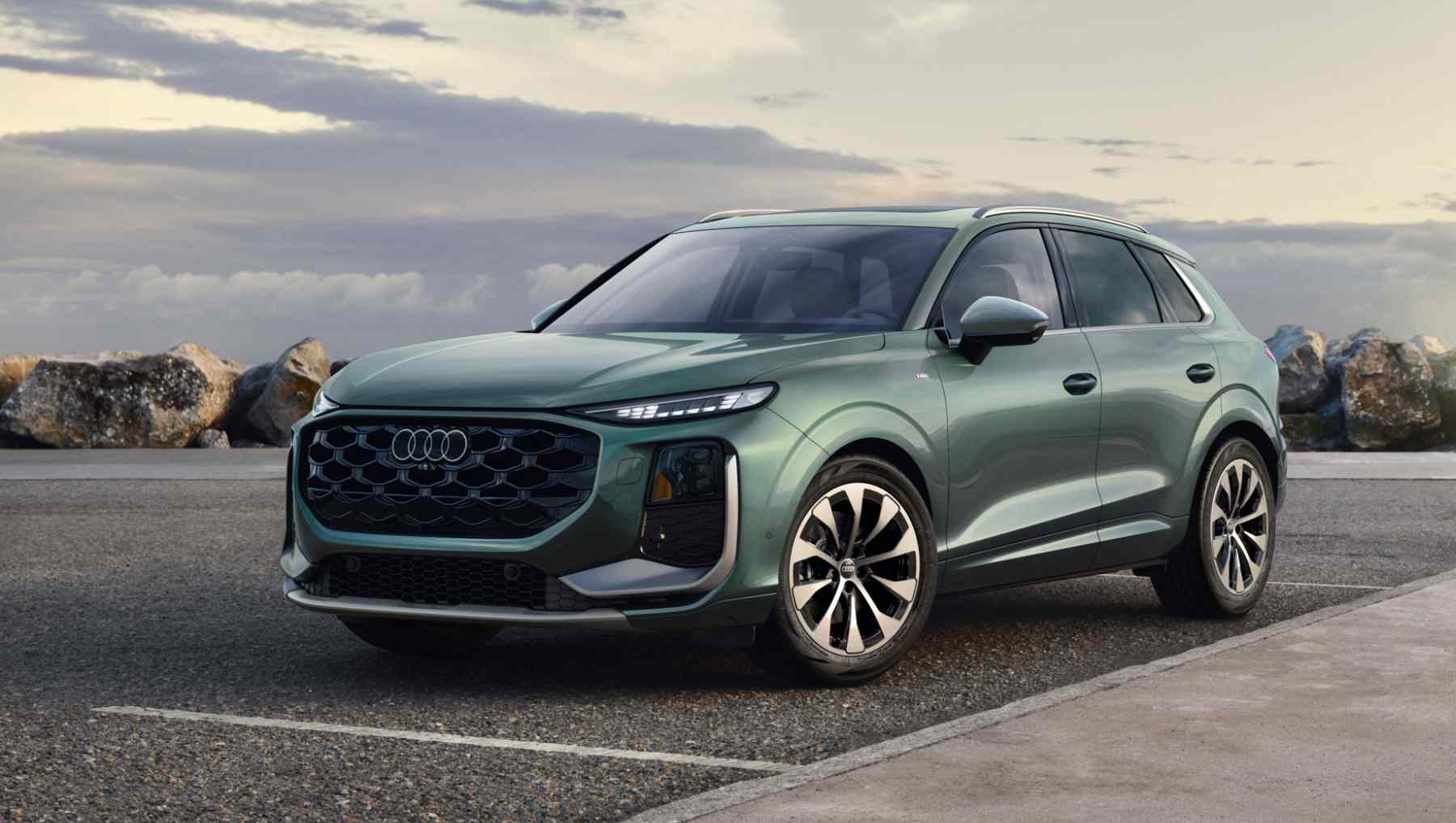

The totally redesigned 2026 Audi Q3 is finally available in dealerships, and might just be the best value entry-level German SUV on the market for people who value power. It offers 255 horsepower, upgraded cargo space, and that clean Audi interior that sets it apart from other luxury brands.
To get a proper idea of just how good the Q3 is, you need to compare it to its rivals — which are the BMW X1 and Mercedes-Benz GLA. Audi’s cheapest SUV is the most expensive of the three, coming in at $43,700 compared to $42,800 for the BMW and $41,500 for the Mercedes. But price is only part of the story.
If you just glance a spec sheet, there’s not much difference between the three vehicles powertrains initially. All three SUVs are rocking a 2-liter, inline-four engine. Though the Mercedes, the least expensive vehicle of the bunch, is also a mild hybrid. But dig into those engines a bit more, and you’ll see a gap open up.
The Audi is the most powerful of the three by a good margin. That 255 horsepower is notably more than the 241 offered by the BMW X1, and significantly more than the Mercedes-Benz GLA’s 221. Line them up against each other, and you’ll see the Audi hit 60 mph in just 5.5 seconds, while the BMW comes in at 6.2 and the Mercedes lags behind with a time of 6.8 seconds. That’s a whole 1.3 second gap, which is fairly significant. Even if you don’t put a lot of stock into 0-60 times.
All three vehicles come with all-wheel drive as standard, and use dual-clutch transmissions. Though Mercedes has opted for an 8-speed gearbox while Audi and BMW have settled on seven.
The Audi does lag behind in other departments
So in performance terms, the Audi is the clear winner. You could even make the argument that the Quattro AWD system is better than both X-Drive and 4Matic, giving the Ingolstadt-based manufacturer a further edge there. But while you won’t find the Q3 lagging behind on a dragstrip, there are areas where the BMW or Mercedes may be a better option.
If you value cargo space, BMW’s smallest SUV is still the biggest when it comes to entry-level German luxury utility vehicles. It has up to 57.2 cubic feet of cargo space, significantly more than the 50.5 offered by Mercedes-Benz and the even tighter 49.9 cubic feet the Audi has available.
In terms of fuel economy, this is where the extra gear and hybrid powertrain offered by Mercedes comes in. It offers 29 MPG combined, which is the most of the three. Though BMW isn’t far off, with the X1 offering 28 MPG combined, and at 25 MPG the Audi Q3 isn’t significantly less efficient. Let’s face it, none of the three are the most economical things on the road either.
So what’s the best vehicle in this particular class? In performance terms, the Audi Q3 clearly takes it. If you want the best all-rounder though, it’s clearly the BMW X1. It’s slower than the Audi, but only by 0.7 seconds, and you don’t really take your compact SUV to the drag strip anyway. [Editor’s Note: I know someone that does actually!] And it’s less economical than the Mercedes-Benz GLA, but only by one MPG. It sits right in the middle of the two price-wise, while offering close to an extra ten cubic feet in cargo space, the biggest outlier on this spec sheet.
So the BMW X1 would make the most sense for people who want an SUV. When it comes to the actual performance cars offered by the likes of Audi, that’s another debate for another day.