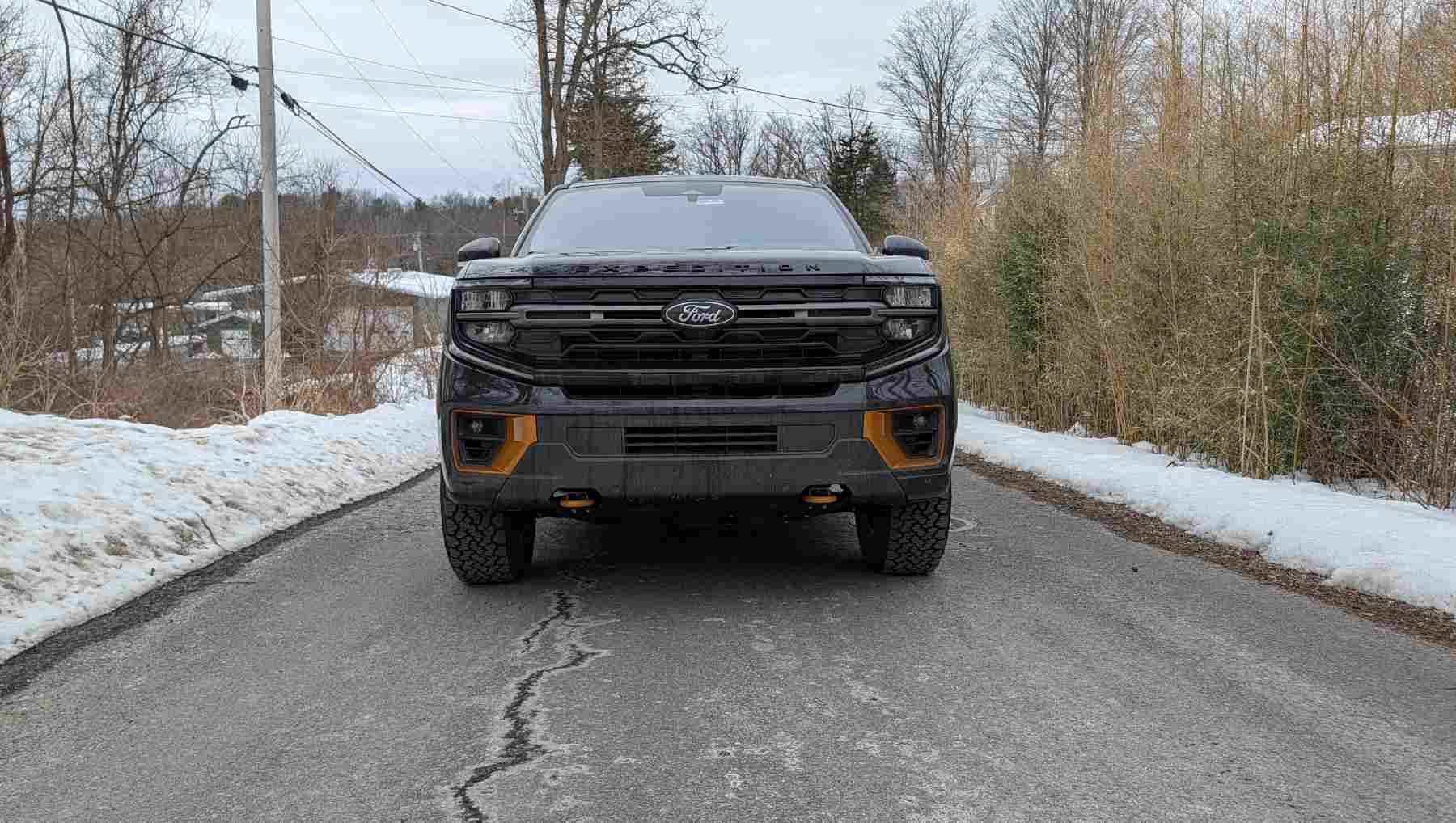
The Ford Expedition is Ford’s full-sized SUV, the sort of thing that goes up against the Chevy Tahoe and the Jeep Grand Cherokee. It’s not the biggest SUV Ford produces; that’s the Expedition that has the word “MAX” (and around another 12 inches) tacked onto the back of it. It’s not the best-selling either; the smaller “Explorer” comfortably snags that title. So what is it good for?
I spent a week with the Expedition, specifically the off-road-focused Tremor trim, and got to grips with its positives and negatives. It should be pointed out, the press fleet only had a 2025 model available. But aside from some minor cosmetic changes, and a cruise control update I will thoroughly explain, both model years are essentially identical.
The Ford Expedition’s drive mode makes a real difference
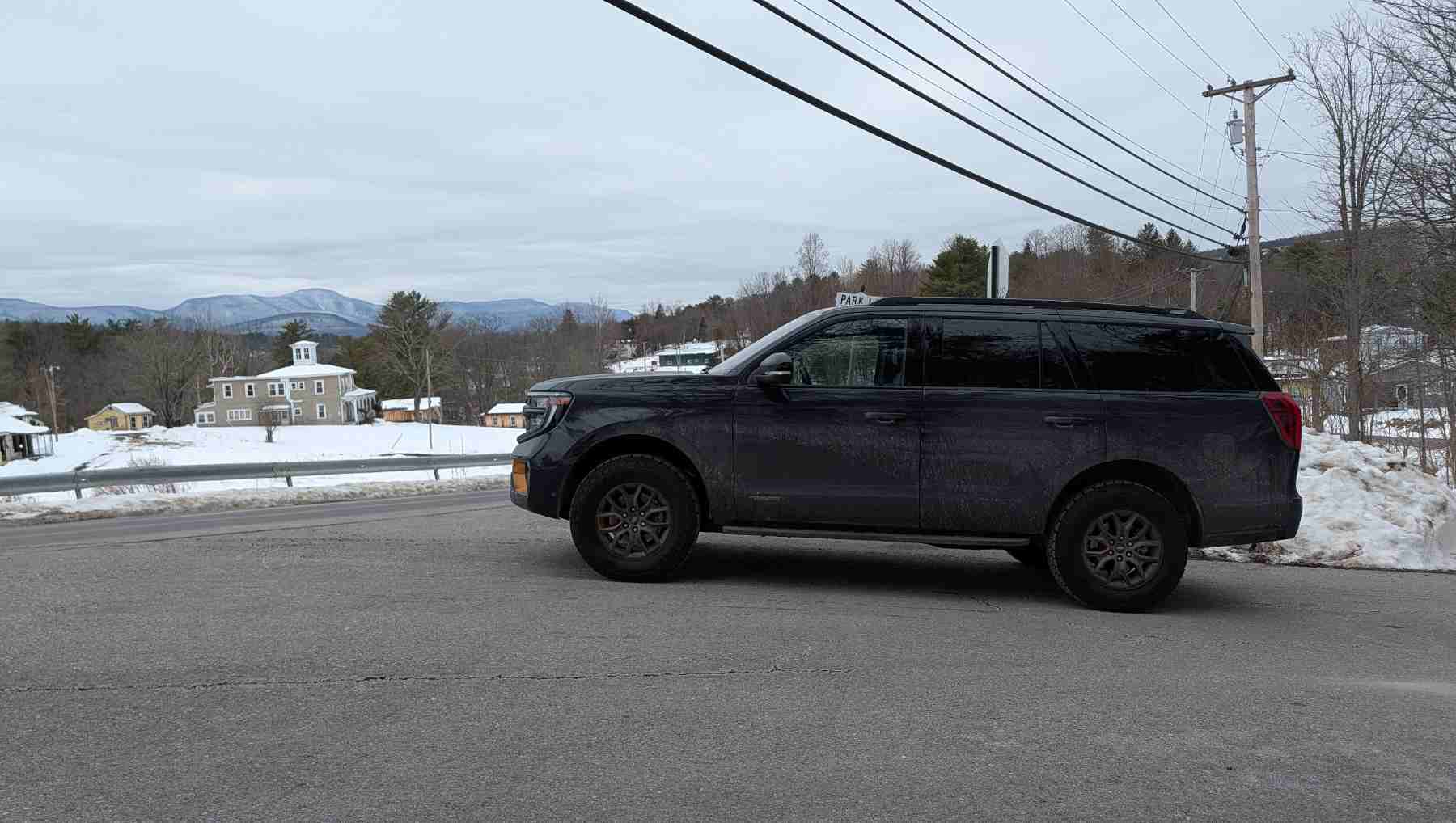
There’s no two ways about it, the Expedition is a bit of a gas guzzler. It’s pretty massive, so even though the 3.5 liter EcoBoost V6 powering it along is far more efficient than some of its direct competitors’ engines, you’re still looking at an average of 18 MPG, with an EPA estimate of 15 in the city and 22 on the highway. You may be able to stretch that a bit further by making use of “Eco Mode,” which is what I did while heading down I-87 in absurdly heavy traffic. Eco-mode did make a difference, but (perhaps expectedly) felt desperately anemic compared to the vehicle’s standard drive mode.
The best thing about spending a couple of hours in Eco Mode is how violently punchy it made the Expedition’s “sport” mode feel once traffic had cleared up. The hefty utility vehicle felt like a BMW X7 M60i compared to it. In reality, though, it isn’t that performance-focused. It’s great compared to how heavy vehicles used to be, but it’s absolutely nothing special these days.
The handling doesn’t feel particularly agile, but the power is there, though. Apparently, an unladen Expedition will go from 0 to 60 in less than 6 seconds. Which is quick for an ICE vehicle the size of a small bus.
It’s worth noting that the “Tremor” trim comes with all-terrain tires, which may have affected both my fuel economy and the truck’s handling. It probably makes up for that if you have some decent recreational terrain on your doorstep. But living in New York, I wouldn’t know anything about that.
The Ford Expedition Tremor’s off-roading specs look good
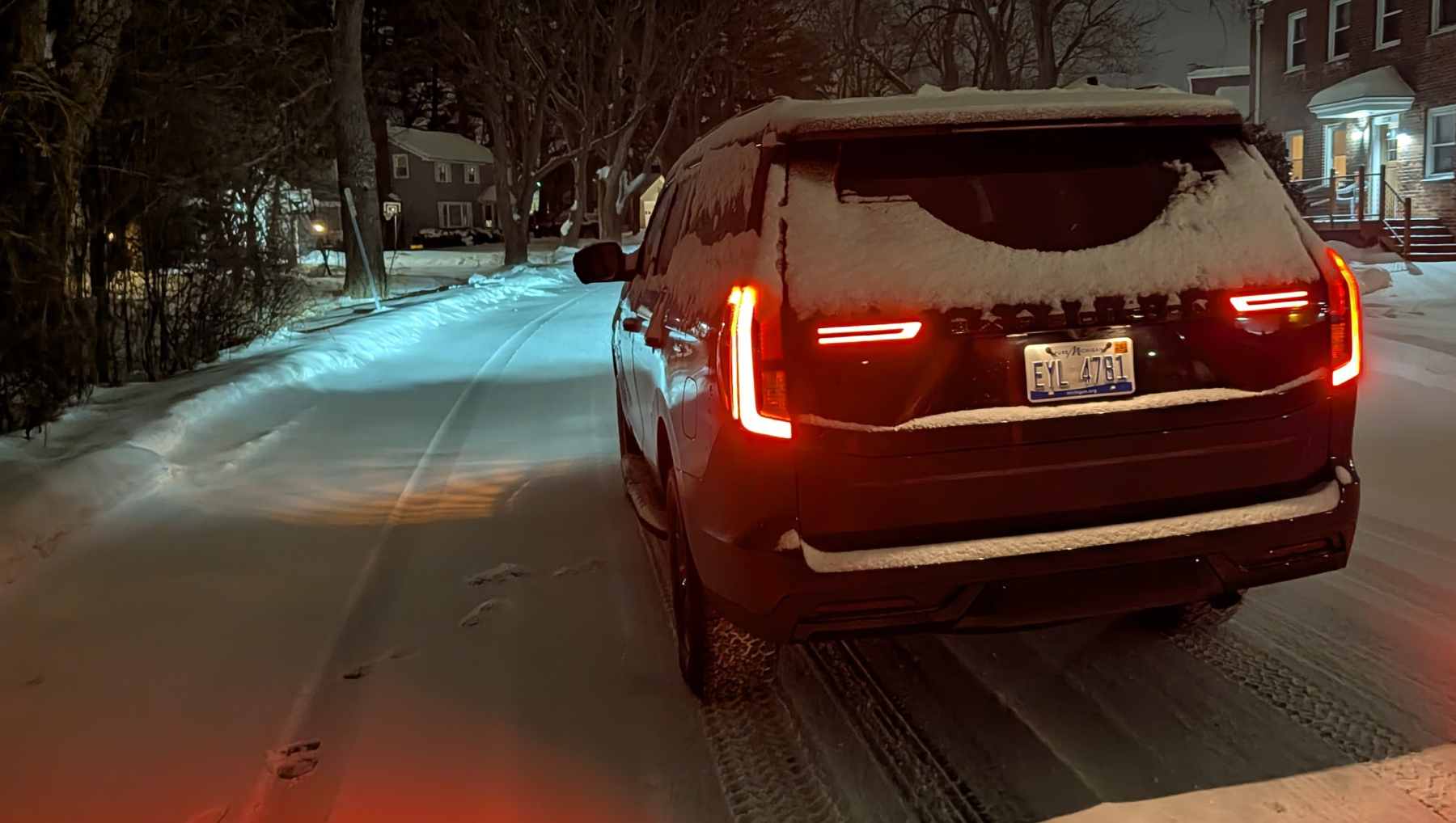
Here’s the most frustrating part of the review, and arguably the most useless. There are no decent, publicly accessible off-roading spots within a reasonable distance of where I reside. So the Expedition finally has a decent off-roading setup in the Tremor trim, and I have no real way of testing it myself. I’ll just have to talk you through the spec sheet.
The biggest difference arguably comes in the form of a locking differential, something the Expedition had previously lacked. This isn’t something you want to engage while on the road, but if you’re struggling through mud, sand, or deep snow, then locking the diff will usually help you push through. It’s not a miracle button; there are still circumstances where this very heavy vehicle will struggle, but it is a great option that will get you through situations that would have left you spinning your wheels otherwise.
In addition to the locking diff, a Tremor will net you a heavy-duty radiator, off-road shocks, off-road suspension, and a two-speed transfer case, in addition to Ford’s vast array of off-road tech. Said tech includes “trail 1-pedal drive, trail turn assist, and a terrain management system with a selection of drive modes.” There are also plenty of trail cameras and sensors that should let you put your wheels where you want to without a spotter, and hopefully avoid denting the bodywork on a rock or a tree.
So, what testing could I do? Well, I’ve done a lot of off-roading, so I can say the spec sheet is pretty impressive for an off-the-line vehicle. It should be enough to handle a bit of moderate off-roading or overlanding (though a winch would be handy if you’re pushing deeply into the “moderate” stuff). The trail cameras are great for when you’re out alone or with someone who has little experience and is useless as a spotter.
Trail turn assist locks your back inside wheel when turning, essentially allowing you to do a kind of handbrake turn and whip the SUV around a corner, it shouldn’t really be able to go around. This one does take some practice to use, and last time I tried it, I went sideways into a log I was supposed to be avoiding. So, y’know, baby steps.
Then there’s trail 1-pedal drive, which is a bit of a love-it-or-hate-it feature. It’s a bit like one-pedal driving in an EV, but designed for navigating ascents and descents. If you hate managing your speed downhill, then this is going to be your favorite feature. If you feel having your foot on the brake gives you more control, you’ll hate it.
I also got to take the Expedition on some unplowed roads during a mild snowstorm. Now, let me just say: you can slide anything on ice and snow if you really want to — and the Expedition is no exception. When I did get it to slide, I could feel the back struggling, and regaining control was incredibly simple. Which is always reassuring when something weighs this much. The brakes did a solid job in the snow, too, and it was easy to keep the Expedition pretty true, even when trying to stop in a hurry. If you live somewhere snowy, muddy, or otherwise lacking decent roads, then an Expedition Tremor is a solid pick.
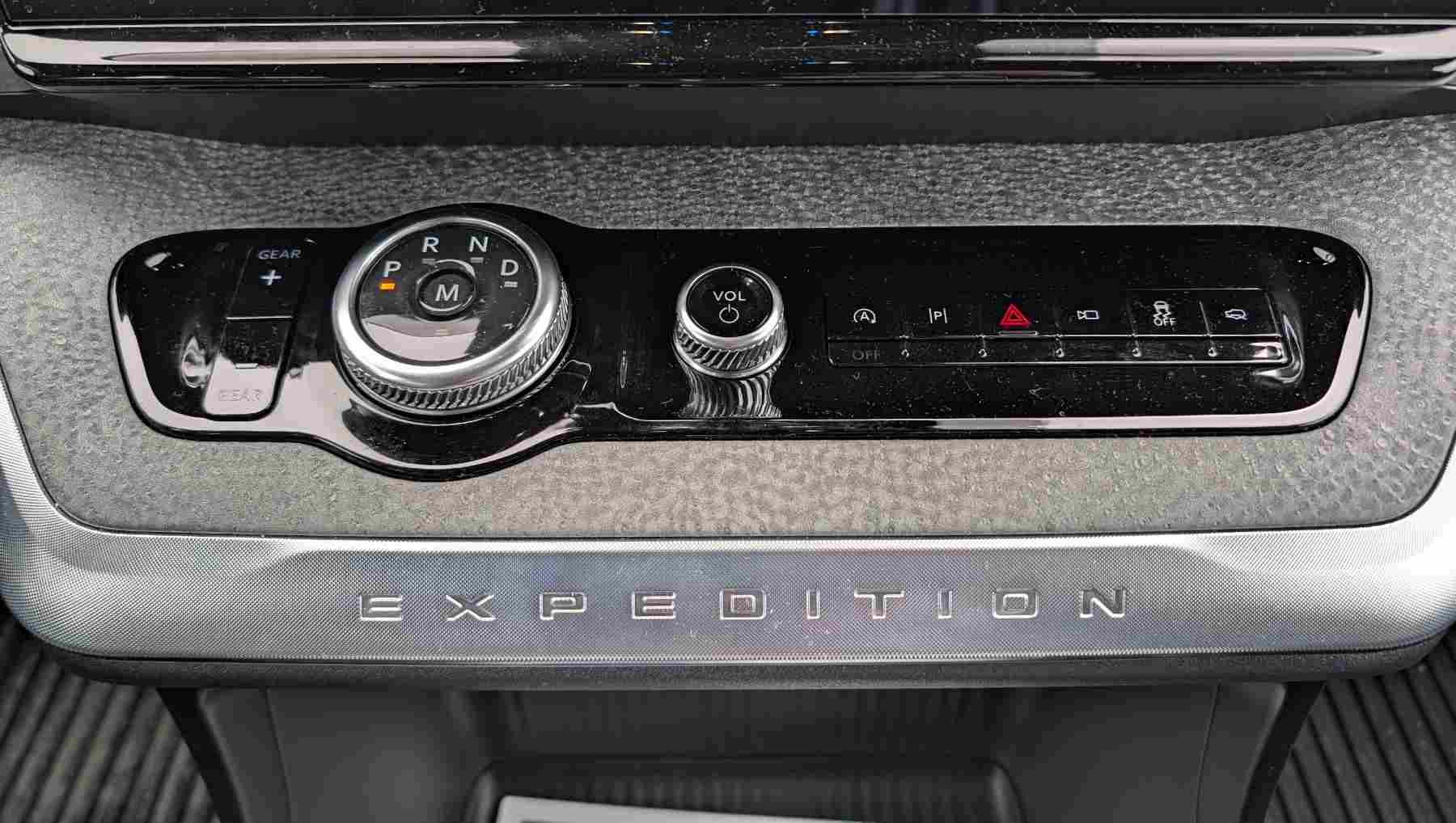
There was one off-roading feature I did genuinely dislike. You can manually select gears on the Explorer, which is pretty handy in many off-road situations. This is done via a switch to the left of the other physical controls below the center screen. I can understand ditching the paddles many vehicles have, as it’s easy to knock them while on rough terrain. However, the switch just felt clunky and miserable for the most part.
Cruise control is the main reason to opt for a ‘26 Expedition
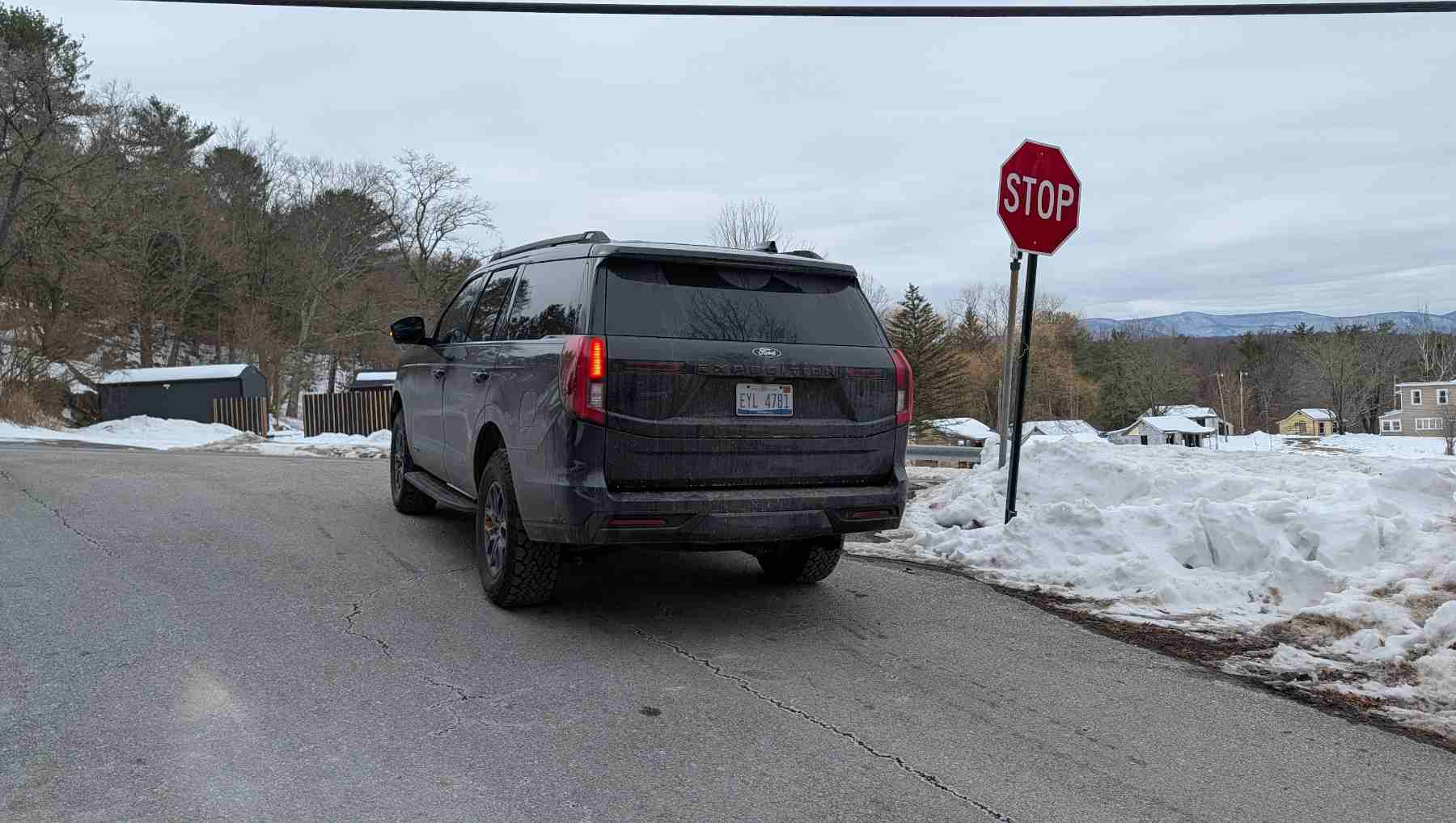
Remember that time when I said BlueCruise 1.5 was the standout upgrade on the 2026 Lincoln Aviator? And the only real reason to pick one over a (likely much cheaper) 2025 model? Of course you do, you read all of my reviews.
Anyway, the same applies to the Ford Expedition. The 2025 models are stuck with BlueCruise 1.4 because the leap to 1.5 requires extra hardware. As 1.5 is what brings it close to GM’s SuperCruise, thanks to its automatic lane changes, people stuck with 1.4 may feel like they’re missing out.
With that being said, BlueCruise is a pricey extra on the Expedition. The vehicle I tested comes with a year of BlueCruise included. But if you want it after that, Ford will charge you just shy of $50 a month, or $495 a year, to keep it going. You can also buy BlueCruise outright at a price of $2,495 — which may add some resale value to the vehicle (as it is transferable) or make sense if you intend to own the vehicle for more than five years. It also shields you from any future price rises that Ford totally has the right to implement.
So, BlueCruise 1.4. How is it? Well, notably worse than 1.5, as lane changes are up to you, so you can’t just relax (while still absolutely paying attention to the road and being ready to intervene at any moment, as you are legally required to). But you can still take your hands off the wheel, which is nice. It is still a bit more vigilant about the eyes on the road thing than many competitors. If you get distracted by a pretty mountain or spend a second too long sipping from your drink, it will shout at you.
The Ford Expedition gives you plenty of SUV to play with
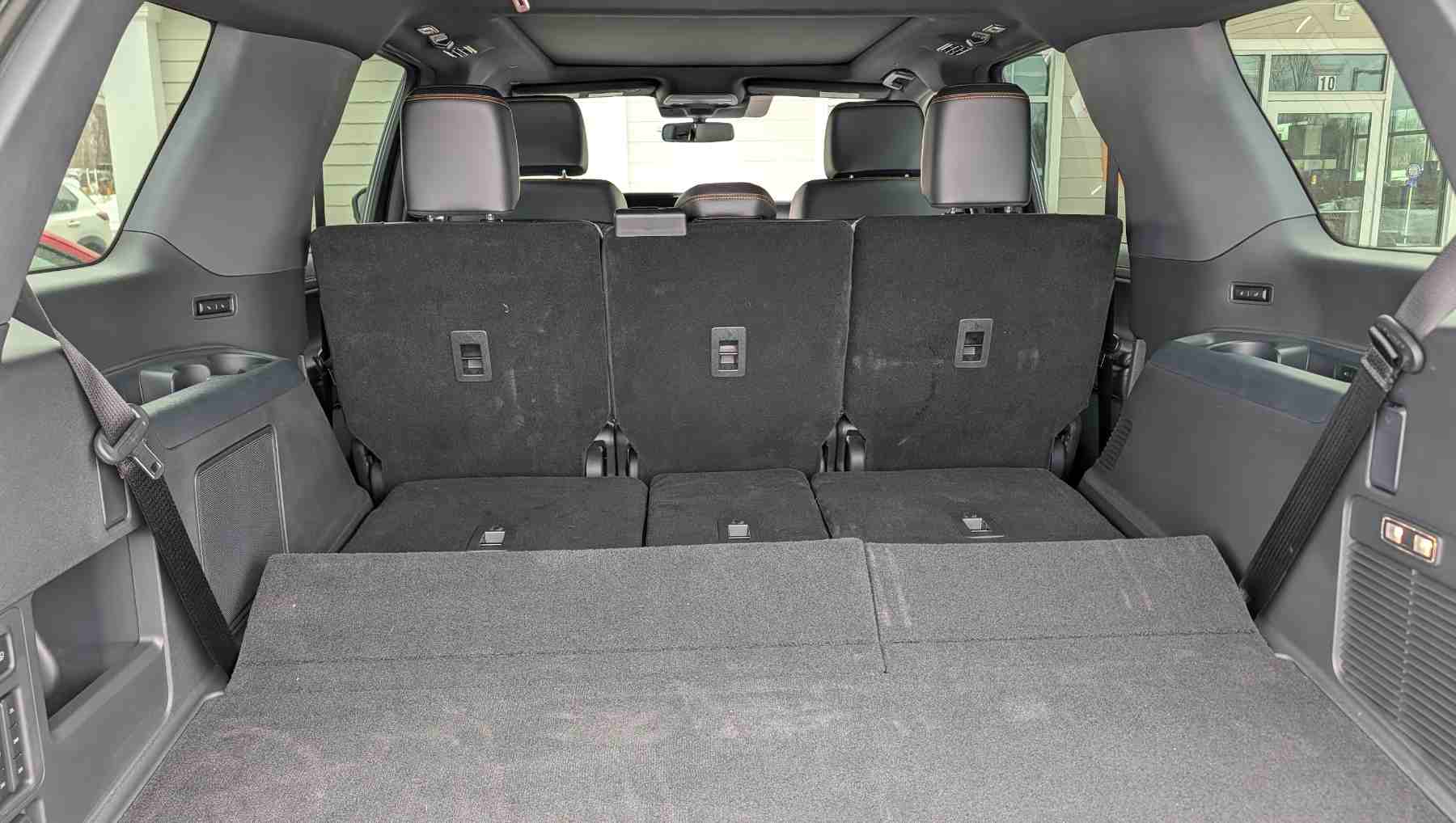
It’s not often I get into the third row of a vehicle without feeling like a pretzel. That’s because the vast majority of “three row” SUVs have backseats that make the leg room on Spirit Airlines look generous. Thankfully, the Expedition is a full size, body-on-frame, unit of a vehicle. That means people that aren’t double amputees can occupy the back row without being too uncomfortable.
It also means there is plenty of storage space, especially if you acknowledge no one loves you and you are destined to die alone. Then you can pop down those back seats and the two captain’s chairs in the middle row for a whopping 108.5 cubic feet of space. I’ve shifted a 65” television in smaller vehicles than that.
If you do have family members or a small social circle, there’s 84.5 cubic feet available behind the second row. And for those of you who manage a pee-wee baseball team or something, having all of the seats up drops the cargo space to a respectable 37.4 cubic feet.
The Tremor also has a roof rack, and is long enough to stop me worrying about tying a kayak or canoe on there. Which I totally would have done if every body of water within 500 miles of me wasn’t underneath about two feet of ice. The automatic split gate is also a beautiful feature, allowing you to easily pop light items in the trunk space or effortlessly drop the gate entirely for larger objects.
The Ford Expedition should take some tips from the Ford F-150
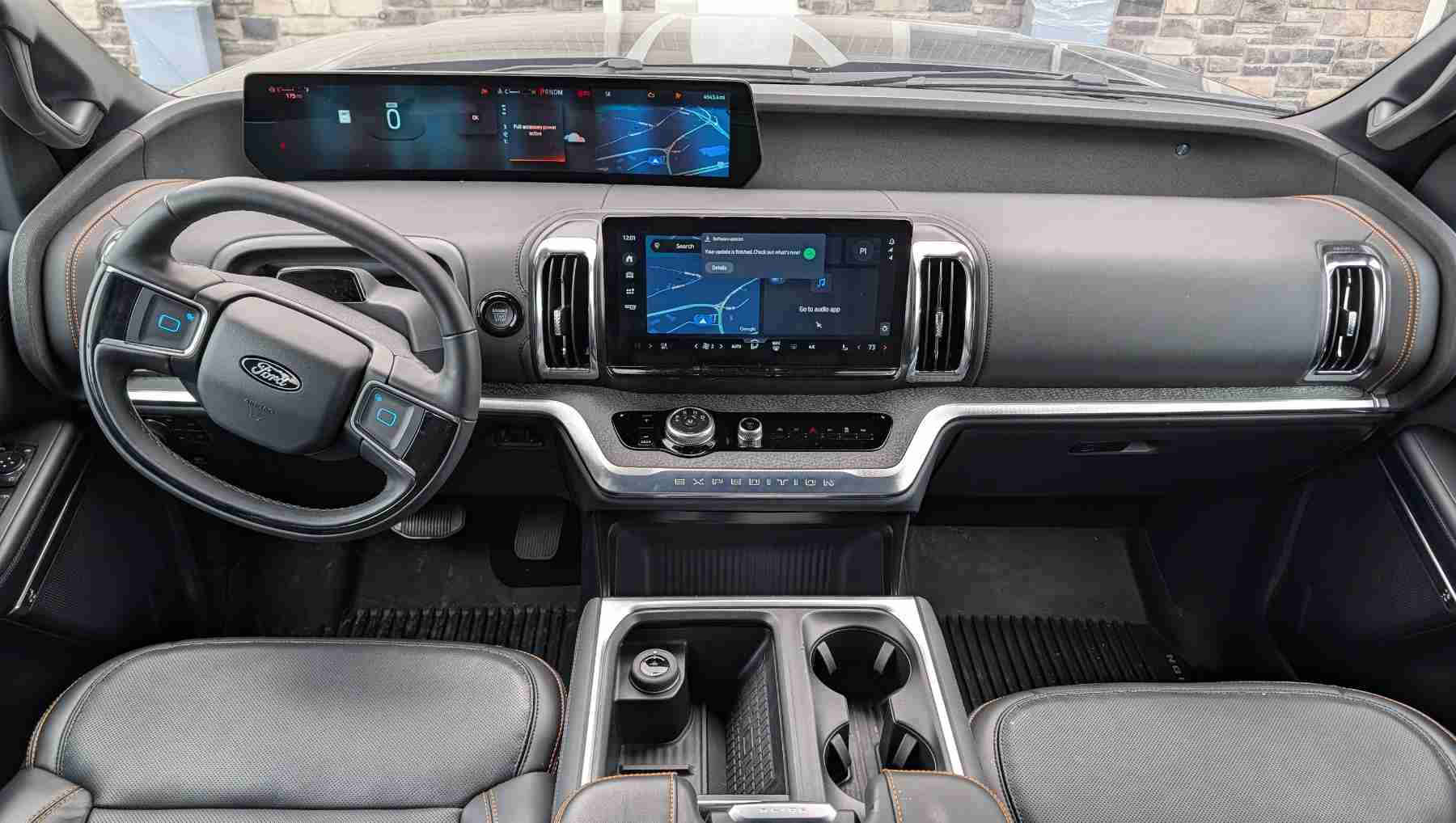
Spending a week with a Ford Expedition Tremor made me want to go overlanding more than anything else. As I’ve mentioned, there’s a lot of room when you pop the seats down. It’s basically a palace back there, compared to a hammock or a two-man tent anyway. But the interior is very plain and utilitarian, which is fine and probably appeals to some people. I do like a spot of luxury in the things I’m likely to end up caking in mud, though.
There are also little touches certain F-150s have, like the addition of a “writing desk” in the center console. The Expedition’s center console moves, but you can’t fold it over in the same way you can in a truck. In terms of size, the Expedition Tremor is actually about an inch longer than the truck and is fully enclosed all the way back. But it seems like Ford puts a lot more effort into its flagship (and best-selling) vehicle.
The infotainment system is a little mediocre, too. While there’s a lot to be said against just jamming a massive tablet on the dash, I feel the F-150’s massive central screen is preferable to the smaller option in the Expedition. The panoramic driver’s display is pretty good though, especially when you’re constantly looking at your map.
Maybe the Tremor package is what the Expedition needed
As mentioned, the F-150 is the golden child with Ford, and with SUVs, that title firmly rests with the mid-sized Explorer. Which sort of leaves the Expedition out in the cold? What is it? A poor take on the full-sized pickup without the bed? A stretched-out version of Ford’s popular SUV?
I feel like the Tremor package, which seems very well implemented, gives the full-sized truck a pretty solid purpose. It’s a great daily driver you can take overlanding. It’s the perfect vehicle for a family adventure if you live in Colorado, California, or anywhere else you’re allowed to enjoy yourself outdoors. I feel like it does need a little more love, but it’s honestly a great choice of vehicle for an active family.
Exact specs and trim of vehicle reviewed:
- 2025 Ford Expedition Tremor 4×4 (MSRP $81,350)
- Individual options included: Dark matter grey metallic ($495), Ford co-pilot360 active 2.0, P275/70R18E A/T BSW tires, 2nd RW 40/20/40 PWR fold bench ($595), BlueCruise equip: 1 year plan (no charge), 18″ DK CRB GR W/ELC spice PKT, Connectivity PKG one time purchase ($745), Underbody protection ($425), Cargo tailgate manager ($390)
Total Cost: $84,000 excluding charges and delivery | 2025 Ford Expedition entry-level MSRP (Active trim): $62,400.