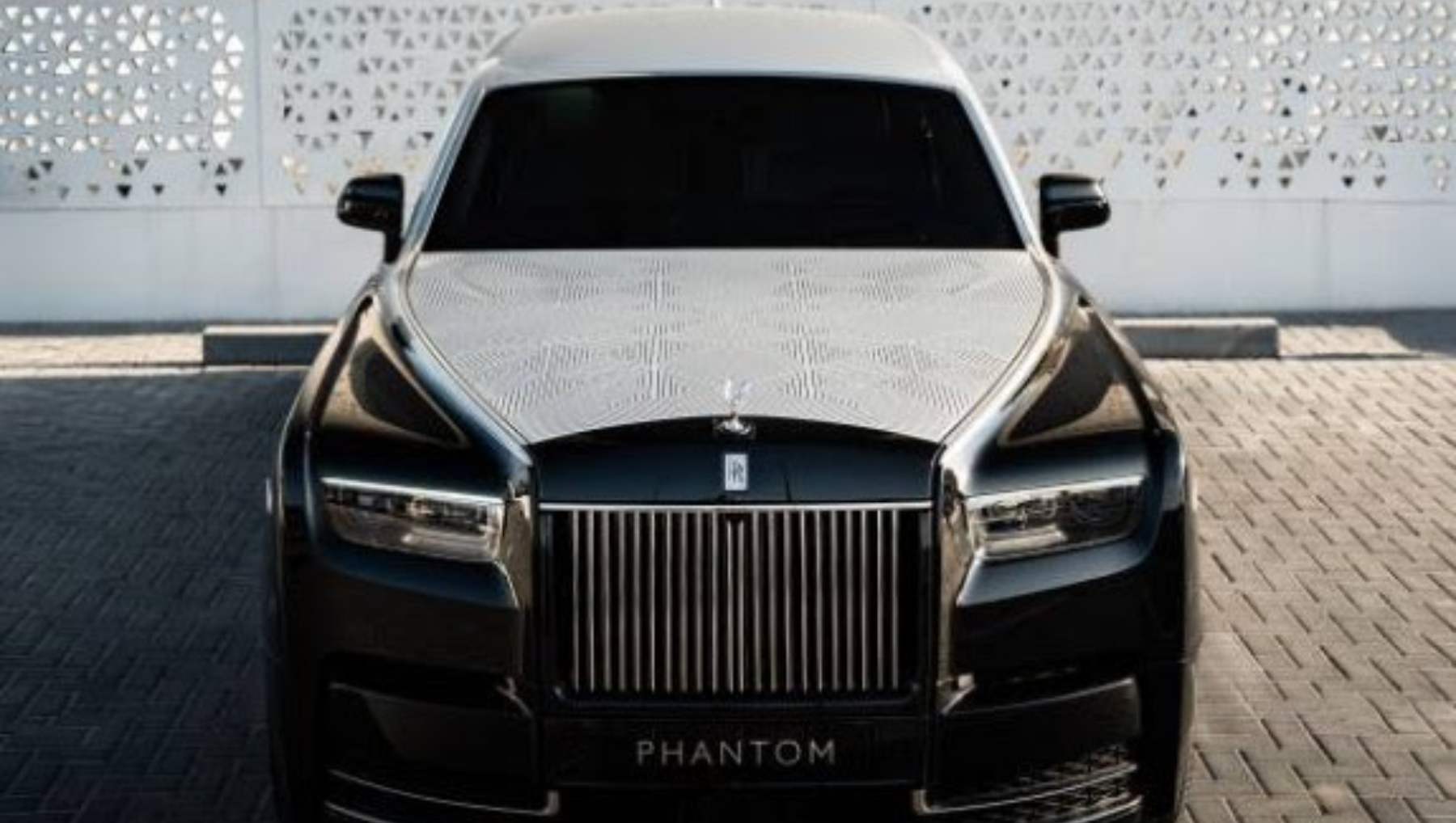

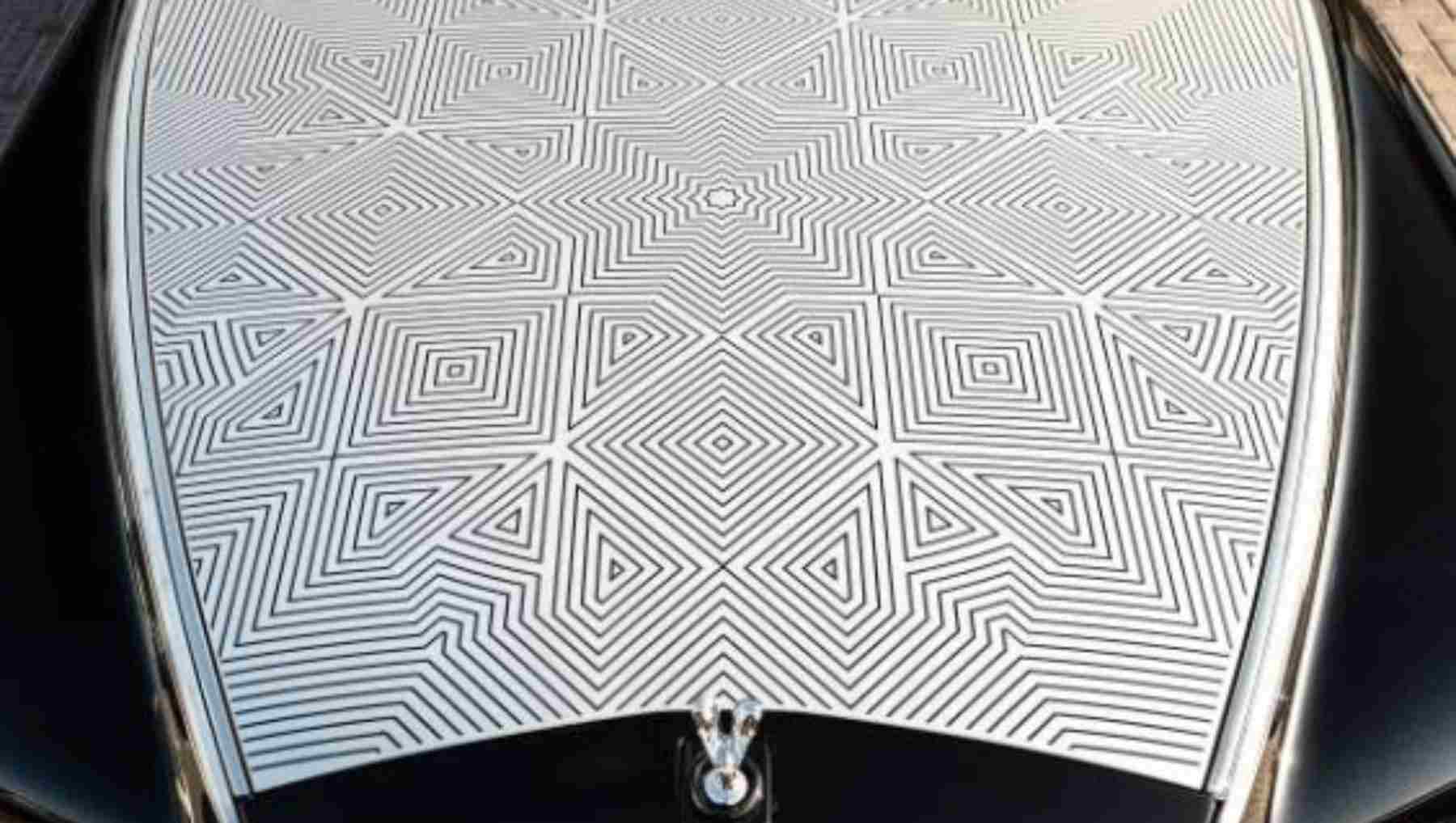
Rolls-Royce has become the first company to fully laser etch a vehicle’s hood. The end product, which draws inspiration from Middle-Eastern architecture, now adorns the “Phantom Arabesque.”
The exact process used to create the “Mashrabiya” pattern took five years to develop, and takes inspiration from “the Italian sgraffito technique,” which alters the color of a surface by removing its top layers. To achieve the effect, the hood is first painted a dark color, then multiple layers of clear coat are applied. Finally, a lighter color is applied on top and the laser goes to work.
With this being Rolls-Royce, it does have to be hand-finished. So someone from Goodwood, who is an expert in some particular craft or other, takes the time to hand-sand the bonnet until it is absolutely perfect. Because it’s a Rolls-Royce. So obviously, the clientele and the amount of money involved means nothing can be less than perfect.
Rolls-Royce Exterior Surface Centre’s General Manager Tobias Sicheneder stated: “Laser engraving allows us to create a surface that is both technically precise and visually alive. Developing this patented process required years of experimentation by the entire team. Phantom Arabesque is the first expression of a technique that opens entirely new creative possibilities for future clients.”
Technically, another company has “laser etched” a vehicle’s hood. Back in 2024, Ferrari unveiled a one-off Roma Spider, which had laser etching on a number of panels including a compass shaped design in the center of the hood. However, Rolls-Royce is the first company to apply the expensive and complex process across an entire bonnet.
Rolls-Royce has a long history of “firsts”
While you could argue that Ferrari did beat Rolls-Royce to the punch when it comes to laser etching, there are plenty of other examples where Rolls-Royce did produce something innovative or unique into one of its vehicles. Which isn’t really a surprise as the ultra-high end manufacturer is in the business of standing out.
Rolls-Royce did not invent satellite navigation, but it did put a unique spin on it with “Satellite Aided Transmission” (SAT). SAT first cropped up in the 2013 Rolls-Royce Wraith, and was essentially a way to make the automatic gearbox far more effective. It used the GPS system to feed details on the road ahead to the vehicle. The Wraith would then know when it was approaching a curve, traffic circle, or highway on-ramp and shift gear appropriately. Similar systems have since cropped up in Audi’s and Mercedes’ vehicles, and it has a lot of utility in the trucking industry. Especially when it comes to adjusting for gradients.
The “floating wheel center caps” were also a Rolls-Royce innovation and are still closely associated with the brand. The caps, which make sure the iconic “RR” in the center of the wheel is always the correct way up, first appeared on the Phantom VII in 2003. It’s one of the Rolls-Royce innovations that parent company BMW has also adopted, with the caps being an optional extra on some of the Bavarian manufacturer’s luxury vehicles. Rolls-Royce’s British rival Bentley uses similar caps on their vehicles.
Nothing says you’ve produced something exceptional like your closest rival copying your homework.
And it’s impossible to do a list like this without mentioning the “Starlight Headliner,” which is another Rolls-Royce feature Bentley subsequently adopted. The Starlight Headliner, which Rolls-Royce first rolled out in 2006, involves the careful placement of fiber optics across the vehicle’s interior roof liner. The end result is something that mimics a starry sky, and that would be nice enough on its own. But Rolls-Royce being Rolls-Royce, things are taken a little further.
If you stare at the headliner for a little while, you’ll notice little “shooting stars” flying across the headliner. Combine it with a glass of champagne or scotch from the decanter or fridge you’ve obviously opted to have added to the middle of the rear seat and you’re in for a pleasant time.
This is just the tip of the iceberg when it comes to Rolls-Royce innovations, but if we start digging through all of the little one-offs that have cropped up in the untold number of unique vehicles the company has created over the last 119-years, we’ll be here all day.